AI PC Goes Wild: Intel Teams Up with NVIDIA, AMD Ditches Integrated Graphics for NPU
 06/22 2026
 362
362
Competition within collaboration is the main theme of the second half of AI PC.
Last year, the most common promotional rhetoric for AI PC could probably be boiled down to three terms: NPU, TOPS, and AI Console (or Copilot overseas). Manufacturers were busy telling users how much AI compute power their laptops had and how much faster the NPU was compared to the previous generation. The problem is, for most consumers, the perceived benefits of these parameters are weak. Leitech (ID: leitech) once discussed this with some friends, and many had only experienced the 'AI Workbench' at startup, rarely opening it again afterward.
 Image Source: Leitech
Are people no longer using AI? Not at all—demand remains cloud-based. Web and client applications for AI products like DeepSeek, Doubao, ChatGPT, and Gemini see extremely high download and traffic volumes, but AI traffic hasn't flowed to the edge as PC manufacturers had hoped.
This year, you'll notice many manufacturers shifting their AI PC messaging to focus on battery life and Claw (a reference to handheld gaming devices), but this approach essentially brings everyone back to the same starting line, making it hard to differentiate from previous products. Clearly, PC manufacturers have realized this, leading to the truly interesting change: AI PC is pivoting.
On one side, Intel and NVIDIA announced a partnership to create an x86 SoC integrating RTX GPU chiplets. On the other, AMD continues to cram more powerful NPUs into its Ryzen AI processors, even at the expense of the GPU.
This suggests AI PC may bid farewell to the first half, dominated by NPU compute power alone, and enter the second half, which truly tests system capabilities, software ecosystems, and user scenarios.
Intel's historical core strengths in the PC market were its x86 ecosystem and OEM channels.
But in the AI PC era, CPU alone is no longer sufficient. AI applications increasingly rely on GPUs, especially in content creation, gaming enhancement, and image/video generation scenarios, where NPU+CPU compute power alone is severely inadequate. Thus, GPU importance rises significantly during high-intensity AI use.
NVIDIA, meanwhile, is the undisputed leader in AI compute, with RTX representing not just a graphics brand but a complete AI acceleration, graphics computing, CUDA ecosystem, and developer ecosystem. For Intel, integrating RTX GPU chiplets into x86 SoCs fills its biggest weakness in the AI PC space.
 Image Source: Leitech
Meanwhile, the GPU, often 'invisible' in Intel's AI PC promotions, returns to center stage, indicating AI PC hardware is evolving from 'CPU+NPU' to deep integration of 'CPU+GPU+NPU.'
In this system, the CPU handles general computing and system scheduling, the NPU manages low-power, always-on, local lightweight AI, and the GPU tackles high-parallelism, high-load, high-performance AI tasks. Each has distinct advantages and cannot be replaced by others. Thus, evaluating an AI PC's strength will no longer rely solely on NPU TOPS but on how these three compute cores collaborate.
This is why Xiaolei finds the Intel-NVIDIA partnership most noteworthy: it could expand the AI PC concept to cover more usage scenarios beyond just office and business needs.
At this point, some may ask: 'Didn't NVIDIA release RTX Spark? Why partner with Intel?'
If you've read Leitech's previous articles, you'll know RTX Spark is a computing platform based on Arm architecture. While it excels in energy efficiency and performance, its compatibility with mainstream systems lags far behind x86.
In other words, to rapidly promote RTX Spark, the best approach is to find a partner, cultivate part of the ecosystem first, and then feed back into the full-fledged RTX Spark.
In contrast, AMD is cramming NPUs into its processors. Intel did something similar last year, but unlike Intel's NVIDIA partnership, AMD made a surprising choice: further integrating CPU, NPU, and GPU in mobile devices while abandoning the GPU in desktops to embrace NPU.
We've already experienced AMD's AI Max series on mobile devices, and honestly, their GPU performance is impressive. They also leverage unified memory to deploy large local models (efficiency aside, the ability to run them matters).
On the desktop side, AMD has released several processors with built-in NPUs, typically by carving out space in existing architectures to trade some performance for AI compute power. The Ryzen AI 400 series, for example, offers up to 50 TOPS of NPU performance and is currently the only processor line meeting Microsoft's Copilot+PC requirements.
But AMD evidently feels this progress isn't fast enough, as they seem planning to strip the integrated graphics added just two years ago from their next-gen Zen6 desktop processors, replacing it with a larger NPU and CUDIMM support.
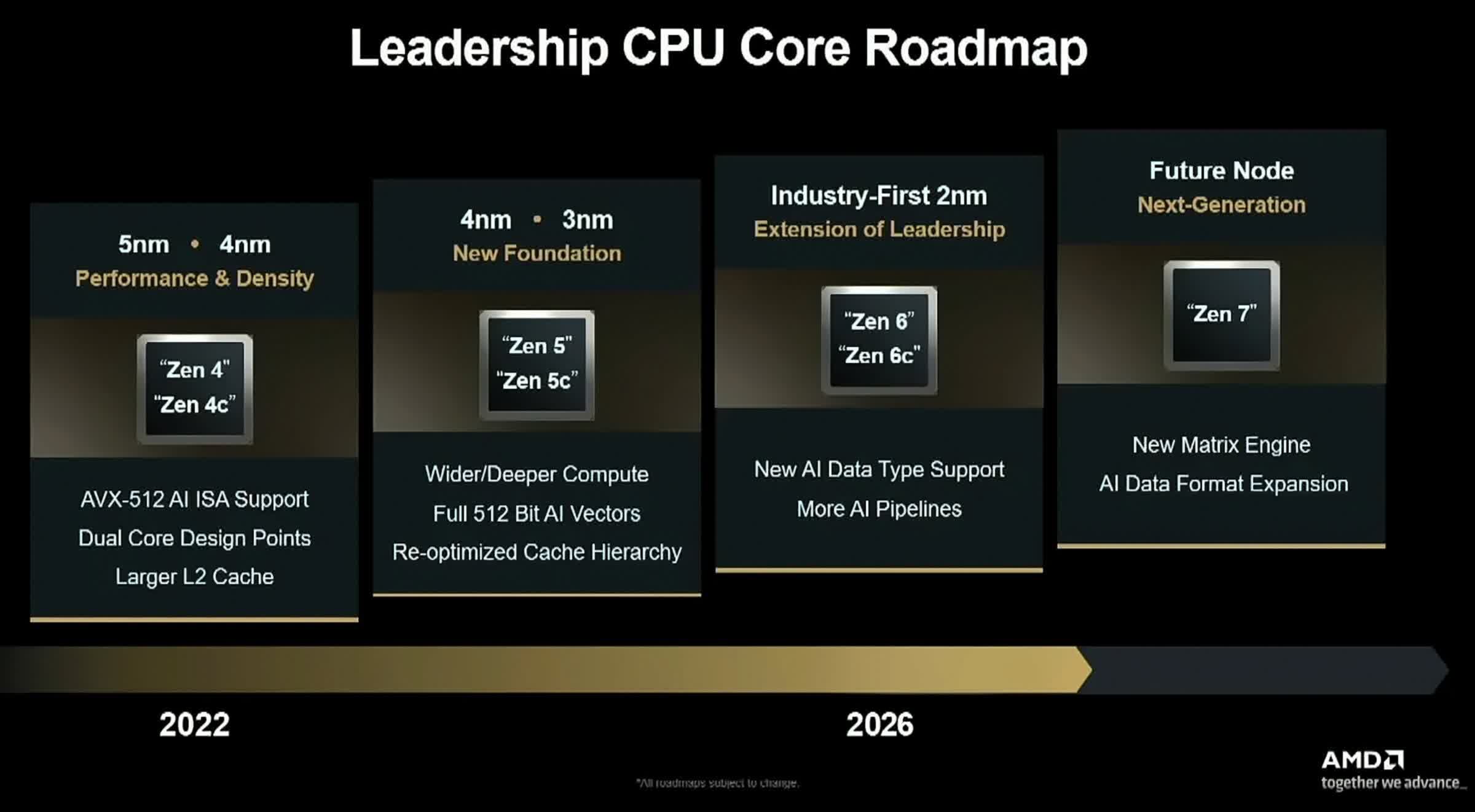
Image Source: AMD
Xiaolei views this decision positively. From a user perspective, the integrated graphics in such mid-to-high-end processors are only useful for keeping the system running temporarily during GPU failures. Trading them for stronger edge compute power and greater memory support isn't a bad move.
However, viewed in this context, it feels like Intel+NVIDIA are heading left while AMD goes right. Of course, this doesn't mean AMD undervalues GPUs—quite the opposite. GPU is their advantage against Intel, as AMD's compute cards are among the few that can marginally keep up with NVIDIA in performance, making them a core player in the AI market.
Xiaolei speculates AMD will next strengthen AI performance in consumer graphics cards. Current RX series cards' only AI advantage is large VRAM, with a clear performance gap against NVIDIA (the opposite of NVIDIA's approach). Thus, the next-gen AMD consumer graphics cards will likely prioritize higher TOPS, perfectly complementing their processors to form a new '3A bundle.'
However, when viewed together, whether Intel partners with NVIDIA or AMD readjusts CPU, GPU, and NPU resource allocation, both point to the same conclusion: AI PC is no longer a story a single processor vendor can tell with one chip.
In the first half of AI PC, the keyword was 'availability'—having an NPU, 40 TOPS, or an AI Console. Next, the question becomes 'usability,' which no single vendor—Intel, AMD, or Qualcomm—can solve independently.
Why? Because AI PC's complexity exceeds what any single vendor can handle alone. CPU vendors understand platforms and OEM channels but may lack the strongest AI developer ecosystem. GPU vendors have compute power and toolchains but still need x86 and Windows ecosystems to enter the mainstream PC market.
Thus, relationships between processor vendors are subtly shifting: they remain competitors but increasingly need to collaborate in certain areas.
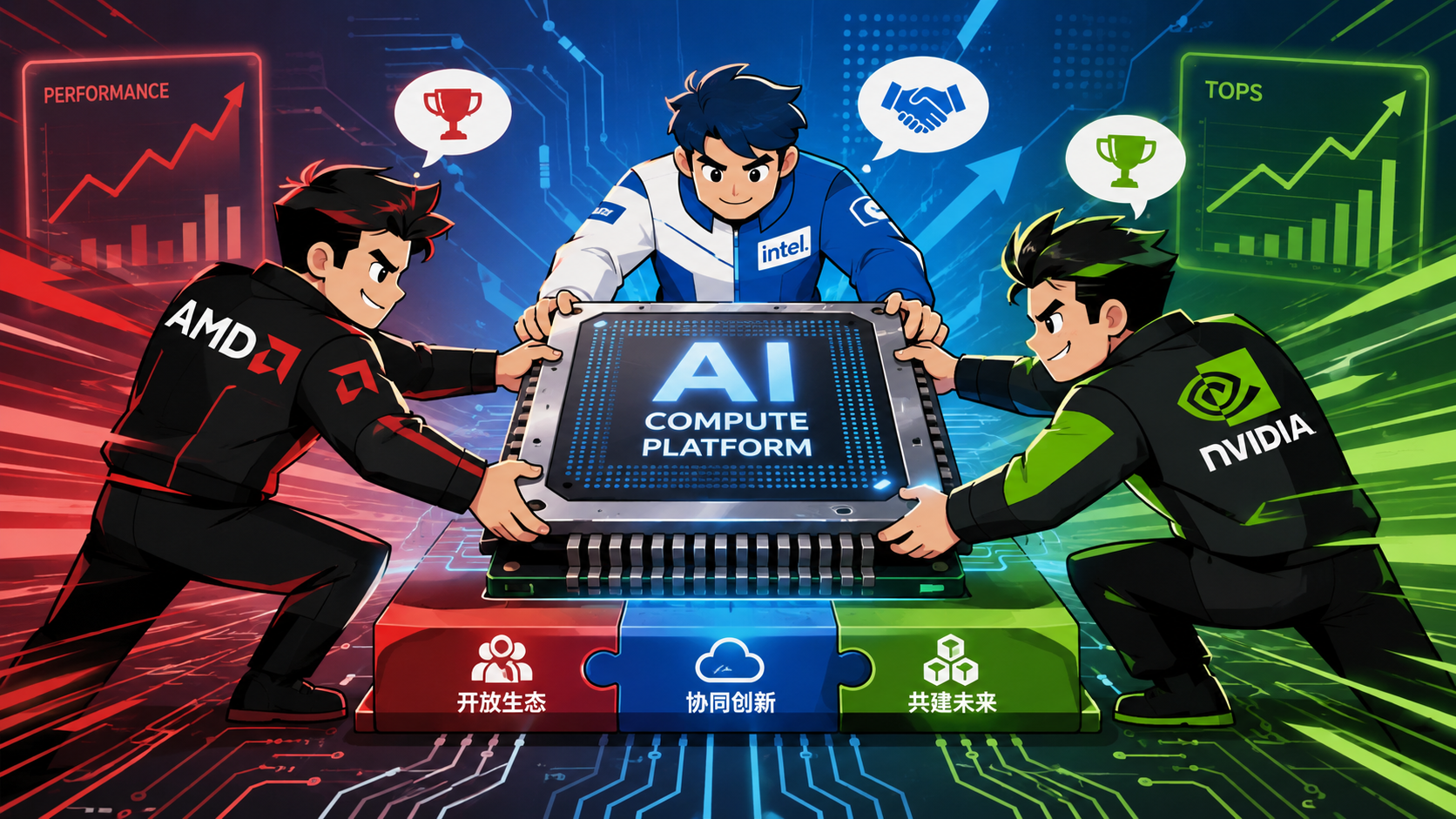
Image Source: Leitech
Intel's partnership with NVIDIA is the most typical example. Historically, the two companies had subtle competition in the PC market—Intel wanted its integrated and discrete graphics to handle more graphical tasks, while NVIDIA wanted RTX to be indispensable for high-performance PCs.
But in the AI PC era, they've found new common ground: Intel needs stronger GPUs and an AI ecosystem, while NVIDIA needs broader PC market access. This isn't about one 'defecting' to the other—the second half of AI PC is simply too large for any single company to dominate.
AMD follows a similar logic. It doesn't necessarily need external partnerships like Intel and NVIDIA, as it already has CPU, GPU, and NPU product lines. However, this means AMD must now prove not just 'having everything' but 'integrating everything better.'
If Ryzen AI processors, Radeon graphics, unified memory, large memory support, and local AI software stacks can work synergistically, AMD's advantage will shift from hardware specs to a complete platform experience.
This is the core change in the second half of AI PC: shifting from parameter competition to system ecosystem competition.
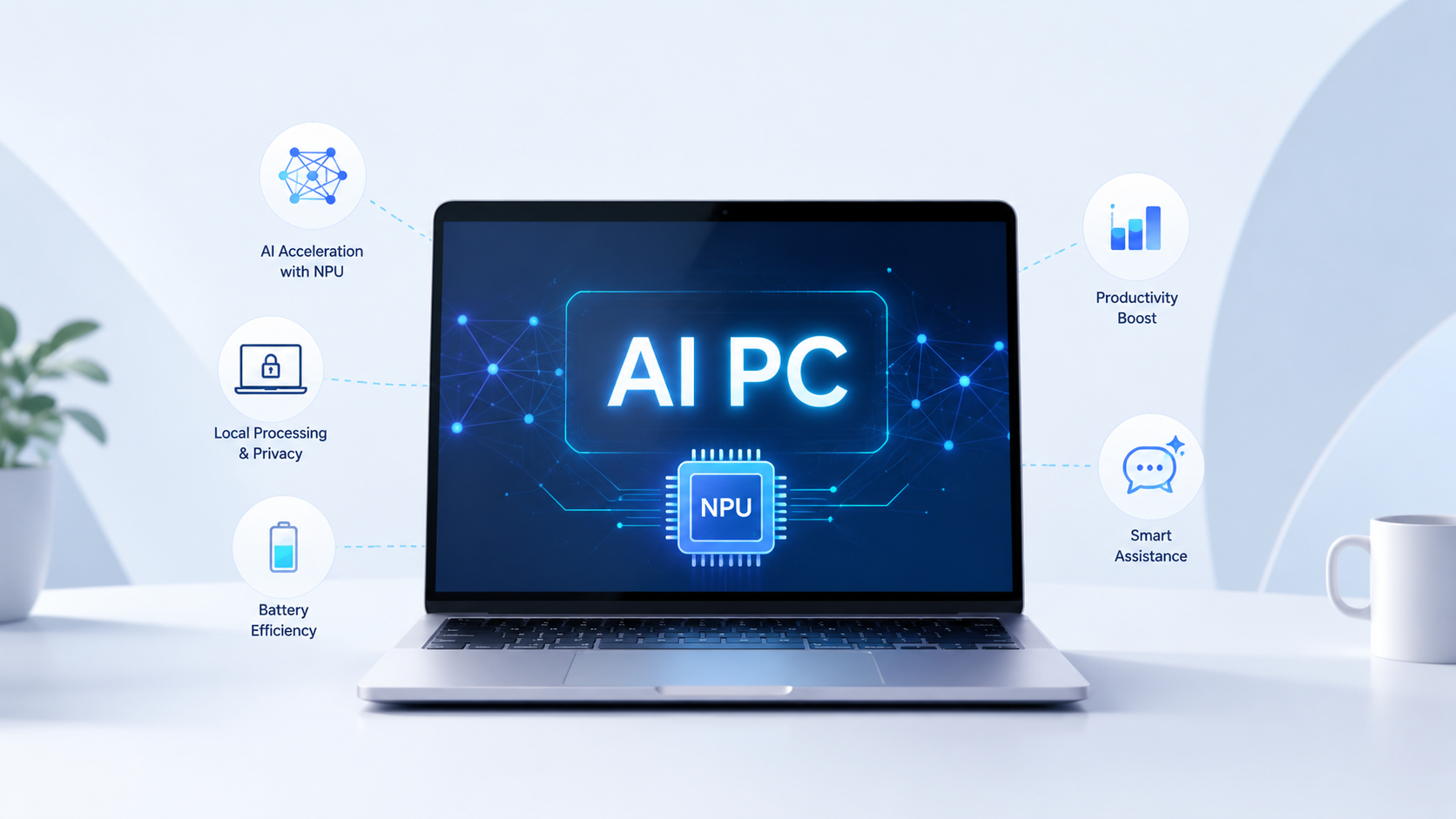
Image Source: Leitech
After all, consumers won't upgrade their laptops just for a few dozen extra TOPS of compute power. But they might pay for faster video rendering, better gaming visuals, quicker meeting summaries, or PCs that proactively assist with tasks—real-world experiences that matter.
In Xiaolei's view, for AI PC to truly become a product users actively embrace, it won't rely on the term 'AI' alone but on whether these specific experiences translate to daily use. Thus, Xiaolei also believes the AI PC market will become even more interesting in the next year or two.
On one hand, strategic differences between processor vendors will widen further. Intel may leverage NVIDIA to bolster high-performance AI and graphics ecosystems, AMD will continue refining its 'CPU+GPU+NPU' closed loop, and Qualcomm will use Arm architecture and long battery life to target the ultrabook market.
On the other hand, collaboration will increase, as no single vendor can define AI PC's final form alone. Simply put, in the first half, everyone rushed to tell users 'I have AI.' In the second half, they must answer a tougher question: What can your AI actually do for me?
Finally, Xiaolei wants to ask readers: What kind of AI PC do you really want?
AIPC, NVIDIA, Intel, AMD, PC
Source: Leitech
Images in this article come from: 123RF Royalty-Free Image Library Source: Leitech
-
![]()
Oil Prices Revert to 7-Yuan Range: Are Gasoline Cars Getting a Reprieve?
-
![]()
Momenta Secures CSRC Approval: Is It Poised to Be the 'Pioneer in Physical AI Stocks'?
-
![]()
What's the Use of Having a General-Purpose Motion 'Cerebellum' for Humanoid Robots?
-
![]()
Volkswagen Starts Operating at a Production Capacity of 9 Million Vehicles
-
![]()
Interpretation of China's Auto Market in May: A Fig Leaf, Two Fault Zones, and Three Surprises
-
![]()
China's Auto Industry Accelerates Expansion in Spain: From Vehicle Sales to 'Local Manufacturing in Europe'
-
![]()
Momenta | Going Public Not for Money
-
![]()
How Much Can Doubao Make by Charging Fees?