The Misunderstood Doubao: More Than Just Social Aspirations
 06/30 2026
 562
562
As early as 2018, when Douyin (the Chinese version of TikTok) boasted only tens of millions of daily active users, ByteDance had already set its sights on social networking.
According to Yu Beichuan, the product manager overseeing Douyin’s social features, Douyin was experiencing rapid growth at the time. However, there were internal concerns that this growth would soon reach its peak. With Jinri Toutiao (ByteDance’s news aggregator) having just surpassed 100 million daily active users, it was believed that without venturing into social networking and focusing solely on content consumption, Douyin’s growth would plateau at a similar level.
In retrospect, this assessment proved overly pessimistic. The human appetite for short videos is no less voracious than that for social communication.
Douyin’s initial foray into social networking during those years was, by the admission of the product manager involved, a failure. However, ByteDance’s exploration of social networking never ceased, much like Tencent’s persistent attempts in the short video space.
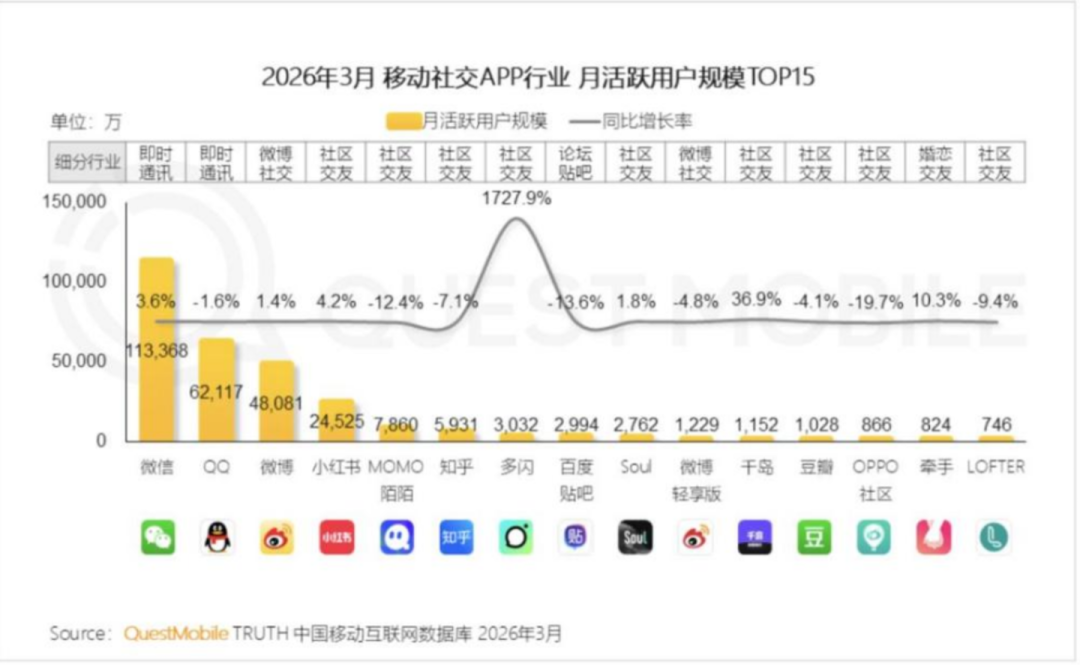
Douyin’s standalone social app, Duoshan, made a surprising resurgence last year, climbing to the top of the App Store’s social app charts. According to a report by QuestMobile, Duoshan’s monthly active users exceeded 30 million in March of this year, marking a staggering year-on-year increase of over 1,700%.
The latest news today is that Doubao, ByteDance’s AI assistant, has initiated gray-scale testing to integrate Feishu (ByteDance’s enterprise collaboration platform) accounts, supporting contact addition and messaging.
When a national-level AI software incorporates chat and communication features, does it signal ByteDance’s renewed ambition to conquer the social networking realm through AI?
What exactly transpired with Doubao being “dragged into social networking”?
On June 29th, several blurry gray-scale testing screenshots surfaced online, purportedly from Doubao, the current trending national-level AI application.
The screenshots claimed that Doubao was testing a new “Conversation” page on a small scale.
The source clearly did not verify the information or had never used Doubao. Doubao has always had a “Conversation” page; it just does not open a new conversation by default each time.
However, other leaked information proved accurate.
Doubao now directly integrates with Feishu’s account system, enabling bidirectional addition of “Feishu friends” and “Doubao platform friends.” The system even thoughtfully designed AI-assisted interactions, automatically generating greetings when new contacts are added successfully.
The combination of keywords like “friend chat” instantly sparked imagination.
For many, their first reaction was that ByteDance, which had long coveted social relationship chains, could finally no longer restrain itself and was using this highly active AI assistant to launch another assault on WeChat’s social throne, riding the wave of the large model era.
However, on the afternoon of the 29th, a Doubao representative quickly stepped in to dispel the speculation.
The official stated that Doubao has no plans to enter the social networking sector and that the rumored actions were purely collaborative attempts between Doubao and Feishu, centered around enterprise office scenarios. The goal is to enable closer business coordination between the two in the future.
This brief “misunderstanding” actually revealed the market’s lingering muscle memory of ByteDance’s “social networking dream.”
The reason behind such a massive overinterpretation of Doubao’s minor move is that over the past seven to eight years, ByteDance has left too many traces of its relentless pursuit in the social networking arena.
Let’s rewind to 2018. Douyin was in the midst of a terrifying growth spurt, with daily active users just surpassing tens of millions. However, amid this rapid expansion, a deep-seated anxiety about hitting a traffic ceiling permeated the internal decision-making ranks.
Yu Beichuan, Douyin’s social product manager at the time, recalled that there were clear concerns internally about the upper limit of pure content consumption products.
With Jinri Toutiao maintaining just over 100 million daily active users, many judged that unless the ultimate moat of social relationship chains was dug, Douyin’s growth engine would eventually stall near this watermark.
In retrospect, this judgment underestimated humanity’s innate dopamine demand for short videos. Douyin did not stop growing due to a lack of acquaintance-based relationships. However, ByteDance’s obsession with social networking took root in that atmosphere of preparing for potential challenges while enjoying prosperity.
In early 2019, Duoshan was launched with great fanfare, declaring war on WeChat alongside LiaoTiao and MT, an event dubbed the “Three Warriors vs. Lü Bu (Lü Bu being a metaphor for WeChat’s dominance).” This was followed by the failure of Feiliao, which focused on interest-based circles; and later, a retreat into the Douyin ecosystem, attempting to foster acquaintance interactions through “Douyin ZaiZai” and “Douyin Moments” in comments and private messages.
Even Duoshan, the standalone app deemed a failure, still managed to top the App Store’s social charts after its forceful restart last year, thanks to resource allocation. Its monthly active users even surpassed 30 million in March this year, achieving an extremely exaggerated year-on-year growth.
The desire for high engagement rates, extremely low retention costs, and an unbreakable network effect is an irresistible lure for any tech giant.
However, ByteDance gradually realized that directly using underlying tools to pry open the already solidified acquaintance-based social network on the C-end (consumer end) faces insurmountable ecological barriers.
When ByteDance launched the Doubao mobile assistant some time ago, it encountered ecological collisions similar to those between WeChat and Duoshan links back in the day. With “walled gardens” still heavily guarded, ByteDance has abandoned head-on confrontation with WeChat on the C-end.
‘AI Social’ Needs Debunking
Whenever a national-level tool product commands massive daily active users, voices always call for it to pursue social fission, as if not doing so would waste traffic.
In the two years since the outbreak of generative AI, this argument has grown even louder.
“AI social” sounds like an extremely sexy capital story.
After Doubao added friend communication features, it was easy to associate it with AI social networking, which was a major reason for sparking everyone’s interest. As model capabilities gradually improve, the space for AI to transform various industries seems to expand.
However, stripping away the conceptual veneer to examine the underlying user psychology reveals that “AI social” at this stage is highly likely just a pseudo-proposition.
During the Spring Festival earlier this year, Tencent attempted “AI social,” with Pony Ma himself promoting it.
The product feature, called “Yuanbao Pai,” sought to leverage WeChat, China’s largest acquaintance-based network, to secure Tencent’s ticket to “AI social” in advance. To promote Yuanbao, Tencent doled out one billion in red envelopes and significantly relaxed external link restrictions, even sparking public sentiment at one point.
The idea was that group chats often go cold during the holidays, so let AI serve as the “group chat atmosphere group,” automatically responding, generating festive New Year greeting emojis, and answering various tricky questions from group members. Tencent attempted to seamlessly embed AI into human connections this way.

The real-world feedback, however, appeared somewhat meager. Months passed, and Yuanbao Pai’s market presence significantly declined, with users’ core social habits remaining virtually unchanged.
After collecting the red envelopes and experiencing the novelty of AI New Year greetings a few times, no one even lurked or bubbled up in group chats.
A more recent and excellent observation sample is WeChat’s native AI assistant, “Xiaowei,” which just began gray-scale internal testing this month.
As a heavyweight feature directly implanted in the top-left corner of WeChat’s main interface, Xiaowei can not only directly invoke various mini-programs but also attempts to deeply intervene in users’ social chains. WeChat clearly hopes to reconstruct the communication methods of 1.4 billion people this way.
However, from existing feedback, while Xiaowei finally represents WeChat’s entry into the AI assistant arena, it largely failed to meet the long-held expectations for a WeChat agent. This may be because the WeChat ecosystem has not yet fully integrated.
Nevertheless, even if we can eventually task Xiaowei with more actions beyond ordering food and hailing rides, the core of social networking will likely remain unchanged.
The charm of real-world social networking lies precisely in the complexity of interpersonal relationships, the entanglement of real-world interests, and the unpredictable fragility and authenticity of human nature.
Human connections require a certain level of reciprocal exposure. We need to know that the person on the other side of the screen is a real carbon-based being who can get angry, feel tired, and hold biases—only then does the connection hold sociological significance.
No matter how much large models iterate, AI’s underlying attribute remains that of a machine. Computing power can simulate an extremely realistic tone, instantly reply with thousand-word essays, and provide timely emotional value, but it cannot provide the weighty sense of “real existence.”
When reports to leaders, follow-ups with clients, and even blessings among friends are all handled by AI, the “social warmth” we cherish becomes increasingly refined and fake under the influence of algorithms.
Having a perpetually correct “peacekeeper” in group chats will only dampen real humans’ desire to express themselves.
The essence of social networking is people; the essence of AI is tools.
With the current technological path, I cannot imagine AI ever truly acquiring the context of all human experiences and encounters, making the same reflections and understandings as the carbon-based beings involved, and thereby perfectly and accurately impersonating real humans in digital form.
As long as this premise remains unchanged, the idea of AI social networking disrupting WeChat remains unfounded.
Doubao Pro + Feishu: A B-End Conspiracy
So, what is the real purpose behind Doubao’s integration with Feishu?
Moving the timeline back a few days, ByteDance just externally launched “Doubao Pro.” Combined with this key node, today’s exposed account interoperability action confirms, as the official stated, that it is a significant move by ByteDance in the B-end (business end) enterprise collaboration arena.
Compared to the basic version of Doubao, which targets the general public and focuses on information search and simple Q&A, the newly launched Pro version anchors its core appeal in moderate to heavy productivity. This includes complex document processing, lengthy and logically rigorous code writing and execution, and precise retrieval deep within enterprise knowledge bases.
If these hardcore professional capabilities remain confined to a webpage in a browser, they would at best serve as a useful external plugin. Employees would constantly need to copy, paste, and switch contexts between work software and the AI webpage—a fragmented experience that significantly hampers productivity.
Seamlessly integrating Doubao into Feishu and allowing AI capabilities to flow directly into the enterprise’s data bloodstream is essential for truly unleashing the power of large models. Feishu has indeed been relatively keen on aligning with cutting-edge trends.
When crayfish became popular, Feishu quickly followed suit and opened relevant permissions.
If you search for deployment tutorials on OpenClaw in the market before WeChat supported access, you will find that the vast majority of demonstration cases use either Telegram or Feishu.
Feishu’s AI-extremely-friendly ecological sandbox is precisely what Doubao, currently in dire need of landing scenarios, desires.
The integration of Doubao accounts with Feishu is not simply about adding a chat window in a sidebar. It allows Doubao to legitimately access the vast amounts of private contextual data within enterprises.
Only by knowing who you are chatting with about a project, understanding your work content, and being aware of your OKRs for the next quarter can Doubao provide truly commercially valuable responses.
The commercial endgame of this productivity combo is already faintly visible. Account integration is just the first step in the underlying infrastructure. As Pro version capabilities mature, future joint subscription services like “Doubao Pro + Feishu Advanced” may emerge.
For ByteDance, this is a dual-pronged strategy.
On one hand, it can convert highly sticky daily collaboration tools into stable, more payment-receptive enterprise-level users for Doubao on the B-end, escaping the difficult commercialization quagmire of C-end large models.
On the other hand, a Feishu deeply integrated with a top-tier large model will help raise its technological moat in the enterprise services market.
If functions like Duoshan and “Xiaohuoren” represent ByteDance’s differentiated explorations in the C-end social sector, then Doubao Pro + Feishu is a solid move in its B-end AI arena.
One focuses on entertainment; the other on efficiency. The two lines run in parallel, mutually undisturbed.
ByteDance’s social ambitions were once directed at WeChat.
Now, it is advancing in a different way.
-
![]()
Luxury Lineup, Highly Anticipated! The Pioneer of Physical AI Gears Up for Hong Kong Stock Exchange Debut!
-
![]()
Mercedes-Benz Withholds Year-End Bonuses for 90,000 Staff: Germany's Industry 4.0 Aspirations in Tatters
-
![]()
Can the Hong Kong Stock Market Pay for World Models? Dissecting Momenta's Prospectus
-
![]()
Set for Secondary Listing in Hong Kong with Market Cap Exceeding 500 Billion: How Luxshare Precision Regains Investor Trust?
-
![]()
Approaching its Secondary Listing in Hong Kong with a Market Cap Exceeding 500 Billion: How Has Luxshare Precision Regained Investor Trust?
-
![]()
Real Insights from New Energy Vehicle Owners in China’s Top 30 Cities by Ownership
-
![]()
Real Thoughts of New Energy Vehicle Owners in Top 30 Cities by Car Ownership
-
![]()
Truth Revealed: Memory Prices Soar, Apple Profits Surge, Yet Memory Makers Bear the Blame