Kimi, Boasting a $31.5 Billion Valuation, Faced an Unexpected Defeat After Predicting a German World Cup Victory
 07/01 2026
 445
445
Kimi's latest funding round has propelled its valuation to a staggering $31.5 billion. However, its bet on Germany clinching the World Cup title proved to be a miscalculation, as the German team was ousted in the round of 32.

On June 30th, the Science and Technology Innovation Board Daily reported that Moonshot AI Kimi, previously valued at $20 billion after its last funding round, has embarked on a new financing phase, with its pre-investment valuation soaring to $31.5 billion. Kimi also revealed that its Annual Recurring Revenue (ARR) surpassed the $300 million mark in mid-June, with revenue growth primarily fueled by a surge in developer usage and API revenue following model enhancements.
At present, API revenue constitutes over 70% of Kimi's total revenue and is on an upward trajectory. Kimi's revenue trajectory mirrors that of Anthropic during its early commercialization phase, marked by increased developer calls, a higher API revenue share, growth in overseas paying users, and price hikes driven by model capability upgrades.
Despite Kimi's promising commercial outlook and positive reception in the capital market, it recently encountered an unexpected setback.
According to a June 9th announcement on Kimi's official WeChat account, for the 2026 USA-Canada-Mexico World Cup, Kimi made public predictions for the outcomes of 104 matches, suggesting that Germany could pull off an upset victory. However, Germany suffered a shocking defeat in the Round of 16, losing to Paraguay in a penalty shootout and failing to advance to the last 16.
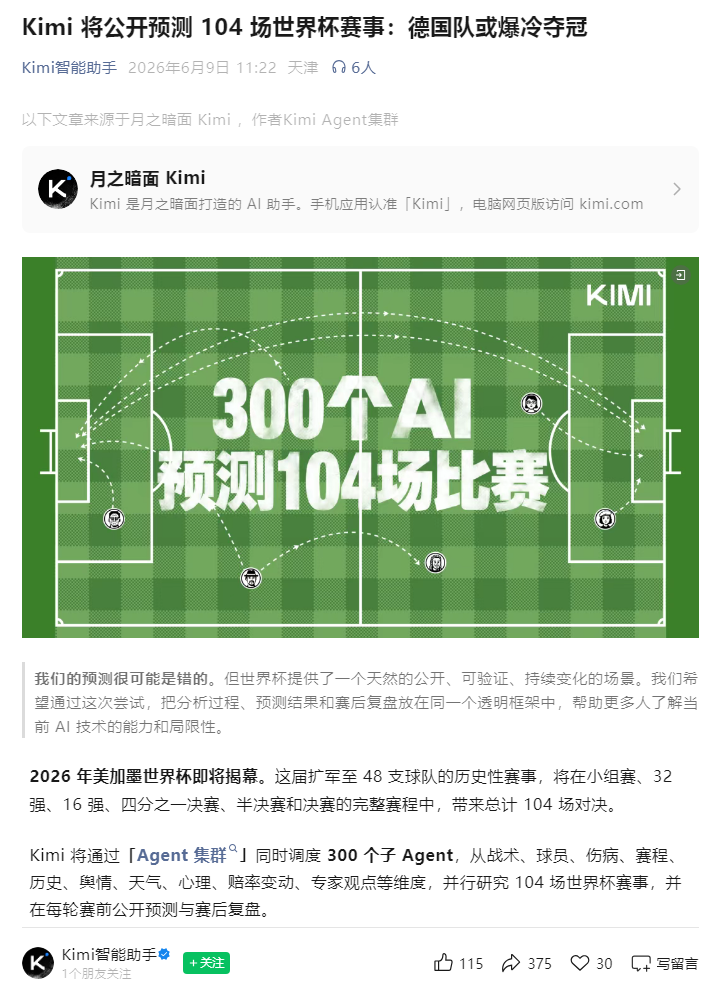
During its World Cup prediction analysis, Kimi utilized an Agent cluster to deploy 300 sub-agents simultaneously, studying 104 matches in parallel from various dimensions, including tactics, player performance, injuries, schedules, historical data, public opinion, weather conditions, psychological factors, odds fluctuations, and expert insights. It released predictions before each round and provided post-match reviews.
Given that football match prediction is a quintessential complex decision-making problem, Kimi opted for the Agent cluster functionality to conduct reasoning and analysis from diverse perspectives. Each Agent was tasked with presenting its own conclusions, supporting evidence, confidence levels, and counterarguments. The final results were presented as probabilities rather than definitive judgments, following fusion, validation, and risk labeling, without merely adopting majority opinions to determine conclusions.
In Kimi's analysis, besides listing Spain and France as the top championship contenders, akin to most mainstream large models, it also posited that Germany's championship prospects might be underestimated by the market. Its model's calibrated baseline estimate for Germany's championship probability was around 11.3%, while the implied probability in some markets hovered around 7.4%.
Ultimately, Germany's elimination in the round of 32 of the World Cup disproved Kimi's prediction. However, when releasing this prediction article, Kimi cautioned that a substantial number of errors could occur during the prediction process. These errors might stem from insufficient or outdated data, invalid key assumptions, model structures failing to account for specific scenarios, on-field events altering match outcomes, and the inherent unpredictability of football matches.
Interestingly, according to the results of a human-machine World Cup prediction competition previously announced by Lenovo Group, Tencent Hunyuan secured the top tier with an accuracy rate of 29/32. MiniMax and iFlytek Spark occupied the second tier with an accuracy rate of 28/32. DeepSeek, Lenovo Tianxi AI, and Zhipu claimed the third tier with an accuracy rate of 27/32.
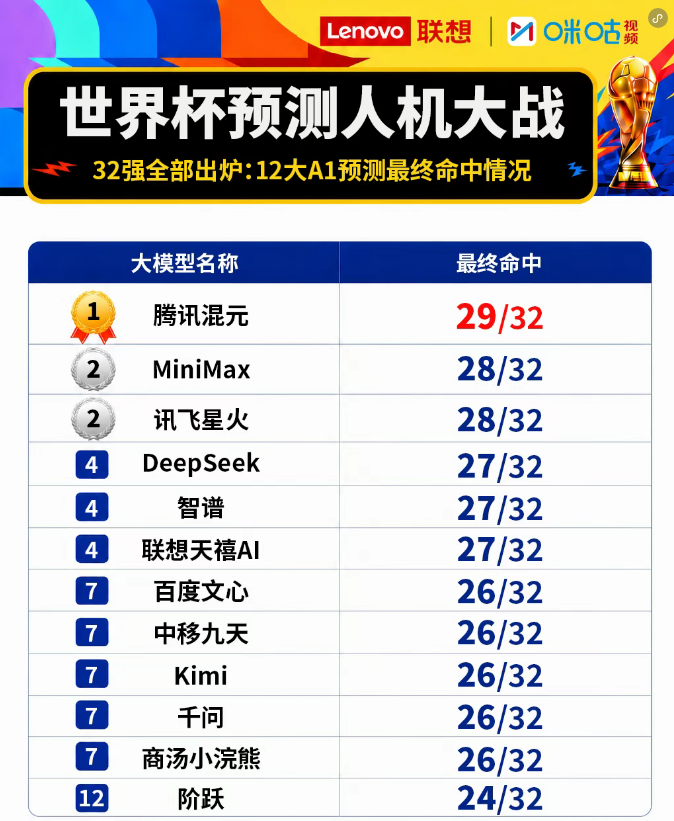
Baidu Wenxin, Tongyi Qianwen, Kimi, China Mobile Jiutian, and SenseTime Little Raccoon fell into the fourth tier with an accuracy rate of 26/32. Stepwise Stellar ranked in the fifth tier with an accuracy rate of 24/32. The highest human accuracy rate stood at 28/32. From an accuracy standpoint, Kimi's reasoning and prediction edge in this World Cup were not particularly notable.
Nevertheless, Kimi's official statement clarified that the objective of this prediction was not to demonstrate its accuracy but rather to leverage the World Cup as a natural, publicly verifiable, and dynamically evolving scenario. Kimi aimed to place the analysis process, prediction results, and post-match reviews within a transparent framework, enabling a broader audience to comprehend the capabilities and limitations of current AI technology.
-
![]()
Prayer for Success, Yet China's Space Industry Must Look Beyond Mere Success
-
![]()
Can Intelligent Driving Talents Adapt to Embodied AI? A Dimensionality Reduction or a Cultural Shock?
-
![]()
Final Assessment: Unveiling the Causes of the Sluggish Domestic Auto Market in the First Half of the Year
-
![]()
Buying a Crippled FSD for 100,000 Yuan! Musk Struggles to Quell Consumer Anger, Are New Energy Vehicles 'Outdated as Soon as They Hit the Road'?
-
![]()
Over €1.15 Billion Spent, No Mass Production in Four Years! The Volkswagen-Bosch Partnership Falters, While the Chinese Market Quietly Flourishes
-
![]()
AI Carnival: Who Will Foot the Bill?
-
![]()
Who Will Foot the Bill for the AI Craze?
-
![]()
Midea’s Air Conditioners Fly Off Shelves in Europe, Boosting He Xiangjian’s 200 Billion Yuan Fortune