Over €1.15 Billion Spent, No Mass Production in Four Years! The Volkswagen-Bosch Partnership Falters, While the Chinese Market Quietly Flourishes
 07/01 2026
 475
475
When one door shuts, another one often swings open.
The partnership between Volkswagen and Bosch in the realm of autonomous driving seems to be nearing its end.
According to reports from multiple international media outlets, Volkswagen is currently revamping its autonomous driving strategy and plans to end its collaboration with Bosch in the "Autonomous Driving Alliance," which has been in place since 2022.
Previously, Volkswagen and Bosch's joint efforts in intelligent driving were overseen by Volkswagen's software subsidiary, CARIAD. Their partnership aimed to create a modular platform for assisted and autonomous driving across various Volkswagen Group vehicle models.
International media reports, citing sources within the Volkswagen Group, reveal that Volkswagen and Bosch have invested over €1.5 billion to date. However, the research and development progress has fallen short of expectations.
Volkswagen has announced that it will transition from a primarily in-house development model to a strategy of sourcing mature hardware and software solutions for further advancement. The company plans to identify new partners by September this year.
In contrast, in the domestic market, Volkswagen continues to roll out models equipped with intelligent driving assistance systems.
So, why is there such a stark contrast in the development of intelligent driving between Volkswagen's home market in Europe and the Chinese market? Will Volkswagen's intelligent driving partners in Europe also turn to Chinese suppliers?
Let's delve into this topic together.
Volkswagen's research and development in autonomous driving can be characterized as starting early but finishing late.
In 2022, when Volkswagen and Bosch officially announced their partnership for autonomous driving R&D, both Tesla and Chinese automakers, along with intelligent driving suppliers, were still in the nascent stages of their intelligent driving technologies:
Tesla's FSD had not yet shed its beta tag; XPENG had just launched its city-assisted driving system, CNGP, which relied on high-definition maps, in Guangzhou; NIO's models on the NT2.0 platform had just been introduced, with NOP+ Beta internal testing commencing at the end of the year; Li Auto's L9 and L8 models, equipped with AD Max and AD Pro, had also just entered the market...
Had things progressed according to the typical trajectory, Volkswagen and Bosch, two renowned industry leaders, should have had a reasonably successful product launch and delivery in the field of intelligent driving, capable of competing with Tesla and other brands.
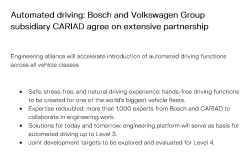
Volkswagen and Bosch believed so at the time. In their joint press release announcing the partnership, they stated that they would collaborate to develop a Level 2 hands-off driving system suitable for urban, suburban, and highway scenarios, as well as a system capable of taking over all driving tasks in highway scenarios (meeting European SAE Level 3 autonomous driving standards), with the first batch of functions scheduled for official vehicle installation in 2023.
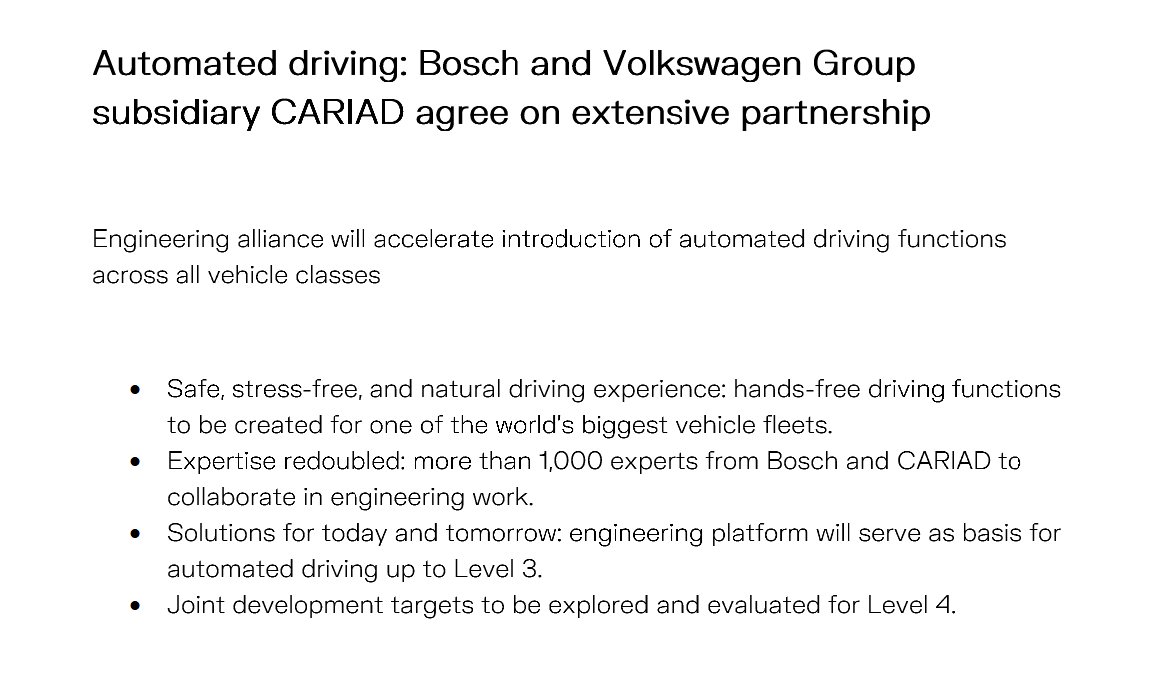
(Image source: CARIAD/Bosch)
However, now that half of 2026 has passed, has Volkswagen and Bosch's intelligent driving technology been installed in any vehicles? The answer is clearly: No.
In the years following the announcement, both sides have been providing updates on their collaboration: In 2023, they deployed test vehicles for verification on public roads; in 2024, they tested technologies based on automated valet parking and automated valet charging; by 2025, they decided to incorporate AI technology into their intelligent driving solutions.
Although there has been new progress each year, none of these technologies have been implemented in vehicles. In other words, Volkswagen and Bosch have spent €1.5 billion and over four years without a single mass-produced model equipped with the high-level intelligent driving technology developed through their collaboration.
For Volkswagen, the more significant issue than the €1.5 billion expenditure is the waste of over four years of time.
How crucial were these four years? From 2022 to the present, the technological advancements of Tesla and a host of Chinese automakers and intelligent driving suppliers have been evident to all.
The current competition in intelligent assisted driving is at a level far beyond what it was four years ago, requiring capabilities that far exceed those of four years ago.
Automakers and suppliers are now competing on computing power, models, and training. Even a slight relaxation could mean falling behind.
Volkswagen and Bosch have spent four years developing a system that has not been implemented, leading one to conclude that the €1.5 billion and four years have been spent in vain.
However, the situation is somewhat different for Volkswagen in the Chinese market. In the past year or two, models equipped with high-level assisted driving have been released one after another. Why is this the case?
Compared to the stagnation in mass production and implementation of intelligent driving technology in its home market in Europe, Volkswagen's performance in the Chinese market seems like a different company altogether.
The reason why Volkswagen can launch so many models equipped with high-level intelligent driving systems in the Chinese market is simple: it relies on suppliers.
For SAIC-VW and FAW-VW, models such as the Tiguan L Pro and the all-new Magotan, released in 2024, are equipped with the IQ.Pilot intelligent assisted driving system jointly developed by Volkswagen and ZHIYU Technology. Models like the all-new Talagon, released in 2025, have been upgraded with an end-to-end large model, supporting highway pilot assist functions.
In addition, models like the SAIC Volkswagen ID.ERA 9X are equipped with Momenta's R7 reinforcement learning world model, while the FAW-Volkswagen ID.AURA T6 and SAIC Volkswagen ID.AURA 5S are equipped with intelligent driving solutions from CARIAD and Horizon Robotics' joint venture, Core Intelligence.
As for Volkswagen Anhui, the UNI-08, developed in collaboration with XPENG and launched in April this year, naturally comes equipped with XPENG's VLA intelligent driving assistance system. The new UNI-06 and UNI-07 models use the Core Intelligence solution.
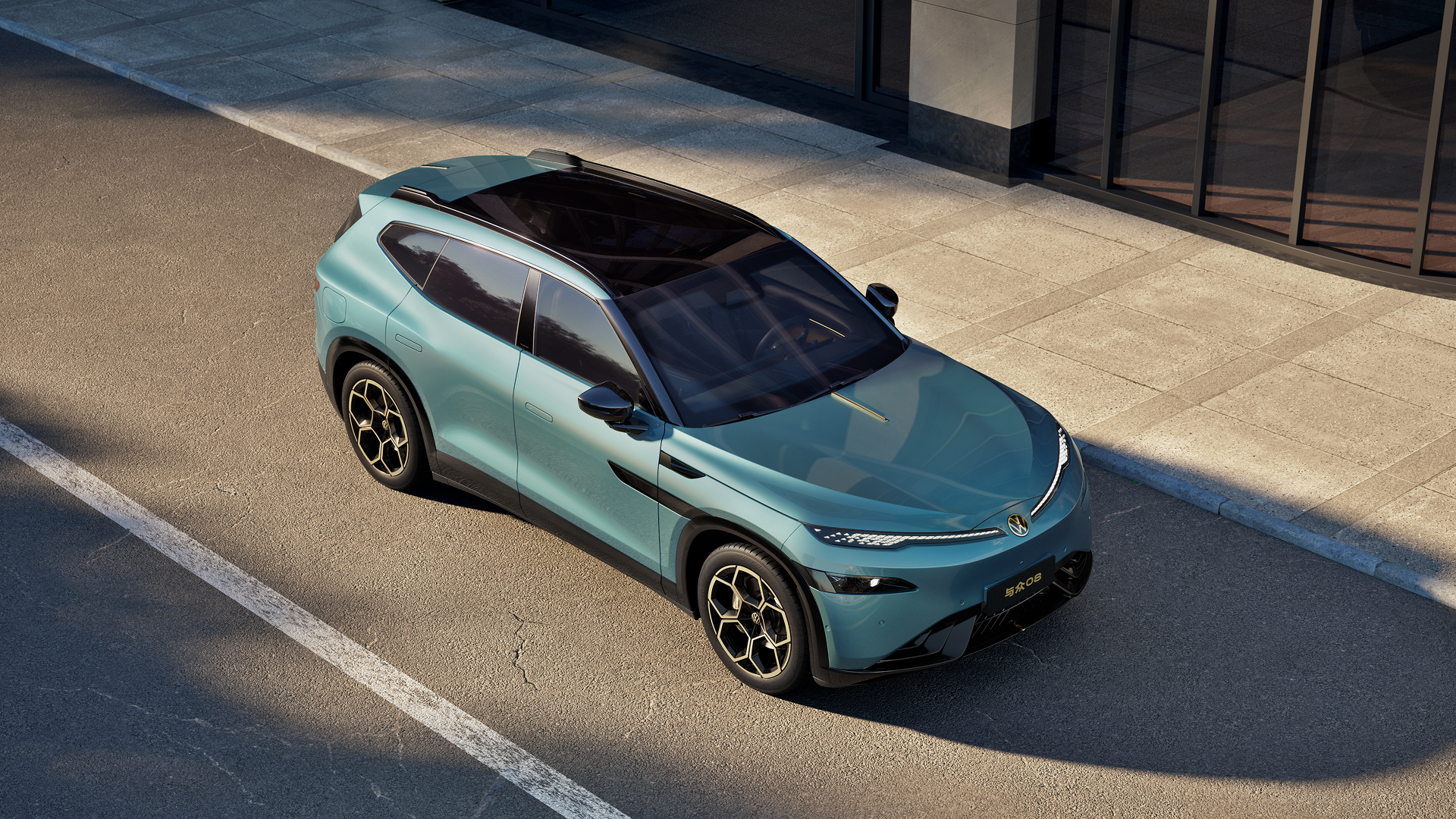
(Image source: Volkswagen Anhui)
The Audi brand also relies on multiple suppliers for its intelligent driving solutions.
The FAW-Audi A5L Qiankun Intelligent Driving Edition, launched in 2025, is equipped with Huawei's Qiankun Intelligent Driving System, and versions of the A6L e-tron and Q6L e-tron also feature Qiankun Intelligent Driving.
SAIC Audi's new energy models, such as the AUDI E5 Sportback and AUDI E7X, adopt Momenta's assisted driving solutions.
ZHIYU, Horizon Robotics, XPENG, Huawei Qiankun, and Momenta—Volkswagen has utilized nearly all of these mainstream domestic intelligent assisted driving suppliers.
In other words, in the Chinese market, Volkswagen has not clung to a single partner as it did in Europe but has chosen the most suitable intelligent driving solutions based on the positioning and needs of each model.
Of course, this is also related to the differences in the development of intelligent driving technology between China and Europe.
In the Chinese market, various intelligent driving suppliers compete with each other, and mature solutions can be found for models at almost every price point, with higher efficiency in implementation.
In the European market, Volkswagen can only rely on collaboration with established automotive component suppliers like Bosch, Continental, and ZF. However, these brands have relatively limited technical accumulation in the field of intelligent driving and often have to cooperate in technology development, similar to CARIAD and Bosch.
To put it simply, in China, Volkswagen can diversify its partnerships, while in the European market, it even has to start building the partnerships from scratch.
Therefore, the differences in intelligent driving between Volkswagen's Chinese market and its home market in Europe are understandable.
As mentioned earlier, Volkswagen's next direction in intelligent driving development will shift to procuring mature hardware and software for further development, similar to its approach in the Chinese market.
So, the question arises: Who will Volkswagen turn to for intelligent driving development, as time waits for no one?
If it chooses familiar Chinese suppliers, their training on European road conditions may not be adequate, and their compliance in Europe and potential impacts from local protectionism remain unknown.
Using solutions from local suppliers would mean bearing the cost of relatively less advanced technology. Both options have their pros and cons, and it remains to be seen how Volkswagen will ultimately choose.
Interestingly, although Bosch's collaboration with Volkswagen on intelligent driving technology has been terminated, its Bosch High-Definition Assisted Driving system, based on NVIDIA and Horizon Robotics chips, has already been implemented and delivered in brands like EXEED, AION, and eπ in the Chinese market.
(Image source: Bosch)
If Volkswagen could utilize Bosch's High-Definition Assisted Driving system in its home market in Europe, it would at least provide a temporary solution.
Let's see what choices Volkswagen will make by September.
Volkswagen, Bosch, intelligent driving, assisted driving
Source: Leikeji
Image sources in this article: 123RF Royalty-Free Image Library. Source: Leikeji
-
![]()
Who Needs Whom More: Is NIO a ‘Treasured’ Exhibit in Museums?
-
![]()
Great Wall Motors Takes a Stance Contrary to GAC Group
-
![]()
Prayer for Success, Yet China's Space Industry Must Look Beyond Mere Success
-
![]()
Can Intelligent Driving Talents Adapt to Embodied AI? A Dimensionality Reduction or a Cultural Shock?
-
![]()
Wang Xing Apologizes as Meituan Adjusts Two Key Departments
-
![]()
Final Assessment: Unveiling the Causes of the Sluggish Domestic Auto Market in the First Half of the Year
-
![]()
Buying a Crippled FSD for 100,000 Yuan! Musk Struggles to Quell Consumer Anger, Are New Energy Vehicles 'Outdated as Soon as They Hit the Road'?
-
![]()
Over €1.15 Billion Spent, No Mass Production in Four Years! The Volkswagen-Bosch Partnership Falters, While the Chinese Market Quietly Flourishes