Prayer for Success, Yet China's Space Industry Must Look Beyond Mere Success
 07/01 2026
 326
326
I deliberated for a considerable time on whether to publish this article, aware that it would inevitably attract criticism. However, when faced with the choice between being criticized and expressing my true beliefs, I opted for the latter. Naturally, I hope every rocket launch is successful, but space exploration is not merely about securing victories in the court of public opinion.
Just halfway through 2026, China's space sector has already produced a set of statistics that warrant thorough analysis.
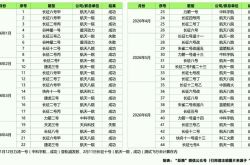
According to public data, as of June 30, China has conducted 44 launches this year, with 41 successes and 3 failures, yielding a success rate of approximately 93.18%.
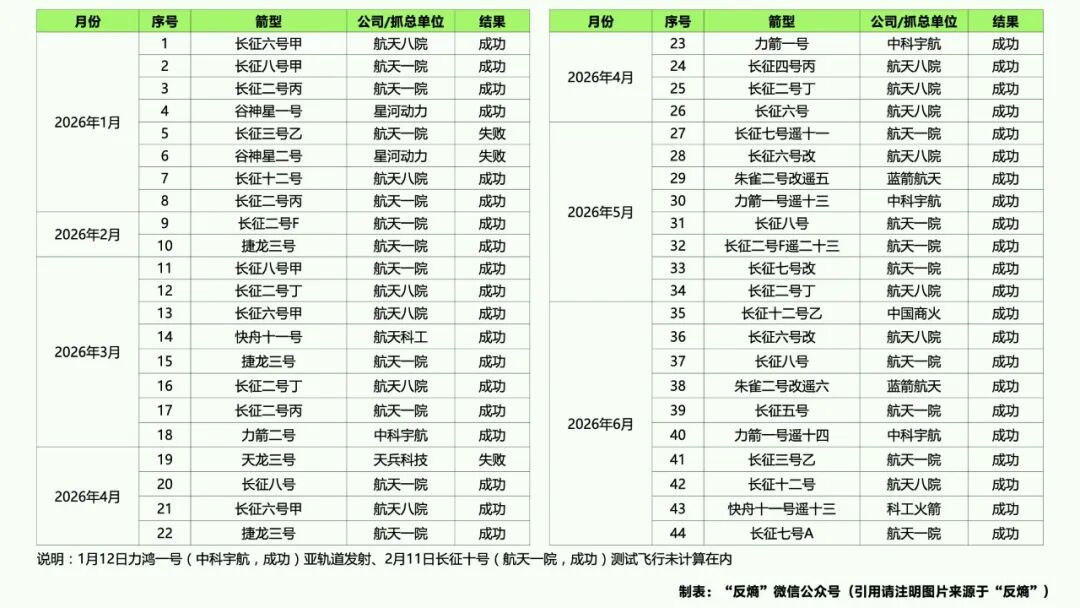
Is this figure high? Certainly not low.
So why is it considered "data worthy of deep analysis"?
Space launches represent one of the most complex, costly, and error-intolerant systems within human industrial frameworks. Rockets, towering tens or even hundreds of meters, comprise thousands of components—engines, structures, control systems, telemetry, launch sites, weather considerations, payloads—every element must operate flawlessly. Achieving over forty launches in less than six months while maintaining a success rate above 90% is a testament to China's space engineering prowess.
Nevertheless, summarizing China's space industry in 2026 solely by its "high success rate" and viewing it merely as a "rise" would overlook the truly significant transformations.
Because these 44 launches vary in difficulty; these 41 successes are not uniform; these 3 failures are not identical.
A routine launch of a mature Long March rocket is one scenario. The maiden flight of a new model is another. The inaugural commercial rocket launch by a national team is yet another. A private commercial rocket attempting a high-capacity liquid rocket launch is still another.
Calculating the success rate by combining all these into a single denominator yields only a statistical result, not an industrial insight.
This metric alone fails to reflect the engineering challenges inherent in different launch missions.
01
In the first half of 2026, the majority of China's space launches remained successful, indicating a stable foundation for the country's space industry.
Especially noteworthy is the Long March series. Its reputation is not built on a single spectacular launch but through decades of model iterations, quality management, launch organization, and engineering reviews, forming a highly mature system. The value of a mature system lies in its consistent delivery rather than in sensational stories.
This is also the most formidable aspect of the space industry.
A single success can hinge on technological breakthroughs, ten successes require systemic capabilities, and hundreds of successes must rely on a complete industrial system. Space is not an industry of isolated innovations but of systems engineering. Engines must be reliable, overall design must be sound, the supply chain must be dependable, launch sites must be trustworthy, telemetry must be accurate, and organizational processes must also be reliable.
Therefore, the success of mature models is, of course, crucial. It forms the bedrock of China's space industry and is a prerequisite for the continuous advancement of national major missions, commercial satellite deployments, and space infrastructure construction.
However, the challenge lies here as well. The success of a mature system attests to China's space industry's existing robust capabilities. Yet, the true incremental capabilities of the future may not automatically emerge from this established system.
Low-orbit satellite constellation networking, high-frequency launches, low-cost space access, high-capacity commercial rockets, and reusable rockets are not directly inherited from past success rates. They necessitate new models, new organizational methods, new cost structures, and also new capabilities to handle trial and error.
In other words, while we certainly hope for China's space industry to succeed every time, it cannot rely solely on success.
02
This statement may sound unappealing and, more accurately, may invite criticism.
Because in public perception, space launches often have only two outcomes: success or deserving criticism.
If a rocket succeeds, China's space industry is lauded. If a rocket fails, the most common reactions in the comment section are: "It exploded again, failed again, wasting money again, trying to scam us again." Even worse, now even successes are met with subtle disses like "Why didn't you recover it?"
Although frustrating, this sentiment is entirely understandable.
Launch failures are never trivial. They mean payload loss, mission delays, customer damage, corporate credibility being questioned, and a significant waste of funds, time, and engineering efforts. No failure can be dismissed as a lighthearted "cost of exploration." Indeed, failure is not a medal. However, space innovation cannot thrive solely on success.
There is a saying in "Zuo Zhuan": "Be vigilant in times of peace; vigilance leads to preparedness, and preparedness ensures safety." This applies precisely to space exploration. The greatest fear in space is not just failure itself but also losing respect for risks after consecutive successes.
A space system that only showcases success is, of course, pleasing to the eye. But if an industry, out of fear of failure, public opinion, or impact on financing, only dares to undertake the easiest tasks, that is a far bigger problem.
Because the truly difficult capabilities often lie outside the comfort zone.
Successfully launching a small solid rocket is, of course, a capability. A mature Long March rocket stably performing tasks is, of course, a capability. But if China's space industry is to support large-scale low-orbit constellations, participate in global space infrastructure competition, reduce launch costs, and move toward reusability, someone must tackle the harder challenges.
Harder challenges naturally come with a higher probability of failure.
03
Please note, I am not suggesting that new rockets are excused from failure.
In the first half of 2026, the Long March 12B is a new rocket, and its maiden flight was successful. The Lijian-2 is also a new rocket, and it also flew successfully. This demonstrates that we cannot simply equate "new rocket" with "failure is understandable."
However, even among new rockets, the maturity levels are vastly different.
Some "new" rockets are extensions of mature systems into commercial scenarios. For example, a commercial rocket from a national team is new in model, mission scenario, and commercial constellation adaptation but not built from scratch. It stands on the long-accumulated capabilities of overall design, propulsion systems, quality control, and launch organization.
Some "new" rockets are upgrades to existing product lines. Companies with prior orbital experience, launch experience, and engineering closure introduce new models, essentially expanding upon existing capabilities.
Others are truly groundbreaking, starting from zero, growing from small to large, and evolving from simple to complex.
Therefore, what we should truly discuss is not "it's normal for new rockets to fail" but rather "why do some maiden flights succeed while others fail, even among new rockets." This question is more important than simply defending failures.
The successes of the Long March 12B and Lijian-2 have raised industry evaluation standards. They demonstrate that maiden flights of new models do not have to fail. Maiden flights are difficult, but difficulty is not an explanation for all problems.
This also makes the other failures more serious and in need of dissection.
04
Objectively speaking, the three failures in the first half of 2026 cannot be lumped together.
The failure of the Long March 3B is a reliability warning for mature models.
When a mature model fails, the implications are entirely different. It is not "trial and error with new technology" or "commercial space paying tuition" but a reminder to everyone that there is no permanent safety net in space engineering. Even highly mature models, with numerous successful flights, cannot be immune to risks simply because of past successes.
Such failures are not suitable for romanticization. They must return to serious quality reset to zero (zeroing), to the reliability boundaries of mature models, and to re-examination of every engineering aspect.
The failure of the Ceres-2 presents a different kind of problem.
It is certainly not simple. More accurately, there are no truly simple models in space exploration. Any launch vehicle, once evolving toward higher capacity, more complex missions, and stronger adaptability, is essentially entering a more difficult stage. Engineering experiences validated in existing models must also be reconfirmed for their applicability under new system conditions.
The transition from the Ceres-1 to the Ceres-2 means that Galactic Energy must upgrade from a mature small solid rocket to a product with higher capacity, more complex configuration, and stronger mission adaptability. This expansion is not merely about "a larger rocket" but an overall elevation of the existing system's capability boundaries.
However, this is not uncharted technological territory.
The issue with the Ceres-2 is more like an engineering problem exposed during the expansion of a commercial rocket system already capable of orbital access. Its difficulty lies not in proving from scratch whether commercial rockets can fly but in whether the already proven capabilities of small solid rockets can be stably scaled up to higher capacity and more complex mission scenarios.
Such failures can certainly be understood as risks in validating new models but should not be elevated into a tragic narrative. Galactic Energy has already proven its orbital access capability with the Ceres-1, and the market's expectation for it is no longer "can it launch" but "can it scale up product line capacity, deliver stably, and launch continuously."
Therefore, the significance of the Ceres-2's subsequent re-flight lies in restoring and reconfirming existing capability boundaries rather than driving a leap in new technological routes.
The failure of the Tianlong-3 is closer to the true hard battle in China's commercial space industry.
High-capacity liquid rockets are not simply scaled-up versions of small rockets. Liquid engines, propellant management, structural weight, flight control, ground support, and launch organization are all more complex. More importantly, they correspond to the real demand for low-orbit satellite constellation networking.
From a product positioning perspective, the Tianlong-3 remains one of the few domestic high-capacity liquid rocket models designed for large-scale constellation networking missions. If China's commercial space industry is to undertake larger-scale, higher-frequency, and lower-cost launch missions in the future, relying solely on small solid rockets will be far from sufficient.
Therefore, the failure of the Tianlong-3 can be discussed within the context of commercial space's critical challenges.
However, even so, the failure itself cannot be downplayed just because the direction is important.
"Maiden flights are risky" can explain probability, "commercial space needs trial and error" can explain the process, and "the technological route is difficult" can explain the challenges, but ultimately, the most important thing is to complete a thorough review and validation of the results.
Failure can still have value, but only if it is proven to have value.
05
For many years, the outside world has primarily viewed China's space industry through national missions, launch counts, the Long March series, and major projects. That was an evaluation system centered on national engineering capabilities.
However, with the rise of commercial space, the evaluation system has begun to change.
The market will not automatically forgive you just because it's your maiden flight. Clients will not ignore payload losses just because your goals are lofty. Capital will not keep investing just because your technological route is advanced. Constellation networking will not pause and wait just because you're "still growing."
China's commercial space industry is gradually facing a reality: failure can be understood, but it cannot be romanticized.
Especially after the successful maiden flights of models like the Long March 12B and Lijian-2, any failed company cannot simply use "maiden flights are difficult" as the sole explanation.
The space industry certainly needs to tolerate failure, but this tolerance is not unconditional. It tolerates engineering risks in high-difficulty innovations, not inadequate preparation; it tolerates serious reset to zero (zeroing) after problems are exposed, not packaging problems with concepts; it tolerates continued re-flights after failure, not narratives left after failure.
This is a hurdle that China's commercial space industry must overcome to mature.
06
Now, you should understand that China's space industry's 93.18% success rate as of 2026 is not just a simple success rate metric but represents China's space industry entering a more complex new cycle.
The mature Long March system continues to provide stability, serving as the foundation. Commercialized new models from national teams are entering the field, adapting mature capabilities to commercial constellation demands.
The growth layer of commercial space is differentiating. One category consists of commercial rocket companies with existing orbital access capabilities and launch experience, continuously proving their productization and scalability through new model validation and iteration, gradually becoming comparable capability benchmarks and raising the industry's overall level.
The other category consists of companies tackling more cutting-edge directions like high-capacity liquid rockets and reusability. These paths are inherently more challenging, exposing problems in real flights and completing capability validation through re-flights and engineering iterations.
This is not just a simple success rate story but a tiered competition.
China's space industry certainly needs success.
Prior to each launch, success is our fervent wish. We yearn for the safe insertion of payloads into orbit, the triumphant completion of missions, the collective exhale of relief from the engineering team, the gratification of clients as they receive the results, and the enhancement of our nation's capabilities—this is the outcome that unites us all in anticipation.
Yet, China's space industry cannot rest its laurels solely on the pillar of success.
Should success be the sole benchmark, the industry might erroneously assume that the most daunting challenges have already been conquered; should success be the sole criterion, companies may grow increasingly hesitant to push the envelope; should success be the sole focus, the public may slowly lose sight of the fact that space exploration is about pushing the boundaries of human capability amidst immense risks.
The true specter is not the occasional failure of a rocket.
The true specter is an industry that, driven by the fear of failure, only dares to undertake missions that are deemed infallible.
Success warrants celebration, and failure must be reset to zero (a clean slate). However, what China's space industry must genuinely cultivate is not merely the ability to launch rockets but also the acumen to pinpoint failures with precision, rectify them comprehensively, and then soar once more.
Let us pray for success. But China's space industry cannot afford to rely solely on success.
-
![]()
Chinese Cars: Germany's 'Praise' Amidst US Fears
-
![]()
Growth Illusion and Undercurrents: Behind the 66% Growth, Insta360's 'Prosperity Dilemma'丨A-Share Avoidance Guide
-
![]()
Who Needs Whom More: Is NIO a ‘Treasured’ Exhibit in Museums?
-
![]()
Great Wall Motors Takes a Stance Contrary to GAC Group
-
![]()
Prayer for Success, Yet China's Space Industry Must Look Beyond Mere Success
-
![]()
Can Intelligent Driving Talents Adapt to Embodied AI? A Dimensionality Reduction or a Cultural Shock?
-
![]()
Wang Xing Apologizes as Meituan Adjusts Two Key Departments
-
![]()
Final Assessment: Unveiling the Causes of the Sluggish Domestic Auto Market in the First Half of the Year