Who Will Foot the Bill for the AI Craze?
 07/01 2026
 570
570
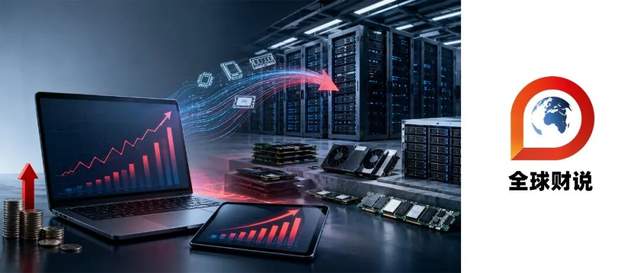
The cost burden of AI has finally been passed on to ordinary consumers.
On June 25, Apple raised the prices of several MacBook, iPad, and other hardware products. Almost simultaneously, Microsoft Xbox announced a global price hike for its gaming consoles starting August 1.
The simultaneous price increases by two consumer electronics giants have clearly brought hardware inflation, previously concealed in servers, data centers, and supply chain contracts, to the forefront of the end-user market.
This is not an ordinary product price adjustment.
In the past, when the capital market discussed AI, the focus was more on large models, GPUs, computing power leasing, optical modules, electricity, etc. The stronger the performance of chip companies, the more the market believed that this technological cycle was still expanding.
However, the price hikes in consumer electronics indicate that the impact is not limited to the cloud.
Data centers' continuous procurement of memory, SSDs, and enterprise-level storage is altering the global allocation of hardware resources and affecting consumer endpoints such as PCs, smartphones, tablets, and gaming consoles through cost transmission.
Chinese enterprise Lenovo Group also stated at its investor day that the current changes in the memory market are “unprecedented,” with supply shortages expected to persist and price increases potentially becoming the new norm in the market.
What consumers see is more expensive computers, while what the industry chain sees is a reshuffling of hardware pricing power.
Apple's price increase this time carries a strong signaling significance.
As the global consumer electronics company with the most supply chain bargaining power, Apple typically has the ability to buffer cost fluctuations through advance orders, inventory management, product portfolio adjustments, and supplier negotiations.
When Apple openly attributes the price hikes to memory and storage cost pressures, it indicates that this round of price increases has exceeded the scope of absorption by leading end-user brands.
According to Reuters, Apple raised the price of the 512GB MacBook Air from $1,099 to $1,299, the 1TB MacBook Pro from $1,699 to $1,999, and the 128GB iPad Air from $599 to $749.
Apple also stated that the company had been absorbing cost increases for consumers over the past period, but it has now reached a stage where price hikes for certain products are necessary.
Microsoft Xbox's price adjustment further proves that the pressure is not limited to a single manufacturer or just computers.
Microsoft stated that due to the significant increase in storage and memory costs, the Xbox 512GB model will see a $100 price hike, while the 1TB model will increase by $150. Gaming consoles are more directly impacted by sudden hardware cost increases.
The core issue worthy of attention is no longer short-term supply shortages in the traditional sense but rather how AI data centers have altered supply chain priorities.
In the past, PCs and smartphones were among the most important sources of demand for memory chips, and consumer electronics giants, with their stable shipments and large scale, held a strong position in the supply chain over the long term.
In the AI era, scenarios such as servers, enterprise-level SSDs, HBM, and high-capacity RDIMMs offer higher profit margins and certainty, prompting cloud vendors, AI companies, and chip giants to lock in supply through long-term agreements. Naturally, memory manufacturers prioritize fulfilling the needs of these clients.
Previously, TrendForce forecasted that traditional DRAM contract prices would rise by 58% to 63% quarter-over-quarter in the second quarter of 2026, while NAND Flash contract prices would increase by 70% to 75% quarter-over-quarter.
More critically, the price hikes are accompanied by shifts in production capacity. DRAM suppliers continue to redirect capacity toward server-related applications, while NAND capacity is increasingly allocated to enterprise-level SSDs, forcing consumer applications to contract under cost pressures.
Gartner's forecast is even more direct. By the end of 2026, the combined prices of DRAM and SSDs are expected to rise by 130% compared to 2025, driving PC prices up by 17% and smartphone prices up by 13%. This will result in a 10.4% year-over-year decline in global PC shipments and an 8.4% decrease in smartphone shipments in 2026.
In Gartner's view, low-cost PCs will be particularly hard hit, with the sub-$500 entry-level PC market potentially disappearing before 2028.
This means that hardware price increases driven by AI will alter consumer replacement cycles, compress the space for entry-level products, and force end-user manufacturers to choose between price hikes, specification reductions, delayed launches, and sacrificing profits.
Over the past two years, market discussions about AI have focused on who could invest more capital. Now, the focus is shifting to who will bear the increasingly high hardware costs.
Shawn Kim, head of Morgan Stanley's European and Asian technology team, refers to this phenomenon as “chipflation,” or chip inflation. In his June 8 report, *The High Cost of AI Memory*, he mentioned that AI infrastructure construction is altering the structure of memory demand, with AI turning storage into one of the most scarce resources, as data centers take an increasingly large “slice of the memory cake.”
According to Morgan Stanley's calculations, by 2028, servers will account for 59% of DRAM demand, significantly higher than the 37% in 2023; enterprise-level SSDs will account for 65% of NAND demand, up from around 18% previously.
This will create a real supply gap. By 2027, PC memory demand may face a 15% shortfall, equivalent to about 58 million PCs; smartphone memory demand may face a 12% shortfall, equivalent to about 134 million phones.
Domestic securities firms' judgments point in the same direction. CITIC Construction Investment believes that from 2026 to 2027, HBM, DRAM, NAND, and small-capacity storage may all experience varying degrees of supply shortages. This round of memory price hikes differs from previous cycles, with the duration and magnitude of price increases likely far exceeding expectations.
When applied to the industry chain, such judgments lead to clearer stratification. Upstream memory manufacturers, enterprise-level SSDs, server memory, and semiconductor equipment sectors may continue to benefit from price increases and expansion demands; however, end-user manufacturers of PCs, smartphones, tablets, and gaming consoles will face greater challenges in balancing rising costs and weakening demand.
Datong Securities mentioned in its TMT industry weekly report that the rise in the memory chip sector is essentially a result of the gradual spread of AI capital expenditures. The market is expanding beyond GPUs and AI servers to explore supporting aspects of data center construction, with memory chips being one of the more certain directions. However, it also cautions that the storage industry remains cyclical, and the sustainability of the market trend ultimately depends on whether AI demand can continue to materialize and whether manufacturers can maintain an effective balance between expansion and pricing.
A cost calculation from the cloud to the endpoint has officially begun.
More subtly, rising hardware costs are beginning to erode capital market sentiment.
Around the time Apple announced its price hikes, AI chip stocks in the U.S. market experienced a collective pullback. On June 23, the Philadelphia Semiconductor Index fell 7.9%, with Micron Technology dropping 13% and Nvidia falling 4.1%. Chip stocks such as Qualcomm and Marvell also came under significant pressure.
Reuters stated that this pullback occurred after a substantial rally in AI infrastructure-related stocks, with the market beginning to worry about the sustainability of AI capital expenditures, valuations, and crowded funding trades.
On June 26, selling pressure on chip stocks had not fully dissipated. The Philadelphia Semiconductor Index fell 5.29%, with On Semiconductor dropping 24%, its largest single-day decline since 2020. Western Digital, Seagate Technology, SanDisk, NXP, Qualcomm, Micron Technology, and Applied Materials all saw significant declines.
Take Micron as an example; its performance is not poor, and memory price hikes even benefit its profitability. However, the market's focus has shifted from “price hikes bringing profits” to whether “AI hardware inflation will suppress endpoint demand and increase capital expenditure pressures.”
At the same time, news of OpenAI delaying its IPO exacerbated these sentiments.
Reuters, citing *The New York Times*, reported that OpenAI is considering delaying its public listing until 2027 to secure a higher valuation. Advisors have presented two options to the company's leadership: wait until 2027 for a $1 trillion valuation or go public sooner at a lower valuation.
This news struck a sensitive nerve in the market, as AI company valuations continue to rise, but commercialization and cash flow validation still require time.
Apple's price hike, Xbox's price hike, soaring memory prices, the pullback in U.S. chip stocks, and the news of OpenAI delaying its IPO may seem like unrelated stories, but they all point to AI entering a phase of “cost calculation.”
This logic can also be mapped to the A-share market.
On the evening of June 26, Xiechuang Data announced plans to issue shares to specific investors to raise no more than 8 billion yuan for projects including a smart computing center, data storage expansion and upgrading, as well as supplementing working capital and repaying bank loans.
Xiechuang Data's private placement is highly representative in the current context. On one hand, it shows that computing power and storage remain directions that capital is willing to support. On the other hand, it cannot be ignored that computing power is not a light-asset story.
While overseas end-user manufacturers are raising prices, A-share computing power companies are financing for expansion. Although they seem to be moving in different directions, both are responding to the same pressure: as hardware becomes more expensive, companies must find ways to absorb costs.
A series of new questions arise: After hardware becomes more expensive, can orders cover costs? Can stable cash flow be generated after projects go into operation? Can the depreciation and financial expenses brought by expansion be absorbed by revenue growth?
This will determine the true differentiation within the AI hardware chain, as AI brings about a cost redistribution from upstream to endpoint.
The price hike for computers is just the beginning—a signal that is easier to see.
From data centers to MacBooks, from enterprise-level SSDs to the replacement budgets of ordinary consumers, AI is not only transforming the cloud but also altering the cost structures of every computer, every hard drive, and every hardware company.
-
![]()
Great Wall Motors Takes a Stance Contrary to GAC Group
-
![]()
Prayer for Success, Yet China's Space Industry Must Look Beyond Mere Success
-
![]()
Can Intelligent Driving Talents Adapt to Embodied AI? A Dimensionality Reduction or a Cultural Shock?
-
![]()
Wang Xing Apologizes as Meituan Adjusts Two Key Departments
-
![]()
Final Assessment: Unveiling the Causes of the Sluggish Domestic Auto Market in the First Half of the Year
-
![]()
Buying a Crippled FSD for 100,000 Yuan! Musk Struggles to Quell Consumer Anger, Are New Energy Vehicles 'Outdated as Soon as They Hit the Road'?
-
![]()
Over €1.15 Billion Spent, No Mass Production in Four Years! The Volkswagen-Bosch Partnership Falters, While the Chinese Market Quietly Flourishes
-
![]()
AI Carnival: Who Will Foot the Bill?