Aiming for 'Double 100,000': Caocao Chuxing's Strengths and Vulnerabilities
 07/02 2026
 336
336

The Pace of Progress Must Not Stop!
Editor: Kele
Contributor: Zhang Ran
Source: Rao Cai – Rao Cai Research Institute
After Achieving Single-Quarter Profitability, Where Is Caocao Chuxing Headed Next?
On June 25th, the company announced a strategic partnership with the Shanghai AI Institute. The two sides will jointly establish the 'Caocao Chuxing AI Innovation Base,' leveraging deep industry-academia-research collaboration to focus on technological breakthroughs and commercialization of AI across the entire mobility chain.
In fact, Caocao Chuxing has already embarked on a comprehensive AI transformation, aiming to deploy 100,000 Robotaxis and 100,000 Robovans by 2030, building a fully closed-loop ecosystem integrating 'personalized customized vehicles + autonomous driving technology + intelligent operations.'
While this grand vision is inspiring, does the company have the strength to escape losses and see its stock price soar?
01
Driven by Core Business and Growth Opportunities
A Rare Competitive Moat
LAOCAI
To leap higher, one must first have a solid foundation. Significant upfront investment is inevitable for future technological advancements, especially with a strong business base as support.
Looking back at 2025, the improvement in Caocao Chuxing's financial core business was a key factor behind its confidence in betting on AI: annual GTV (Gross Transaction Value) increased by 38.2% year-on-year to RMB 23.43 billion; revenue reached RMB 20.19 billion, up 37.7% year-on-year.
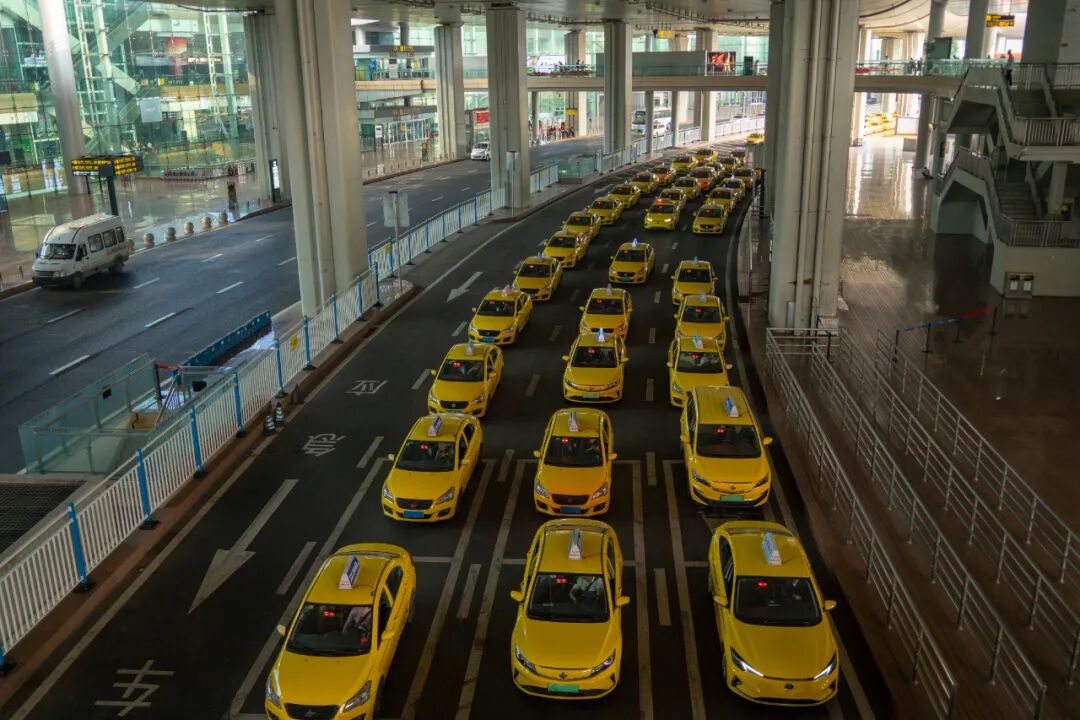
Specifically, revenue from mobility services was RMB 18.56 billion, accounting for 92% of total revenue. The gross profit margin rose to 9.4% from 8.1% the previous year. It should be noted that despite a net loss attributable to the parent company exceeding RMB 600 million for the full year, the fourth quarter of 2025 marked the first time adjusted net profit turned positive, driving the annual loss to shrink by 50.8% year-on-year, indicating that the unit economic model has preliminary run through (preliminarily proven viable).
The reasons for this include the continuous amplification of platform scale effects: in 2025, Caocao Chuxing's average monthly active users reached 41.3 million, up 43.9% year-on-year; average monthly active drivers reached 631,000, up 35.4% year-on-year. By the end of the year, the company's business covered 195 cities across China, and net cash flow from operating activities surged by 60.3%.
Secondly, the customized vehicle strategy played a crucial role. By the end of 2025, the company had self-operated over 38,000 customized vehicles (primarily for ride-hailing services) across 31 cities. Annual vehicle sales also jumped from 8,004 to 15,346 units, mostly consisting of the second-generation customized model, the Caocao 60.
Breaking down the cost structure, TCO (Total Cost of Ownership) was the largest single expense: both the Maple 80V and Caocao 60 models were specifically developed for shared mobility scenarios. Taking the Caocao 60 as an example, according to Frost & Sullivan calculations, its TCO per kilometer can be as low as approximately RMB 0.47, about 40% lower than mainstream pure electric models in the industry. This cost advantage directly improved gross margins. As scale effects continue to materialize, the timing of an overall profitability turning point becomes an enticing question.
Currently, Caocao Chuxing has established a full lifecycle management system covering vehicle procurement, insurance, maintenance, and residual value management. Leveraging Geely Holding's ecological partner, Yi Yi Interconnect, it has deployed 448 battery swap stations, enabling 60-second rapid battery swaps. In terms of maintenance, average maintenance and repair times and costs decreased by 25% and 54% year-on-year, respectively.
Moreover, beyond strengthening foundational operational capabilities, the company has also aggressively expanded its business scope: for example, in December 2025, Caocao Chuxing announced the acquisition of 100% of Yao Chuxing's equity and 100% of Geely Business Travel's equity. After integration, it will form a one-stop tech mobility platform covering individual and corporate clients, standard and premium services, and 'mobility + business travel.'
These dual efforts have ultimately translated into a service experience perceptible to users. According to China Youth Daily, in nine user surveys conducted from the fourth quarter of 2023 to the fourth quarter of 2025, Caocao Chuxing was rated as having the 'best service reputation' among major shared mobility platforms in China.
A series of positive financial reports validate the sustainability of the business model and the effectiveness of core competitiveness. Industry analyst Wang Tingyan believes that the customized vehicle strategy has built a cost-side barrier, while AI capabilities enhance operational efficiency across the entire chain. Together, they reshape service reputation, forming a unique brand moat that provides the company with continuous growth momentum.
02
From 'Two-Step Approach' to '1 to N'
Experiencing the Power of AI Leadership
LAOCAI
With a stable core business, strategic transformation and upgrading become a natural progression.
In June 2026, Caocao Chuxing launched a comprehensive AI transformation, aiming to concentrate its previously accumulated resources on future competitive high grounds. This can be divided into two steps:
The first step is to use AI to enhance the efficiency and quality of existing businesses, unlocking greater scale effects. The company applies AI large model technology to the 'Caocao Brain' intelligent decision-making system, optimizing supply-demand matching in real-time and improving prediction accuracy and optimal order dispatching. This technology-driven efficiency path allows the platform to continuously optimize its unit economic model while expanding in scale.

The second step is to move from tool application to strategic restructuring, initiating a new paradigm of physical AI. The company positions this AI transformation as a 'globally leading physical AI mobility tech platform,' with RoboX as its core.
Caocao Chuxing CEO Gong Xin explained: 'The core of the RoboX strategy is to build a tripartite capability system of intelligent customized vehicles, intelligent driving technology, and intelligent operations, turning vehicles into execution terminals for intelligent agents and constructing a physical AI operational network connecting digital intelligence with the physical world.'""In short, the AI layout is not limited to optimizing existing business efficiency with technology but rather uses RoboX as a framework to fundamentally reconstruct the product form and operational logic of mobility services.
As Geely Holding Group CEO An Conghui stated: 'Caocao Chuxing is not just a tech mobility platform under Geely Holding; it is also our most important vehicle for exploring future mobility, achieving commercial operation of Robotaxis, and validating cutting-edge technologies and full-ecosystem collaboration capabilities.'
This is not just talk—a series of significant moves have already showcased its pioneering spirit:
In terms of intelligent customized vehicles, at the Beijing Auto Show in April 2026, the native Robotaxi model Eva Cab, deeply involved by Caocao Chuxing, made its debut. This vehicle has no steering wheel or front passenger seat and is entirely developed for autonomous driving operation scenarios. Its designed lifespan is two to three times that of ordinary passenger vehicles, with key component lifespans significantly exceeding those of ordinary passenger vehicles. It is planned for mass production in 2027, with a cumulative deployment of 100,000 units by 2030.
In intelligent driving and operations, in December 2025, Caocao Chuxing signed a strategic cooperation agreement with Qianli Intelligent Driving to jointly accelerate the large-scale application and commercialization of intelligent driving technology. The company is developing the Caocao Robo OS operating system for the future era of unmanned mobility, integrating intelligent customized vehicles, intelligent driving technology, and intelligent operations to form a complete solution covering 'demand, supply-demand matching, and fulfillment.'""In terms of diversified scenarios and commercialization, the RoboX strategy is not limited to the Robotaxi scenario but also includes Robovan, Robobus, and other diversified scenarios. At the same time as the announcement, Caocao Chuxing reached a strategic cooperation agreement with Geely Remote Commercial Vehicles to jointly promote the large-scale application of Robovan models.
In February 2025, the Caocao Intelligent Driving Autonomous Platform went live first in Hangzhou and Suzhou, initiating pilot Robotaxi operations. In December of the same year, the company released the Robotaxi 2.0 solution, marking the official start of the transition from a primary safety officer to unmanned operation.
As of February 2026, Caocao Chuxing had deployed 100 Robotaxis in Binjiang District, Hangzhou. In April, the company became the first in Hangzhou to conduct unmanned road tests for Robotaxis. In the first half of the year, it also established an independent AI division, restructuring its organizational setup to accelerate its transformation into an AI-native company.
Industry analyst Sun Yewen believes that AI values scalability and reuse. Vast amounts of data, rich operational practice, and increasingly sophisticated scenario models gradually raise Caocao Chuxing's industry barriers. The pioneering strength gained from early experimentation will inspire more and more flywheel effects. As Robotaxi operational validation deepens, after completing the '0 to 1' validation phase, the '1 to N' large-scale replication and ecological closed-loop collaboration will bring about a qualitative leap in the company's competitiveness, securing an early entry ticket to the next Dividend cycle (bonus cycle).
03
Favorable Timing, Geography, and Human Resources: The Overseas Path Grows Broader
LAOCAI
Without exaggeration, the overseas expansion strategy is accelerating!
Just last month, Caocao Chuxing's official WeChat account announced a key acceleration in its internationalization strategy, forming a pattern of launching from Hong Kong and advancing along dual lines in the Middle East and Europe.
On June 18th, the company announced the launch of Robotaxi services in Hong Kong, planning to make Hong Kong the world's first benchmark city for the RoboX strategy and provide a transitional platform for faster subsequent internationalization.

The Middle East market is one of the focal points of this overseas expansion. Major Middle Eastern economies, such as Saudi Arabia and the UAE, have long relied on oil and natural gas resources, resulting in a fragile energy-dependent economic structure. To address this, Saudi Arabia released Vision 2030, and the UAE introduced the AI Strategy 2031, both designating digital economy, intelligent transportation, and advanced autonomous driving as core pillars of national economic transformation. These top-down national strategies, combined with the unique local market environment, provide excellent conditions for Robotaxi deployment.
At the regulatory level, unlike most countries' cautious attitude toward fully unmanned autonomous driving, Middle Eastern countries directly break through traditional traffic regulations, opening dedicated policy channels to enable rapid full-process approvals, from road testing and safety officer removal to full-domain commercial operations. For example, the UAE government's AI Strategy 2031 gives 'green lights' to unmanned vehicles throughout the process.
Saudi Arabia is creating a global autonomous driving policy testbed—NEOM, a future city where fully unmanned driving serves as a core pillar of the transportation system. Combined with abundant financial reserves and an urgent demand for green energy transformation, the conditions are highly favorable, prompting Caocao Chuxing to make a decisive move. In November 2025, it signed a memorandum of cooperation with the Abu Dhabi Investment Office.
Under the agreement, Caocao Chuxing will launch local testing in Abu Dhabi in 2026 and plans to deploy its first batch of Robotaxi vehicles, jointly promoting the construction of local Robotaxi service systems. Its subsequent cooperation with K2 Group marks the entry into substantive project deployment.
In the European market, Caocao Chuxing reached a strategic cooperation agreement with May Mobility. The two sides will jointly conduct feasibility studies and commercial exploration around Robotaxi deployment, with plans to advance pilot implementations under suitable conditions.
Public information shows that May Mobility is a global autonomous driving technology company. Its self-developed In-situ AI technology integrates deep learning, dynamic world models, and real-time reasoning capabilities, enhancing autonomous vehicles' adaptability to complex road environments. It has already operated autonomous mobility services in markets such as the United States and Japan.
Industry analyst Lin Yong believes that by expanding its network of partners and focusing on pilot projects in key regions, Caocao Chuxing's globalization strategy is transitioning from 'testing the waters' to 'deep cultivation.' As domestically validated business models, operational experience, and overall solutions scale up, the company's transformation logic from a mobility platform to a physical AI tech platform becomes increasingly clear, with its transformation path growing broader.
04
Overcoming Five Challenges: The Pace of Progress Must Not Stop
LAOCAI
However, every coin has two sides. Behind the impressive achievements, some vulnerabilities cannot be ignored. Especially at a critical juncture of intensifying industry competition and the company's own upward breakthroughs, timely identification and resolution of weaknesses and strengthening of foundational capabilities are essential.
First, market competition is intensifying, with leading competitors launching aggressive offensives. Both mobility platforms and autonomous driving represent long-term tracks requiring sustained heavy investment, and the window of opportunity is narrowing. Players must grow rapidly, accelerate commercialization, and seize market share.
According to China Fund News, in March 2026, Pony.ai delivered over 100 Robotaxis to the OnTime fleet, launching mixed operations of human-driven ride-hailing and Robotaxis in Guangzhou. The company plans to triple its Robotaxi revenue in 2026 compared to the previous year, expand its fleet to 3,000 vehicles by the end of the year, and deploy services in over 20 cities.
XPENG Motors also stated its plan to launch Robotaxi passenger demonstration operations in the second half of 2026. On June 29th, Tongcheng Travel announced a massive investment of over RMB 1.4 billion to launch a comprehensive tender offer for Dida Chuxing, bringing massive traffic from lower-tier markets and valuable capital infusion to the latter...
Surrounded by strong competitors, Caocao Chuxing's core business has just reached quarterly profitability and lacks stable self-sufficiency. Meanwhile, large-scale autonomous driving R&D, vehicle procurement, and operational site management all require continuous capital investment. Facing competitors' aggressive offensives, how to respond calmly and maintain market position is a serious question.
Second, persistent losses and short-term debt repayment pressures remain objective challenges. In 2025, despite Caocao Chuxing's revenue exceeding RMB 20 billion, it still did not escape losses, with a net loss attributable to the parent company exceeding RMB 600 million and an operating loss of RMB 463 million. Its self-generating cash flow capacity needs strengthening. Over a longer horizon, losses amounted to RMB 1.972 billion, RMB 1.916 billion, and RMB 1.251 billion in 2022-2024, respectively. While the narrowing losses are commendable, the timing of a true turnaround remains uncertain, and investor confidence has its limits.
As of the end of 2025, the company's total liabilities exceeded RMB 9.2 billion, with current liabilities nearing RMB 7.3 billion and a net current liability position of RMB 4.241 billion; various loans totaled RMB 7.2 billion. Even with tens of billions of yuan in unused bank credit lines, short-term concentrated debt repayment pressures remain objective.
In early 2026, Caocao Chuxing announced a new share placement plan, intending to place up to 12 million shares to raise approximately HKD 383 million in net proceeds. Over 60% of these funds will be invested in autonomous driving-related businesses.
Once again, there is a heavy reliance on aggregated platform traffic, and high marketing expenses are eroding profits. The improvement in fundamentals cannot conceal a structural dilemma: the lifeblood of Caocao Chuxing's orders is still controlled by aggregated platforms. According to the prospectus, from 2022 to 2024, the proportion of order transaction value from aggregated platforms in the company's Gross Transaction Value (GTV) increased from 49.9% to 85.4%, while the proportion of order volume rose from 51.4% to 85.7%. During the same period, the commission paid by the company to aggregated platforms as a percentage of the GTV they facilitated remained stable between 7.2% and 7.5%.
Data from East Money Choice shows that from 2023 to 2025, the company's research and development expenses were 340 million yuan, 235 million yuan, and 206 million yuan, respectively, showing an overall downward trend. Meanwhile, sales and marketing expenditures surged from 836 million yuan to 1.803 billion yuan during the same period. In 2025 alone, the commission paid to aggregated platforms reached 1.565 billion yuan.
Amidst this decline and rise, there is a need to be vigilant about imbalanced resource allocation and being swayed by short-term gains. Industry analyst Sun Yewen pointed out that changes in the commission ratio or slight adjustments in algorithm weights by aggregated platforms could potentially push the hard-earned profit turning point back into the loss zone. If the vicious cycle of over-reliance is not broken, coupled with shrinking R&D investment and inflated marketing expenses, it could affect the company's long-term technological competitiveness and development momentum.
Furthermore, some compliance management loopholes and user complaints serve as reminders that the company must always tighten its quality control measures.
For instance, on June 29, the Shanghai Online Car-Hailing Collaborative Supervision Task Force, in conjunction with multiple departments, conducted a Centralized interviews (centralized interview) with 24 online car-hailing and aggregated platform companies across the city, circular (reporting) industry-wide issues and typical cases, and demanded rectification within a specified timeframe. Among them, Caocao Chuxing had seven cases filed against it.
Another example is in September 2021, when the Ministry of Transport, together with the Cyberspace Administration of China, the Ministry of Industry and Information Technology, the Ministry of Public Security, and the State Administration for Market Regulation, jointly interviewed several online car-hailing platforms, including Caocao Chuxing. They explicitly required the platforms to immediately rectify issues such as price dumping and big data-based discrimination, and to accelerate the clearance of unlicensed vehicles and drivers.
According to Jiemian News, the operating entity of Caocao Chuxing is Hangzhou Youxing Technology Co., Ltd. Tianyancha shows that as of July 1, the company had received a total of 1,648 administrative penalties, with a total penalty amount of 13.3782 million yuan. In May alone, there were 20 penalties, mostly related to providing services with vehicles that had not obtained the Network Pre-arranged Taxi Transport Certificate and drivers who had not obtained professional qualifications.
Browsing through complaints on Heimao Tousu (Black Cat Complaints), as of July 1, 2026, Caocao Chuxing had accumulated 14,520 related complaints, focusing mainly on issues such as the standardization of driver services, customer service response efficiency, and disputes over deductions.
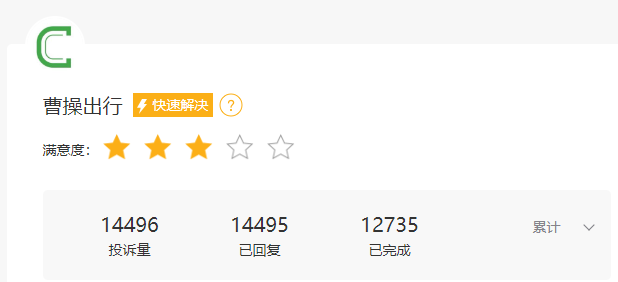
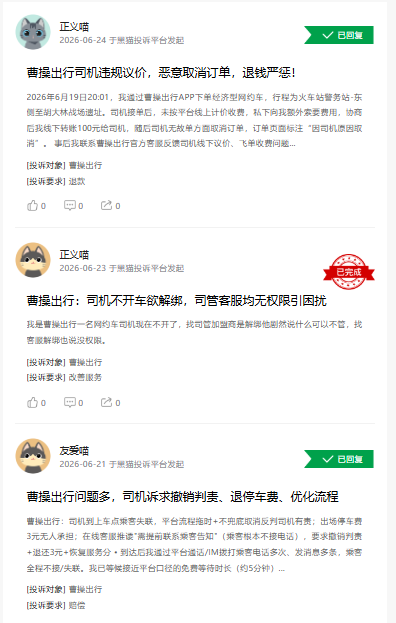
(All the above complaints have been reviewed by the platform.)
Objectively speaking, it is unrealistic to expect everyone to be satisfied given the diversity of users. The above complaints may have biases, and the penalties also have a certain lag, which may not reflect the current reality. However, for Caocao Chuxing, service reputation is a core asset for differentiated competition on the platform and an important support for driving user stickiness and brand premium. It is always right to listen more, learn from one to infer others, and build on strengths while addressing weaknesses.
Finally, the stock price has broken below its issue price, and capital confidence urgently needs to be boosted. As of July 1, Caocao Chuxing's closing price was 19.87 Hong Kong dollars, a cumulative decline of over 30% from the year's opening price of 30 Hong Kong dollars and more than half from the issue price of 41.94 Hong Kong dollars, with a market capitalization of less than 12 billion Hong Kong dollars.
The same old saying applies: attending to small matters leads to great achievements, and the devil is in the details. Whether it's convenient travel or intelligent driving, winning over users and taking the lead relies on individual orders, repeated positive Word of mouth experience (reputation experiences), and high-quality scenarios.
The 'Double 100,000 Goal' for Robotaxi is a good story, but whether it can truly be told brilliantly will determine the timeline for profitability and the seating arrangement at the next round of dividend tables. Strengthening internal capabilities, addressing weaknesses, overcoming obstacles, boosting confidence, and eliminating vulnerabilities—on the eve of AI commercialization, Caocao Chuxing cannot afford to halt its progress; its moat needs to be deepened and widened further.
This article is original content from Rao Cai.
If you wish to reprint it, please leave a message.
-
![]()
Preparing for the 6G Era: US Completely Shuts Down 2G Networks, China Unicom Initiates Gradual Decommissioning of WCDMA 3G Networks
-
![]()
Mid-year 2026 Sales Review: Auto Market Shifts from Scale Expansion to Systemic Capabilities for Long-term Positioning
-
![]()
From the ARD Protocol, the Turning Point for the Agent Industry Has Arrived
-
Pinduoduo's Strategic Leap in Xiong'an: Beyond Investment, a Pledge to Flourish
-
Liang Wenfeng Has No Desire to Become Another Sam Altman
-
![]()
Revenue Soars, Losses Mount in Billions, Sales Stumble: Avatr's Hong Kong IPO Bid Amid Breakthroughs and Anxieties
-
![]()
Breaking Industry Records in Financing Speed, the Dark Horse of Embodied AI Rides the Wave of Enthusiasm | Gechao
-
![]()
Pix Exclusive | Mercedes-Benz China Establishes GTM Department to Avoid Repeating CLA's Mistakes