Breaking Industry Records in Financing Speed, the Dark Horse of Embodied AI Rides the Wave of Enthusiasm | Gechao
 07/02 2026
 471
471

Editor | Yang Xuran
Since its inception, the company has secured approximately 6 billion yuan in funding. It completed three rounds of financing in less than four months, raising a total of 4.5 billion yuan and setting a new benchmark for the fastest financing speed in the embodied intelligence industry.
Qianxun Intelligence, established just two years and three months ago, has demonstrated remarkable performance in the primary market.
Recently, Qianxun's embodied base model, Spirit v1.6, topped the RoboArena international evaluation rankings, outperforming U.S. tech giants like NVIDIA. It became the first Chinese embodied model to achieve the top spot on this world-class list, which was previously dominated by Silicon Valley.
With significant capital investment and technological breakthroughs, these two pivotal events for embodied intelligence companies converged, catapulting Qianxun into the spotlight within the sector and instantly drawing widespread industry attention.
However, RoboArena soon issued a statement claiming 'there were signs of benchmark manipulation' and subsequently removed Spirit v1.6 from the official rankings. Interestingly, it was also reported that Xie Junyuan, Qianxun's core R&D leader, had resigned.
From 'surpassing NVIDIA' to 'being removed,' from 'raising 4.5 billion' to 'the departure of a core technical expert,' and from 'sector euphoria' to 'implementation bottlenecks,' the contrasting fortunes surrounding Qianxun Intelligence encapsulate the fervor and challenges in the current narrative of embodied intelligence.
This in-depth article is brought to you by the content team at Gechao WAVE. Follow us across multiple platforms.

Frenzy
Qianxun Intelligence narrates the story of a post-80s academic prodigy's second entrepreneurial venture.
Han Fengtao, born in 1984, graduated with a bachelor's degree from the School of Automation at Huazhong University of Science and Technology, a master's degree from Zhejiang University, and a Ph.D. in robotics under the supervision of academic titan Ding Han.
At the age of thirty, he resigned from a state-owned enterprise and co-founded Luosai Robotics with Zheng Lingyin and others, venturing into the industrial robotics field and leading the delivery of over 20,000 robots. Over a decade of entrepreneurship, he witnessed the historic leap of 'industrial robot localization rates increasing from 3% to 54%' but also observed the dilemma of most companies failing to turn a profit.
Industrial robots operated in closed scenarios with fixed movements, and the limitations of AI 1.0 capabilities prevented the realization of expected embodied intelligence.
The turning point came in 2022 with the emergence of ChatGPT in November, signaling the arrival of the AGI era. Han recognized the opportunity to create a true 'embodied intelligence brain.'

In the summer of 2023, Han decided to embark on his second entrepreneurial journey. At the time, he needed to find an AI technology expert. He reportedly interviewed over 100 individuals before finally aligning with Gao Yang, an assistant professor at the Institute for Interdisciplinary Information Sciences at Tsinghua University.
In January 2024, Qianxun Intelligence was established, forming a 'strategy + technology + operations' iron triangle with Han Fengtao, Gao Yang, and Zheng Lingyin.
Gao Yang, with a bachelor's degree from Tsinghua University's Computer Science Department and a Ph.D. from the University of California, Berkeley, under the mentorship of Pieter Abbeel, a titan in embodied intelligence and co-founder of leading embodied intelligence company Physical Intelligence.
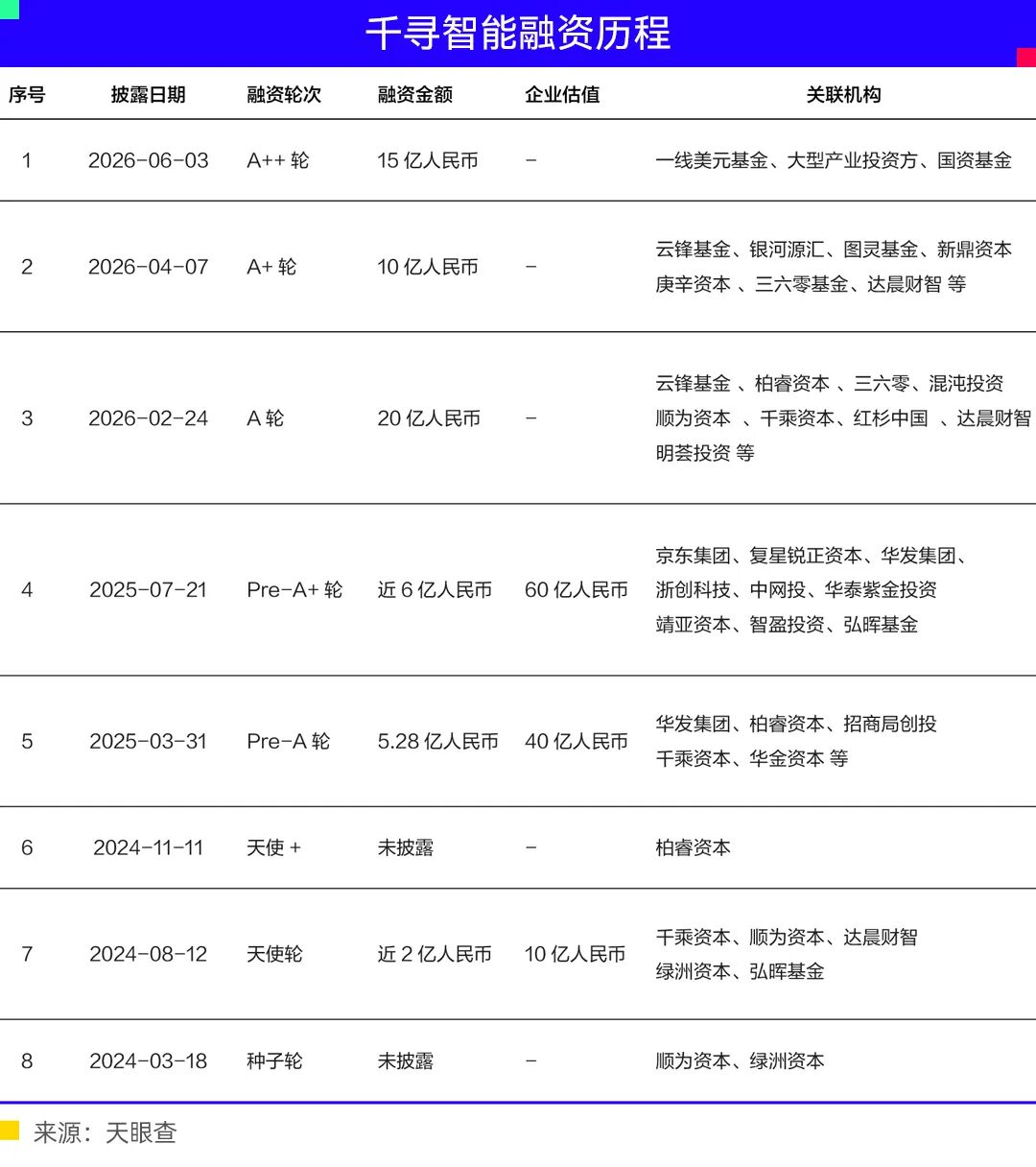
The combination of an 'industry veteran + AI expert' immediately garnered capital favor. Within just seven months of its establishment, the company completed nearly 200 million yuan in seed and angel round financing; in 2025, it secured 1.1 billion yuan in Pre-A and Pre-A+ rounds.
Financing in the embodied intelligence sector reached fever pitch this year, despite Han cautioning the industry against recklessness by likening it to 'child labor.' However, desperate capital rushed to secure a seat at the table, with the industry completing 288 financing deals in the first half alone, totaling over 46 billion yuan.
Yet, capital allocation in the market was extremely imbalanced, with severe '80-20 differentiation,' where the top five companies secured 17.1 billion yuan (37%). Qianxun's financing pace accelerated, completing two rounds totaling nearly 2 billion yuan in February, with its valuation smoothly surpassing 10 billion yuan; it secured another 1 billion yuan in April and 1.5 billion yuan in an A+ round in June.
Qianxun's 4.5 billion yuan raised in the past three months equates to nearly one-third of the total raised by over 200 companies.
This growth rate is even more astonishing—Unitree Technology, founded in 2016, took nine years to reach a 10 billion yuan valuation, while Qianxun shortened this cycle to just over two years.
In an interview with LatePost, Han stated, 'Embodied intelligence in 2026 will be very much like large models in 2023. If you can't secure significant funding and your model performance doesn't rank at the top, you won't even have a seat at the table.'
Capital continues to scramble for top robotics companies, with financing transforming from an accelerator into a ticket. Qianxun's investor lineup is stellar, featuring Shunwei Capital (backed by Lei Jun), Yunfeng Capital (backed by Jack Ma), and significant investments from Liu Qiangdong, Zhou Hongyi, and Ge Weidong, as well as funds from Saudi Aramco, Sequoia, and Fortune Capital.
Capital fervor and industrial explosion have pushed the unique logic of the embodied field to the extreme with Qianxun Intelligence.

The Brain
Based on a decade of refinement in industrial robotics, Han shifted his focus to the 'brain' level, particularly in general-purpose modeling, after entering the embodied intelligence field.
Currently, AI is evolving from digital AI to physical AI. Jensen Huang also clearly stated at NVIDIA's shareholder meeting that physical AI is the next growth wave after AIGC.
Physical AI is no longer limited to processing text or images but can work in real environments like humans. While past AI lived in virtual worlds, physical AI not only possesses a 'body' but also requires a 'brain' capable of understanding physical laws and operating physical systems.
Wang Xingxing also admitted that whoever first develops a dedicated large model truly applicable to the robotic physical world would 'deserve a Nobel Prize.'
NVIDIA introduced the first-person perspective world foundation model Cosmos and paired it with a robust ecosystem of chips and other technologies.
Qianxun Intelligence shares a similar mindset with NVIDIA. Han prioritizes 'functionality' as the robot's foremost requirement, naming it Moz (after Mozi), hoping to 'create the next generation of intelligent labor.'
In July 2024, Qianxun released a video of a robot making coffee, which Han considered the first domestic end-to-end robotic model; by the end of the year, the team began training robots in more complex long-duration tasks like folding clothes, considered one of the most challenging single tasks for robots.
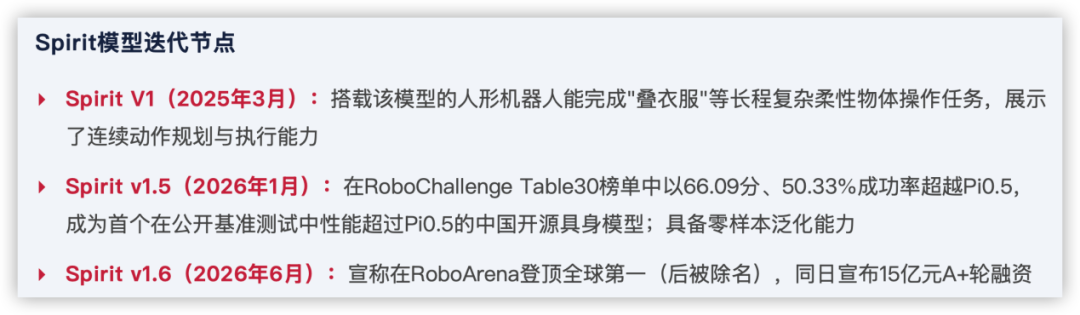
In March of the previous year, Qianxun released the Spirit v1 VLA model early access version and the full-power controlled humanoid robot Moz1 in June, equipped with its self-developed VLA model; in January 2026, it open-sourced the Spirit v1.5 model, and five months later, Spirit v1.6 topped RoboArena globally (before being removed).

Source: RoboArena Rankings
As humanoid robots begin shipping explosively, the industry is already discussing implementation issues in the embodied intelligence sector, but Han remains cautious. He explicitly stated that 2026 will not be the year of implementation or survival for the embodied industry but rather a year of rapid performance improvement for embodied models, with most efforts focused on models.
Only when embodied models achieve 70-80% task success rates through zero-shot learning can robots rapidly scale, with true large-scale implementation expected in the second half of 2027 to 2028.
AI capabilities depend on computing power, algorithms, and data. Data for large language models can be found on the internet, libraries, etc., so performance improvements rely on computing power infrastructure; however, in the physical AI world, robots must learn not from existing images and text but how to grasp a cup or correct failed actions—a data system that simply doesn't exist on the internet.
Thus, data is the decisive factor in physical AI.
Qianxun's 2026 goal is to collect 1 million hours of valid data, choosing a distinct technical route—its 'Data Pyramid' training philosophy and 'Dirty Data' strategy.
During pre-training, Qianxun avoided the high computing power consumption of traditional 'world model' frame-by-frame prediction, opting instead for pre-training based on massive existing human videos to reduce computing costs.
This forms its 'Data Pyramid,' with massive internet videos at the base (low-cost, high-coverage), interaction data from teleoperation and wearable devices in the middle, and high-precision data from real-world rollouts at the top.
The team proposed a counter-industry consensus 'Dirty Data' concept—'Dirty data is the key to scaling VLA models.'
The real world is inherently filled with unknown uncertainties, and deliberately retaining 'dirty data' such as failures, chaotic movements, and non-standard operations is more valuable than 'clean data.' Such training enables robots to behave more like humans and better adapt to the real world.
Focusing more on the brain also reflects Han's 'strategic resolve.' He believes that before resolving 'bottlenecks' in world models, efforts should focus on improving model capabilities; only after resolving these bottlenecks should speed be considered.
Because in Han's view, 'current models have the intelligence of a two- or three-year-old child.'

Early Stages
Simultaneously gaining recognition from world-class rating agencies and capital, Qianxun instantly became a rising star in the embodied intelligence sector.
RoboArena, launched by top universities like UC Berkeley and Stanford alongside AI giants like NVIDIA, is a global authority in general-purpose models for embodied robots, dubbed the 'Embodied Intelligence Olympics,' analogous to Chatbot Arena in the large language model field.
Qianxun's Spirit v1.6 surpassed leading models from NVIDIA Cosmos, Physical Intelligence, and others, generating significant buzz. Combined with its recent frequent financing, sources claim its valuation has approached 20 billion yuan.
RoboArena employs an open-registration distributed evaluation logic, allowing any institution to register as an evaluator. On June 14, RoboArena stated that after investigation, only 25 evaluations of Spirit v1.6 were valid post-rollback, failing to meet the 100-evaluation threshold for ranking. Ultimately, Spirit v1.6 was 'removed' from the official rankings.
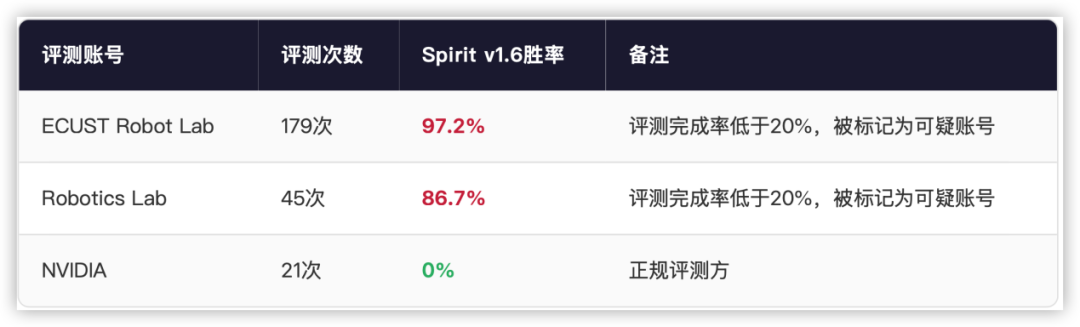
From topping the world rankings to being officially 'removed' took just 72 hours. Qianxun has yet to respond to this incident.
While the ranking evaluation itself had certain 'bugs,' this mishap also raised external doubts about Qianxun's technical capabilities.
Compared to the unexpected 'disqualification,' the departure of its core R&D personnel would undoubtedly alarm capital more. Reports indicate that Xie Junyuan, head of Qianxun's embodied intelligence department, resigned in April and had previously withdrawn from the shareholder list of Qianxun's subsidiary, Wanjing Qianxun.

Source: Tianyancha
In March 2025, Xie joined Qianxun from ByteDance as head of the embodied intelligence department, leading R&D and team-building for embodied large models. A graduate of the University of Science and Technology of China's Computer Science Department, he previously served as a core deep learning architect at Amazon and a senior AI expert at ByteDance.
Now, leaving after just one year will undoubtedly impact Qianxun. Sources suggest this AI prodigy hopes to focus on the small and medium-sized enterprise (SME) segment, promoting lightweight vertical model businesses, while the company prioritizes the 'general large model' path.
Currently, Qianxun has recruited Guo Junliang, a former senior researcher at Microsoft Research Asia, to lead its embodied models. Whether replacing the core R&D leader will affect model iteration remains uncertain.
At the commercialization level, Han remains calm. However, Unitree Technology shipped over 5,500 units last year and aims for 10,000-20,000 units this year; Zhiyuan Robotics secured over 10,000 new orders. While Qianxun collaborates with Bosch, JD Pharmacy, and CATL, large-scale implementation remains in the very early stages.
The embodied AI industry is currently trapped in a dilemma where 'Demos are stuck in showrooms.' Nevertheless, numerous investors and enthusiasts are eager to see these robots make progress in real-world applications—even though everyone understands that it is still too early for such expectations.
The lofty expectations from investors and the general public could potentially influence Han Fengtao's strategic determination. Once industry frontrunners such as Unitree and ZhiYuan solidify their scale advantages, the commercialization journey of QianXun Robotics will present a significant challenge.

In Conclusion
As we step into 2026, the hard technology sector in global capital markets is experiencing a period of intense excitement. Firms like Zhongji Xuchuang, Cambricon, and Zhipu have all soared to trillion-dollar market valuations, and investors are now on the lookout for the next big breakthrough.
The promising future of Physical AI has become a widely accepted notion within the artificial intelligence community. In this fervent climate, QianXun Robotics has managed to achieve remarkable growth in both financing and valuation.
Undoubtedly, the company has successfully 'earned its place at the table,' emerging as a key player representing Physical AI in the realm of embodied intelligence.
Han Fengtao has outlined an ambitious goal: to 'transform the company into a mid-sized entity before the major competitors fully penetrate the market, with a target of selling at least 100,000 robots annually.' It's evident that there's a substantial disparity between this vision and the present state of the industry.
Gao Yang once remarked that we (in the field of embodied AI) are currently at the 'Robot GPT-1' stage and may advance to stage 3.5 within the next four years. Yet, it is this very gap, coupled with the promising prospects ahead, that provides capital with even more incentive to make substantial early investments.
After all, at this pivotal moment when the trillion-dollar market is just beginning to unfold, no one wishes to be left in the dust.
-
![]()
Is Baidu Now Fostering Its Own 'Yao Shunyu'?
-
![]()
NVIDIA Goes Wild! DeepSeek V4 Inference Costs Slashed by 80%
-
![]()
Preparing for the 6G Era: US Completely Shuts Down 2G Networks, China Unicom Initiates Gradual Decommissioning of WCDMA 3G Networks
-
![]()
Mid-year 2026 Sales Review: Auto Market Shifts from Scale Expansion to Systemic Capabilities for Long-term Positioning
-
![]()
From the ARD Protocol, the Turning Point for the Agent Industry Has Arrived
-
Pinduoduo's Strategic Leap in Xiong'an: Beyond Investment, a Pledge to Flourish
-
Liang Wenfeng Has No Desire to Become Another Sam Altman
-
![]()
Revenue Soars, Losses Mount in Billions, Sales Stumble: Avatr's Hong Kong IPO Bid Amid Breakthroughs and Anxieties