Can Chinese AI Giants Bridge the Gap with Claude Code in the Agent Race?
 07/02 2026
 490
490
From Alibaba and Tencent to ByteDance, Kimi, MiniMax, and Zhipu.
Over the past six months, agent products exemplified by Claude Code/Cowork and Codex have unmistakably emerged as the most prominent trend across the entire AI industry.
On June 30, Anthropic discreetly unveiled Claude Science, an AI workbench tailored for scientists.
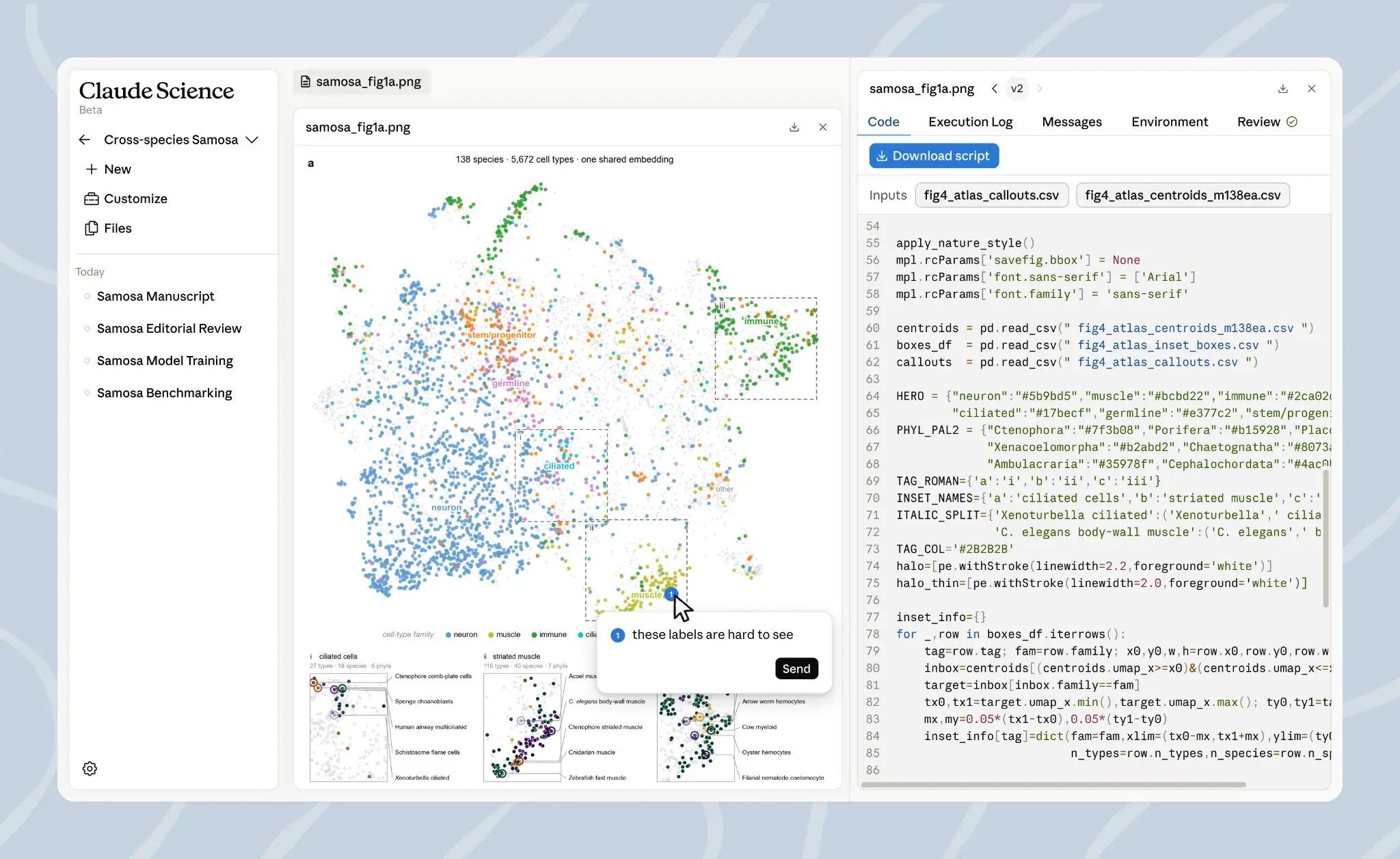
Image Source: Anthropic
Anthropic's strategy is becoming increasingly evident. Initially, it focused on coding tasks with Agents (Claude Code), then expanded to encompass various office tasks (Claude Cowork), and ultimately ventured into more intricate professional domains such as scientific research (Claude Science).
In reality, Anthropic observed that non-technical teams, including marketing and data teams, began utilizing Claude Code by bypassing the chat interface, leading to the graphical interface "encapsulation" of Claude Cowork.
Beyond the ongoing refinement of its underlying models, many may not be aware that domestic AI is also making strides in agent products. Alibaba, Tencent, ByteDance, Kimi, MiniMax, and Zhipu are all developing agents, generally following Anthropic's lead by distinguishing between Code and Work products, albeit with varying emphases.
So, before model capabilities fully surpass those of leading overseas products, can Chinese AI leverage cheaper, more open, and locally adapted agent products to encourage more domestic users to adopt the "I command, Agent works" work style? Leikeji AGI (ID: leikejiagi) examines this question.
Tencent WorkBuddy is arguably the most well-known domestic agent product, with many likely encountering its advertisements on WeChat and installing it during the "Lobster Craze." However, besides WorkBuddy, Tencent also offers CodeBuddy for developers, mirroring the functionality of Claude Cowork and Code.
Internally, Tencent has already utilized these tools for R&D and non-technical teams. Officially disclosed data indicates that CodeBuddy is used by over 95% of Tencent's engineers, while WorkBuddy facilitates mixed human-AI development, aiding small teams in iterating products more rapidly.
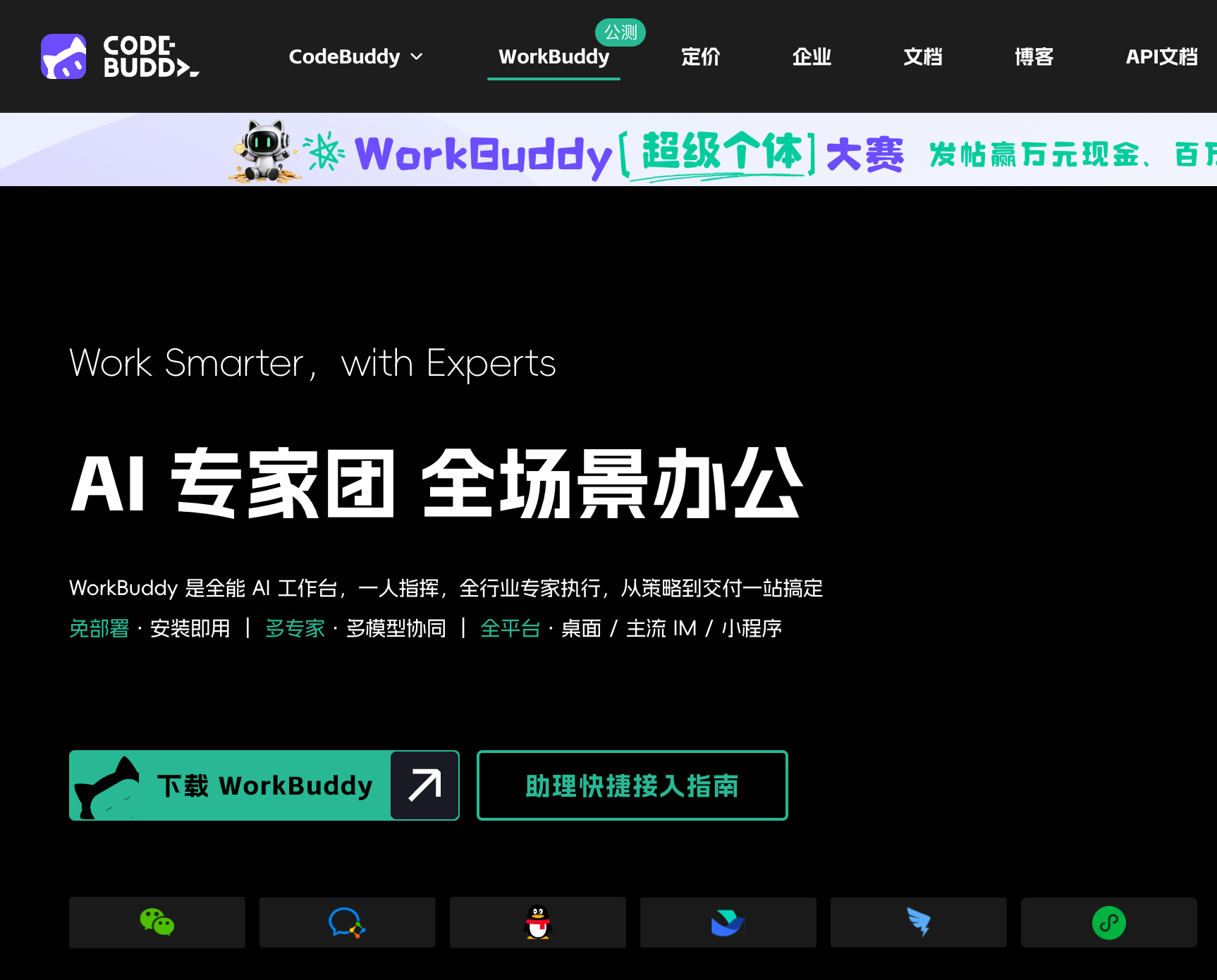
Image Source: Tencent
We won't delve into CodeBuddy here. Compared to code development, WorkBuddy targets a broader range of productivity scenarios, handling document processing, content organization, collaboration tasks, and general office needs.
Tencent's strength lies in this area. WorkBuddy can fully leverage Tencent Docs, Tencent Meeting, IMA Knowledge Base, Tencent Lexiang, and WeChat's ecosystem advantages.
Many individual users' materials, meeting minutes, to-dos, and communications are already dispersed across these platforms. Thus, a key reason many use WorkBuddy is its ability to directly capture daily "context" and then organize content, generate documents, and advance tasks within the platform.
Facing the agent wave, Moonshot AI is among the latest large model companies to launch corresponding products, also divided into Kimi Code and Work.
Kimi Code integrates into CLI and IDE, capable of reading and writing files, executing commands, searching code, fetching web content, and generating subagents for parallel tasks. Kimi Work targets local workflows, allowing mounting of local folders, browsing web pages via WebBridge, running Python, executing scheduled tasks, and requiring user confirmation before modifying files or running code.
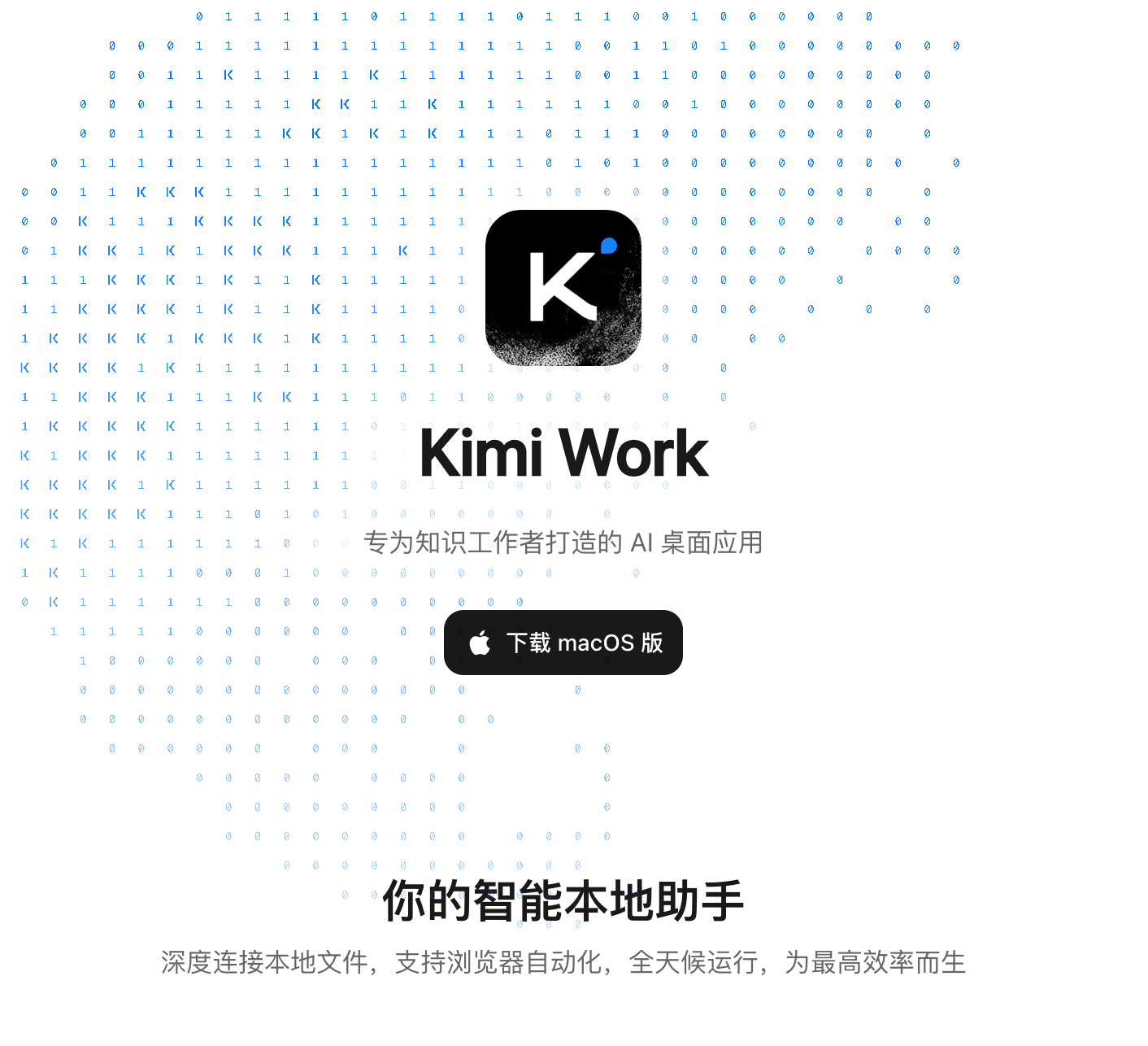
Image Source: Kimi
For a considerable time, Kimi has been recognized by ordinary users for its "long text" capabilities. Reading papers, financial reports, dozens of PDF pages, or organizing vast amounts of web material have always been Kimi's most user-perceptible strengths. At the agent stage, Kimi's natural progression is clear: not just reading materials to answer questions but continuing to assist users in processing files, running scripts, modifying code, and generating results.
If Claude Code and Codex excel at closed-loop code tasks, Kimi's more noteworthy aspect is its attempt to transform "long text reading" advantages into "long-task" advantages. Meanwhile, in both Kimi Code and Work, agent clusters are an unavoidable design. According to officials, when facing complex problems, Kimi can automatically coordinate multiple specialized agents, simultaneously decomposing and solving multi-layered tasks.
Additionally, to attract financial users, Kimi Work has pre-integrated deep data sources for A-shares, Hong Kong stocks, and US stocks. These, arguably, constitute the differentiated experience of Kimi Code and Work.
Alibaba Qoder stands out somewhat uniquely. It's not a new product built from scratch but evolved from an AI IDE product (Tongyi Lingma) through several iterations into a new agent product, spawning a series including Qoder Desktop, QoderWork, QoderWake, Qoder CLI, and Cloud Agents.
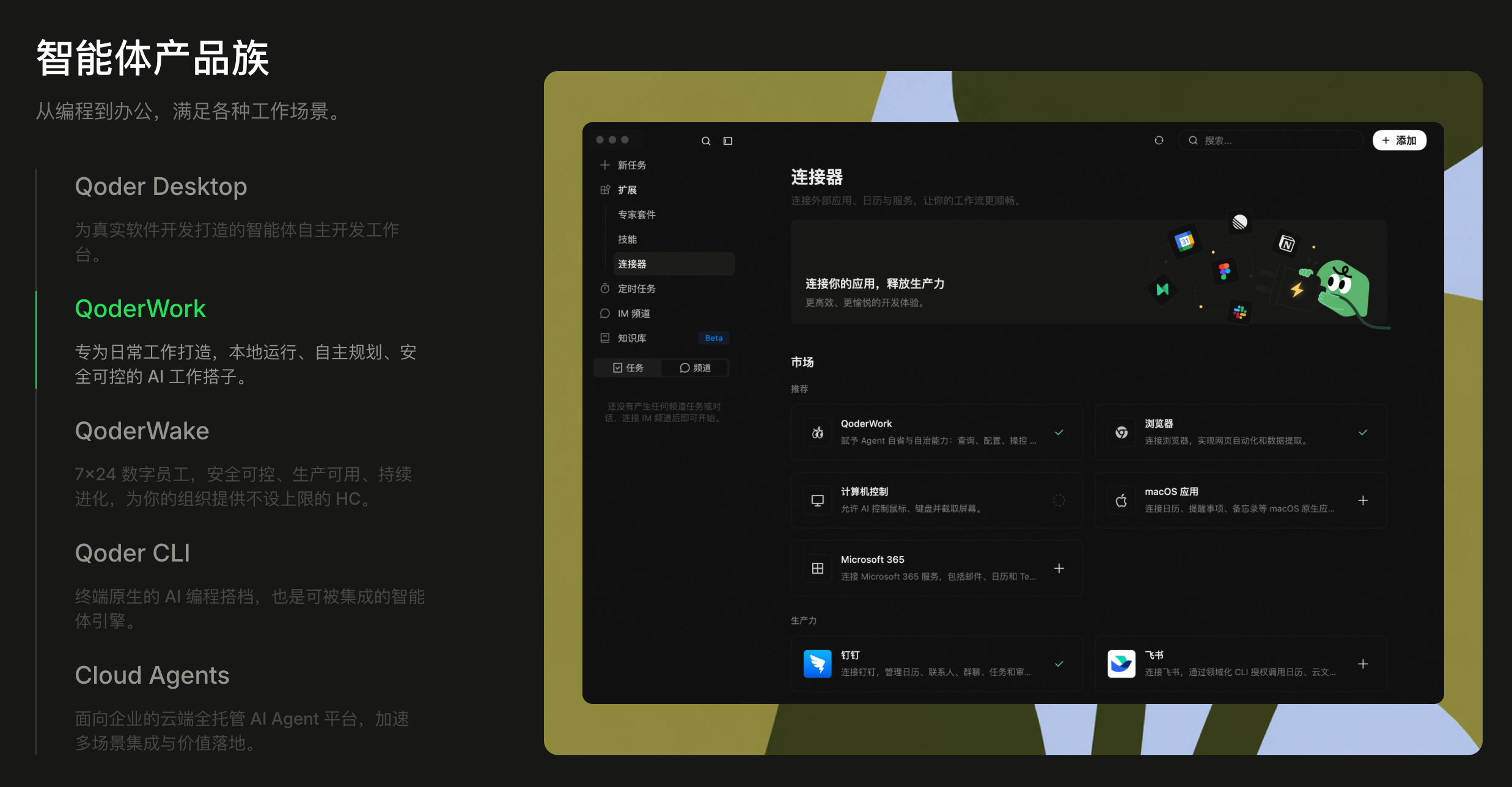
Image Source: Alibaba Qoder
The core remains Qoder Desktop and QoderWork. Qoder Desktop targets software development scenarios, akin to Claude Code. QoderWork targets daily work, handling file organization, data processing, document generation, browser automation, desktop control, and scheduled tasks—positioning it close to Claude Cowork.
QoderWork extends agent capabilities from coding to general work. As a desktop-end intelligent work assistant, QoderWork can complete file organization, data processing, and document generation via natural language, connect office tools, control browsers and computers, and support scheduled tasks, suitable for repetitive yet crucial tasks like daily data pulling, weekly reporting, and monthly material organization.
From a product design perspective, besides a "general" mode, QoderWork offers specialized "design," "slideshow," and "writing" modes, clearly emphasizing actual user scenarios. However, beyond this, no significant unique strengths have been observed yet.
Like the previous companies, MiniMax launched two products: MiniMax Code and MiniMax Agent. Notably, with the June release of its new large model MiniMax M3, MiniMax Code underwent a major update. According to officials, it's an agent product designed specifically for M3 and trained alongside it.
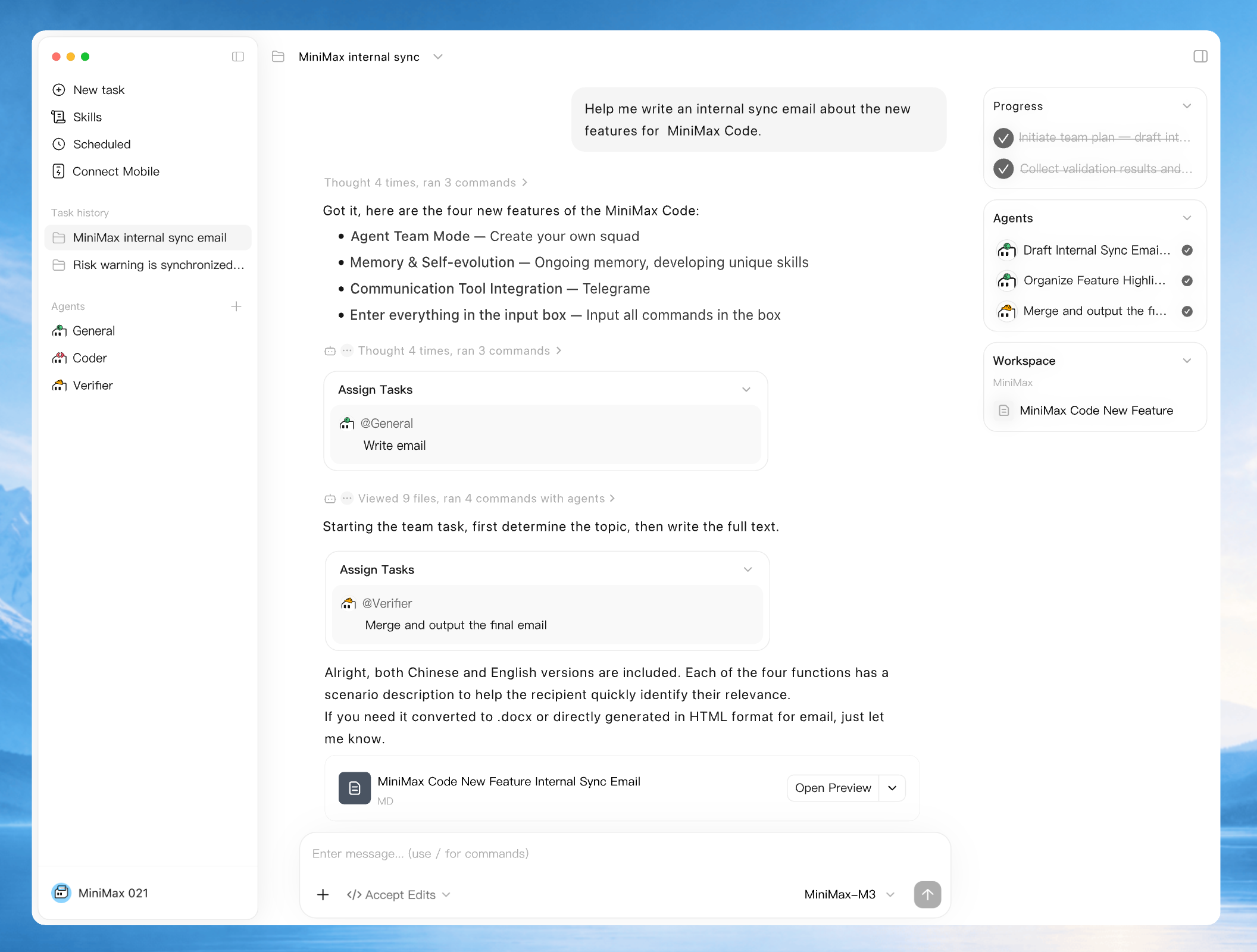
Image Source: MiniMax
Simply put, MiniMax Code fully leverages M3's capabilities in long context, Coding/Agentic, and native multimodality, making it the top agent choice for MiniMax-M3. For long tasks, MiniMax Code breaks tasks into Workflows, with agent clusters collaborating, autonomously running through Producer + Verifier adversarial Harness loops.
Indeed, Claude Code also introduced a similar strategy called Dynamic Workflows, but MiniMax Code focuses more on "deep reflection and continuous error correction." The agent adjusts plans and priorities in real-time based on task progress, and users can intervene anytime to add requirements or correct directions.
As for MiniMax Agent, it actually attempted long tasks earlier, launching Mavis mode in its May update, utilizing multi-agent collaboration, including a design similar to Codex's ability to intervene in agent thinking and work anytime—essentially a preview before June's MiniMax M3 release and MiniMax Code update.
However, it's worth noting that this path is most prone to discrepancies between demos and real experiences. Long context doesn't equate to true global understanding, and multi-agent collaboration doesn't guarantee more stable results. The more roles and longer the chain, any deviation at any step can amplify into errors.
Strictly speaking, TRAE (SOLO) initially gained recognition as an AI IDE, competing with development tools like Cursor and Claude Code. However, its recent upgrade to TRAE Work has pushed boundaries further, with an official positioning that's straightforward: not just coding.
According to the official introduction, TRAE Work offers multi-endpoint access via Web, Desktop, and Mobile, accommodating both local and cloud tasks without relying on TRAE IDE to run. After initiating a task on the desktop, the agent can continue running in the cloud or locally, with multiple tasks progressing in parallel. After leaving the computer, users can still check progress, review results, and adjust directions on their phones.
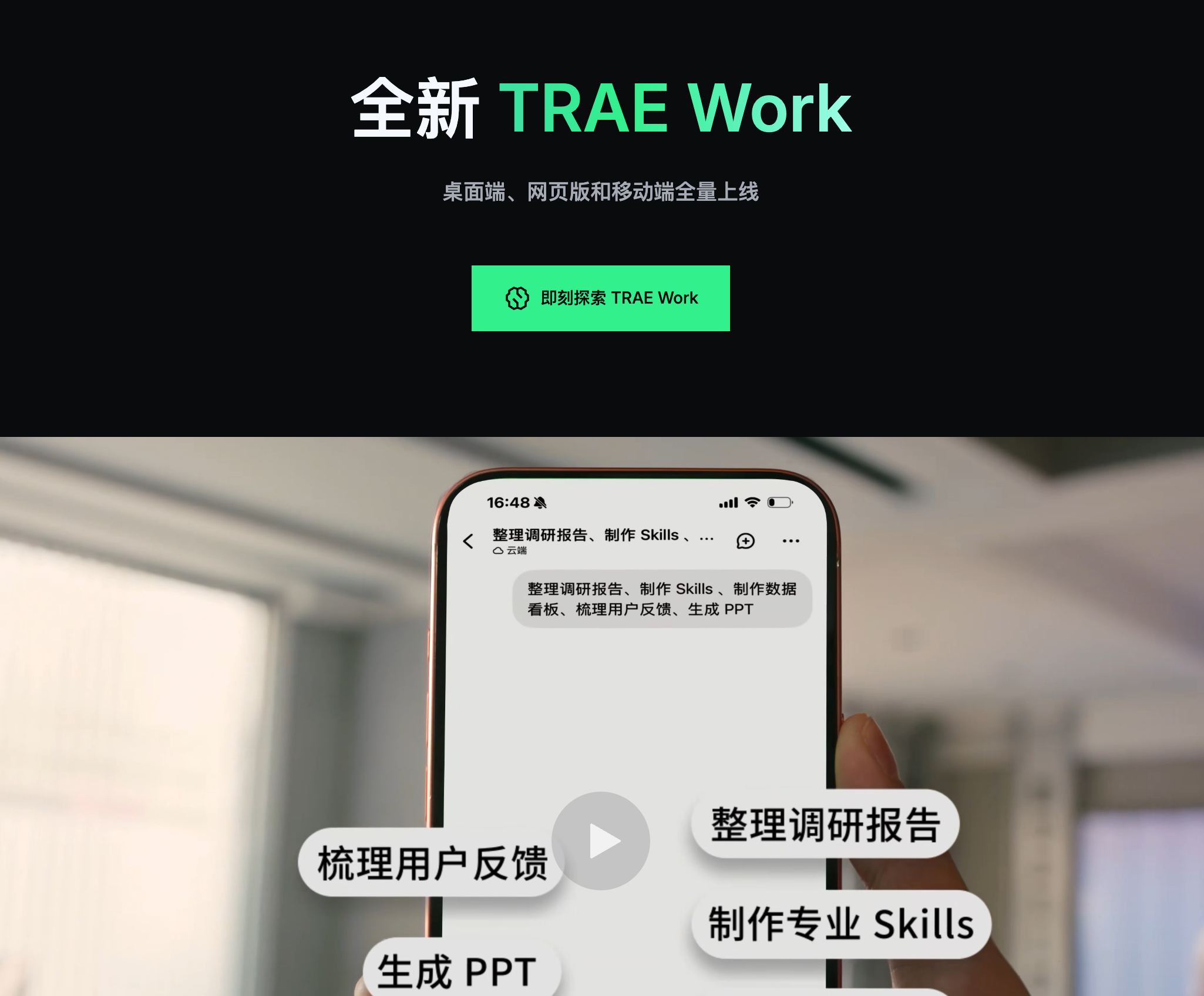
Image Source: ByteDance TRAE
Additionally, TRAE Work is divided into Work and Code modes, which can be seen as ByteDance's version of Codex, combining Code and Work agent products into one. The Code mode continues handling development tasks, while the Work mode targets more general work scenarios, such as data organization, project advancement, web operations, file processing, and content generation. The difference is that Codex truly combines them, whereas TRAE Work operates in two modes, requiring separate entry points.
This approach is very ByteDance. Unlike Tencent WorkBuddy, which leverages WeChat, Docs, and Meetings for ecological context, TRAE Work functions more as an efficiency gateway for individuals and small teams. It doesn't necessarily require users to enter an office ecosystem first but instead makes "tasks" the core unit: you just hand over your requirements, and it handles decomposition, execution, and progress feedback, with users able to intervene anytime.
Another noteworthy move by TRAE is open-sourcing Trae Agent. According to its GitHub page, Trae Agent is an LLM Agent toolkit for software engineering tasks, supporting file editing, bash execution, structured thinking, and task completion, as well as integrating with various model providers.
Compared to others, Zhipu's approach is more focused. It hasn't rushed to position itself as a general-purpose office agent but instead explicitly targets developer scenarios first, launching Zhipu ZCode. However, like Kimi and MiniMax, it aims at the challenges and scenarios of long tasks. This differs from many domestic agent products' strategies. Tencent, Alibaba, Kimi, and ByteDance all pursue both Code and Work lines.
Notably, when Zhipu released the industry-impressive GLM-5.2 last month, it also upgraded ZCode 3.0, fully switching to its self-developed ZCode Agent kernel and deeply adapting it to GLM-5.2, optimizing for long reasoning, tool invocation, and large-scale engineering execution chains.
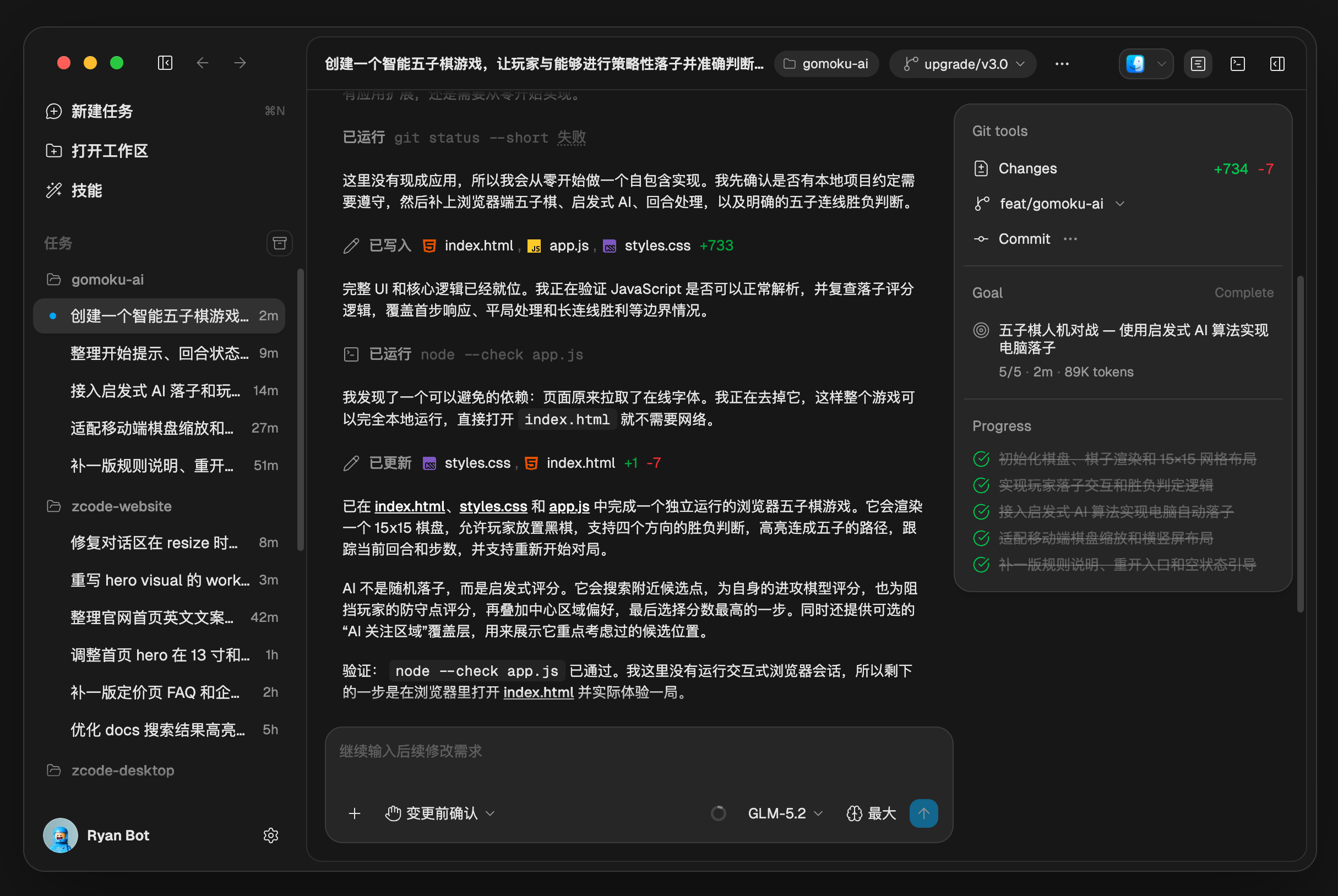
Image Source: Zhipu
ZCode 3.0 also introduced enhancements around the actual development experience, such as grouped task workspaces, Zread project knowledge bases, and visual Git branch graphs. These may not sound as flashy as multi-agent collaboration or long context, but they relate to Code Agent stability: for an agent to take over an engineering task, it must first understand the project, remember the context, and let users clearly see what it changed and where it stands.
The advantage of this path is clear goals, but the drawback is also evident. ZCode's user base won't initially be as large as WorkBuddy or TRAE Work, and its imagination space is more concentrated in developer scenarios. However, if it can truly run stably on complex codebases, long tasks, and engineering validations, it may more easily build trust among professional users.
Viewing these products together, domestic agents are not simply replacing Claude Code, Claude Cowork, and Codex in the same way.
Ali Qoder, ByteDance TRAE, and Tencent Buddy series—big companies are all learning from Anthropic and OpenAI in Code + Work, but their product paths and focuses are clearly different. As the large model startups that survived the 'Hundred Models War,' Kimi, MiniMax, and Zhipu all place greater emphasis on technological advantages, attempting to tackle 'long-term tasks,' a necessary path for agents, while also emphasizing vertical integration from models to agents.
However, when it comes down to it, domestic agents are not just chasing a single product like Claude Code, Claude Cowork, or Codex; they are pursuing a whole new way of working: users no longer just ask AI a single question but instead entrust an entire task to AI, then review, correct, take over, and continue to direct the process.
Compared to overseas products, the advantage of domestic agents is primarily their closer alignment with local workflows.
Claude Code, Claude Cowork, and Codex have higher product maturity and stronger developer mindshare, but they are, after all, more centered around the software ecosystems, office environments, and subscription systems of overseas users. The tools and systems used daily by domestic users are often WeChat, Tencent Meeting, Tencent Docs, DingTalk, Feishu, local files, domestic models, and internal enterprise knowledge bases. If an agent cannot handle these contexts, no matter how powerful it is, it will likely remain stuck in the demonstration and novelty phase.
This is also the opportunity for WorkBuddy, QoderWork, and TRAE Work. They may not necessarily be smarter than Claude Cowork from the start, but if they can seamlessly integrate into the office, communication, and file environments already familiar to domestic users, they have the chance to first increase usage frequency.
On the other hand, domestic agents are generally more willing to integrate with different models and more open to allowing developers and enterprises to modify their capabilities.
For individual users, this means the ability to switch between effectiveness and cost; for enterprises, it means the ability to connect their own tools, permissions, data, and business processes. An agent is not just a simple chat product; it inherently needs to connect with tools, files, systems, and workflows. The deeper it goes into real business operations, the more important this controllability becomes.
In summary, domestic agents are not lacking in direction—Code, Work, Multi-Agent, Long Context, Desktop Workspace, Cloud Tasks, Enterprise Collaboration. What really matters next is who can stably complete more real-world tasks.
Users may open an agent for the first time out of curiosity. But if they are willing to open it again on the second and third days, it must be because it truly saves them effort.
Ali, Tencent, ByteDance, Kimi, Zhipu
Source: Leikeji
Images in this article are from: 123RF Licensed Image Library Source: Leikeji
-
![]()
Preparing for the 6G Era: US Completely Shuts Down 2G Networks, China Unicom Initiates Gradual Decommissioning of WCDMA 3G Networks
-
![]()
Mid-year 2026 Sales Review: Auto Market Shifts from Scale Expansion to Systemic Capabilities for Long-term Positioning
-
![]()
From the ARD Protocol, the Turning Point for the Agent Industry Has Arrived
-
Pinduoduo's Strategic Leap in Xiong'an: Beyond Investment, a Pledge to Flourish
-
Liang Wenfeng Has No Desire to Become Another Sam Altman
-
![]()
Revenue Soars, Losses Mount in Billions, Sales Stumble: Avatr's Hong Kong IPO Bid Amid Breakthroughs and Anxieties
-
![]()
Breaking Industry Records in Financing Speed, the Dark Horse of Embodied AI Rides the Wave of Enthusiasm | Gechao
-
![]()
Pix Exclusive | Mercedes-Benz China Establishes GTM Department to Avoid Repeating CLA's Mistakes