My Mother Thought She Was Dying After Self-Diagnosing with AI Due to a Fracture
 07/02 2026
 328
328
AI can exacerbate ignorance, and this is not merely a hypothetical threat. According to the latest data from the National Bureau of Statistics in 2026, the total population in China with a cultural level below junior high school currently stands at 790 million. This is undoubtedly a challenge for the majority, not just a minority. AI companies must cater not only to the elite but also take into account the discriminative abilities of users with lower educational levels.
I write this article with a mixture of anger and exhaustion.
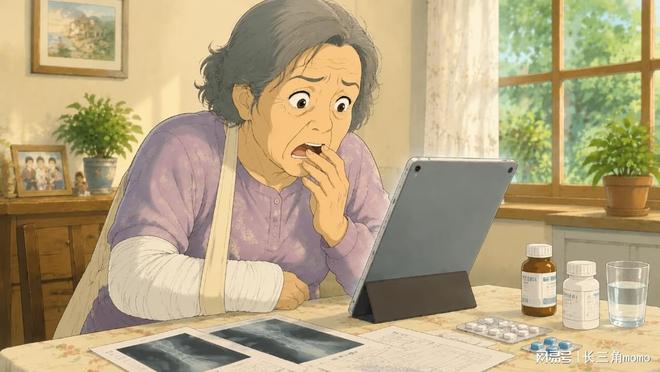
A woman in her sixties, whose arm fracture was not healing properly, eventually turned to AI for self-diagnosis and concluded that she was on the verge of death. She informed her family to prepare for her funeral. How could a simple fracture escalate into a life-threatening condition? Such is the "magic" of AI.
Because AI had shattered this woman's heart.
This is not a tale from someone else's life; this woman is my mother.
Three months ago, my mother accidentally fractured her arm and kept it a secret from me. Over the next two months, her bone failed to heal. An X-ray later revealed the issue—it was healing too slowly. After a hospital examination, she discovered she had severe osteoporosis.
Upon realizing she had a problem, she began using AI for self-diagnosis. She sent all her test data and symptoms to AI and received various alarming results. Consequently, a person who could originally sit and play mahjong for eight hours straight without fatigue started staying in bed, complaining of back pain, waist pain, being unable to sit up, and experiencing difficulty breathing all day.
AI told her that her bone condition was equivalent to that of a 130-year-old and that she would crumble at the slightest touch. However, she overlooked one crucial point: where did the data for a 130-year-old person come from?
Her ultimate conclusion was that her osteoporosis was caused by renal tubular phosphorus leakage, with her kidneys continuously losing phosphorus and no cure available. She would require lifelong maintenance therapy to stabilize blood phosphorus levels, ensure normal bone mineralization, and prevent bone pain, fractures, and deformities. She even identified the medications she should take and informed me that she would need to continuously use a new targeted drug, Burosumab.
As an individual with independent thinking abilities, I naturally did not believe AI's diagnosis. I also input her data and symptoms into AI myself and discovered that this was just one of the possible causes for her osteoporosis, and it was the worst-case scenario. But she was willing to believe that this was her condition.
With her stubbornness, she communicated with doctors at various hospitals and with her family. No one else understood, so now she had to use this logic to communicate directly with the doctors. As I watched her guide the doctors like an expert, I found it both pitiful and ridiculous.
The result of this strong psychological suggestion was that she began to exhibit symptoms matching AI's diagnosis. Eventually, she started calling my aunts who were far away in our hometown to settle her affairs, believing that she would not survive this time and was terminally ill.
I also vaguely sensed something was amiss because the consequences of a person's heart being shattered are severe. Her long-term self-intimidation led to depression, causing her to sleep all day, have a reversed day-night cycle, lose her appetite, and her physical condition worsened. If no intervention was made, she might truly collapse in the end.
Therefore, I almost used all the connections around me to find orthopedic and endocrinology doctors from major hospitals across the country to examine her data. After understanding the details, all the doctors reached the same conclusion: severe osteoporosis, slow bone healing, and malnutrition caused by long-term anxiety. The most urgent issue now was to address her mental state, make the patient feel better, eat well, sleep well, exercise more during the day, and take some vitamin D and calcium supplements. She would gradually heal afterward.
Thus, I knew the approach to take. This was not a physical ailment but a mental one. As her child, I needed to invest more time in companionship and explanation to counteract the negative emotions caused by AI. I needed to make her understand again that her body was fine and that she should live a positive and sunny life.
This is a thought-provoking issue. AI's ability to influence the minds of ordinary people is far greater than we imagine.
If short videos have already formatted human brains once, then AI is formatting them a second time. AI will guide many people with low cognitive abilities in their lives, work, and even interpersonal relationships.
However, the problem arises: AI can tell you everything and give you many suggestions, but it takes no responsibility for you.
In this world, human brains can be divided into two types: one possesses independent consciousness and a questioning spirit, while the other is prone to belief and has weak discriminative abilities. After AI lists various possibilities, the former can often find the correct path among the clues, while the latter will get lost and find the wrong path.
For example, there have been many tragic cases of misguidance in AI medical consultations. The recent case of soaking fingers in saltwater is still fresh in our minds. I believe this has become an ethical issue, similar to intelligent driving. This matter concerns people's health and even their lives, and answers should not be provided casually in the current manner.
Yes, AI makes independent thinkers smarter but makes the ignorant even more ignorant.
Tencent has always advocated that technology should be for good. I believe this applies to all AI companies. You are undertaking the most important cognitive migration in human history. In this process, you must consider the judgment and adaptability of vulnerable groups.
A casual answer from AI may destroy a person, a family, and crush the spirit of an ignorant individual.
In our physical world, the most feared thing is the nuclear bomb. However, in our mental world, the power of AI is no less formidable than that of a nuclear bomb.
I originally wanted to name and scold a specific company, but I think that would be unfair. In fact, everyone is more or less the same. It's just that the story I'm about to tell happened to involve the product of this company. Therefore, I am accusing most of the AI large model software on the market now.
According to the latest data from the National Bureau of Statistics in 2026, the total population in China with a cultural level below junior high school currently stands at 790 million. This is undoubtedly a challenge for the majority, not just a minority. AI companies must cater not only to the elite but also take into account the lives of users with lower educational levels.
Short videos have already wreaked havoc on the world once. Is AI going to continue wreaking havoc?
Without 100% certainty, I hope AI will guide the weak to seek answers from professionals rather than directly providing an irresponsible yet definitive AI answer.
Big companies are clever and will shirk legal responsibility in ways you can't see. However, in human society, conscience is always there. When conscience is lost to a certain extent, there will naturally be backlash.
And responsibility is the foundation of technology for good and the foundation of a great company.
-
![]()
Is Baidu Now Fostering Its Own 'Yao Shunyu'?
-
![]()
NVIDIA Goes Wild! DeepSeek V4 Inference Costs Slashed by 80%
-
![]()
Preparing for the 6G Era: US Completely Shuts Down 2G Networks, China Unicom Initiates Gradual Decommissioning of WCDMA 3G Networks
-
![]()
Mid-year 2026 Sales Review: Auto Market Shifts from Scale Expansion to Systemic Capabilities for Long-term Positioning
-
![]()
From the ARD Protocol, the Turning Point for the Agent Industry Has Arrived
-
Pinduoduo's Strategic Leap in Xiong'an: Beyond Investment, a Pledge to Flourish
-
Liang Wenfeng Has No Desire to Become Another Sam Altman
-
![]()
Revenue Soars, Losses Mount in Billions, Sales Stumble: Avatr's Hong Kong IPO Bid Amid Breakthroughs and Anxieties