Mass Production of Embodied AI Approaches, Competition Heats Up in Core Infrastructure
 07/17 2026
 334
334
By Xiang Ling Shuo
At WAIC 2026, humanoid robots remain the most eye-catching exhibits. However, industry insiders have shifted their discussions from 'Can it do backflips? Can it grasp objects?' to a new context—Can it run continuously for 24 hours? Can it repeat actions 10,000 times? Can it achieve the required yield rates on production lines?
The era of showcasing technical prowess has ended. Players in the field now face a new script with two bold words on the cover: Mass Production.
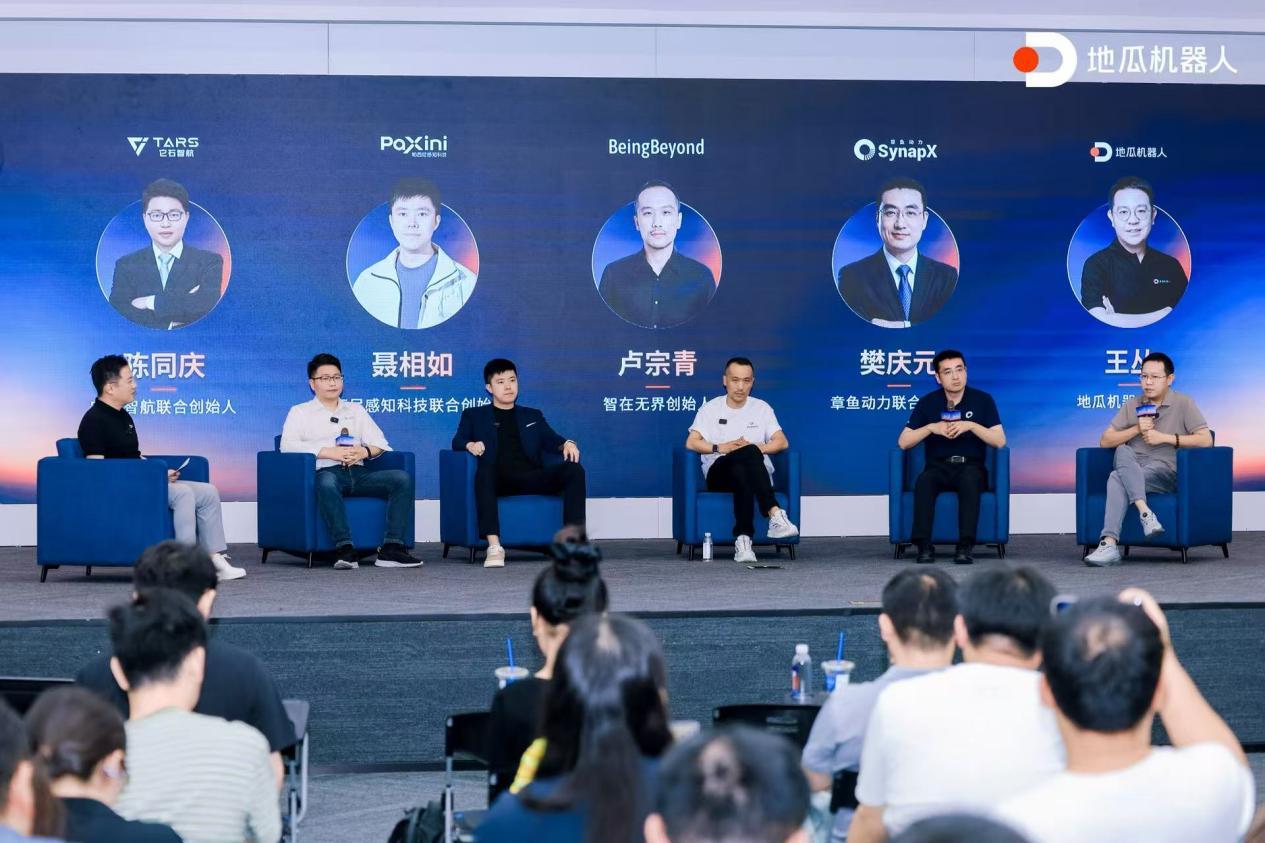
Just one day before WAIC opened, Diguabot held a low-key media briefing.
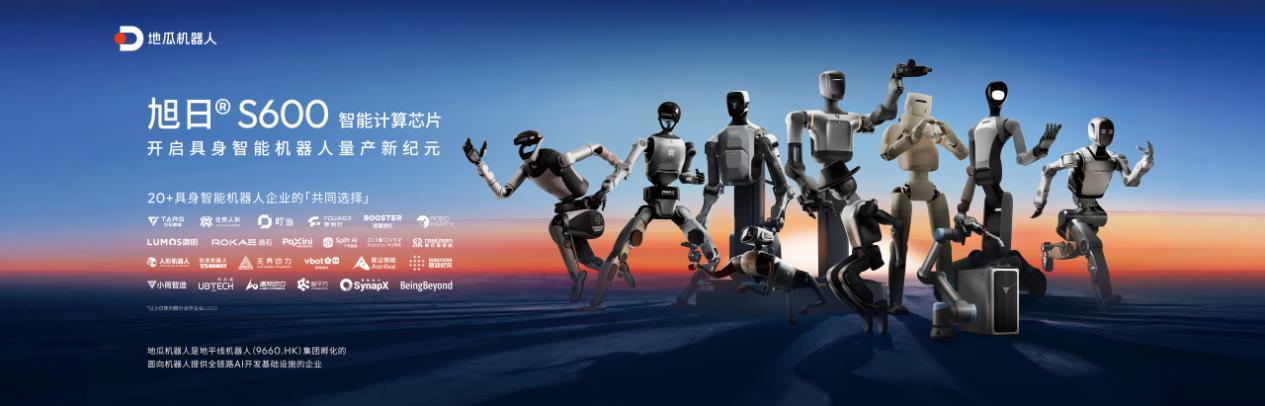
Diguabot neither builds complete humanoid robots nor robotic dogs. Instead, its Sunrise S600 computing platform has already secured collaborations with over twenty leading clients, covering nearly all mainstream sectors including humanoids, industrial embodied AI, and large models.
Its mission is straightforward: to provide a universal industrial-grade brain foundation for all robots, bridge gaps across chips, toolchains, and supply chains, and propel the entire industry from lab demos to mass production of thousands or even millions of units.
While this may sound less glamorous, it precisely addresses the most critical pain points in today's embodied AI industry.
From Showcasing Strength to Calculating ROI: The Industry Reaches an Inflection Point
2026 marks the first year of mass production for embodied AI—not due to a sudden technological breakthrough, but because the industry's evaluation criteria have fundamentally changed.
Previously, robotics projects could secure funding by showcasing a single successful experiment in a video. Now, clients' first questions are: What's the failure rate? What's the cycle time? How long is the ROI period? When can mass production begin? Can you ensure stable delivery?
These questions eliminate most demo-stage projects.
The journey from lab-verified demos to mass production involves three insurmountable challenges: model deployment at the edge, coordination of computing power between 'large' and 'small' brains, and supply chain integration.
The gaps between these challenges are far wider than most imagine.
The first hurdle is model deployment.
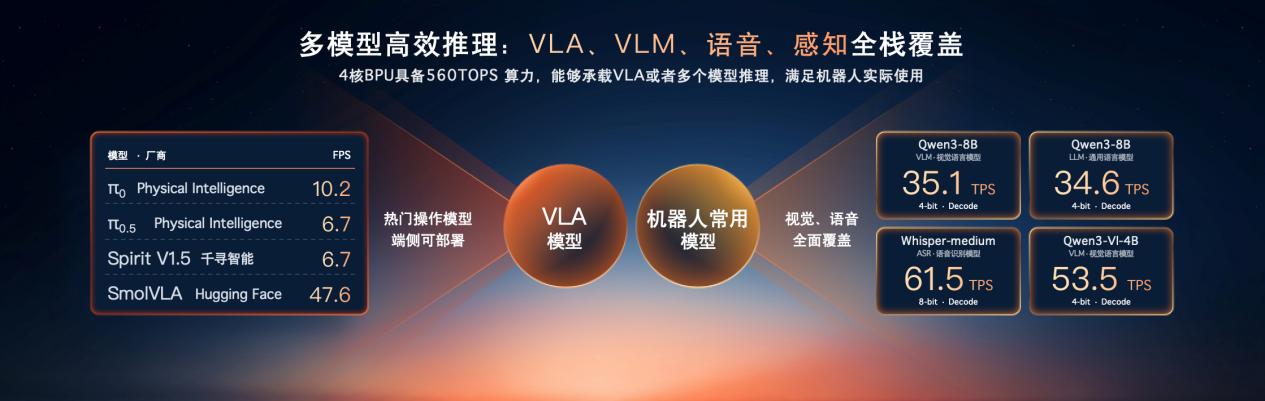
The industry now heavily discusses VLA models, recognizing that large models can bring general capabilities to robots. However, real-world implementation immediately collides with practical barriers.
Running models in the cloud introduces unresolvable issues like network latency and jitter. In industrial settings, millisecond-level delays can cause operational failures, potentially halting entire production lines and requiring redeployment. Running models at the edge faces constraints in power consumption, cost, and bandwidth.
Deploying trained large models requires quantization, adaptation, and optimization—a workload comparable to training the model itself.
The second challenge lies in the complexity of computing systems.
Robots don't rely on a single large model; they must simultaneously process data from multiple cameras and sensors, control dozens of joint motors with precision, and perform real-time path planning and anomaly handling. Perception, decision-making, and motion control each operate as separate systems.
Many previous solutions used multi-chip configurations, which were costly and plagued by communication delays and synchronization instability between systems. In mass production, every additional component introduces a potential failure point.
The third and often overlooked challenge is consistency in mass production.
For ten prototypes, engineers can fine-tune parameters individually. For a thousand units, every PCB, interface, and component batch must ensure consistent performance while passing comprehensive reliability tests for temperature extremes, vibration, and shock. They must also maintain long-term operation under varying conditions.
There are no shortcuts—this relies entirely on supply chain collaboration and accumulated engineering expertise.
These three challenges create an awkward situation: Algorithm companies possess model capabilities but lack hardware mass production expertise; hardware companies can build bodies but struggle with edge-side large models; complete machine companies face supply chain and reliability hurdles from scratch.
The entire industry is navigating uncharted waters, with each company reinventing the wheel. Diguabot sees opportunity here.
Rather than competing in the complete machine race, it aims to be the 'shovel seller'—refining the most universal, foundational, and engineering-intensive components into standardized platforms, enabling all partners to move forward lightly equipped.
This positioning sounds familiar. Before the smartphone boom, Qualcomm played this role. Before autonomous driving matured, Horizon Robotics followed a similar path. History often repeats itself in similar rhythms.
An Industrial-Grade Brain Involves More Than Stacking Computing Power
The Sunrise S600 took center stage at the briefing, boasting 560 TOPS of AI computing power. However, viewing it merely as a high-compute chip misses its design logic entirely.
Many vendors in the embodied computing space focus on stacking TOPS figures.
In real-world scenarios, how much of that theoretical computing power can be realized is another matter entirely. Robots don't run benchmarking software but complex collaborative systems. Whether computing power can be fully utilized, whether latency can be minimized, and whether power consumption can be controlled all depend on architectural design and software-hardware synergy.
Diguabot's confidence comes from its third-generation BPU Nash architecture. This architecture is deeply optimized for Transformer operators, achieving over 27x acceleration for Transformer networks compared to its initial architecture. This matters because mainstream VLA and VLM models are based on Transformer architectures—native optimization at the architectural level is far more efficient than simply stacking compute units.
More critically, its single-chip full-stack design integrates a quad-core BPU, octa-core CPU, and hexa-core real-time control MCU within one chip. Large model inference, environmental perception, task scheduling, and motion control all occur on this single chip.
The value of this becomes clear in mass production scenarios. Multi-chip solutions struggle with cross-chip data transmission, leading to latency and stability issues. Single-chip designs eliminate external communication overhead, improving control precision and response speed while simplifying hardware architecture, reducing BOM costs, and lowering failure probabilities.
For mass production, simplification itself enhances reliability.
Looking deeper, hardware parameters are just the foundation. What truly matters is mass production-grade reliability design. Few notice that the Sunrise S600's core module supports wide temperature operation from -40°C to 105°C and has passed 11 reliability verifications. These specs seem extreme for consumer products but are ideal for robots.
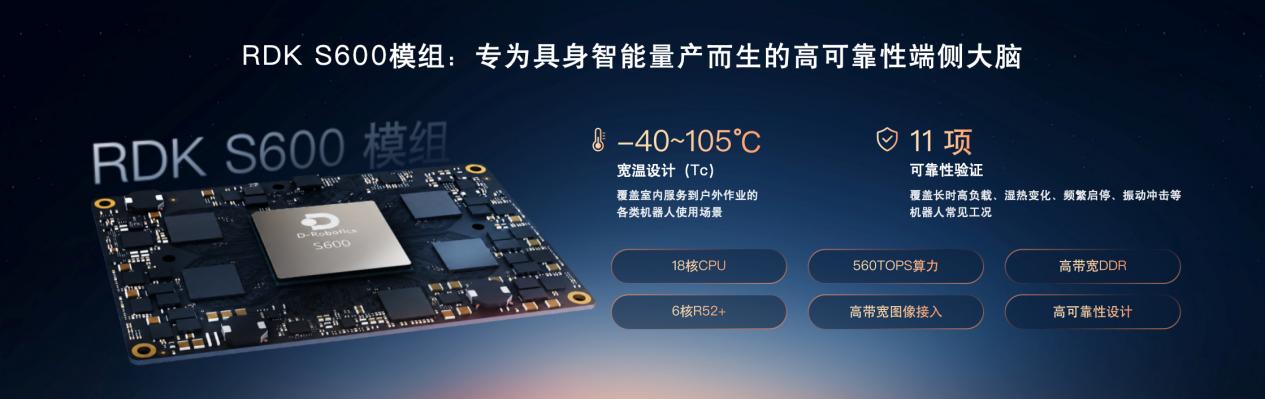
Humanoid robots typically house computing modules in their chest cavity, where motors and batteries generate significant heat, easily exceeding 80°C internally. Industrial robots operate in hot factory environments under continuous heavy loads. If chips can only function at room temperature, they'll throttle or crash in real-world conditions, rendering high computing power meaningless.
Beyond hardware, Diguabot pre-installs a comprehensive set of foundational algorithms in its chips. From omnidirectional environmental perception and multi-camera visual localization to pure vision-based operation control and bipedal motion control, the four core functions robots need for operation are ready-made.
Clients don't need to develop basic algorithms from scratch but can directly build scenario-specific functions on top. It's like developing smartphones without writing camera algorithms or using automotive chips without coding navigation bottom layer (bottom-layer) systems. By precipitate ( precipitate ) General ability into foundational platforms and letting upper-layer companies focus on differentiation, this embodies the core value of platform-based products.
An interesting observation emerges: Many believe the core competitiveness (competitive edge) of embodied AI lies in models and algorithms, but as mass production nears, it becomes clear that algorithms are just one piece. Hardware reliability, toolchain maturity, and supply chain stability—these less glamorous engineering capabilities ultimately determine whether products can succeed in the market.
True Barriers Don't Appear on Spec Sheets
If Diguabot merely sold chips, it wouldn't differ fundamentally from other computing vendors. Its true differentiation lies in the ecosystem and toolchains beyond the chip, along with its industrial collaboration capabilities.
Anyone experienced in chip deployment understands a simple truth: Customers don't just buy chips but the ability to rapidly implement their business use cases on top. Toolchain usability, technical support responsiveness, and resource availability determine selection.
At the briefing, Diguabot officially open-sourced Moss™ Agent Engine. Simply put, this uses AI to develop AI robots.
Traditionally, developing robot functions required professional engineers to write code, tune parameters, and debug errors—a simple grasping function might take weeks. Now, through the Moss framework, developers can issue natural language commands, and the system automatically handles target recognition, path planning, and motion debugging. Development cycles shrink from months to weeks, achieving order-of-magnitude efficiency gains.
This relies on a complete cloud-edge-device collaborative development system. The cloud-based RoboGo platform handles data generation, model training, and quantization deployment. The PC-based RDK Studio manages hardware connections and application debugging. The edge-side Moss Agent executes and provides feedback. Together, they form a closed loop that reconstructs the entire development workflow.
The long-term impact is greater than imagined.
One of the biggest bottlenecks in embodied AI is talent—engineers who understand both robotics and AI while mastering edge optimization are extremely rare. Lowering development thresholds with AI tools essentially expands the industry's talent pool. When more people can participate, the industry's iteration speed will truly accelerate.
At the supply chain level, Diguabot has also partnered with over 100 chain companies covering sensors, actuators, controllers, and contract manufacturers. Most notably, several automotive Tier 1 suppliers have joined.
The automotive industry has decades of experience in large-scale manufacturing, with far deeper accumulation in functional safety, quality control, and supply chain management than the robotics industry. Introducing automotive-grade controller solutions, mass production standards, and manufacturing expertise to robotics effectively elevates the entire industry's mass production capabilities.
Clients adopting the Sunrise S600 platform no longer need to negotiate with suppliers individually or handle adaptations—they can directly select mature solutions from the ecosystem.
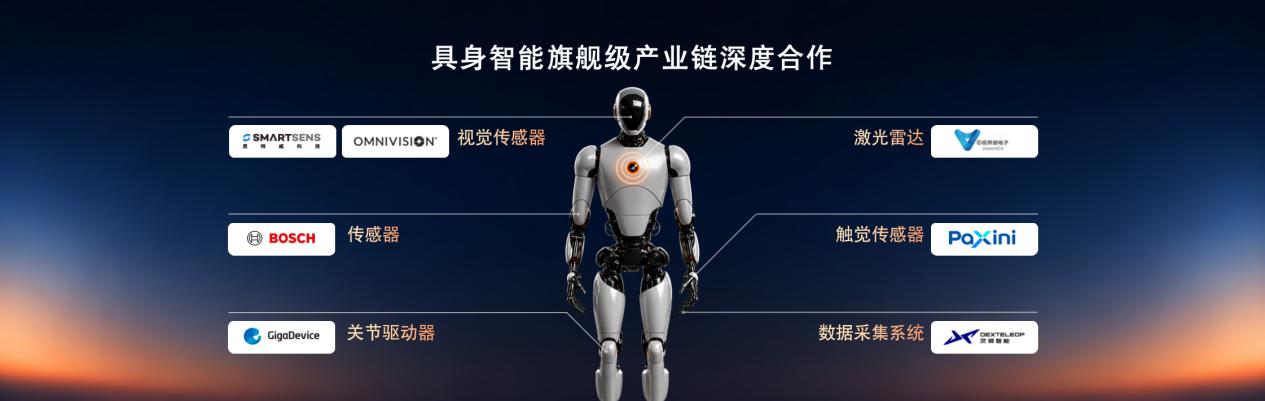
When discussing chip barriers, people often focus on architecture, process nodes, and computing power figures. However, those with industrial experience understand that early collaboration with clients, early resolution of mass production issues, and early supply chain integration create advantages far harder to overcome than paper specifications.
As Diguabot CEO Wang Cong noted in a group interview, all barriers are ultimately relative. Technical advantages expire quickly. Only demand understanding, engineering experience, and supply chain relationships accumulated through real projects generate compounding returns over time.
Someone Must Navigate the Mass Production Minefield First
Of course, it's premature to declare victory. The entire embodied AI industry remains in an extremely early stage, with no established standard solutions.
For instance, model sizes continue to evolve rapidly. Current edge-side VLA models typically have several billion parameters, but this could scale to tens of billions within a year, making computing power requirements unpredictable.
The data dilemma remains unresolved. Improving model generalization requires massive real-world data, but without strong models, real-world deployment projects remain elusive. This chicken-and-egg problem can only be broken through sustained investment—building products, entering markets, and iterating gradually. This explains why the industry continues burning capital on data collection and pilot projects.
Another unknown is the boundary of generalization capabilities. Current deployments focus on relatively closed scenarios like warehouse handling and production line material transfer. Truly general-purpose humanoid robots capable of handling diverse tasks in open environments still have a long way to go. Industry insiders recognize that discussing full-scenario generalization is premature—mastering and achieving ROI in several vertical scenarios represents the most pragmatic approach for now.
This is precisely where platform companies derive value. With vastly different scenarios, not every company can rebuild foundational computing power and toolchains from scratch. A universal foundation enabling scenario-specific innovation across the industry reduces trial-and-error costs and accelerates iteration speeds.
This is no easy task. Building a platform requires accommodating diverse needs, adapting to various models, and handling countless peculiar scenarios—it means doing the dirty work and earning seemingly less lucrative profits. However, success would establish the company as infrastructure for the entire industry, making it indispensable to all players.
Crossing over from autonomous driving to embodied AI, Diguabot brings not just chip technology but a complete mass production methodology. It understands how to transition from demos to mass production, knows where the pitfalls lie, and recognizes which shortcuts exist and which must be avoided at all costs.
These insights cannot be acquired theoretically—they must be earned project by project. And right now, the embodied AI industry desperately needs people who have navigated these pitfalls before.
*All images sourced from the internet
-
The Moment to Evaluate Montage Technology Has Arrived
-
![]()
StepOn Has Solved the Monetization Challenge of Large Models with Just a Smartphone
-
![]()
Is a Camera the New AI Safety Guardian? Hikvision Introduces Active Vision Operation Monitoring Gun-Ball Camera at WAIC 2026
-
The Second Half of AI: Cost-Effectiveness Takes Center Stage
-
![]()
Location, Concentration, and Trajectory Tracking: Hikvision’s TDLAS Gas Cloud Imaging Telemetry System Debuts at WAIC 2026
-
The 'AI Study Tour' Under the Original Equipment Manufacturer Model is Set to Create a New Wave of Internet-Famous Science and Innovation Cities
-
![]()
Now, There's a 'Basis' to Curb 'Price Wars': Future Reports of Automakers Setting Low Prices Will Be Probed Under New Rules
-
![]()
WAIC 2026: Farewell to Parameter Races, Full-Chain AI Commercialization