Now, There's a 'Basis' to Curb 'Price Wars': Future Reports of Automakers Setting Low Prices Will Be Probed Under New Rules
 07/17 2026
 374
374
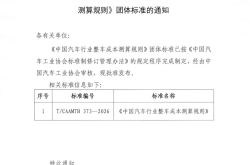
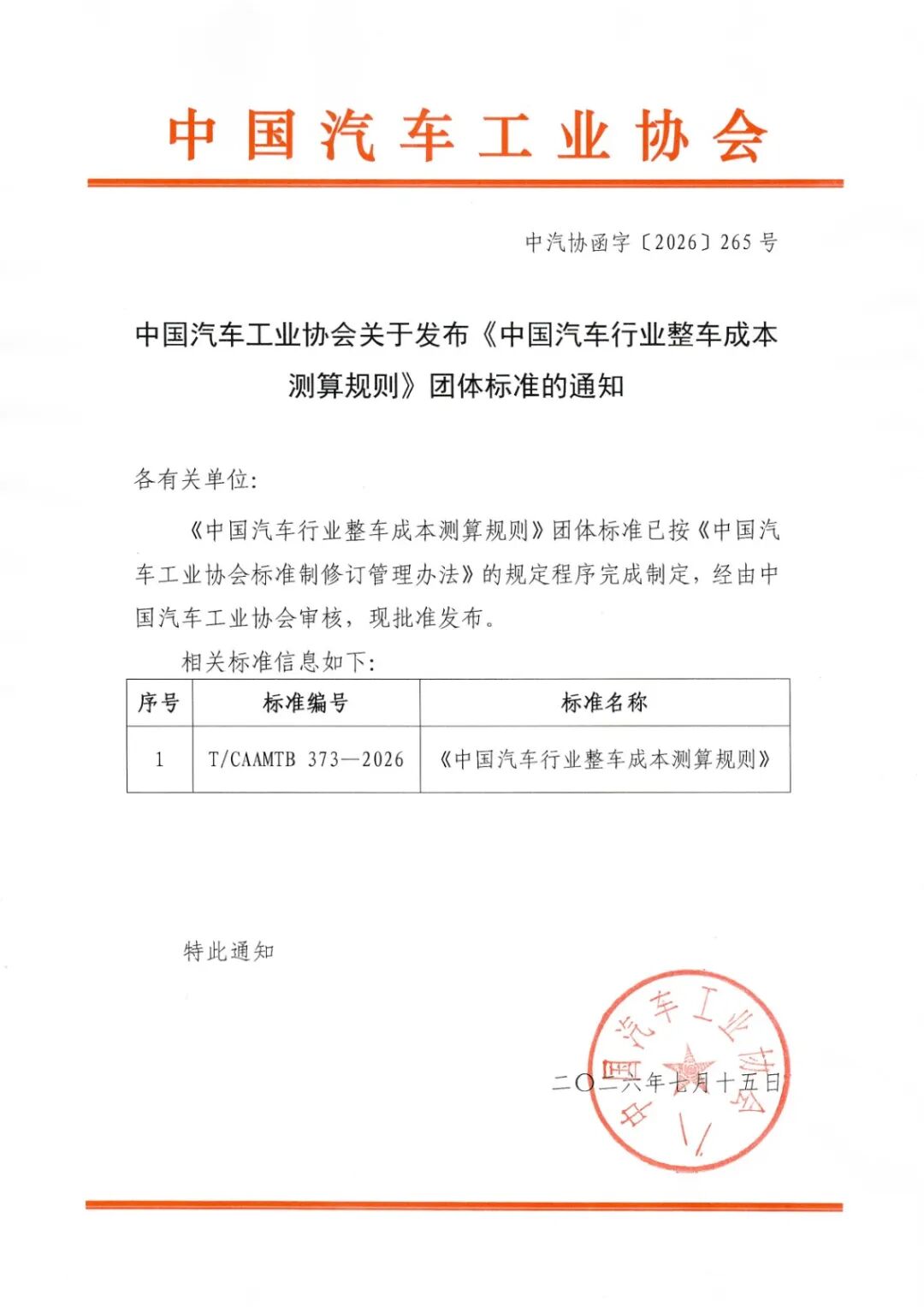
Recently, the China Association of Automobile Manufacturers (CAAM) officially unveiled the group standard, "Rules for Calculating the Complete Vehicle Cost in China's Automotive Industry." Spearheaded by CAAM and co-developed by 18 leading domestic automakers, this standard marks China's first unified framework for cost calculation in the complete vehicle sector. According to Fu Bingfeng, Executive Vice President and Secretary-General of CAAM, it "bridges a structural gap in the automotive industry's standard system."

A Price War Sparks the Creation of a 'Fair Scale'
The immediate impetus for introducing this standard has been the prolonged and intense price war.
Since 2026, the domestic automotive market has witnessed a flurry of new product launches, yet demand growth has remained lackluster. This has compelled most automakers to resort to price competition to sustain sales volumes. Data from the China Passenger Car Association reveals that in the first five months of 2026, the profit margin of China's automotive industry stood at 3.4%, significantly lower than the 6.1% average for downstream industries. Several listed automakers reported substantial declines in their first-half performance, with Seres projecting a net loss of RMB 1.5 billion to RMB 1.8 billion, and GAC Group anticipating a net loss of RMB 4.06 billion to RMB 4.57 billion.
"Some automakers, in their quest for market share, have shortened R&D cycles and simplified validation processes. Unreasonable cost-cutting and malicious price reductions have fueled an involutionary price war, pushing the automotive industry's profit margins below those of China's broader manufacturing sector," noted Zhang Shulin, former Deputy Director of the Automobile Department under the former State Mechanical Industry Ministry and former Executive Vice President and Secretary-General of CAAM.
An even more insidious issue than dwindling profits is the absence of a unified cost calculation method across the industry. Different companies categorize items like transportation fees, warranty costs, and sales rebates in vastly different ways, rendering cross-enterprise cost data comparisons impossible. The disparity in calculation methods—where "Company A calculates costs while Company B calculates expenses"—has long been a persistent problem. Zhang Shulin highlighted, "The significant variations in cost calculation methods among enterprises, unclear subject boundaries, and lack of reference for pricing related-party transactions have made cost data incomparable across enterprises and left the industry without a benchmarking rule."
Against this backdrop, in March 2026, under the guidance of the Price Supervision and Competition Bureau of the State Administration for Market Regulation, CAAM officially embarked on developing a group standard for cost calculation. Remarkably, from inception to official release, the process took just four months.
Why Did 18 Automakers 'Come to the Same Table'?
The 18 automakers involved in crafting this standard encompass both traditional and new-energy automakers, central and private enterprises, as well as passenger and commercial vehicle manufacturers. The roster includes: FAW Group, Dongfeng Motor, SAIC Motor, Changan Automobile, BAIC Group, GAC Group, JAC Motors, Chery Automobile, Sinotruk, Geely Auto, Great Wall Motor, BYD, NIO, Li Auto, Leapmotor, XPeng, Seres, and Xiaomi Auto.
The selection of these 18 companies was far from arbitrary. According to sources, CAAM organized "18 key new and established complete vehicle manufacturers, including both traditional and new-energy automakers, as well as commercial and passenger vehicle producers." In essence, the selection logic considered three dimensions: ownership structure (comprehensive coverage of central, local state-owned, and private enterprises), technological routes (equal emphasis on traditional fuel and new energy), and product types (inclusion of both passenger and commercial vehicles). These 18 companies essentially represent the core forces of China's automotive industry, and their collective endorsement signifies that the standard is grounded in the industry's broadest consensus.
"The standard development process adhered to principles of openness and collaboration throughout," stated CAAM. During the development phase, the working group fully considered suggestions from corporate finance personnel and industry experts to ensure the final outcome aligned with industry realities and enjoyed broad consensus. Fu Bingfeng emphasized that this standard "is a pragmatic response to the real needs of industry competition governance."
Three Key Highlights: Unified Standards, Clear Boundaries, and Flexibility
The crux of this standard lies in establishing a cost and expense calculation model for individual automotive products. Specifically, it boasts three key highlights:
First, a unified approach across the entire supply chain. The standard stipulates that net revenue must exclude promotions, rebates, and value-added tax, with all types of price adjustments, such as financial subsidies and trade-in subsidies, encompassed within the unified deduction scope. The production cost of complete vehicles is clearly defined to encompass five major categories: direct materials, direct labor, manufacturing expenses, vehicle transportation fees, and warranty costs. Henceforth, there will be no more discrepancies in calculation methods, and a unified calculation logic for the cost of individual vehicle products will be adopted industry-wide.
Second, clear rule boundaries to ensure genuine and accurate costs. The standard establishes explicit bottom lines at the rule level: malicious cost reductions through related-party transactions or accounting estimate adjustments are strictly prohibited; the pricing of internally procured components must not be lower than the material cost of the components themselves; and the entire cost calculation process must retain original vouchers, contract records, and approval documents to ensure that every cost is verifiable and traceable.
Third, flexibility to accommodate industry realities, avoiding a 'one-size-fits-all' approach. The standard permits companies to choose, based on their actual circumstances, whether to include transportation and warranty costs in their costs or deduct them from revenue. In special circumstances, such as seasonal production fluctuations or new product ramp-up, reasonable adjustments can be made to abnormal costs. This approach of "retaining appropriate flexibility under unified rules" ensures industry-wide comparability while enabling the standard to be genuinely implemented.
From 'Separate Calculations' to 'Common Benchmarking': What Impact on the Industry?
The implementation of this standard will reshape the competitive logic of the automotive industry at multiple levels.
For enterprises, it serves as an 'operational manual' for cost management. The standard, through its normative appendices, outlines a complete calculation chain covering the entire process from production to sales, enabling companies to directly reference this model to streamline their internal accounting systems.
For the industry, it acts as a yardstick to address 'involution.' With a unified calculation method, cost data across enterprises becomes horizontally comparable. In the future, if relevant departments or associations receive reports of malicious involutionary behavior, they can conduct investigations based on this standard.
For regulators, it serves as a bridge connecting policies with the market. The standard works in tandem with the "Compliance Guidelines for Pricing Behavior in the Automotive Industry" previously issued by the State Administration for Market Regulation.
CAAM stated that following the standard's release, it would undertake a comprehensive range of tasks: organizing systematic training, promoting pilot demonstrations, and establishing a regular communication mechanism. The true value of the standard lies in its application. Only when every automaker genuinely utilizes this 'fair scale' can it transition from paper to the shop floor, from standard to practice.
The fact that 18 automakers, once fierce market competitors, can unite to endorse a unified cost calculation standard is itself a potent signal: China's automotive industry is shifting from 'competing on who has the lowest price' to 'competing on who has more genuine costs and finer management.'
However, whether this 'fair scale' can truly weigh the industry's healthy development hinges not only on the scientific rigor of the standard but also on the industry's resolve to practice self-discipline.
-
The Moment to Evaluate Montage Technology Has Arrived
-
![]()
StepOn Has Solved the Monetization Challenge of Large Models with Just a Smartphone
-
![]()
Is a Camera the New AI Safety Guardian? Hikvision Introduces Active Vision Operation Monitoring Gun-Ball Camera at WAIC 2026
-
The Second Half of AI: Cost-Effectiveness Takes Center Stage
-
![]()
Location, Concentration, and Trajectory Tracking: Hikvision’s TDLAS Gas Cloud Imaging Telemetry System Debuts at WAIC 2026
-
The 'AI Study Tour' Under the Original Equipment Manufacturer Model is Set to Create a New Wave of Internet-Famous Science and Innovation Cities
-
![]()
Now, There's a 'Basis' to Curb 'Price Wars': Future Reports of Automakers Setting Low Prices Will Be Probed Under New Rules
-
![]()
WAIC 2026: Farewell to Parameter Races, Full-Chain AI Commercialization