WAIC Observation: The Race of Embodied AI Shifts from Body to Brain
 07/17 2026
 415
415
The next inflection point for embodied AI lies not in the body but in the brain.
This year's WAIC left me with the strongest impression yet: the field of embodied AI is becoming increasingly vibrant.
The exhibition hall was filled with humanoid robots walking with steady gaits, robotic arms precisely screwing caps and plugging connectors, and robotic dogs running, jumping, and even carrying out inspection tasks. Players across the industrial chain gathered at various booths, discussing joint motors, motion large models, and production costs—all striving to equip robots with stronger "physical capabilities."
Yet, as I observed, something felt missing. While these robots have become increasingly skilled in their movements, the way humans interact with them remains fundamentally unchanged from a decade ago. Engineers pre-program action scripts, operators guide robots step-by-step with teach pendants, and consumer-grade products mostly rely on voice commands. As machines grow more capable of movement, humans still face convoluted pathways to make them perform tasks.
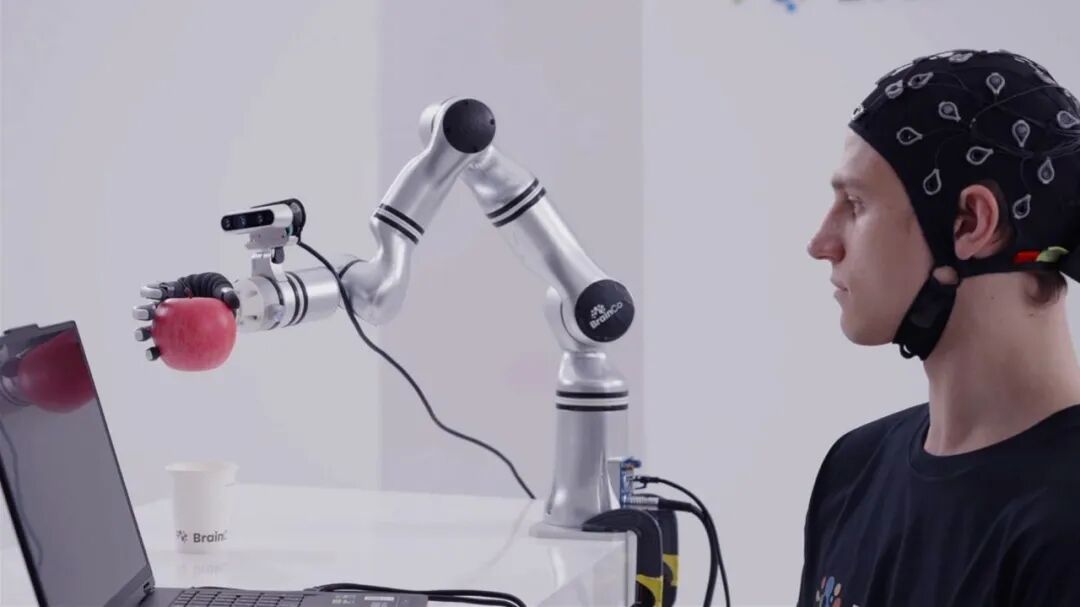
However, standing at BrainCo's booth, I witnessed a different scene. A user donned a lightweight EEG headset—no hand gestures, no speech, not even a forward lean. Simply by imagining a grasping motion, the robotic arm in front slowly activated, precisely gripped a cup, and steadily delivered it to a designated location.
The entire process involved no traditional interaction mediums. The machine was driven solely by pure brain intent.
Many in attendance viewed this as a flashy, sci-fi-esque demonstration, but to me, it signaled something far more significant.
BrainCo's release of the world's first integrated BCI-robot AI research platform addresses a critical issue: when a robot's physical capabilities are sufficiently advanced, the efficiency of intent-based interaction becomes the true limiting factor in human-machine collaboration.
More bluntly put, the next phase of embodied AI is being redefined—shifting from "capable of movement" to "capable of understanding humans."
01
In Today's Embodied AI Race,
What's Missing Isn't the Body—It's the Gateway
Over the past two years, nearly all resources in the embodied AI sector have been poured into "physical capabilities." From localizing core components to optimizing motion control algorithms and enhancing general capabilities through large models, the entire industrial chain has focused on one question: how to make robots move more stably, precisely, and flexibly.
In fact, progress has been faster than many anticipated.
Two years ago, discussions centered on whether humanoid robots could walk steadily. This year, mainstream manufacturers' products can already navigate stairs, avoid obstacles, and manipulate small objects with complex precision. In industrial settings, robotic arms achieve hair-strand-level repeat positioning accuracy, and quadrupedal robots are deployed in inspection and security roles. In terms of "physical" execution, many robots already excel at a wide range of real-world tasks.
Yet, when it comes to genuine human-machine collaboration, shortcomings become immediately apparent.
On industrial production lines, robot movements are mostly pre-programmed and fixed. Switching tasks or workpieces requires professional reprogramming and demonstration, a lengthy and high-threshold process ill-suited for flexible manufacturing demands.
In daily scenarios, voice interaction dominates—but recognition rates drop in noisy environments, complex commands require repeated breakdowns, and the lengthy chain of "language organization → speech recognition → semantic understanding → command conversion" introduces delays and errors. Physical interactions like handles and buttons inherently demand operators free their hands and focus entirely, conditions often unattainable in many settings.
The root cause of these issues is the same: all traditional interaction methods require humans to translate their mental intentions into standardized machine-readable commands. This translation process inherently introduces inefficiency and raises usage barriers—not to mention excluding individuals with physical disabilities from the outset.
Brain-computer interfaces offer an entirely different solution. They bypass all intermediaries, directly reading human motor intentions at the source and converting them into machine execution commands. Between humans and machines, language, gestures, and buttons are no longer needed as translators—thoughts can flow directly into the physical world.
This direction, of course, did not emerge today. During the 2014 FIFA World Cup in Brazil, a paralyzed young man opened the game by kicking a ball with a brain-controlled exoskeleton, showcasing the technology's potential to the public for the first time. In subsequent years, advancements like BrainGate's research published in *Nature* and Neuralink's clinical volunteers achieving thought-based writing have continuously pushed technological boundaries. However, these cases have largely remained confined to medical settings, relying on customized laboratory systems with prohibitive costs and limited replicability for general robotics research.
I once discussed this topic with researchers in related fields at universities. Building a functional brain-controlled robot experimental system requires simultaneously mastering three entirely distinct technical domains: EEG hardware, signal decoding algorithms, and robot control interfaces. Ordinary teams often spend months on hardware adaptation, low-level coding, and system integration, leaving little time for core research and scenario exploration. Most available solutions consist of scattered code libraries or algorithm demos, lacking a complete productized framework—the barrier remains firmly in place.
This is precisely the problem BrainCo's platform aims to solve. Rather than stopping at isolated technical breakthroughs, it integrates EEG acquisition, experimental paradigms, neural decoding, control mapping, and robot execution into a standardized software workflow. Tasks that previously required interdisciplinary teams months to complete are now encapsulated into a plug-and-play tool. Even researchers without BCI expertise can go from device setup to robot operation in under 10 minutes.
Specifically, from a product perspective, this platform covers the complete chain of brain-controlled robot research.
On the hardware side, it supports both wet and dry electrode devices, with multi-stage sampling rates ranging from 250 to 1000Hz and 32-channel configurations to meet varying research precision needs. Software-wise, it natively supports two classic BCI paradigms—motor imagery and steady-state visually evoked potentials—and includes mature decoding algorithms like FBCSP+SVM and EEGNet, with adjustable parameters and support for custom algorithm integration. For execution, it interfaces with mainstream devices such as Unitree's G1 Edu humanoid robot, Reeman's six-degree-of-freedom robotic arm, and Deep Robotics' Lite 3 robotic dog, directly mapping decoded brain signals to corresponding robot actions.
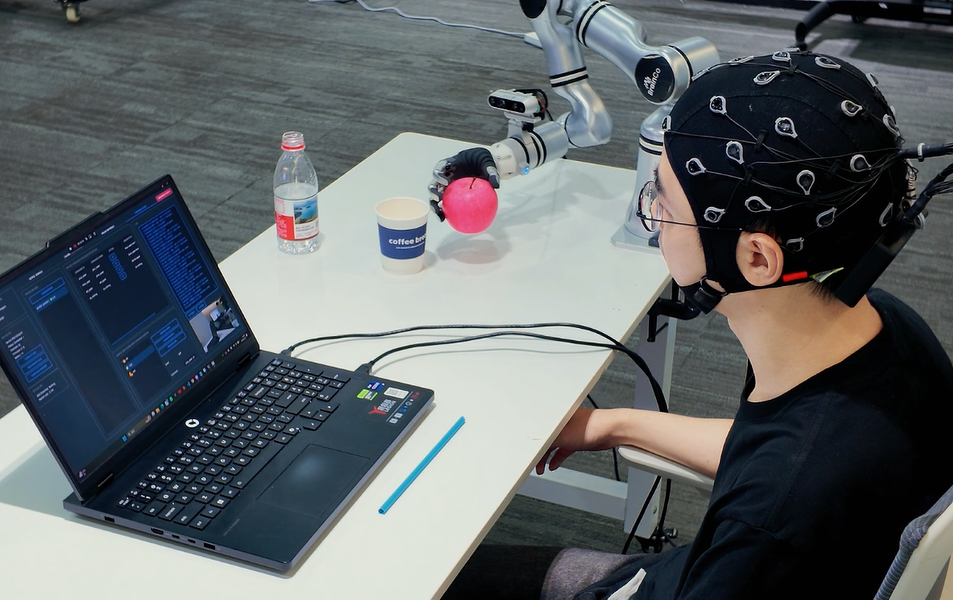
The entire platform employs a graphical user interface, visualizing all processes from impedance detection and data acquisition to offline training and online inference—eliminating the need for low-level coding from scratch.
Many may not grasp the significance of this. For embodied AI researchers, it means no longer needing to invest massive effort in building BCI technical stacks from the ground up. They can now stand on a mature foundation to drive applied innovation.
From another perspective, this platform resembles infrastructure development for the brain-controlled robotics field. It brings technologies previously accessible only to top-tier laboratories within reach of ordinary research teams. When more participants engage, the entire field's iteration speed will truly accelerate.
02
Trinity Intelligence Isn't Just a Concept—It's a Fully Functional Closed Loop
The industry has discussed "trinity intelligence"—the collaboration of brain-computer interfaces, artificial intelligence, and embodied AI—for some time. Many view it as the ultimate form of human-machine fusion: BCIs read human intentions, AI breaks down task sequences, and embodied AI executes physical actions, forming a complete perceptual feedback loop.
Yet, for a long time, these three components developed independently in their respective lanes, with few fully integrated products reaching the market.
BrainCo's brain-controlled robot training platform is a rare example that brings trinity intelligence from concept to reality. It doesn't merely add a BCI module to robots but fundamentally integrates the full technical stack from neural signals to physical actions, enabling true synergy among the three.
In terms of specifics, the system's EEG sensing devices employ mass-produced hardware with 24-bit data precision, WiFi 6 wireless transmission, and 6–8 hours of battery life—stability validated by market adoption. Its neural decoding algorithms, optimized through years of clinical data, achieve industry-leading motion intention recognition accuracy, completing intent-to-action conversion within 200 milliseconds.
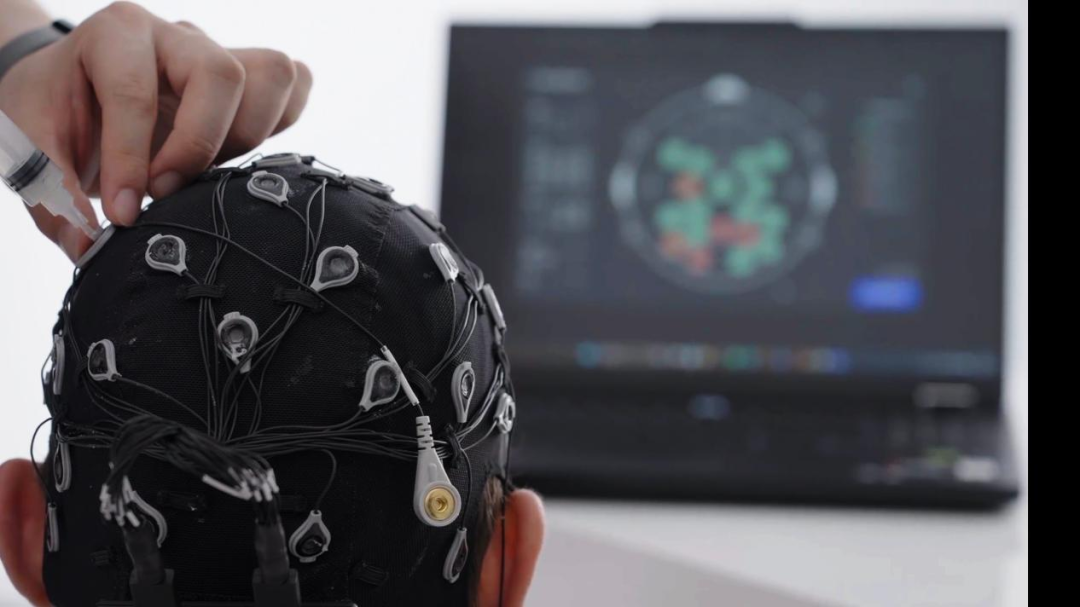
Between BCIs and embodied AI, artificial intelligence plays a pivotal bridging role. The platform's built-in traditional machine learning and deep learning algorithms extract features and recognize intentions from complex EEG signals while breaking down abstract motion intentions into executable robot action sequences. When a user imagines a grasping motion, the AI not only identifies the intent but also orchestrates the robot to complete visual localization, path planning, finger closure, and other coordinated operations automatically—no manual step-by-step instructions needed.
Interestingly, BrainCo chose not to develop its own robot bodies but instead adopted an open, compatible approach. Beyond integrating multiple third-party devices, the platform offers standardized access interfaces, allowing robot manufacturers to register actions and task libraries for rapid BCI capability adaptation. This positioning makes it more akin to a BCI operating system than a standalone product—and it's precisely this platform attribute that supports a trinity intelligence ecosystem.
Often overlooked is the data acquisition solution released alongside the brain-controlled robot platform, which fills another critical gap.
This solution addresses the data shortage for training dexterous operations in embodied AI through hardware like a dual-arm wheeled robotic data collection platform and high-precision data gloves, providing large-scale, high-quality real-world training data.
If the brain-control platform solves how humans issue commands to machines, the data acquisition solution tackles how machines learn actions. Together, they support the embodied AI technical system from both human-machine interaction and physical capability directions.
When combined, these three elements form a bidirectionally enhancing closed loop. Intent data from BCIs enriches AI's understanding of human behavior patterns; AI advancements, in turn, optimize BCI decoding precision and robot execution effects. In the future, tactile and force feedback from embodied AI endpoints could even transmit back to the brain via BCIs, creating genuine bidirectional human-machine collaboration.
This fundamentally differs from traditional human-machine interaction. The old model involved humans unilaterally issuing commands to machines, which then executed them. Under the trinity intelligence architecture, humans and machines engage in bidirectional collaboration—intentions flow to machines, while perceptions feedback to the brain, jointly completing tasks.
03
BCI's Next Frontier: From Medical Wards to Industrial Settings
After years of development, BCI commercialization has primarily focused on medical rehabilitation. Brain-controlled exoskeletons and prosthetic hands for paralyzed patients, neurorehabilitation training systems, and sleep intervention devices represent clear, high-willingness-to-pay scenarios—the first landing grounds for the technology. BrainCo's own commercialization path also began in healthcare before expanding into consumer electronics and other fields.
However, the medical market has inherent size limitations. For BCIs to evolve into a general-purpose technology influencing the entire information industry, they must find broader application scenarios. The explosion of the embodied AI sector provides precisely that entry point into the general market.
The industrial logic here is clear.
As embodied AI advances, robots' physical execution capabilities grow stronger, enabling them to undertake more tasks and dramatically increasing the frequency and complexity of human-machine interactions. When robots transition from fixed production line equipment to flexible manufacturing partners, and from laboratory research tools into daily work and life, the bottlenecks of traditional interaction methods will become increasingly pronounced. At that point, BCIs—as the most direct intent-based interaction method—will gradually unlock their value.
From this perspective, the launch of products like the brain-controlled robot training platform targets not just the current research market but also the future industrial dividends of BCI-embodied AI convergence. As a platform-oriented product for research and development scenarios, its primary goal isn't immediate large-scale consumer monetization but establishing industry infrastructure and nurturing the ecosystem.
For universities and research institutions, this platform drastically lowers barriers to brain-controlled robot research, allowing teams to focus on algorithmic innovation and scenario exploration rather than reinventing the wheel. For robot manufacturers, integrating BCI capabilities through standardized interfaces enables rapid differentiation in interaction methods, expanding applications in healthcare, special operations, and other fields. For the industry as a whole, a unified platform facilitates data and technical standardization, accelerating track (sàidào, "track") technology iteration.
This path should feel familiar—it mirrors the early development of smart terminal operating systems. By first maturing the underlying foundation and lowering development barriers, a surge of upper-layer application innovations followed.
Similarly, as technology continues iterating, brain-controlled robot applications will gradually move from laboratories to industrial settings.
Imagine industrial manufacturing scenarios where workers intuitively control robotic arms for high-risk, precision operations via thought, freeing their hands for judgment-intensive tasks. In medical rehabilitation, Limb disorders (zhītǐ zhàngài, "physical disabilities") patients could not only regain mobility through brain-controlled prosthetic hands but also perform more daily activities via brain-controlled humanoid robots, enhancing life autonomy. In special rescue operations, responders could remotely control robots in hazardous zones through mental commands, with operation response speeds multiplying over traditional manual controls. These scenarios aren't sci-fi fantasies—they represent inevitable directions as technology evolves.
From niche medical rehabilitation applications to general-purpose embodied AI interaction, BCIs are steadily stepping into a broader industrial world. China's 15th Five-Year Plan has already listed BCIs as a key future industry direction, while embodied AI is seen as the core carrier for next-generation smart terminals. Their deep integration represents both technological inevitability and industrial policy guidance.
This step marks not the endpoint for brain-controlled robots but the starting line of a new track (sàidào, "track").
— END —For more, click below to follow
-
The Moment to Evaluate Montage Technology Has Arrived
-
![]()
StepOn Has Solved the Monetization Challenge of Large Models with Just a Smartphone
-
![]()
Is a Camera the New AI Safety Guardian? Hikvision Introduces Active Vision Operation Monitoring Gun-Ball Camera at WAIC 2026
-
The Second Half of AI: Cost-Effectiveness Takes Center Stage
-
![]()
Location, Concentration, and Trajectory Tracking: Hikvision’s TDLAS Gas Cloud Imaging Telemetry System Debuts at WAIC 2026
-
The 'AI Study Tour' Under the Original Equipment Manufacturer Model is Set to Create a New Wave of Internet-Famous Science and Innovation Cities
-
![]()
Now, There's a 'Basis' to Curb 'Price Wars': Future Reports of Automakers Setting Low Prices Will Be Probed Under New Rules
-
![]()
WAIC 2026: Farewell to Parameter Races, Full-Chain AI Commercialization