22 Billion Yuan in Subsidies Rolled Out! 117,000 New Energy Heavy Trucks Sold in H1, Penetration Rate Tops 33%
 07/22 2026
 472
472
On July 21, a pertinent official from the Ministry of Transport signaled a significant move at a press conference hosted by the State Council Information Office: In 2026, the replacement of outdated commercial trucks will persist, with 22 billion yuan allocated from ultra-long-term special treasury bonds to bolster this initiative, with a special emphasis on new energy heavy trucks. Coupled with a plan to establish 3,000 charging and battery-swapping stations, the new energy heavy truck market is poised for a dual surge, propelled by both policy support and market demand.
22 Billion Yuan in Subsidies Directly Inject Vitality into the Market
Accelerated Expansion of Energy Replenishment Infrastructure
The current policy boasts unprecedented strength, with its essence distilled into two key pillars: "Substantial financial incentives + Supportive infrastructure development."
Regarding subsidies, the 22 billion yuan in ultra-long-term special treasury bonds will primarily underwrite the replacement of commercial trucks adhering to National III and IV emission standards, with a preference for new energy heavy trucks.
Under the current subsidy framework, scrapping old trucks can fetch a maximum subsidy of 45,000 yuan per unit, while procuring new 4-axle or heavier new energy heavy trucks can secure a maximum subsidy of 95,000 yuan per unit. The cumulative maximum subsidy per vehicle can soar to 140,000 yuan. The policy's implementation spans the entire year of 2026, necessitating the completion of all scrapping, registration, and application procedures within this timeframe.
In terms of energy replenishment, the nation will concentrate its efforts on national highways, bustling freight corridors along ordinary national and provincial roads, urban clusters such as the Beijing-Tianjin-Hebei region, Yangtze River Delta, Guangdong-Hong Kong-Macao Greater Bay Area, and Chengdu-Chongqing region, as well as pivotal nodes like freight hubs, ports, mining zones, factory sites, and industrial parks. Over 3,000 electric heavy truck charging and battery-swapping stations will be erected to foster a seamless "network of interconnected dots" for energy replenishment facilities. This signifies that the operational scope of new energy heavy trucks will progressively expand from enclosed industrial parks to major highways.
Furthermore, the policy explicitly encourages key transportation entities, including large-scale transportation firms, express delivery and logistics companies, and sizable freight fleets, to adopt new energy heavy trucks in mainline highway transportation, thereby assuming a demonstrative and leading role.
Sales Soar in H1
Penetration Rate Nears 35%
Buoyed by these favorable policies, the new energy heavy truck market has yielded remarkable outcomes. 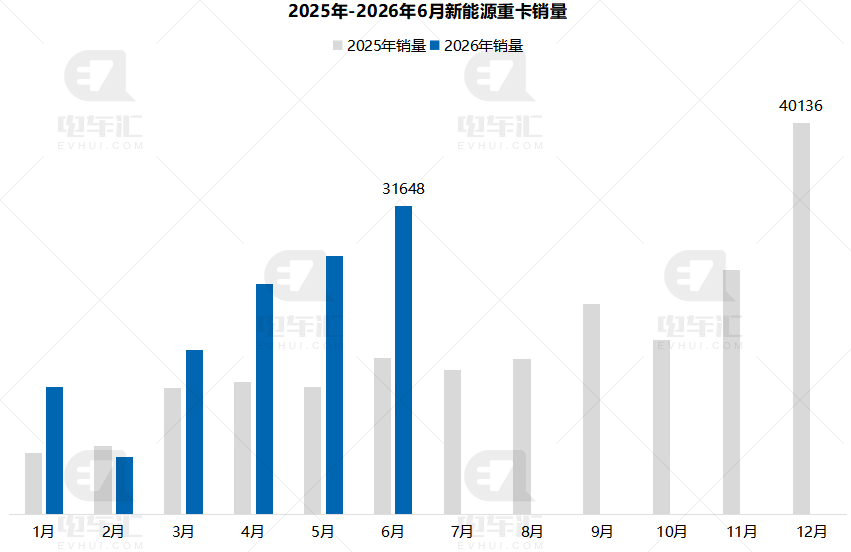
According to terminal sales data compiled by EVHub, in the first half of 2026, cumulative sales of new energy heavy trucks surged to 117,000 units, while total heavy truck sales across the nation reached 347,000 units, translating to a new energy penetration rate of 33%. Concurrently, sales of new energy heavy trucks have witnessed rapid growth, with a cumulative sales increase of 71% in the first half of the year. Monthly sales in May and June hit 26,000 and 32,000 units, respectively, both registering year-on-year doubling growth. 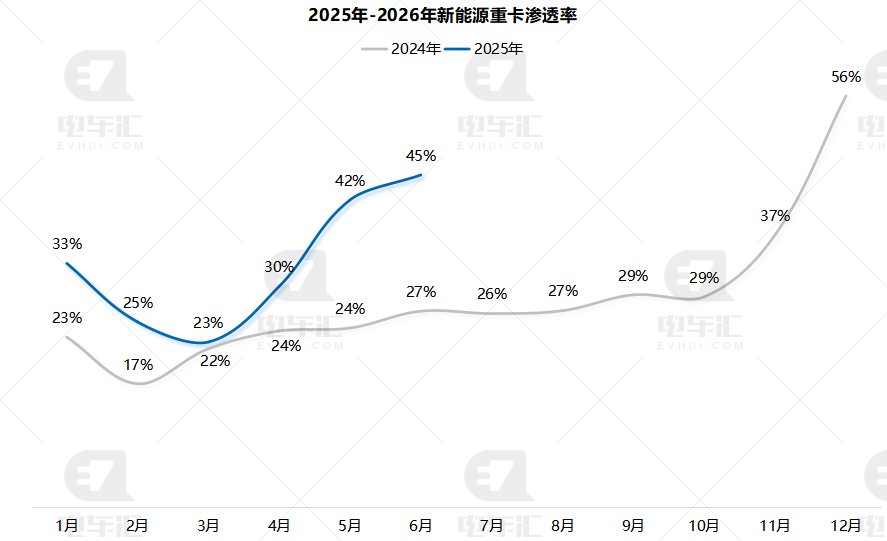
From the vantage point of the penetration rate curve, new energy heavy trucks are in the midst of an accelerated penetration phase. The penetration rate hovered around 42% in June 2025 and remained above 30% in the first half of 2026. With the full-fledged implementation of subsidy policies in the latter half of the year and the advent of the traditional peak season, the penetration rate is anticipated to ascend further.
Fierce Competition Among Market Leaders
New Entrants Make a Splash
Behind this rapid market expansion lies a dramatic reshuffling of the industry landscape.
In terms of sales among new energy heavy truck enterprises in the first half of 2026, XCMG clinched the top spot with over 20,000 units sold, marking a 73% year-on-year surge. New energy heavy trucks constituted 99% of the company's total heavy truck sales. Sinotruk secured the second position with cumulative heavy truck sales of 19,000 units, achieving a remarkable year-on-year growth rate of 118% and emerging as the fastest-growing brand among leading players. The top ten enterprises in new energy heavy truck sales also encompass FAW, Sany, Daimler, Shaanxi Automobile, Dongfeng, Geely, JAC United Truck, and Leichi. The gap among market leaders continues to narrow, intensifying competition.
Notably, the battery-swapping heavy truck segment is emerging as a new growth frontier. From January to May, sales of new energy battery-swapping heavy trucks climbed by 29% year-on-year, with Geely, XCMG, and Foton Daimler occupying the top three sales positions. Additionally, new entrants such as United Heavy Truck and Zero One Motors have delivered stellar performances, with year-on-year growth rates reaching 974% and 1058%, respectively. New variables are rapidly surfacing in the industry.
According to the "Implementation Plan for Promoting the Large-Scale Application of New Energy Heavy Trucks" jointly issued by eleven departments, by 2030, the penetration rate of new energy heavy trucks is projected to reach 40%, with the installed base surpassing 1.6 million units and accounting for roughly 20% of the total. In regions such as the Beijing-Tianjin-Hebei region and Fenhe-Weihe Plain, the electrification rate of short-haul transportation on fixed routes is expected to exceed 80%.
Judging by the sales of 117,000 units and a 33% penetration rate in the first half of 2026, the industry is well on its way to achieving these targets. With the full-fledged impact of the 22 billion yuan subsidy policy and the continuous enhancement of energy replenishment infrastructure, the transition from fuel-powered to new energy heavy trucks is anticipated to accelerate further, heralding the "new energy era" for the heavy truck industry at an even swifter pace.
-
![]()
Following the Explosive Success of Kimi k3, Moonshot AI is Reportedly in Final IPO Financing Discussions
-
![]()
Baidu Dazi's Ambitious Overtaking with 'Product-Centric' Upgrades
-
![]()
AI PC Is Becoming Obsolete! The Rise of AC: Do Agents Really Need Their Own Computer?
-
![]()
Times Are Changing: Domestic New Energy Vehicles Are Driving Traditional Luxury Brands to the Wall, Prompting BBA to Slash Prices En Masse for Survival
-
![]()
The Myth of Musk
-
![]()
Which Type of Talents Do Automakers Prefer to Promote: Science or Liberal Arts Graduates?
-
![]()
Why has OPPO's strategy been readjusted in less than three months?
-
![]()
New Models Falter: Over 700 New Cars in the First Half of the Year Struggle, Only 4 New Models Surpass 10,000 Units in Sales, Achieving Hot Sales | Mingjing Pro