Co-Lead Optoelectronics Pours 1.7 Billion Yuan into Investment, Triggering a 20% Surge to Limit-Up!
 08/17 2026
 523
523
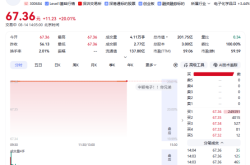
On the morning of August 14, shares of China Stone Technology soared to the daily limit. With 340,000 buy orders locked in, the trading volume surpassed 200 million yuan, and the total market capitalization exceeded 20 billion yuan.
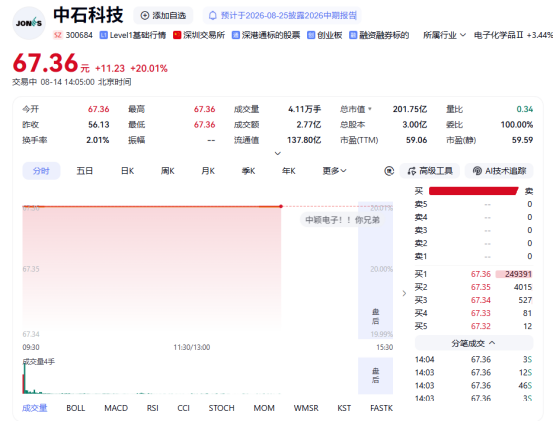
On the evening of August 13, Co-Lead Optoelectronics, a frontrunner in the optical module sector, unveiled its plan to acquire a 10.47% stake in China Stone Technology for 1.747 billion yuan in cash, at a transfer price of 55.70 yuan per share. The sellers are the company's controlling family: the married couple Wu Xiaoning and Ye Lu, along with their son, Wu Han. Collectively, they held a 41.90% stake, which will decrease to 31.42% post-transaction.
The pricing of this transaction is particularly noteworthy. China Stone Technology's stock had already climbed by 8.23% the previous day, closing at 56.13 yuan. The transfer price of 55.70 yuan is just 0.77% lower than the closing price, indicating that Co-Lead Optoelectronics is essentially acquiring the shares at a near-market price.
Co-Lead Optoelectronics' motivation for this purchase stems from the escalating speed and heat generation challenges in optical modules.
The announcement highlighted that with the ongoing mass production of high-end optical modules such as 800G and 1.6T, power consumption density is on the rise, leading to a significant uptick in heat dissipation requirements. This is anticipated to foster strong synergies with the company's business operations.
As optical modules transition from 400G to 800G and then to 1.6T, their speed doubles, and so does their heat generation. A single 1.6T optical module consumes over 30 watts of power. When hundreds of thousands of these modules are densely packed into a data center, traditional cooling methods become inadequate. Consequently, thermal interface materials, vapor chambers, and liquid cooling have transitioned from optional to essential solutions.
China Stone Technology is a seasoned player in this domain, specializing in thermal conductive materials. According to financial reports, its 2025 revenue reached 1.835 billion yuan, marking a 17.1% year-on-year increase. Net profit attributable to shareholders surged to 339 million yuan, up 68.1%, with even higher growth (95.3%) in non-recurring profit and loss.
A staggering 97.61% of its main business revenue is derived from thermal conductive materials, with over half sold overseas. Its product range spans from high-thermal-conductivity graphite and thermal interface materials to heat pipes, vapor chambers, and liquid cooling modules, transitioning from selling individual materials to offering comprehensive thermal management solutions.
The company's initial customer base comprised mobile phone manufacturers. Its major clients include North American tech behemoths such as Samsung, Microsoft, Google, Amazon, as well as Huawei, Honor, and DJI, with the top five clients contributing 73.5% of its revenue. For over a decade, it has been addressing heat dissipation challenges in smartphones, laptops, and tablets. Its graphite films are likely present in high-end models from Apple and Samsung.
Now, this expertise is being leveraged in the AI sector.
In a research briefing from May this year, China Stone Technology announced the launch of VC module cooling solutions for the optical communications industry, enhancing both cooling performance and value. These solutions have secured certification from leading domestic and international clients, with bulk deliveries in progress and customer coverage and delivery scales continuing to expand.
Among these, the liquid cooling segment is a pivotal new business focus. The company acquired a 51% stake in China Stone Xunleng, bolstering its manufacturing capabilities for cold plates and liquid cooling modules, and entering the AI server liquid cooling supply chain as a Tier 2 supplier.
This transaction also sends a significant signal across the industry: AI's heat dissipation concerns have shifted from servers to optical modules.
In recent years, the spotlight has been on computing power chips. NVIDIA's transition from A100 to H100 and then to GB200 has witnessed a surge in single-rack power consumption from a few kilowatts to tens of kilowatts, making liquid cooling a necessity rather than a luxury. For a considerable period, the power consumption of optical modules was overlooked.
However, as speeds escalate, the heat generation of 1.6T optical modules has emerged as a critical issue, making heat dissipation a key determinant in product power consumption, performance, and order acquisition. Companies with effective solutions can secure a larger market share. China Stone Technology's VC modules are well-positioned to evolve in tandem with optical module technology.
At this juncture, Co-Lead Optoelectronics opted to invest 1.7 billion yuan in cash to transform a heat dissipation supplier into a shareholder-level ally, rather than maintaining a mere buyer-seller relationship. Equity binding represents the strongest form of supply chain lock-in. Optical module giants are now acknowledging that heat dissipation is no longer a replaceable component in the supply chain.
For the Wu Xiaoning family, this transaction embodies a different strategic calculation.
China Stone Technology went public in late 2017 with an issue price of 8 yuan, now trading at 67.36 yuan—an eightfold increase over eight years. By selling a 10.47% stake, the controlling family will pocket 1.747 billion yuan in one fell swoop while retaining a 31.42% controlling stake. This move achieves both cashing out and introducing strategic investors in a single step.
For China Stone Technology, adding a global optical module leader to its shareholder roster is akin to securing a ticket to the core circle of the AI computing power supply chain. For Co-Lead Optoelectronics, a single night's decision has secured critical heat dissipation supply capabilities for high-speed optical modules. This transaction is a win-win proposition.
It took China Stone Technology over two decades to transition from mobile phone heat dissipation to AI heat dissipation. Co-Lead Optoelectronics accomplished a similar shift in just one night, moving from purchasing materials to acquiring equity.
In the AI wave, computing power is the overt trend, while heat dissipation is the covert one. While the overt trend generates noise, the covert one is quietly reshaping the industrial landscape. When an optical module leader is willing to pay 1.7 billion yuan in cash for a heat dissipation company, the business of heat dissipation has been elevated to a new echelon.
-
![]()
The "Happiness" of Xpeng
-
![]()
China Mobile: Coping with Tax Hikes and Fee Reductions, Are High Dividends the Sole Pillar?
-
![]()
Wei Brand V8X Unveiled: Can Great Wall Overcome the High-End Market Challenge?
-
![]()
Why Did Musk Set His Sights on Space Computing After Starlink?
-
Major Adjustment! Nokia Plans to Close R&D Center in China, Lay Off 1,600 Employees
-
![]()
Co-Lead Optoelectronics Pours 1.7 Billion Yuan into Investment, Triggering a 20% Surge to Limit-Up!
-
![]()
AI Smartphone Competition: Some 'Add Icing on the Cake,' Others 'Determine Survival'
-
The Irresistible Allure of Extreme Sports vs. The Limited Appeal to the Masses: Why Panoramic Cameras Remain a Niche Product