Why Did Musk Set His Sights on Space Computing After Starlink?
 08/17 2026
 356
356
Starlink Has Already Advanced This Far—Why Is Musk Still Not Satisfied?
In early August, SpaceX and NVIDIA unveiled Starmind AI. NVIDIA confirmed that the satellite computing payload utilizes the Vera Rubin NVL72; SpaceX's official website also features a dedicated page for Starmind, aiming to harness space-based solar energy to deliver low-cost, high-performance AI computing to Earth.
Six months ago, this development might have been dismissed as just another "GPU in space" stunt. Today, such a view is no longer tenable.
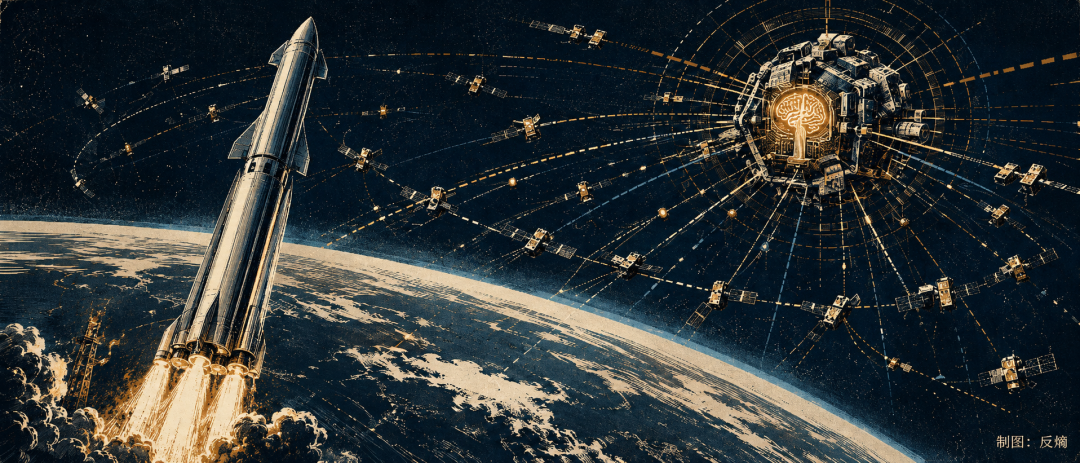
In January, SpaceX submitted an application to the U.S. Federal Communications Commission (FCC), seeking to establish a non-geostationary orbit data center system comprising up to 1 million satellites. In February, it acquired xAI, integrating aerospace and AI operations under one corporate umbrella. By June, SpaceX went public on NASDAQ at $135 per share, raising $75 billion with a valuation of approximately $1.77 trillion.
Two months later, Starmind arrived.
SpaceX already operates one of the world's largest commercial low-Earth orbit satellite internet networks through Starlink, with over 10,000 satellites deployed. While Starlink's core offering is connectivity, Starmind pushes the business further into computing.
If some AI inference, remote sensing image processing, and data filtering can be completed in orbit, the value of satellite networks will extend beyond transmission to data processing. For SpaceX, the rockets, satellites, and networks accumulated over the past two decades will, for the first time, directly connect to the AI infrastructure market.
01 Since founding SpaceX, Musk has consistently shortened the distance between the company and its end markets.
Initially, SpaceX built rockets to provide launches for NASA and commercial clients; later, it developed Starlink and directly operated a satellite internet network. Rockets gradually became transportation tools, with their capacity supporting SpaceX's management of its orbital assets.
Starmind follows the same trajectory.
When economist Ronald Coase discussed firm boundaries in *The Nature of the Firm*, one of his core concerns was transaction costs. When coordinating a process internally becomes more efficient, firms are incentivized to expand their boundaries. SpaceX's evolution over the past two decades reflects this logic: engines, rockets, launches, satellite manufacturing, and constellation operations were progressively brought in-house. Starmind now extends this chain further into AI infrastructure.
NVIDIA provides the Vera Rubin computing platform, and SpaceX has completed its acquisition of xAI. While confirmed customers for Starmind have not been disclosed, nor the extent to which Starmind will reuse Starlink's platform and network, it is premature to simply view this as "adding GPUs to Starlink."
However, SpaceX's capabilities have transformed. It now controls space transportation, satellite mass production, and large-scale low-Earth orbit networks while integrating AI infrastructure and large AI model operations into its corporate structure—a combination rare among global tech companies.
Traditional satellite networks primarily handle data collection and transmission, with complex computing remaining on the ground. As AI inference, image recognition, and data filtering move into orbit, communication nodes may gradually acquire computing node attributes. Terrestrial internet underwent a similar expansion, evolving from connectivity to content delivery, storage, and cloud computing, with networks increasingly bear (chéngzài, "carrying") greater value.
SpaceX aims to take another step forward in low-Earth orbit, keeping access to space, in-orbit connectivity, and AI computing within its ecosystem as much as possible.
02 This step coinciding with SpaceX's public listing makes its capital market implications hard to ignore.
During its June IPO, SpaceX debuted with a valuation of approximately $1.77 trillion. After its first day of trading, its market cap exceeded $2 trillion. In the year prior, the company reported $18.67 billion in revenue, with Starlink contributing about 60%. Such a valuation already reflects extremely high expectations for future growth.
During the 19th-century U.S. railway expansion, capital chased railroads largely because of the anticipated urban, trade, and industrial growth they would enable. SpaceX faces similar pressure today: while the Falcon 9 has transformed the global commercial launch market and Starlink has opened up satellite internet, a company valued at nearly $2 trillion still needs even larger growth drivers.
These changes are already evident in its financials. In Q2 2026, SpaceX reported $7.8 billion in revenue, up 92% year-over-year, with Starlink contributing over half; AI business revenue reached approximately $2.6 billion, more than tripling year-over-year. Meanwhile, quarterly capital expenditures hit $18.4 billion, with about $15.8 billion allocated to AI-related infrastructure. After these disclosures, SpaceX's stock price briefly fell about 12%, as capital market concerns focused on how quickly such massive investments could translate into revenue and cash flow.
Starmind thus serves dual purposes: technical exploration of orbital AI computing and pushing SpaceX's future market boundaries further into AI infrastructure.
The 1 million satellites figure is best understood in this context. It represents the system's upper limit in the FCC application—neither approval for deploying that many satellites nor near-term production capacity—but it demonstrates how much orbital computing space SpaceX hopes to reserve.
Starlink has already propelled SpaceX from the launch market into the communications market, and Starmind now attempts to carve out a place in AI infrastructure. For a company valued at nearly $2 trillion, this market is far more enticing than selling a few extra rocket launches.
03 The laws of physics offer Musk no special treatment.
Deploying high-performance AI computing nodes in orbit requires more than just GPUs; it necessitates power supply, energy storage, communications, storage, and thermal management systems. Greater computing power increases energy and heat dissipation demands, which translate into weight, surface area, and continuous launch requirements.
Thus, Starmind's scalability is closely tied to Starship. SpaceX's public filings already link Starship to future large-scale AI computing satellite deployments; Reuters reported in June that Starship has yet to prove the rapid reusability required for large-scale orbital computing deployments. As of August, SpaceX continues conducting new flight tests and upper-stage recovery validations.
After reaching orbit, power supply and thermal management become critical. Orbital computing relies primarily on solar energy and storage, with high-power AI payloads demanding larger energy systems. In a vacuum, heat dissipation within equipment can utilize thermal conduction, heat pipes, and fluid loops, but expelling waste heat into external space primarily relies on radiation.
Another often-overlooked contradiction exists: satellites aim for longevity, while AI chips age rapidly.
Traditional satellites emphasize high reliability and long lifespans, as longer operation amortizes manufacturing and launch costs. AI data centers operate on a different rhythm: each new GPU generation improves performance, bandwidth, and energy efficiency. Even if a server remains functional, it may gradually exit production clusters due to performance and efficiency gains from newer hardware.
A computing satellite operating for seven or eight years might see its chips undergo multiple generational replacements during its service life; if replaced every two or three years, manufacturing, network replenishment, launches, and deorbiting become ongoing expenses.
Once orbital data centers reach a certain scale, computing satellites' lifecycles will likely align more closely with servers, requiring continuous rolling replacements across the constellation. The rocket's role will evolve accordingly: beyond tonnage per launch, frequency and cost efficiency in delivering new hardware to orbit will matter.
This plays to SpaceX's greatest strength while exposing Starmind's biggest unknown.
04
Starmind remains far from a mature orbital data center. SpaceX's own public filings warn investors that space-based AI data centers rely on inadequately validated technologies and may never prove commercially viable.
Yet its significance extends beyond a single AI satellite.
For the first time, SpaceX has so comprehensively advanced a business direction spanning space communications to space computing, with NVIDIA now involved. Henceforth, orbit will be discussed more seriously as a deployment space for computing infrastructure, alongside communications, remote sensing, and navigation.
Coase's question remains relevant here. By bringing more processes in-house, SpaceX must ultimately demonstrate whether this organizational approach improves efficiency. If orbital computing can only perform ground-based tasks at higher costs, even superior rockets and satellites will struggle to alter its economics. However, when certain tasks gain clear advantages from data location, transmission constraints, or latency requirements, Starlink's extensive space network may acquire a second layer of value as computing infrastructure.
Historically, infrastructure's impact often exceeds initial expectations. Railroads ultimately shaped cities and industry; power grids reorganized production and life; the internet evolved from a communication network into today's vast digital economy.
Such scale remains far off. The 1 million satellites remain in application documents, while transportation, energy, thermal management, and hardware updates all face significant challenges.
Nonetheless, SpaceX has already pushed a long-term question to the forefront of the industry:
When computing infrastructure begins leaving Earth, who can first establish an orbiting system that operates sustainably, updates continuously, and has paying customers?
Starlink positioned SpaceX prominently in the space communications era. If infrastructure boundaries indeed shift toward orbit next, SpaceX clearly intends to claim that spot for itself.
-
![]()
The "Happiness" of Xpeng
-
![]()
China Mobile: Coping with Tax Hikes and Fee Reductions, Are High Dividends the Sole Pillar?
-
![]()
Wei Brand V8X Unveiled: Can Great Wall Overcome the High-End Market Challenge?
-
![]()
Why Did Musk Set His Sights on Space Computing After Starlink?
-
Major Adjustment! Nokia Plans to Close R&D Center in China, Lay Off 1,600 Employees
-
![]()
Co-Lead Optoelectronics Pours 1.7 Billion Yuan into Investment, Triggering a 20% Surge to Limit-Up!
-
![]()
AI Smartphone Competition: Some 'Add Icing on the Cake,' Others 'Determine Survival'
-
The Irresistible Allure of Extreme Sports vs. The Limited Appeal to the Masses: Why Panoramic Cameras Remain a Niche Product