FPGA, A Renewed Lease on Life
 12/08 2025
 677
677
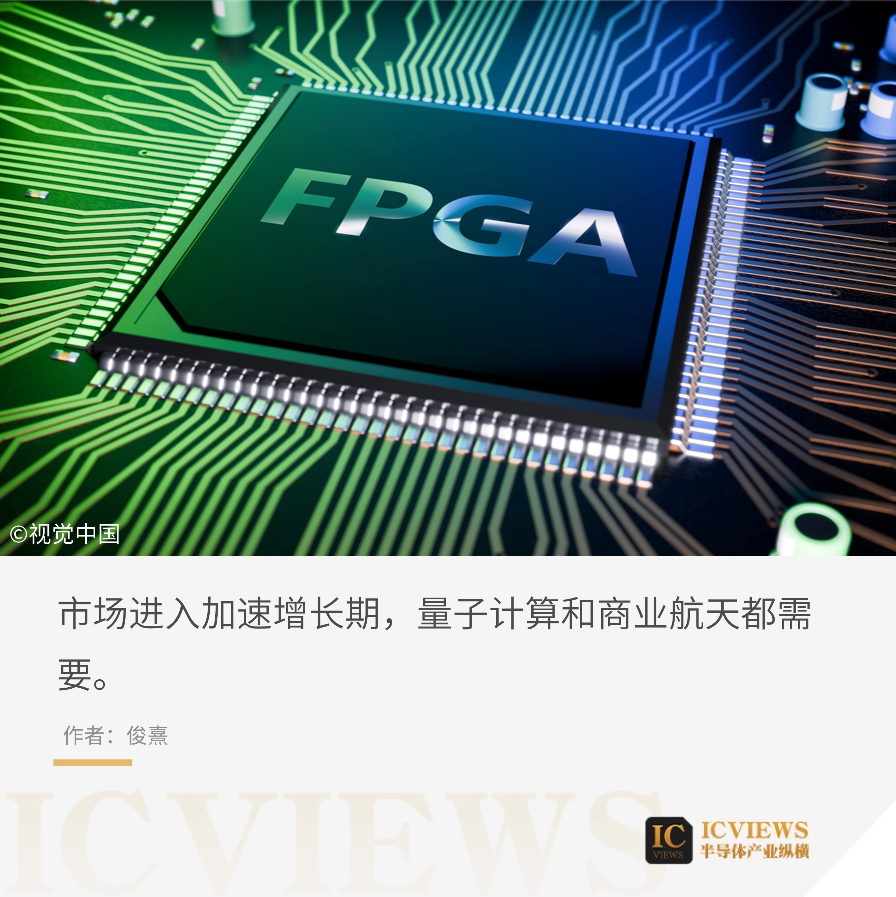
The market demand for FPGA is undergoing profound changes.
According to the latest report from market research firm MarketsandMarkets, the global Field-Programmable Gate Array (FPGA) market is entering a period of accelerated growth, with the projected scale expected to rise from $11.73 billion in 2025 to $19.34 billion by 2030, marking a significant increase in the compound annual growth rate.
Data from TrendForce indicates that this growth is primarily driven by emerging fields such as AI acceleration, edge computing, and robotics. In contrast, the traditional telecommunications sector has seen its growth rate drop below 5%, forming a stark contrast with the over 20% growth in emerging sectors.
Moreover, FPGA has been found to possess unique advantages in recently burgeoning fields like quantum computing and space computing.
This year marks the 40th anniversary of the first commercial FPGA, which introduced the concept of reprogrammable hardware. Today, FPGA's market position seems to be undergoing a 'reprogramming' of its own. Let's explore where this transformation originates and how major manufacturers are responding.
01
FPGA: Securing Three Key High Grounds
AI and Quantum Computing
In the realm of high-performance computing (HPC) and AI infrastructure, CPUs and GPUs are facing increasingly severe challenges from the 'memory wall' and 'I/O wall.' During large model training and inference, the energy consumption and latency caused by data movement often exceed those of the computational tasks themselves. To address this pain point, FPGAs are widely deployed between network interfaces and compute units, acting as data gatekeepers. Through inline processing technology, FPGAs can perform preprocessing tasks such as unpacking, cleansing, and format conversion directly on the transmission path before data enters the GPU or CPU. This near-data computing architecture effectively eliminates noisy data, addressing the common 'garbage in, garbage out' problem in AI training, thereby significantly reducing the invalid load on the main processor and alleviating interconnection bottlenecks in large-scale intelligent computing clusters.
Meanwhile, in the cutting-edge field of quantum computing, FPGAs have demonstrated their ability to break through physical limits in timing control. The core challenge in quantum computing lies in the extreme fragility of quantum bits (qubits), where even minor environmental disturbances can cause rapid decoherence of quantum states. To maintain computational effectiveness, the control system must complete the closed-loop process of 'error detection-decoding-correction' within microsecond-level coherence times. Traditional CPUs or GPUs, constrained by interrupt scheduling mechanisms and instruction pipelines, typically have response latencies in the microsecond or even millisecond range, making it difficult to meet the stringent timing requirements of quantum error correction. In contrast, FPGAs, leveraging pure hardware logic circuits, can achieve deterministic responses at the nanosecond level.
On October 24, IBM stated that using off-the-shelf FPGA chips in conjunction with quantum computers enables real-time execution of complex quantum error correction algorithms, operating over 10 times faster than traditional software decoding solutions while eliminating the need for expensive GPU clusters.
Commercial Space
In the commercial space sector, with the large-scale deployment of low-Earth orbit satellite constellations, spacecraft design philosophies are shifting from expensive customization to low-cost, mass-produced, and rapid deployment. Against this backdrop, FPGAs resolve the adaptability-cost conflict in space environments through their reconfigurable nature. FPGA-based software-defined radio technology allows spacecraft to reconstruct underlying hardware logic circuits by uploading new bitstreams after launch and orbit insertion. This means satellites can flexibly adapt to different ground station communication waveforms or instantly update encryption algorithms in the face of security threats, enabling 'over-the-air' hardware function upgrades.
Furthermore, NASA's High-Performance Space Computing project demonstrates the trend of computing architectures evolving toward open standards by embedding open-source RISC-V soft cores in FPGAs. This heterogeneous approach allows designers to utilize the FPGA's abundant logic resources to implement radiation-hardened designs such as Triple Modular Redundancy (TMR) while retaining the processor's high-level language programming capabilities, significantly reducing system size, weight, and power consumption to meet the engineering constraints of next-generation microsatellites.
Using NASA's recommended service provider and product list in the 'Small Spacecraft Avionics' report as a sample for statistics, FPGAs have become the most widely used chip type among various suppliers.
Embodied Intelligence
In the fields of embodied intelligence and Industry 4.0, robotic motion control and environmental perception impose new requirements for 'physical-level concurrency' on computing chips. Complex robots, such as humanoids, typically possess dozens of degrees of freedom in their joint motors. If CPU or MCU time-sharing multiplexing mechanisms are used to process control tasks, significant task scheduling jitter is likely to occur. In contrast, FPGAs can allocate independent hardware logic blocks to each motor control loop, meaning that regardless of the number of joints in the system, all motor control algorithms run in parallel at the physical level, achieving microsecond-level closed-loop current control. Combined with embedded FPGA (eFPGA) or FPSoC architectures, designers can integrate the CPU's decision-making capabilities with the FPGA's sensing capabilities, with the CPU handling high-level logic such as path planning and the FPGA managing low-level multi-sensor fusion and neural network acceleration. This software-hardware collaborative heterogeneous architecture establishes an excellent balance between edge computing power and power consumption.
02
Leading Manufacturers: Diverse Strategies
Against the backdrop of technological architecture reconstruction, the world's top four FPGA manufacturers—AMD, Altera, Lattice, and Microchip—have formulated differentiated strategic paths based on their respective technological accumulations and market positioning.
AMD: Building a Heterogeneous Computing Ecosystem After integrating Xilinx, AMD is redefining FPGA's business boundaries through 'adaptive computing,' positioning it as a crucial component of its embedded AI and edge computing portfolio. The company focuses on promoting the Versal adaptive SoC platform, which integrates ARM processors, AI engines, DSPs, and FPGA logic, aiming to address millisecond-level real-time control and low-latency requirements that GPUs struggle to cover through heterogeneous architectures, thereby establishing technological barriers in L4 autonomous driving and complex robotics. In the data center sector, AMD leverages Pensando DPU technology to accelerate SmartNICs using FPGAs, addressing data interconnection and movement bottlenecks in large-scale AI clusters.
Altera: Independent Operations and AI Integration In 2025, Altera, operating independently and backed by Silver Lake, is in a period of business recovery. New CEO Raghib Hussain has established a profit-oriented operational strategy and is advancing plans for a 2026 IPO. Technologically, Altera has chosen the 'AI integration' path, embedding AI Tensor Blocks directly into the FPGA logic array in its Agilex 5 series. Unlike AMD's heterogeneous SoC approach, Altera emphasizes deep integration of AI computing power with logic units, offering significant energy efficiency advantages in edge inference scenarios, primarily targeting the industrial vision and medical equipment markets. Meanwhile, Altera aims to lower software development barriers and expand application ecosystems by connecting with the OpenVINO toolchain through the FPGA AI Suite.
Lattice: Consolidating Low-Power Advantages and Expanding into Mid-Range Markets Lattice's strategic focus lies in solidifying its low-power market share while leveraging the Avant platform to penetrate the mid-range market. Addressing the product iteration gap in the mid-range market (100K-500K logic cells), the Avant platform, with its energy efficiency advantages brought by 16nm process technology, has successfully entered the communication edge and industrial automation supply chains. Additionally, Lattice continues to deep cultivation (double down on) its server control chip business, a long-standing area of strength, providing stable cash flow support as AI server shipments grow.
Microchip: Focusing on High Reliability and the RISC-V Ecosystem Microchip continues to deep cultivation (double down on) the high-reliability application market, with its strategic core lying in the integration of radiation-hardened technology and the RISC-V ecosystem. In the commercial space and defense sectors, the RT PolarFire series maintains its competitive edge in deep space exploration with its non-volatile process-derived resistance to single-event upsets. In terms of architectural innovation, Microchip actively promotes the application of the RISC-V architecture, hardening the RISC-V processor subsystem directly within the FPGA in its PolarFire SoC. By defining next-generation space computing standards, it strengthens its technological influence in specialized industries.
03
Domestic Manufacturers: Rising Performance
After a round of inventory adjustment cycles, the domestic FPGA industry is showing signs of moderate recovery alongside technological upgrades.
Financial data from listed companies indicates that the industry's most challenging phase of 'proactive inventory reduction' is nearing its end. Anlu Technology reported revenue of 145 million yuan in the third quarter of 2025, a 11.42% increase quarter-over-quarter, with inventory levels declining by 9.50% year-to-date, establishing a trajectory of performance recovery. Fudan Microelectronics also confirmed favorable shipment conditions for its FPGA product line, with business development trending toward stability. Chengdu Micro demonstrated rigid demand in specialized fields, with revenue growing by 22.45% year-over-year in the first three quarters, primarily driven by increased orders for specialized integrated circuits.
While performance is recovering, domestic manufacturers are accelerating their transformation from single logic devices to SoC-based, AI-enabled, and advanced process technologies, with technological layouts blossoming in multiple areas. Anlu Technology is actively pursuing heterogeneous computing, with its 'Flying Dragon Series' FPSoC integrating dual-core ARM/RISC-V processors and hardware acceleration units, finding applications in agricultural drone flight control and robotic joint control, completing the transition from chip supplier to solution provider. Fudan Microelectronics is advancing its 'chip-software-solution' ecosystem, deploying a computing power spectrum ranging from 4 TOPS to 128 TOPS. Its first 32 TOPS chip has seen favorable adoption, directly competing in the edge AI inference market. Meanwhile, Unigroup Guoxin Microelectronics, a strategic force in the autonomous programmable logic direction, launched the multi-core heterogeneous SoPC product PG2K100, integrating dual-core A53 processors and multi-channel hardcore MIPI, demonstrating excellent performance adaptability in industrial control and automotive electronics.
In terms of process breakthroughs and differentiated interface innovations, the domestic camp has also made significant progress. Unigroup Guoxin Microelectronics released China's first independently developed 50 million-gate-level mass-produced FPGA product, PG3T500, based on FinFET process technology, filling the gap in domestic mid-to-high-end industrialization. Goya Semiconductor has carved out a differentiated path in interface and packaging innovation, being the first in China to achieve independent research and development of the MIPI CPHY interface and successfully integrating a 12.5 Gbps high-speed SerDes interface into small-scale FPGAs, breaking through the performance bottlenecks of traditional small-package chips. In the automotive-grade sector, Goya Semiconductor's products have shipped over 6 million units with a failure rate controlled at single-digit PPM, widely used in core components such as power control and LiDAR, validating the reliability of domestic FPGAs in the automotive supply chain.
-
![]()
Li Shufu's Lesson in 'Abstract' Thinking: With Speed Dividends Peaking, What Will Drive China's Auto Industry Through the Next Two Decades?
-
![]()
World’s Pioneering! Automated Production Line for Million-Scale Volume Holographic Waveguides Launched in Tianjin
-
![]()
Cars Can't Be Made with the 'Quick Buck' Mentality: Li Shufu's Candid yet Impactful Remarks
-
![]()
Can You Snag a Complete Trio of Digital Gadgets for 10,000 Yuan? AI Recommendation Showdown: How Trustworthy Are Doubao, DS, Qianwen, Kimi, and Yuanbao?
-
![]()
DingTalk Undergoes Leadership Overhaul Amid Alibaba’s AI Strategy Unveiling
-
![]()
Revealing the Myth of the '10 Billion Subsidy': Pinduoduo Faces Heightened Scrutiny with Its '100 Billion Initiative'
-
![]()
Yousu's '70,000-Character Long Essay' Resonates with Alibaba Executives' 'Cultural Awareness'
-
Analysis | SpaceX is about to land on Nasdaq. Where is the breakthrough point for China's commercial aerospace?