NIO's Li Bin Bets on Trillion-Yuan Market Cap 'Earnout' Agreement
 03/13 2026
 671
671
Produced by | Yiguan Finance Author | Yecha Baixue
NIO, founded 11 years ago, has often been criticized for its 'losses,' 'cash burn,' and questions about 'when it will turn a profit.' The secondary market has even more dissatisfaction with NIO's sustained losses.
This time, NIO finally had a moment of triumph.
In the fourth quarter of 2025, NIO achieved its first single-quarter profit, fulfilling founder Li Bin's year-old pledge and triggering a capital market frenzy.
Following the earnings release, NIO's U.S.-listed shares surged by over 25% within three days, with a single-day peak gain of 15.18%; its Hong Kong-listed shares (09866.HK) followed suit, soaring by over 16% in a single day. The market demonstrated its recognition of NIO's turnaround with tangible capital inflows.
Meanwhile, another development captured market attention.
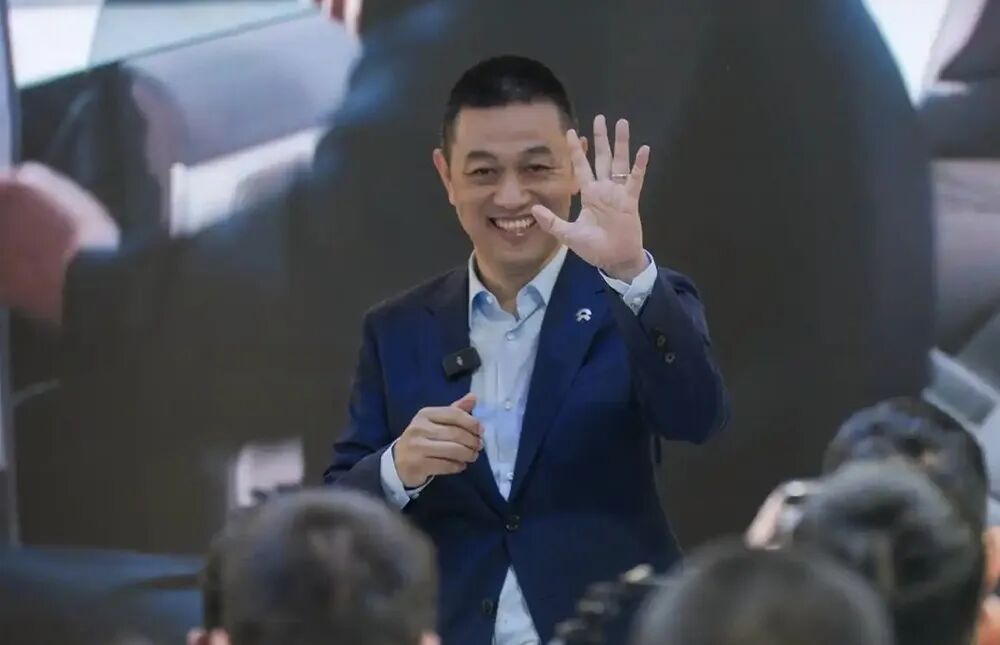
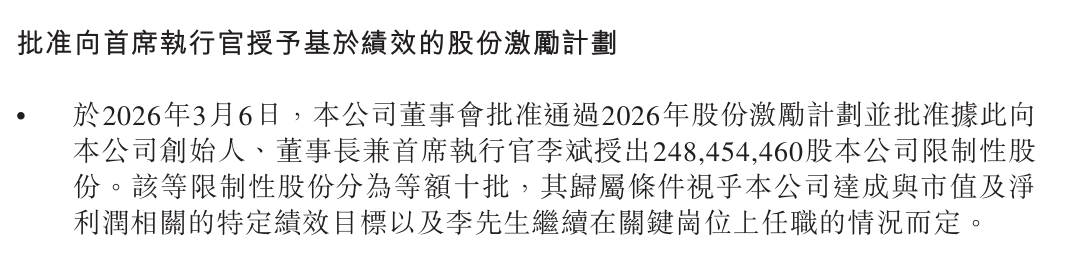
On the day of the earnings release, NIO disclosed a long-term equity incentive plan for Li Bin—granting him 248 million restricted shares, divided into ten equal tranches.
(Source: Earnings Report)
The vesting conditions are deeply tied to the company's market capitalization and net profit—shares will only vest when the market cap sequentially surpasses $30 billion, $50 billion, $80 billion, $100 billion, and even $120 billion.
This is widely regarded as a disguised 'trillion-yuan earnout agreement.' Spanning twelve years, this 'earnout agreement' sends a far more complex signal than a mere earnings report.
Is single-quarter profitability a stroke of luck or a testament to strength? Why does Li Bin believe he can lead NIO to a $100 billion market cap?
Li Bin Delivers on His Pledge, NIO 'Stages a Comeback'
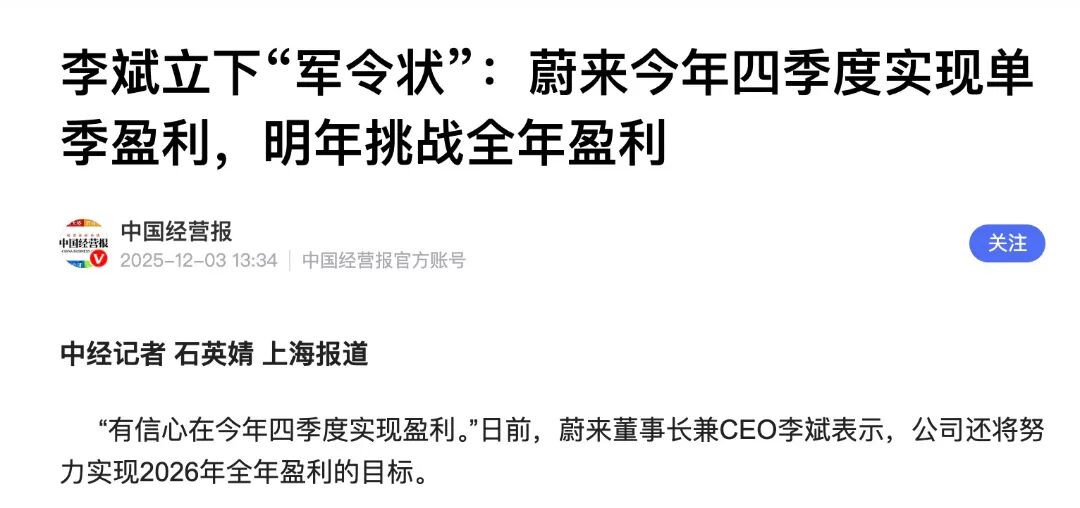
In March 2025, news spread widely that Li Bin had pledged to achieve profitability by the fourth quarter of that year. At the time, NIO was mired in heavy losses, with market doubts mounting. On March 10, 2026, NIO's latest earnings data provided an answer.
(Screenshot from media reports)
The earnings report showed that in the fourth quarter of 2025, NIO achieved an operating profit of RMB 807 million and a net profit of RMB 283 million—its first single-quarter profit in 11 years of operation.
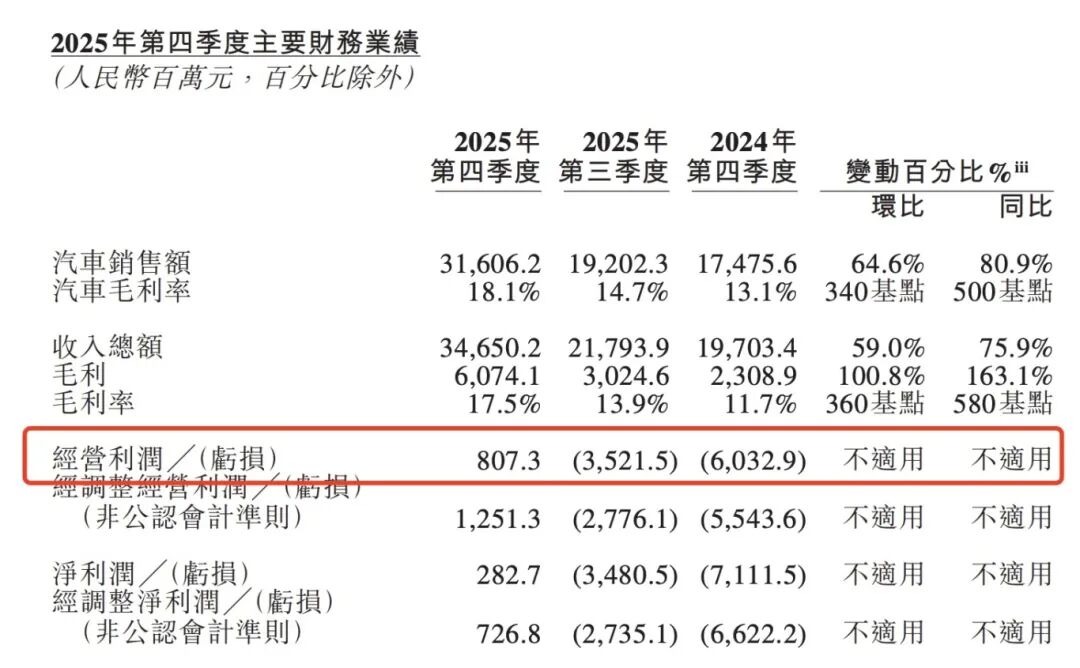
The capital market responded swiftly with positive feedback: following the earnings release, NIO's U.S.-listed shares rose by 15.18%, while its Hong Kong-listed shares surged by over 16% intraday the next day, pushing its market cap back above the RMB 100 billion threshold and reaching a new high for 2026.
Was NIO's 'comeback' to single-quarter profitability a matter of luck or strength?
This profitability was not a fluke but the result of synergistic effects from sales growth, product mix optimization, and cost reduction and efficiency improvement.
First, record-high deliveries. In the fourth quarter of 2025, NIO delivered 124,800 vehicles, up 71.7% year-over-year and 43.3% quarter-over-quarter, setting a new record. Full-year deliveries reached 326,000 units, up 46.9% year-over-year, also a record high. Economies of scale helped dilute fixed costs.
Second, product mix optimization. Multi-brand synergy covered different market segments, driving sales growth. NIO, LEAPMOTOR, and Firefly brands worked in tandem, enabling a record 124,800 deliveries in Q4. Notably, the NIO ES8 set a new record for monthly deliveries of vehicles priced above RMB 400,000; the LEAPMOTOR L90 became the best-selling pure electric large SUV in 2025; and Firefly maintained its leadership in the premium compact car market.
Sales volume was the foundation, but the true driver of NIO's 'comeback' was its growing profitability.
In Q4 2025, NIO's gross margin for vehicles reached 18.1%, up 5 percentage points from 13.1% in the same period in 2024 and 3.4 percentage points from 14.7% in Q3 2025.
Strong sales of high-margin models boosted NIO's profitability. In December 2025, the NIO ES8 achieved 22,256 monthly deliveries, accounting for nearly 70% of NIO-branded sales, with a gross margin of 20%. In Q4, ES8 deliveries reached approximately 39,700 units, accounting for 31.8% of total deliveries, with a gross margin closer to 25%.
Sub-brands LEAPMOTOR and Firefly also began contributing incrementally. In Q4 2025, LEAPMOTOR delivered 38,300 units, while Firefly delivered 19,100 units. The multi-brand strategy not only expanded sales coverage but also began supporting revenue and gross profit.
Finally, cost reduction and efficiency improvement. In Q4 2025, NIO's R&D expenses were RMB 2.026 billion, down sharply by 44.3% year-over-year, with the R&D expense ratio dropping from 26.43% in Q1 to 5.83% in Q4. Selling and administrative expenses were RMB 3.537 billion, down 27.5% year-over-year, with the marketing expense ratio falling from 36.58% to 10.22%.
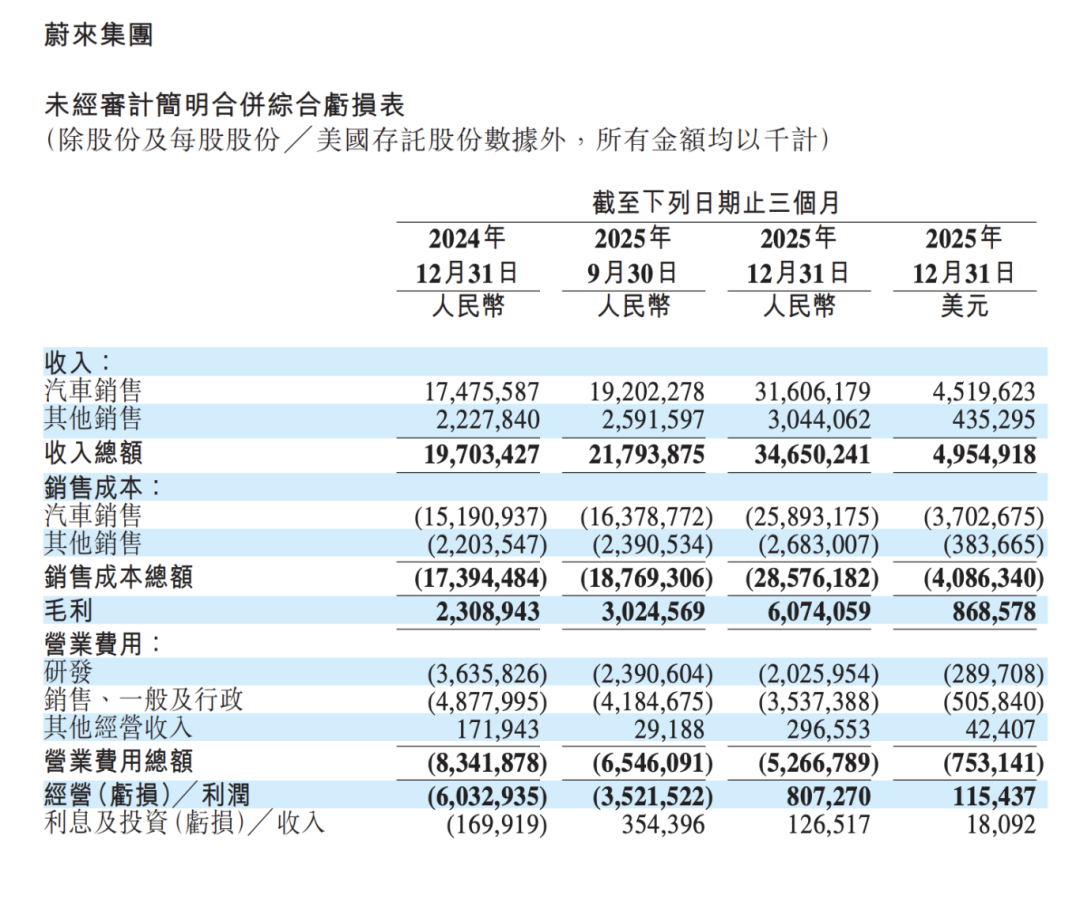 (Source: Earnings Report)
Meanwhile, NIO replaced NVIDIA's Orin-X chips with its self-developed 'Shenji NX9031' chips, optimizing per-unit costs.
Another Trillion-Yuan 'Earnout': A 'Promise' or a 'Sure Thing'?
On the same day as the earnings release, NIO's board approved an equity incentive plan for Li Bin: granting approximately 248 million restricted shares, vesting in ten tranches, with vesting conditions tied to specific performance targets for market cap and net profit. This is widely regarded as a disguised 'trillion-yuan earnout agreement.'
What signals does this 'earnout agreement' send? Is it a 'promise' or a 'sure thing'?
First, deep alignment of shareholder and management interests: management is deeply bound to the company's future, with highly aligned interests, meaning they can only benefit by creating significant shareholder value.
Second, clear long-term strategic goals: the vesting conditions for this equity incentive plan are extremely stringent, directly linked to market cap (surpassing $120 billion) and net profit (currently ranging from $1.5 billion to $6 billion). This means NIO is no longer satisfied with short-term profitability but has established a long-term ambition to become a global tech-driven automaker.
Finally, boosting investor confidence. The company's prolonged losses and repeated survival crises have frustrated investors. Li Bin, as NIO's visionary leader, is attempting to signal to investors through this move that NIO's market cap is severely undervalued. He aims to regather capital market confidence with a long-term narrative and attract long-term investors.
Why Does Li Bin Believe in Himself, and What Gives Him Confidence? How Likely Is NIO to Reach a $100 Billion Market Cap?
Throughout NIO's history, Li Bin has secured investments at critical junctures, driving the company's growth. Why has he attracted global investors during a capital winter? I believe it's not solely due to his personal charm but more because of the company's financial metrics.
Single-quarter profitability proves NIO's ability to turn around, but sustaining profitability faces multiple challenges. From a full-year perspective, NIO has not yet escaped losses. At its current share price, NIO's U.S.-listed market cap remains in the tens of billions of dollars, with over tenfold growth needed to reach the $120 billion target—a highly improbable feat that requires a transformation from an 'automaker' to a 'tech energy giant.'
First, NIO needs to achieve sustainable growth in sales and profitability.
Q4 2025 profitability opened the door to valuation re-rating, but to support a $100 billion market cap, NIO must achieve full-year sustained profitability and demonstrate predictable profit growth.
Setting aside the daunting challenge of a $100 billion market cap, for NIO—which posted a full-year net loss of RMB 14.9 billion in 2025—achieving 'Non-GAAP full-year profitability' in 2026 will be an arduous task.
Externally, competition in the new energy vehicle market is intensifying; policy-wise, further reductions in subsidies are putting pressure on gross margins; cost-wise, rising raw material prices are exerting 'tremendous pressure' on cost control and margins.
Full-year deliveries in 2025 reached 326,000 units. NIO's current three-brand matrix—NIO for premium, LEAPMOTOR for family markets, and Firefly for compact cars—has taken shape, but achieving market penetration to support annual sales of one million units will be no small feat.
The immediate challenge for NIO is how to transition from 'quarterly profitability' to 'sustained profitability.'
Financial structure also warrants attention. As of the end of 2025, NIO's current liabilities exceeded current assets by RMB 7.858 billion versus RMB 7.663 billion, respectively. While the company believes its existing funds are sufficient to sustain operations for the next 12 months, liquidity pressures have not been fully alleviated. With a full-year net loss still at RMB 14.943 billion, achieving the 2026 Non-GAAP full-year profitability target remains unproven.
Second, can the value release of the battery swap ecosystem drive a shift in valuation logic? The ability to fully socialize the battery swap business and convert the swap network into stable cash flows will determine whether the company's valuation logic shifts from 'manufacturing' to 'platform.'
In 2025, NIO's services and community business revenue exceeded RMB 10 billion, achieving profitability. Qu Yu projects that even with the addition of 1,000 new swap stations in 2026, the profitability of this business will continue to improve. The transition of the energy replenishment network from a cost center to a profit center could provide new support for valuation.
Finally, commercialization of full-stack self-developed technologies. External software subscription revenues from intelligent driving algorithms and self-developed chips can unlock significant growth potential, but their contribution must increase substantially as a percentage of total revenue.
NIO's self-developed advanced intelligent driving chip, 'Shenji NX9031,' began external technology licensing in November last year, with cumulative shipments exceeding 150,000 units. Its chip subsidiary, Shenji, completed a first-round financing of over RMB 2.2 billion, with a post-money valuation nearing RMB 10 billion. Shenji's independent operations have opened up Imagining space for external empowerment, but the scale of its future market remains to be seen.
NIO's story is no longer just about car manufacturing but a comprehensive competition involving technology routes, business models, ecosystem construction, and entrepreneurial vision. The ultimate outcome for Li Bin and NIO remains to be seen, and the market will watch closely.
-
![]()
The Unstoppable Rise of 'Optical Progress and Copper Decline': Sunny Optical’s Strategic Vision for the Next Decade
-
![]()
AI + Going Global in the Second Half: No Intermission for Robot Vacuum Cleaners
-
![]()
The Suffering Endured in E-commerce, Walmart Doesn't Want to Repeat in AI
-
![]()
What Does the Doubling of New Energy Vehicle Exports Mean?
-
![]()
Ghosn: 'Only I Can Save Nissan'
-
![]()
Volkswagen Lays Off 100,000 Employees, The Elephant Sits Down
-
![]()
Expanding Production Capacity! Yutong Optics Acquires Approximately 1.5 Hectares of Industrial Land in Chang'an, Dongguan
-
![]()
Why Is Nokia Making a Comeback in the AI Era?