Why Did Microsoft Face Such a Severe Setback?
 02/06 2026
 541
541
Microsoft's stock plunge isn't a tale of "failure"; rather, it's a story of phased costs.
Authored by/Haiyue
Edited by/Shayu
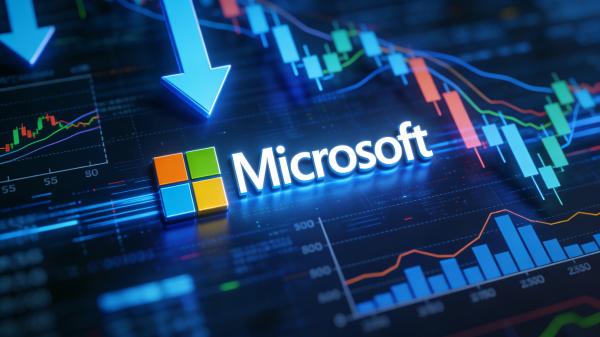
On January 30, 2026, during U.S. stock trading hours, Microsoft's shares temporarily plummeted by over 12%, wiping out approximately $430 billion in market value in a single day—marking the second-largest single-day market cap loss in U.S. stock history. Although the closing decline narrowed to 9.99%, market sentiment couldn't fully recover.
Judging from the results, this was a "financial report without issues." Quarterly revenue soared to $81 billion, up 17% year-over-year; non-GAAP earnings per share reached $4.41, up 23% year-over-year; Azure's growth stood at 38% at constant currency, slightly surpassing consensus expectations. In any normal market cycle, such results would have sufficiently bolstered continued stock price growth.
However, the issue is that the market is no longer operating in a "normal cycle."
In an era where AI is reshaping capital allocation logic, investors are no longer merely concerned with "whether there is growth." Instead, they are asking: Is the growth worth the current price, the current investment, and the current pace?
Microsoft's setback wasn't because AI has lost its allure—quite the contrary, it's because AI is proving to be extremely costly.
AI investments are not without returns; rather, the returns are simply being actively delayed.
What truly rattled the market wasn't Azure's growth slowing from 40% to 38%, but a set of numbers that were harder to ignore: Quarterly capital expenditure soared to $37.5 billion, a 66% year-over-year surge, significantly exceeding market expectations once again.
This was a classic case of misaligned expectations.
Over the past two years, capital markets have formed an almost default assumption: The more invested in AI infrastructure, the faster cloud business growth should be. In other words, the market expected a near-linear relationship—as CapEx rises, Azure's growth should immediately accelerate.
But Microsoft's reality is: Money is being spent at an ever-faster pace, yet cloud growth hasn't taken off in sync.
This doesn't imply that demand is lacking. On the contrary, Microsoft's management repeatedly emphasized on the earnings call that Azure's current core constraint is capacity, not orders. Against a backdrop of tight computing power, Microsoft has chosen to prioritize allocating new computing resources to first-party products and internal R&D, rather than fully monetizing them for short-term external cloud revenue.
From a corporate strategic standpoint, this choice is not difficult to comprehend.
For Microsoft, Azure is not the endpoint but the infrastructure foundation of the AI era. What truly determines long-term value is whether high-margin, high-stickiness application-layer products—such as Copilot or even more AI workflows yet to materialize—can emerge on top of this foundation.

The problem is that capital markets are not adept at pricing in "delayed fulfillment" narratives.
What does a $37.5 billion quarterly expenditure signify? It means Microsoft is no longer just "doubling down" but betting on a long-term path. This scale of investment essentially shifts cash flows from the next few years—or even longer—into today's cost structure.
In an environment where interest rates remain high and global capital risk appetite tightens, such behavior naturally triggers a revaluation at the valuation level.
More importantly, the "verifiability" of this investment is extremely low.
Is computing power being utilized in the most effective way?
When will internal products generate scalable revenue?
Will the marginal returns on AI infrastructure decline as rapidly as they did in the early days of cloud computing?
These questions currently lack clear answers.
Capital markets can tolerate uncertainty but cannot accept uncertainty without a clear timeline. And Microsoft is precisely in such a phase: Its strategic direction is clear enough, but the path length and return curve remain highly ambiguous.
Standing at the ecosystem's center has become a source of risk exposure.
If capital expenditure was merely the emotional trigger, what truly unsettled the market was Microsoft's increasingly complex position within the AI ecosystem.
On one hand, Microsoft remains one of the most core infrastructure providers in the global AI wave; on the other, it is highly business-bound to OpenAI. According to disclosures, about 45% of Microsoft's future $625 billion in cloud service contracts are related to OpenAI.
This is an extremely rare relationship structure.
From a commercial perspective, OpenAI has brought unprecedented demand growth to Microsoft; from a risk perspective, this concentration alone is enough to keep any long-term capital vigilant. Especially as OpenAI advances new funding rounds while introducing multiple cloud and chip partners, the market is beginning to realize a problem: Microsoft does not fully control the pace of this value chain.
More subtly, Microsoft is attempting to "de-OpenAI-ize" but has not fully succeeded.

Self-developed chips, the MAIA series, and internal model frameworks represent Microsoft's key efforts to reduce external dependencies. However, these initiatives are still in their ramp-up phase, with improvements to gross margins and cost structures remaining at the expectation level.
Meanwhile, while AI monetization at the application layer has shown clear progress, it has not yet formed a scale sufficient to cover infrastructure investments. Copilot's user base is growing rapidly, and usage frequency is rising, but this resembles a "slow-moving curve" rather than a cash flow engine that can offset computing costs in the short term.
In other words, Microsoft is undergoing a typical phase of strategic leadership but financial lag.
During this phase, the company's internal logic is self-consistent: Sacrificing short-term visibility for long-term technological and ecological advantages. However, in the secondary market, this logic is easily reduced to a single sentence: Spending too much, earning too slowly.
This is why even as Goldman Sachs, Morgan Stanley, and other institutions maintain "buy" ratings, they simultaneously lowered target prices and valuation multiples. Not because they are bearish on Microsoft, but because the AI-era valuation framework is changing—markets are beginning to scrutinize capital efficiency more seriously rather than simply rewarding scale and narrative.
Epilogue
Microsoft's stock plunge isn't a story of "failure"; rather, it's a tale of phased costs.
In the global AI race, Microsoft still occupies one of the most advantageous positions: It boasts the strongest enterprise customer base, the most mature cloud infrastructure, and the deepest product penetration capabilities. But it is also paying an increasingly clear cost—the front-loading of capital expenditures and the resulting valuation pressure.
This is not a problem unique to Microsoft but a shared contradiction of the entire AI era:
When technological progress requires massive upfront investments, will capital markets still be willing to infinitely discount the present for "future certainty" as they did in the past?
With a 12% decline, Microsoft has prematurely posed this question to all tech giants.
In the short term, stock price volatility may persist; but over a longer horizon, this feels more like the beginning of a revaluation—markets are no longer simply paying for "AI narratives" but are demanding clearer return paths.
For Microsoft, the real test lies not in the next earnings report but in whether, when new computing capacity comes online and internal products mature, it can prove that this expensive bet was ultimately worth it.
-
![]()
Li Shufu's Lesson in 'Abstract' Thinking: With Speed Dividends Peaking, What Will Drive China's Auto Industry Through the Next Two Decades?
-
![]()
World’s Pioneering! Automated Production Line for Million-Scale Volume Holographic Waveguides Launched in Tianjin
-
![]()
Cars Can't Be Made with the 'Quick Buck' Mentality: Li Shufu's Candid yet Impactful Remarks
-
![]()
Can You Snag a Complete Trio of Digital Gadgets for 10,000 Yuan? AI Recommendation Showdown: How Trustworthy Are Doubao, DS, Qianwen, Kimi, and Yuanbao?
-
![]()
DingTalk Undergoes Leadership Overhaul Amid Alibaba’s AI Strategy Unveiling
-
![]()
Revealing the Myth of the '10 Billion Subsidy': Pinduoduo Faces Heightened Scrutiny with Its '100 Billion Initiative'
-
![]()
Yousu's '70,000-Character Long Essay' Resonates with Alibaba Executives' 'Cultural Awareness'
-
Analysis | SpaceX is about to land on Nasdaq. Where is the breakthrough point for China's commercial aerospace?