A Token Cloud Looms on the Horizon
 07/15 2026
 414
414
Over the past six months, the cloud computing sector has been singularly focused on one theme: token sales.
Nearly all major cloud service providers have fully embraced token-based billing for their AI services, swiftly abandoning traditional CPU and memory leasing models, as well as time-based billing. Suddenly, tokens have become the cornerstone of the cloud industry.

Following the explosive popularity of Seedance 2.0, ByteDance's daily token consumption in the video model market now accounts for a staggering 80% of the entire market share. Token sales are soaring.
In March of this year, Alibaba announced the formation of the Alibaba Token Hub (ATH) business group, directly overseen by CEO Wu Yongming. Its strategic vision is to "create, deliver, and apply tokens." To support this goal, Alibaba Cloud has even implemented a sales evaluation system centered around token value.
While internet cloud providers are enthusiastic, emerging cloud computing forces, represented by telecom operators, are also vying for prominence [bù gān shì ruò] (unwilling to play second fiddle). In May, China Mobile officially unveiled its Token Operation Ecosystem at the 2026 Mobile Cloud Summit, launching the Token Operation Ecosystem Alliance in collaboration with ecosystem partners.

At this juncture, it's clear that in 2026, tokens will be the buzzword at every cloud computing conference and event, without exception. Tokens dominate the cloud landscape wherever you look.
But is selling tokens really that straightforward? Is the widespread adoption of the token economy driven by genuine demand, or is it merely wishful thinking on the part of cloud providers?
I aim to present a counterpoint to this token-dominated cloud narrative.

The primary advantage of token-based billing is its alignment with the flexible usage patterns of AI. You pay for what you use, making AI more accessible and cost-effective for small and medium-sized developers.
However, as with most things in life, there's a flip side. What benefits small and medium-sized developers may not necessarily be advantageous for large enterprises.
Large government and corporate users have substantial AI access needs, and token consumption can quickly escalate to astronomical levels. For them, token-based billing may not be cost-effective and poses a significant challenge: budgeting becomes nearly impossible.

Token costs are essentially a form of IT expenditure, and for large enterprises, IT spending revolves around fixed costs, advance planning, and stringent budgeting.
Many IT department roles are dedicated to budgeting and cost control. Yet, with token-based billing, IT spending suddenly becomes highly variable and difficult to manage. If a business department decides to embark on a challenging project on a whim, the token bill could skyrocket overnight. Consequently, the IT department's annual cloud service budget could be depleted in a single night.
To facilitate enterprise AI adoption, we might accept this scenario. So, the IT department pleads for and coordinates an increased budget. But then, the following month, token consumption drops sharply, leaving the increased budget unused. The question then arises: how should future AI budgets be set? Should they be set at all? Should the IT department or the business department bear the AI costs? After heated debates, the likely conclusion is that public cloud + AI is not yet mature, and on-premises deployment is recommended.

No one can accurately predict costs in advance, not only because token triggers are unpredictable but also because cloud providers' discount schemes are often manipulative.
Token prices are dictated by leading cloud providers and large model companies, resulting in highly volatile pricing. The usual tactic is a price war: cloud providers aggressively reduce token prices to attract users. Once users are hooked, they withdraw discounts and reduce subsidies, leaving enterprises with exorbitant token bills. This year, we've witnessed many popular models experience price hikes of tens or even hundreds of times per thousand tokens.
Small businesses might fare better, as they can adapt quickly and stop using tokens when prices rise. However, large enterprises face significant business inertia and high validation costs, often left to suffer in silence when cloud providers employ such tactics.
For over a decade, cloud computing has been seen as more accessible to small businesses and less attractive to large enterprises. Focusing on the token economy exacerbates this issue. Large enterprises dare not adopt AI that renders their budgets meaningless.

If canceling discounts and indirect price hikes represent the black box of token billing on paper, then in practice, enterprises discover that this new model is riddled with layers of complexity. While the token economy is still in its infancy, the opacity surrounding tokens created by cloud providers is already flourishing.
Traditional cloud service billing models, such as charging by rental duration or server quantity, are relatively straightforward—akin to a flat-rate charter service. However, token-based billing resembles taxi metering: it seems fair based on usage, but whether the provider takes a detour or the meter jumps every 800 meters instead of every kilometer remains unknown.

Many enterprises report that cloud providers' token deductions generally exceed their estimated usage. This phenomenon is particularly evident when purchasing AI gateway services, where systems may inflate access volumes, lack usage caps, and encourage excessive token consumption.
Beyond inflated access volumes, the token model may also involve misleading practices. Many enterprise users find that the APIs they purchase cannot pass official model authentication, likely due to the substitution of expensive closed-source models with fine-tuned open-source alternatives.
Another tactic involves cloud providers offering "value-added services" such as Agent frameworks and model instances at bargain prices, essentially free. Initially, enterprises feel cared for, only to discover later that these services are designed to lock them in. Once adapted, switching to other cloud services incurs significant costs. If an enterprise's AI architecture becomes deeply reliant on a single cloud provider's ecosystem, token price hikes can be used to trap users, ensuring the provider meets its KPIs.

Even if enterprises resolutely migrate to other cloud ecosystems, problems persist. They find that API standards, token billing models, and model ecosystem tools vary widely among cloud providers. Enterprises must start from scratch, learning and adapting to another provider's complex schemes.
The lack of industry standardization is the root cause of all token opacity.
Who came up with this token concept? It may be small, but it packs quite a punch.

For enterprise users, accessing large models on public clouds presents an inherent challenge: security.
The token economy has risen too quickly, and cloud providers' ambitions have blinded them to security considerations. Compared to traditional IT or software services, enterprise large models are inherently insecure scenarios. Accessing large models on the cloud means sending all relevant information to the cloud, where providers can see all user requests and responses. As tokens circulate, all sensitive enterprise information flows out as well.

Is there a solution to this problem? So far, cloud providers have not offered technically convincing solutions. Instead, they emphasize their regulatory frameworks and corporate ethics. Friends, this is the cutthroat battlefield of cloud services. Believing in their ethical standards requires evidence of past achievements, doesn't it?
While tokens leak enterprise information, users may also face a series of security-related issues. For example, can service continuity be guaranteed? How can timely operational support be ensured under token-based billing? How can large models adapt to stringent enterprise production environments?
These security risks remain unresolved at this stage. The booming token + cloud ecosystem is essentially experiencing wild growth and disorderly expansion.

Let's shift our focus to cloud providers. The cloud computing industry [sài dào] (track) sees new trends every year, but few manage to turn a profit. Each new trend forces cloud providers to reshape their business landscapes and organizational structures—something they're accustomed to doing repeatedly.
The key question with the token economy is whether it can differ from past AI trends and enable cloud providers to genuinely profit.
It's hard to say at this point. High-quality, even monopolistic models, have seen strong commercial feedback so far. However, the vast majority of cloud providers continue to invest in and incur losses from token economies and related large models and Agent businesses.
The fiercely competitive cloud computing landscape means that every commercially viable niche model track [sài dào] (track) faces intense competition. When competition becomes too fierce, cloud providers typically slash token prices, leading to another decline in overall cloud computing revenue. At that point, the token economy transforms from a lucrative opportunity into a disappointing endeavor, repeating the cycle endlessly.

The underlying logic that undermines the token economy's potential is that tokens need to help cloud providers' users generate revenue. However, this billing model means that as enterprise revenues and user numbers grow, token consumption increases accordingly. Essentially, enterprises developing AI applications and scenarios may end up working for cloud providers. This is a difficult business model to sustain.
But it doesn't matter—new trends will emerge after technological upgrades. Last year, it was SaaS; this year, it's tokens. As the song goes, "I've done whatever it takes to make money."
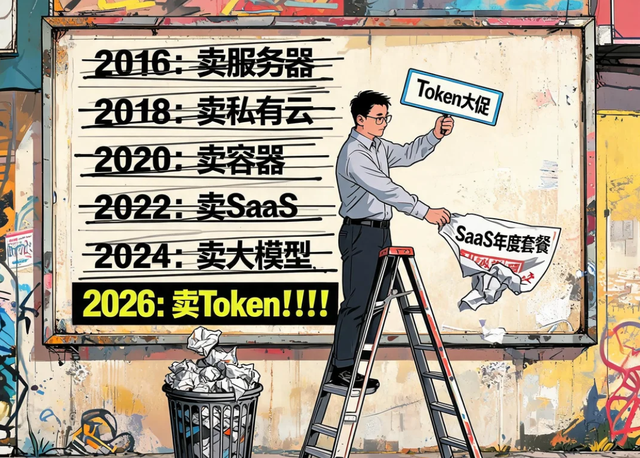

Ultimately, cloud providers aim to sell fixed model and infrastructure costs at high margins with decreasing marginal costs. At this stage, the token economy represents a lucrative economic behavior with substantial average order values and profit margins that align with societal trends. The rush to capture this market is undeniable.
The issue lies in how the token economy's hype has inadvertently created a chaotic, wild west environment. Non-standard industry rules, endless billing schemes, and unresolved security risks allow cloud providers to exploit users' pursuit of AI trends for quick gains. However, this business model is unsustainable, akin to killing the goose that lays the golden eggs.
These issues demand resolution and cannot be allowed to fester, leaving customers increasingly dissatisfied. Cloud providers have no retreat left. AI was once seen as cloud computing's second front, but now it has become the primary—perhaps even the only—battlefield.
This battlefield [zhàn chǎng] (battlefield) requires not just cheap tokens and token-centric strategies but also more powerful models, enterprise-friendly technologies, commercial credibility, and corporate responsibility.

The future of tokens lies within the cloud computing industry; the answers about tokens still drift in the wind.
-
![]()
How Can Embodied AI Overcome the Data Challenge of 'Being Able to Work'? Solutions from Five Leading Players
-
![]()
Half-Year Pre-Tax Loss Hits 4.5 Billion, Full-Year Net Cash Outflow Reaches 16.2 Billion! GAC Incurs 8,000 Yuan Loss per Vehicle Sold
-
![]()
In a Bid to Propel Towards a $10 Billion IPO, Jieyue Xingchen Weaves a Hardware Fairy Tale: A 'Chinese Version of Apple + OpenAI'?
-
![]()
REDMI Note 17 Pro First Impressions: Built to Last and Waterproof, Who Cares About Cost-Effectiveness?
-
![]()
MiHoYo’s AI Companion BSide is Here! I Tried It Out—Great Aesthetics, But Needs Work
-
![]()
A Token Cloud Drifting in the Winds of Change
-
![]()
A Token Cloud Looms on the Horizon
-
![]()
Qualcomm, NVIDIA, and Horizon Robotics: Pioneering Similar Paths in Automotive Tech