In a Bid to Propel Towards a $10 Billion IPO, Jieyue Xingchen Weaves a Hardware Fairy Tale: A 'Chinese Version of Apple + OpenAI'?
 07/15 2026
 359
359
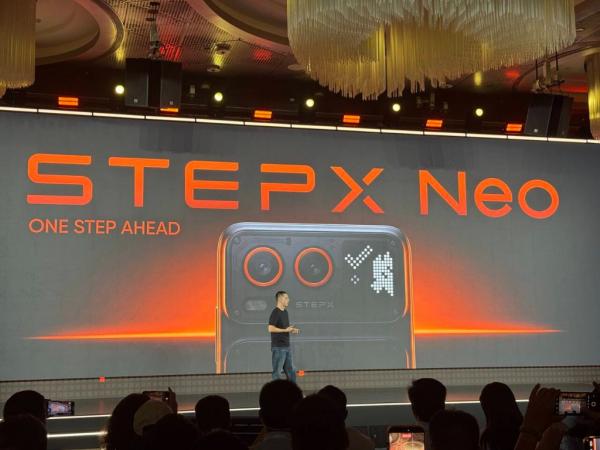
On the evening of July 13, in Shanghai.
Yin Qi, one of the 'AI Four Little Dragons' and founder of Megvii Technology, took the stage as chairman of the large model unicorn 'Jieyue Xingchen' just 170 days into his tenure, holding a press conference. At the event, Jieyue Xingchen unveiled its intelligent agent-native operating system, Step AOS, personal intelligent agent Amoo, and directly presented a large model-native intelligent agent phone, STEPX Neo.
An AI large model company venturing into the capital-intensive smartphone manufacturing sector?
The press conference lacked an experience zone. The real device made only a fleeting appearance on the podium, with even the most fundamental details—such as price, core specifications, and release date—remaining undisclosed. This was less of a traditional phone launch and more of a 'probe' by Jieyue Xingchen into the capital markets and tech circles.
Yin Qi, a prodigy from Tsinghua Yao Class who led Megvii Technology through three failed IPO attempts with cumulative losses nearing $1.5 billion, now plunges headfirst with Jieyue Xingchen—valued at nearly $10 billion—into the fiercely competitive smartphone market, where supply chains are deeply entrenched. Is this a strategic move by large model companies to break through 'application silos,' or is it a capital story forcibly packaged to expedite a Hong Kong IPO?
In today's smartphone industry, no press conference is complete without a mention of AI.
However, AI phones from Apple, Huawei, and Xiaomi essentially add an AI 'gateway' to existing operating systems like iOS or Android, appending an 'external' assistant. AI remains a 'guest' within these systems, its capabilities constrained by the number of interfaces the system and super apps are willing to expose.
Jieyue Xingchen aims to disrupt this underlying logic. Yin Qi's vision is audacious: 'Opening a door for intelligent agents in old systems leaves them as permanent guests. Build them a house, and they become natives.'
To construct this 'house,' Jieyue Xingchen developed Step AOS, an intelligent agent-native operating system. Here, the traditional phone interaction logic is overturned. Previously, using a phone involved 'process interaction': to plan a Beijing business trip, you'd manually open Ctrip for flights, switch to WeChat for messages, and then open the calendar for scheduling.
Step AOS pursues 'outcome interaction.' You simply tell the agent, 'Arrange my trip to Beijing tomorrow night.' System resources and app functions are fragmented into 'atomic capabilities,' automatically invoked and executed across apps by the agent.
To support this ambition, Jieyue Xingchen breaks down data silos between apps, employs 'edge-cloud multi-brain' collaboration, and eschews the criticized 'simulated finger taps' for deep interface protocols, allowing agents to operate in the background directly.
This innovation sounds impressive—the reason STEPX Neo earned China's sole 'Artificial Intelligence Terminal Intelligence Grading L3' certification. Yet, for all its forward-thinking, it remains a 'phantom phone' with no announced mass-production timeline.
Why would a large model company venture into hardware, a 'death trap' proven by internet pioneers like Amazon's Fire Phone and Gree's smartphone?
Jieyue Xingchen isn't building phones for their razor-thin hardware margins. This reflects the 'entry anxiety' plaguing all Chinese large model companies.
The first half of the large model industry was dominated by parameters and benchmarks. Now, the second half demands monetization.
If large model companies stick to apps, they remain passive tools, their fates controlled by others. Apple, Huawei, and Xiaomi aggressively develop in-house large models, reserving system-level privileges for their own solutions. Third-party large model apps, denied access to sensors, calendars, and galleries, remain 'smart chatboxes.'
Super apps like WeChat, Alipay, and Meituan guard their data like fortresses. Without cross-app ecosystem integration, large models can't accomplish real tasks.
'Entry points will narrow. Without system-level access, intelligent agents remain cloud-bound, waiting to be called,' Jieyue Xingchen is acutely aware.
Over the past two years, Jieyue Xingchen has provided large model infrastructure for over 60% of Chinese phone makers—yet remained an 'invisible man,' denied core data and vulnerable to being replaced by in-house models.
Thus, Jieyue Xingchen's hardware logic: buy the device, get the system—and seize the entry point.
Yin Qi doesn't expect hardware profits or revenue from pre-installed apps or pop-up ads. Instead, he returns to 'Token consumption.' The phone is just a container; when users rely on agents for tickets, rides, and work, the real value lies in backend computing services and commissions.
But ideals often clash with reality.
Missing super app: Why won't Tencent cooperate?
For agents to act on users' behalf, they need access to national-level services. At the launch, Jieyue Xingchen brought aboard Ctrip, Alipay, Didi, Meituan, WPS, and others. Yin Qi stressed that unlike the ill-fated 'Doubao Phone' approach of simulated taps, Jieyue Xingchen binds deeply via API interfaces.
Yet, awkwardly, Tencent—Jieyue Xingchen's key investor—kept WeChat off the initial partner list.
Can a phone without system-level AI integration with WeChat sell in China? Super apps guard their data fiercely; previous AI phones trying to read WeChat via simulated taps were banned.
Even with APIs, Alibaba and Meituan might open edge services, but getting WeChat to expose bottom-layer interfaces to a third-party agent system? That's like 'taming a tiger for its fur.'
Moreover, hardware is a tough business.
Manufacturing demands massive upfront capital, inventory management, yield scaling, offline channels, and after-sales networks.
Jieyue Terminal President Ni Jiayue understands this, but even with manufacturing giant Huaqin Technology as a shareholder, building phones remains a capital-heavy grind.
Especially for a device claiming to run billion-parameter models locally while managing power and heat—its mass-production costs remain uncertain.
Without scale, there's no supply chain leverage. Jieyue Xingchen admits 'no sales targets,' but in phones, low sales mean no access to the latest chips or reduced BOM costs.
Furthermore, AI phones' main selling point—'full automation'—requires deep system access to locations, chats, bank cards, and schedules. Amid rising privacy concerns, will users trust a year-old large model company with their data? A single 'AI mis-transfer' or 'privacy leak' could crush Jieyue Xingchen.
Given these 'three mountains,' why push forward?
Because the capital window for large models is closing rapidly.
Among the 'Six Little Tigers' of large models, Zhipu and MiniMax have already rushed to capital markets. Moonshot AI targets consumers with Kimi's ultra-long text, while Baichuan AI focuses on healthcare. If Jieyue Xingchen remains just an API provider, it won't fetch premium valuations.
Recently, Jieyue Xingchen secured a nearly $2.5 billion B+ round led by a Hong Kong investor, valuing it at $9 billion pre-money. It dismantled its red-chip structure, entering Pre-IPO mode, aiming to be Hong Kong's 'third large model stock.'
At this juncture, capital markets crave not 'another parameter boost' but 'the ultimate AI commercial closed loop.' This is Yin Qi's genius. After Megvii's five-year, three-IPO failures, he knows exactly what capital wants.
Building a large model-native phone and launching Step AOS isn't just about hardware—it's weaving a grand tale of 'China's Apple + OpenAI.' Through software-hardware integration, Jieyue Xingchen seeks to prove to HKEX that it's not just an AI algorithm seller but an ecosystem giant capable of defining future smart terminals and owning physical-world traffic entry points.
-
![]()
How Can Embodied AI Overcome the Data Challenge of 'Being Able to Work'? Solutions from Five Leading Players
-
![]()
Half-Year Pre-Tax Loss Hits 4.5 Billion, Full-Year Net Cash Outflow Reaches 16.2 Billion! GAC Incurs 8,000 Yuan Loss per Vehicle Sold
-
![]()
In a Bid to Propel Towards a $10 Billion IPO, Jieyue Xingchen Weaves a Hardware Fairy Tale: A 'Chinese Version of Apple + OpenAI'?
-
![]()
REDMI Note 17 Pro First Impressions: Built to Last and Waterproof, Who Cares About Cost-Effectiveness?
-
![]()
MiHoYo’s AI Companion BSide is Here! I Tried It Out—Great Aesthetics, But Needs Work
-
![]()
A Token Cloud Drifting in the Winds of Change
-
![]()
A Token Cloud Looms on the Horizon
-
![]()
Qualcomm, NVIDIA, and Horizon Robotics: Pioneering Similar Paths in Automotive Tech