Qualcomm, NVIDIA, and Horizon Robotics: Pioneering Similar Paths in Automotive Tech
 07/15 2026
 331
331
As we progress through 2026, the automotive industry faces a challenging landscape. In the first quarter, profit margins plummeted to 3.2%, marking a decade-low. Concurrently, NIO announced that shipments of its self-developed Thor chip had exceeded 550,000 units, slashing the hardware cost of intelligent driving per vehicle by about 10,000 yuan. Li Auto's Mach M100 reached mass production in May, becoming the world's first mass-produced dynamic data stream AI chip. Amidst these contrasting trends—declining profits juxtaposed with rising innovation—a clear industry signal emerges: when profit margins are squeezed, any technology that can reduce BOM costs is embraced. Cockpit-driving integration and central computing are at this crucial juncture.
Traditionally, smart cars required at least two independent computing systems—one for the intelligent cockpit and another for intelligent driving. Each had its own chips, memory, cooling systems, and wiring layouts. These two 'brains' operated in isolation, leading to hardware redundancy, wasted space, and inefficient system coordination. Today, cockpit-driving integration merges these two 'brains' into one. The crux of this transformation lies in using a single chip to handle both cockpit and intelligent driving computations while sharing a unified memory pool—an ultimate form known in the industry as 'single-chip shared memory.' The shift from 'one box with dual boards' to 'one chip with shared memory' is rapidly reshaping automotive semiconductor rules.
The hardware integration of cockpit-driving systems has evolved steadily. Initially, it took the form of 'One Box': a single enclosure housing two boards. The intelligent driving domain controller and the intelligent cockpit domain controller coexisted within the same physical chassis but operated independently. Its primary advantage was in saving separate housings and simplifying wiring. Tesla's HW3.0 and HW4.0, along with Xiaomi's four-domain integrated controller, exemplify this form.
The next evolutionary step was 'One Board': a single board featuring dual chips. The computing chips for intelligent driving and the cockpit were placed on the same printed circuit board, transforming inter-chip communication from a cumbersome process to a more streamlined one. NIO's 2024 central computing platform, ADAM, adopts this hardware form: intelligent driving and cockpit chips are on the same PCB but are hardware-isolated. By 2026, GAC officially launched the Xingling Electronic and Electrical Architecture 4.0, equipped with a 3nm flagship chip, achieving the first integration of six domains: intelligent driving, intelligent cockpit, chassis, powertrain, body, and connected car. XPENG unveiled its new-generation EEA4.0 electronic and electrical architecture, while Xiaomi's YU7 integrated four domains, reducing the volume of the electronic and electrical architecture by 57%. Leading domestic automakers have established an EEA architecture system consisting of 'one central computing platform plus two to four regional controllers.' Chips are no longer mere hardware procurement items but core components of the vehicle's intelligent architecture.
The ultimate form is 'One Chip': single-chip shared memory. A single system-level chip simultaneously handles cockpit and intelligent driving computations, with data flowing freely within the chip at nanosecond-level latency and hundreds of GB per second bandwidth. Computing resources become a unified pool that can be dynamically allocated. Solutions like Horizon Robotics' Xingchen 6P and Black Sesame Technologies' Wudang C1296 aim for this level.
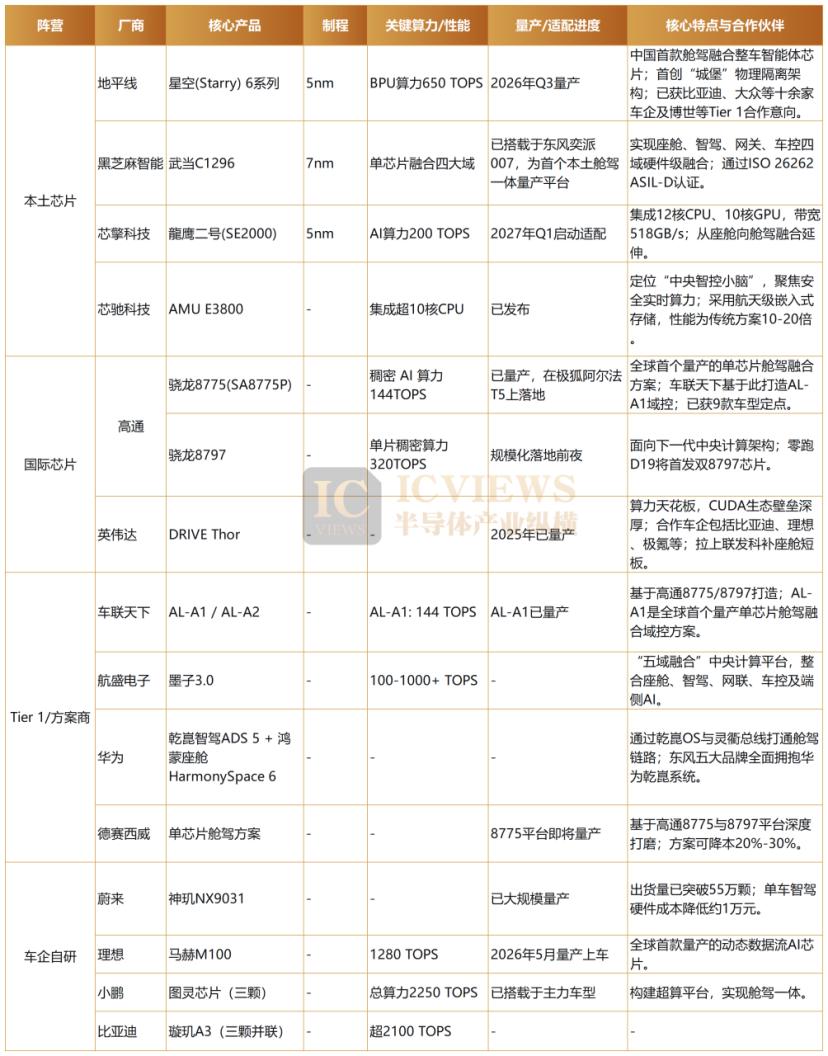
In this competitive landscape, local chip manufacturers have emerged as formidable players. In April 2026, Horizon Robotics released China's first cockpit-driving integrated vehicle intelligence chip, the 'Xingchen' 6 series. The flagship Xingchen 6P, crafted with a 5nm automotive-grade process, delivers 650 TOPS of BPU computing power and boasts a memory bandwidth of 273 GB/s. Critically, Horizon Robotics pioneered the 'Castle' physical isolation architecture within the chip—the cockpit and intelligent driving operate on independent computing units without interference while sharing memory. The Xingchen 6P has garnered cooperation intentions from over ten automakers, including BAIC, BYD, Changan, and Volkswagen, as well as domestic and international Tier 1 suppliers like Bosch and Denso. Chery's iCAR has announced itself as the first partner for the Xingchen chip. Yu Kai, founder of Horizon Robotics, stated that this chip aims to simultaneously 'reduce space occupancy by 50%, lower the comprehensive cost per vehicle by 1,500 to 4,000 yuan, and shorten the research and development delivery cycle from 18 months to 8 months.'
Almost simultaneously, Black Sesame Technologies inked a platform-level cooperation agreement with Dongfeng Motor. The Dongfeng Tianyuan Intelligent Cockpit Plus, a cockpit-driving integrated mass-production platform jointly developed by the two parties, is equipped with the Wudang C1296 chip. The Wudang C1296, crafted with a 7nm automotive-grade process, achieves hardware-level integration of four domains—cockpit, intelligent driving, gateway, and MCU vehicle control—on a single chip. It has also passed ISO 26262 functional safety's highest certification level, ASIL-D. This platform will debut on the Dongfeng eπ007 and is planned for scalable application across multiple mass-produced models from 2026 to 2027. This marks the first local cockpit-driving integrated mass-production platform. Ding Ding, Vice President of Products at Black Sesame Technologies, revealed that the company's next-generation chip is already in planning and is expected to launch around 2027, featuring a more advanced process node.
In April 2026, Semidrive Technology unveiled the 5nm automotive-grade AI cockpit-driving integrated chip 'Dragon Eagle II.' With 200 TOPS of AI computing power, it integrates a 12-core CPU, a 10-core GPU, and offers a bandwidth of up to 518 GB/s. It natively supports multimodal large models exceeding 7B parameters and is planned for adaptation starting in the first quarter of 2027. Wang Kai, founder of Semidrive Technology, disclosed that the Dragon Eagle II can simultaneously handle the parallel execution of three complex tasks: AI, intelligent cockpit, and intelligent driving. After selling one million units of the 'Dragon Eagle I' in the cockpit market, Semidrive capitalized on the opportunity to launch the 'Dragon Eagle II' in April 2026. Featuring 5nm technology and 200 TOPS of power, adaptation is set to begin in Q1 2027. According to Wang Kai, this chip can simultaneously support AI, cockpit, and intelligent driving tasks. Notably, its architecture covers various price segments, from entry-level to flagship models—Semidrive clearly does not intend to limit itself to the cockpit market.
Semidrive Technology took a different approach by releasing the AMU safety real-time computing base for central supercomputing architectures. Its flagship product, the E3800, integrates over ten cores on a single chip, introduces aerospace-grade embedded memory with performance ten to twenty times that of traditional eFlash, and incorporates a high-performance NPU for deep CPU-NPU coupling and collaboration. Semidrive positions itself as the 'central intelligence control cerebellum,' providing a real-time computing base for the vehicle's central computing. Unlike Horizon Robotics and Black Sesame Technologies, which focus on high-computing-power AI SoCs, Semidrive concentrates on safety computing power for real-time tasks like vehicle chassis control and body response—the two sides of the central computing platform.
International giants are also ramping up their efforts. Qualcomm's Snapdragon Ride Flex SoC (Snapdragon 8775) has achieved mass production deployment and secured design wins for nine vehicle models. The higher-performance Snapdragon 8797 is on the verge of large-scale implementation. The BAIC Arcfox Alpha T5 became the first domestic model to achieve mass production of cockpit-driving integration based on Qualcomm's 8775, earning the title of the 'first cockpit-driving integrated vehicle.' Autolink's AL-A1 domain controller, built on the Snapdragon 8775, is the world's first mass-produced single-chip cockpit-driving integrated domain controller solution. Leapmotor's new flagship SUV, the D19, debuts with dual Qualcomm 8797 central domain controller chips, constructing a cockpit-driving integrated architecture.
NVIDIA's DRIVE Thor entered mass production in 2025, with partner automakers including BYD, Li Auto, Zeekr, and Xiaomi. At the Beijing Auto Show in April 2026, Lenovo Car Computing unveiled the first domestic cockpit-driving intelligent computing platform, Auto AI Box, based on NVIDIA's DRIVE AGX Thor. JIYUE announced that starting in 2026, its mass-produced models will be equipped with NVIDIA's DRIVE Thor. Aptiv announced in June 2026 that it would expand its cooperation with NVIDIA to build a 'mass-production-ready base' for the Jetson Thor. NVIDIA also partnered with MediaTek to address cockpit needs, attempting to 'dominate' the entire landscape with Thor. Danny Shapiro, NVIDIA's Vice President of Automotive, stated that the company's automotive business in China is growing significantly, with 2026 set to be a crucial year for revenue contribution from the automotive sector.
The trend of automakers developing their own chips is equally pronounced. NIO's Thor NX9031 has been mass-produced in large numbers across its high-end models, including the ET9, ES9, and ES8, with shipments exceeding 550,000 units by early 2026. Li Auto achieved mass production of its Mach M100 in May 2026, becoming the world's first mass-produced dynamic data stream AI chip with 1,280 TOPS of computing power. Adopting a data flow architecture, it claims a utilization rate exceeding 82%. XPENG built a supercomputing platform based on three self-developed Turing AI chips, delivering a total computing power of 2,250 TOPS. BYD's Xuanji A3 features three parallel chips, exceeding 2,100 TOPS.
If one must inquire why cockpit-driving integration is gaining momentum precisely in 2026, the answer is likely pragmatic—it's about cost savings.
The past three years of price wars and intense R&D investment have pushed Chinese automakers' profits to the brink. In the first quarter of 2026, the industry's sales profit margin stood at just 3.2%, with most Chinese automakers earning less than 10,000 yuan in net profit per vehicle. With such slim margins, any technology that saves a few hundred yuan becomes an immediate topic of discussion.
Cockpit-driving integration is precisely that cost-saving solution. Horizon Robotics claims its Xingchen chip can reduce the comprehensive cost per vehicle by 1,500 to 4,000 yuan. Semidrive's Dragon Eagle II promises savings of 2,000 to 3,000 yuan. Semidrive's X10 solution also saves 1,500 to 3,000 yuan. The R&D cycle shortens from 18 months to 8 months, and space occupancy is halved.
Li Bin of NIO also stated: 'In the past, NIO extensively procured NVIDIA's Orin-X chips, spending $300 million at its peak in one year. The cost of four Orin chips per vehicle ranged from $1,900 to $2,500.' After the Thor chip was introduced, the hardware cost for intelligent driving per vehicle dropped by approximately 10,000 yuan. This figure is significant enough for any automaker's financial statements to prompt the CEO to push for self-developed solutions.
The second driving force is that distributed architectures have reached their limits.
Over the past decade, the automotive industry has focused on one thing—adding ECUs to vehicles. Every new function came with a dedicated ECU: one for heated seats, one for window regulation, one for rain sensing, one for automatic headlights. Eventually, a vehicle contained over a hundred ECUs, with wiring harnesses exceeding two kilometers in length and weighing as much as an adult. What were the consequences? Software updates became nightmarishly difficult, cross-functional coordination was nearly impossible, and the material and assembly costs of wiring harnesses skyrocketed.
By 2026, this model had reached its breaking point. Adding more would affect range due to weight, complexity would spiral research and development cycles out of control, and communication delays would leave the vehicle's responses lagging.
The industry has reached a consensus: the next-generation vehicle architecture must be central computing with regional control. Cockpit-driving integration has become a crucial step toward central computing in electronic and electrical architectures—first merging the cockpit and intelligent driving domains, the two most computing-intensive areas, to pave the way for the subsequent integration of chassis, powertrain, and body systems.
While single-chip solutions sound ideal, the reality engineers face is far more complex. Cockpit chips are already masters of heterogeneous computing—CPU, GPU, NPU, video codecs, audio processing, and display outputs are all crammed onto a single silicon die, creating an astonishing level of complexity. Autonomous driving chips pursue a different logic: determinism. For every frame of image data that enters, the time required to complete inference and output control signals must be precisely predictable, with no room for jitter. One represents extreme multifunctional integration; the other, extreme timing determinism. Placing these two design philosophies on the same chip is an engineering challenge of the highest order.
Zhang Yuantao, Vice President of ADI China, offers corroborating evidence for this evaluation from a different perspective. In his opinion, high-end automobile manufacturers are hesitant to embrace single-chip integration for two primary reasons. From a cost perspective, "high-end vehicles do not need to scrutinize costs excessively; they do not seek extreme cost-saving solutions that involve integrating multiple functions into a single material." Regarding risks, "integrated solutions heighten complexity. Specialized chips designed for specific applications deliver superior performance in terms of both safety and functionality." High-end vehicles tend to favor using a premium chip for the cockpit and two or even four chips for intelligent driving, thereby optimizing performance and isolation. It is not that single-chip technology falls short; rather, for high-end products, the "certainty" of performance and safety takes precedence over saving a few thousand yuan.
The converse of this logic positions mid-to-low-end models as the most appealing arena for cockpit-driving integration. For vehicles priced around 100,000 yuan, employing separate chips for the cockpit and intelligent driving escalates BOM (Bill of Materials) costs. Each chip may be overly powerful on its own but insufficient when combined. This dilemma is resolved with single-chip solutions. Zhang Yuantao predicts that cockpit-driving integration is an inevitable trend in the mid-to-low-end market, "to the extent that a single chip will handle both intelligent driving and the cockpit functions, as this truly facilitates cost control and aligns with platform-wide trends." In the mid-to-high-end market, "discrete SoCs (System on Chips) are likely to dominate—meaning there will be separate cockpit SoCs and separate intelligent driving SoCs, but they may be integrated into a One Box solution, with two boards housed in one box or two chips on a single board."
Therefore, the trajectory for the adoption of cockpit-driving integration is likely to follow a "bottom-up" approach rather than a "top-down" one. It will initially penetrate the largest-volume mid-range market, while the high-end market will retain a segregated architecture with physical integration over the long term.
-
![]()
How Can Embodied AI Overcome the Data Challenge of 'Being Able to Work'? Solutions from Five Leading Players
-
![]()
Half-Year Pre-Tax Loss Hits 4.5 Billion, Full-Year Net Cash Outflow Reaches 16.2 Billion! GAC Incurs 8,000 Yuan Loss per Vehicle Sold
-
![]()
In a Bid to Propel Towards a $10 Billion IPO, Jieyue Xingchen Weaves a Hardware Fairy Tale: A 'Chinese Version of Apple + OpenAI'?
-
![]()
REDMI Note 17 Pro First Impressions: Built to Last and Waterproof, Who Cares About Cost-Effectiveness?
-
![]()
MiHoYo’s AI Companion BSide is Here! I Tried It Out—Great Aesthetics, But Needs Work
-
![]()
A Token Cloud Drifting in the Winds of Change
-
![]()
A Token Cloud Looms on the Horizon
-
![]()
Qualcomm, NVIDIA, and Horizon Robotics: Pioneering Similar Paths in Automotive Tech