Xie Xin Now Reports to Subordinate: ByteDance Shifts Decade-Long SaaS Focus to Large Models
 07/31 2026
 471
471
Doubao and Office Solutions Take Center Stage
Author: Qingyun
Editor: Xiaobai
Illustrations: AI Generated
Produced by: Qiangdiao Next
On the morning of July 30, ByteDance announced a restructuring of its To B business through an internal email.
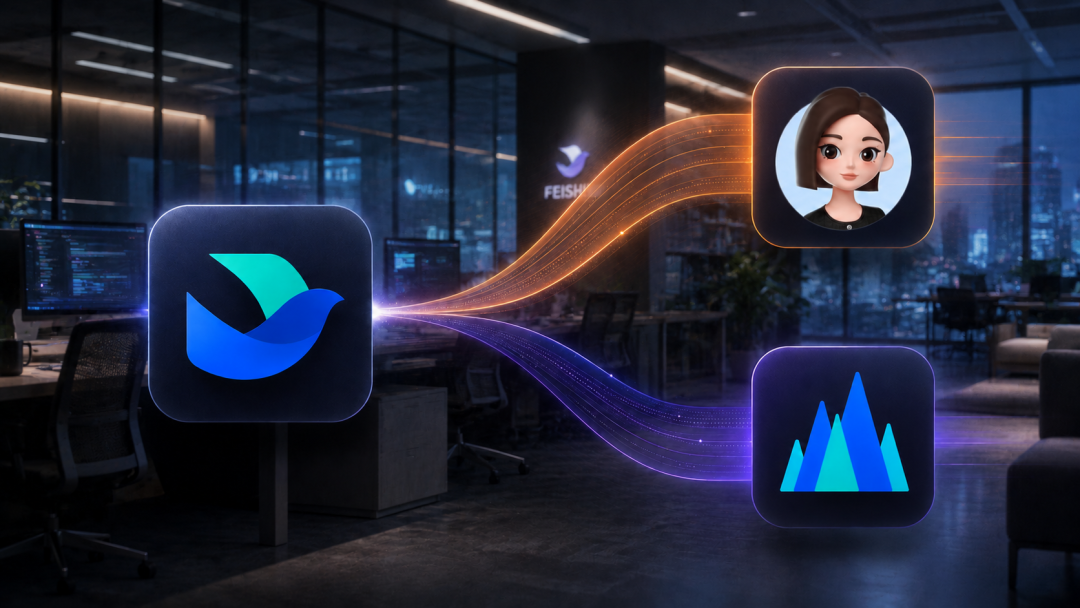
The Feishu product team will merge with the Doubao product team to form a new Doubao product team, led by Doubao head Zhao Qi. Consequently, Feishu head Xie Xin will now report to Zhao Qi. Additionally, the Feishu GTM team will integrate with Volcano Engine to establish a new To B sales organization, the "Creativity Service Platform." This platform will handle marketing, sales, and customer service for ByteDance's MaaS, SaaS, and other cloud services, under the leadership of Volcano Engine head Tan Dai.
Feishu has not been discontinued. ByteDance informed Qiangdiao Next that existing products and services will continue to operate. The Doubao enterprise edition, which has been co-developed with the Feishu team, is already undergoing beta testing with some Feishu clients. However, Feishu, as an independent business unit directly reporting to the company, has effectively ceased to exist in its prior form.
In 2016, Xie Xin, then ByteDance's HRVP, proposed to Zhang Yiming the development of office tools for the company's approximately 1,200 employees. By the end of that year, a 10-person Lark team was established. For nearly a decade, Xie Xin has led this product line, transitioning from project lead to the head of an independent business.
Now, with Xie Xin reporting to the younger Zhao Qi and Feishu becoming a product under Doubao, this marks ByteDance's most significant To B business adjustment since implementing business segmentation in 2021. Feishu retains its brand, products, and clients but loses the autonomy to independently define products, organize sales, and be responsible for revenue.
01. Feishu Retains Brand but Loses Independence
This adjustment affects both Feishu's product and commercialization rights.
After integrating into Doubao, Feishu's roadmap will no longer solely focus on collaborative office solutions. The Doubao enterprise edition seamlessly integrates Feishu Docs, Sheets, Meetings, Group Chats, and the Enterprise Knowledge Base, adding data isolation, permission control, and security audit capabilities. Doubao will handle task understanding and execution, while Feishu will provide enterprise data, organizational relationships, permissions, and a collaborative environment for task completion.
Previously, Feishu served as the front end for user work, with AI embedded as a set of features. Under the new structure, Doubao has the opportunity to become the task entry point, with Feishu providing context and execution environment. The Feishu brand remains, but product priorities will shift: increasing seats and subscription revenue is no longer the sole goal. Model invocation volume, Agent task completion, and contributions to Volcano Engine revenue will also be considered.
On the commercialization side, more direct changes are evident. The newly established Creativity Service Platform will oversee marketing, sales, and customer service for ByteDance's MaaS, SaaS, and other cloud services. Previously, Feishu could independently acquire clients, sign contracts, and manage renewals. Going forward, it will be part of Volcano Engine's overall enterprise client portfolio, sold alongside models, computing power, data platforms, and Agent services.
While official announcements only confirm adjustments to the product team and GTM system, these two areas determine a business's focus, clientele, and revenue growth, sufficiently altering Feishu's position within ByteDance.
02. Revenue Focus Drives Organizational Change
Feishu's adjustment is not due to stagnant growth.
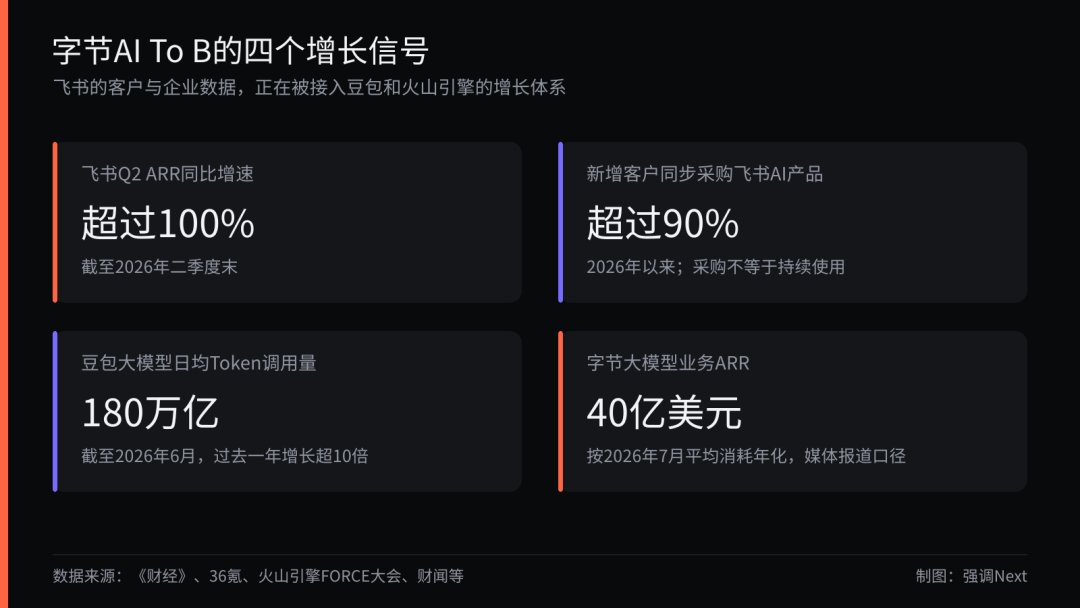
According to media reports, Feishu's 2025 revenue exceeded 3 billion yuan. By the end of Q2 2026, Feishu's ARR (Annual Recurring Revenue) grew by over 100% year-on-year. More than 90% of new clients this year also purchased Feishu AI products. Benefiting from the rapid development of ByteDance's large models, AI has clearly become a crucial tool for Feishu to acquire new clients and increase average revenue per user.
Another curve is even steeper. As of June this year, Doubao's large model daily Token invocation volume exceeded 180 trillion. ByteDance also revealed that based on July's average consumption, its large model business ARR reached $4 billion. This explains why resources are now tilting toward models and cloud services after the adjustment.
Liang Rubo stated at Volcano Engine's conference in June this year that "climbing the AI peak is ByteDance's most important task right now" and referred to MaaS as ByteDance's foundational business. This adjustment marks the first large-scale implementation of that statement in To B operations.
Previously, Feishu and Volcano Engine separately acquired clients, with Feishu selling collaboration software and business tools, and Volcano Engine selling cloud and model services. The issue was that enterprises rarely purchase AI services along internal departmental boundaries. Clients need to integrate models with internal data, configure permissions, invoke business systems, and ultimately create products usable and manageable by employees. Selling models, cloud, and SaaS separately increases integration costs and can lead to internal friction over client ownership, contracts, and delivery responsibilities.
With a unified GTM strategy, ByteDance can use Feishu to enter organizations, Doubao to execute tasks, and Volcano Engine to provide models, computing power, and billing. While Feishu's subscription revenue remains important, the Doubao invocation volume and Volcano Engine contracts it generates will carry greater weight.
03. Agents Rewrite the Position of Office Software
Before the emergence of large models, there was no compelling reason to merge Feishu and Volcano Engine. Feishu managed communication, documents, meetings, and organizational relationships, while Volcano Engine provided cloud, data, and technical services, operating at different levels of enterprise IT architecture.
Agents have changed this dynamic.
Enterprises are willing to pay continuously for the stable completion of tasks like reporting, approvals, customer service, and sales follow-ups. Models must read enterprise knowledge, recognize employee permissions, invoke business systems, and write results back into existing workflows. Feishu's accumulated chats, documents, meetings, knowledge bases, and multi-dimensional tables serve as both the context for Agents to understand the enterprise and the tools for executing work.
This shifts the value of office software. Previously, it sold seats to employees, with revenue capped primarily by employee numbers. Agents, billed by invocation volume, task volume, or even business outcomes, can grow with workload. Microsoft already offers both fixed subscriptions and usage-based billing in its Copilot system, while Salesforce charges based on Agent actions. Seats remain the entry ticket to enterprises, but incremental revenue increasingly comes from subsequent invocations and executions.
This is also why ByteDance adjusted both products and GTM simultaneously. Whoever controls the Agent entry point can decide which model a task invokes, what data it reads, what tools it uses, and ultimately which product gets credited for the revenue.
Office software remains important but is gradually transforming from a standalone SaaS business driving independent growth into a distribution channel, data layer, and permission system for models and cloud services to enter enterprises.
ByteDance is not alone in making these adjustments.
04. Three Companies Differ in Revenue Focus
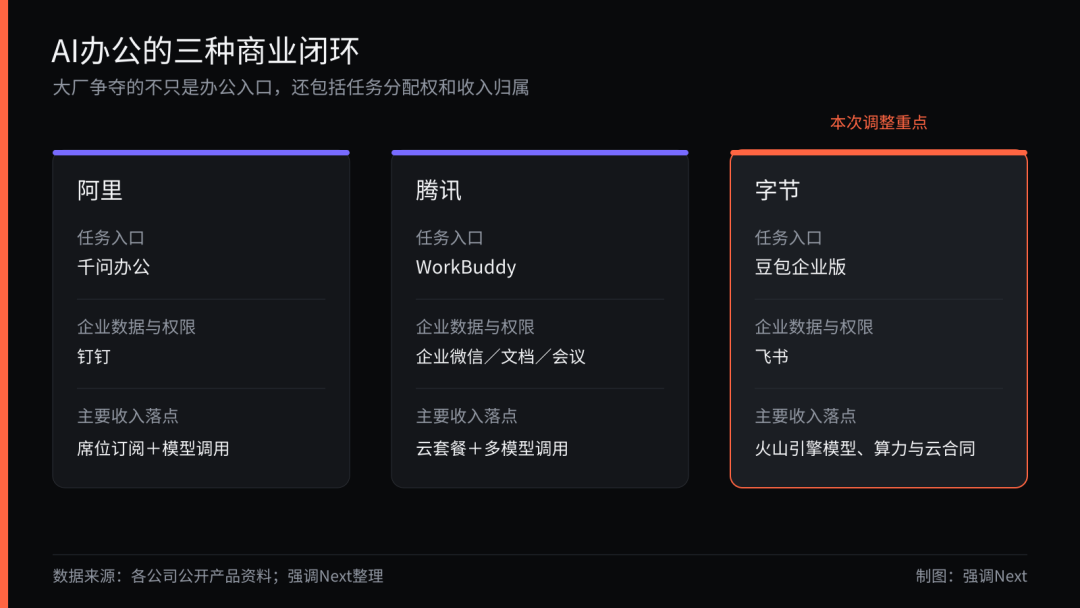
Alibaba, Tencent, and ByteDance are all rebuilding AI-powered office solutions, but their control points differ.
Alibaba has consolidated capabilities from QoderWork, Wukong, and MuleRun into Qianwen Office, led by DingTalk CEO Chen Yusen. Qianwen Office launched as a standalone client before integrating into DingTalk. Alibaba places "Qianwen" front and center, using the model brand and standalone client to compete for individual task entry points, then leveraging DingTalk to supplement enterprise organization, permissions, and workflows.
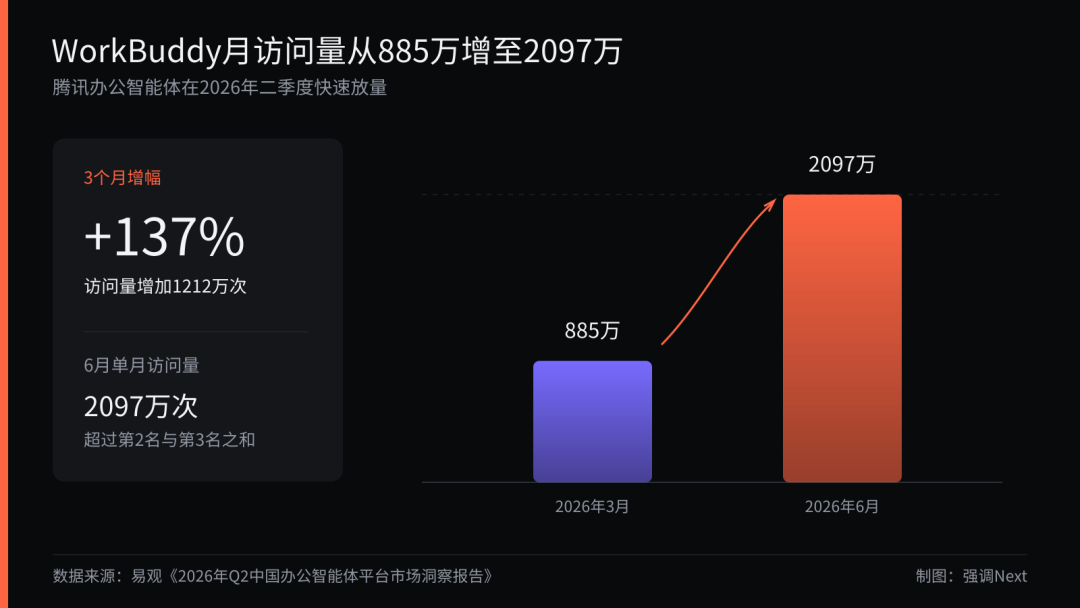
Tencent's WorkBuddy emphasizes multi-model and connectivity capabilities. It supports Hunyuan and multiple third-party models while allowing enterprises to integrate custom models. In June 2026, WorkBuddy reached 20.97 million monthly visits, ranking first among 17 desktop office agents in Analysys' statistics. With relatively open model selection, Tencent can use Tencent Cloud, Docs, and Meetings to handle tasks, data, and billing.
ByteDance leans more toward integrating its proprietary models and cloud services. Feishu products move under Doubao, and sales integrate into Volcano Engine, concentrating product control and client contracts under Doubao and Volcano Engine. The advantage is making Doubao the default executor of enterprise tasks, converting invocations into Volcano Engine revenue.
Tencent has taken an early lead in this AI office battle and continues to double down. However, AI office success cannot be measured by desktop visits alone. The real war has just begun.
Traffic only indicates who first occupied user entry points. More importantly, whether enterprises use the solutions long-term and whether internal data and business systems are truly integrated will determine where contracts and revenue ultimately land.
05. Integration Has Just Begun
Business adjustments cannot solve all problems.
Feishu previously arranged products and sales according to SaaS logic, emphasizing customer experience, seat expansion, and renewals. After integrating into Doubao and Volcano Engine, model invocations and cloud contracts will receive higher priority.
These two sets of goals do not always align. Cloud businesses prioritize usage volume and large contracts, while SaaS relies on long-term usage and stable renewals. When resources conflict, whether Feishu's product integrity and customer needs receive adequate attention will directly impact the integration's success.
Large enterprises typically want to retain choice in multi-model, private deployment, and data boundaries. If Feishu over-serves Doubao, it may compromise its neutrality as an enterprise collaboration platform. If it remains sufficiently open, ByteDance may not fully convert Feishu clients into Doubao invocations. ByteDance must balance proprietary model priority with customer choice.
While over 90% of new clients purchasing Feishu AI products is a positive signal, it is not yet conclusive. Usage frequency, renewal rates, revenue per client, and actual invocation volume of the Doubao enterprise edition post-purchase will determine whether Feishu becomes a growth lever for ByteDance's AI To B or merely shifts its commercialization challenges to another department.
Xie Xin's shift from leading an independent business to reporting to Zhao Qi reflects changes in ByteDance's internal value hierarchy.
Over the past decade, Feishu strived to be an independent, user-friendly enterprise software. Now, it must create value between Doubao and Volcano Engine while preserving its established products, clients, and revenue.
The Feishu brand remains, but the era of independent operations has ended, ushering in ByteDance's grand To B era.
- END -
-
![]()
AI Giants Start Borrowing to Fuel Computing Power
-
![]()
China's AI API Call Volume Overtakes U.S.: A Global Turning Point for Domestic Large Models
-
![]()
Meta Painted the Biggest Pie, Invested the Most Money, but Didn't Even Get a Sound
-
![]()
"AI+" Majors Abound: Are They a Response to a 5-Million Talent Shortage?
-
![]()
Under the Pressure of Rising Storage Costs, Life is Tough for Everyone! Q2 Global Smartphone Shipments Decline by 6%: Samsung, Apple, and Xiaomi Rank in the Top Three
-
![]()
OpenAI's Triple Meltdown: Codex, API, and ChatGPT Collapse Simultaneously—Who Foots the Bill for Agent-Era Downtime?
-
![]()
Silicon Valley Initiates 'Downgraded Consumption' in Large AI Models
-
![]()
ByteDance’s ToB Restructuring: A Strategic Pivot for AI Dominance