The Stronger the Model, the More Valuable the Application Becomes
 08/04 2026
 470
470

Beyond Models, There Are Applications.
Author I Wang Bin
Cover I AI-Generated
Since 2026, the large model industry has entered a new phase of accelerated growth.
Leveraging the performance improvements of foundational models and the booming programming market, companies like OpenAI, Anthropic, and domestic players such as Zhipu and Kimi have rapidly iterated their models, with commercial revenues continuing to climb.
At the end of last year, Anthropic's Annual Recurring Revenue (ARR) was only $9 billion, but external estimates now put it at over $70 billion. Kimi's latest funding round targets a valuation of $50 billion, a tenfold increase in six months, with its latest ARR reaching $300 million.
If we follow the popular logic of the past two years that 'models devour applications,' the more tasks models can accomplish, the less value remains at the application layer. Microsoft CEO Satya Nadella once predicted that independent commercial applications might collapse in the Agent era.
Yet reality hasn't fully followed this script. While models have advanced, a multitude of AI application companies have also flourished. AI programming tools like Cursor and Lovable need no introduction, while AI applications in the audio-visual space, such as ElevenLabs and HeyGen, continue to emerge.
Some traditional internet-era tool companies have also successfully transformed with AI. Adobe achieved record-high revenue in the second quarter of its 2026 fiscal year, with quarterly income exceeding $6.6 billion. Grammarly, the veteran grammar-checking tool once considered most vulnerable to large models, smoothly transitioned into an AI writing platform, generating over $700 million in annual revenue last year.
Domestically, Meitu has similarly been reborn through AI. By 2025, Meitu had achieved seven consecutive years of positive net profit growth. In its recent 2026 first-half earnings forecast, Meitu expects adjusted net profit attributable to the parent to increase by 36% to 40% year-on-year. Meanwhile, revenue from its core imaging and design products grew by 30.9% year-on-year to $1.8 billion, with paid subscribers exceeding 18.44 million—both record highs.
It's evident that amid rapid advancements in model capabilities, AI applications are exploring new industry niches through product evolution and business model transformation.
The 'Model Devours Everything' Narrative Hasn't Materialized
AI has indeed made developing applications easier than ever—now anyone can build one. According to Appfigures, new applications in the Apple App Store and Google Play increased by 60% year-on-year in the first quarter of 2026, with April seeing a doubling in growth.
Yet while applications are proliferating, few truly survive.
RevenueCat data shows that applications launched before 2020 still contribute nearly 70% of subscription revenue today. Despite the vast number of new applications emerging since 2025, their combined revenue share is just 3%. a16z's Top 100 Consumer Generative AI Apps list, updated every six months, sees constant turnover.
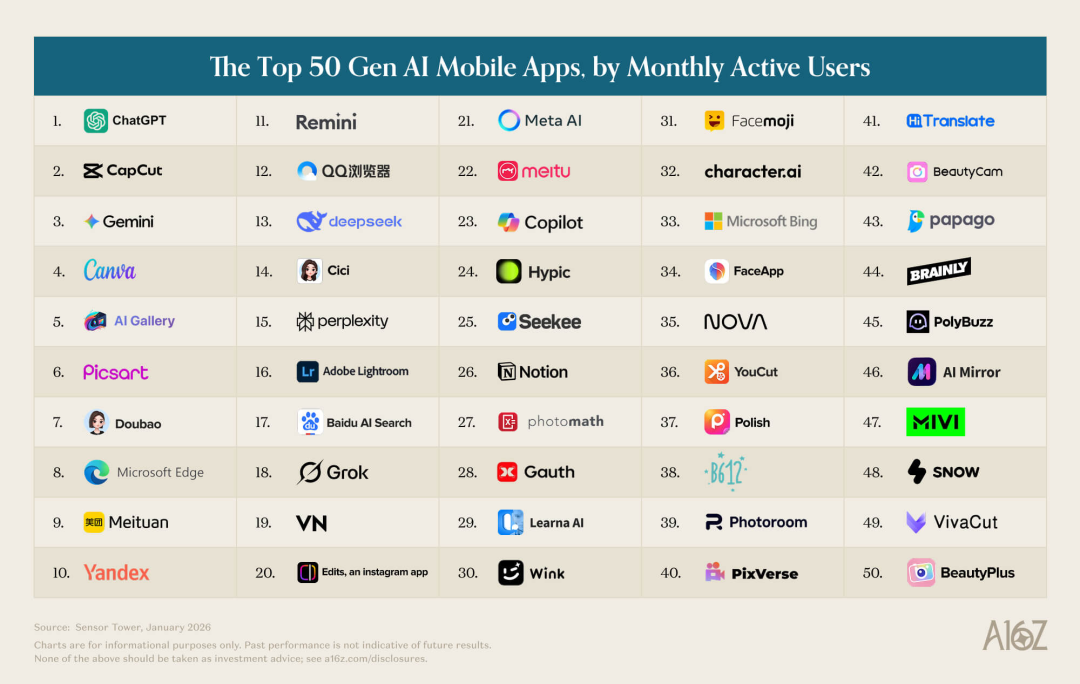
a16z's Ranking
Yet the 'model devours everything' scenario hasn't unfolded as predicted.
Cursor, often criticized as a 'wrapper,' continues to grow rapidly even as large models pivot fully toward coding, resisting absorption by Claude Code and Codex. Legal AI application Harvey integrates into professional processes like due diligence, contract review, and litigation, with its valuation rising to $11 billion in 2026. AI video app HeyGen expanded from digital human generation to scripting, translation, dubbing, and localization, with its latest ARR surpassing $200 million, doubling in eight months. Among Chinese app companies, Meitu recently disclosed that its AI productivity apps reached $620 million in ARR by June, a 47.8% year-on-year increase.
The idea of 'models devouring everything' resembles an unrealistic fantasy in this era of rapid technological advancement, akin to a deus ex machina in short dramas. While model iteration may render some single-function applications unviable, those deeply rooted in niche markets can create more value and handle complex professional tasks.
a16z argues that the evolution of foundational models amplifies the advantages of software vendors, as complex and expensive tasks can now be transformed into simple, user-friendly functions, enabling ordinary users to directly engage and achieve commercialization.
Take Meitu as an example. Before AI, its primary revenue source was advertising. However, in 2022, at the dawn of the AI boom, Meitu's VIP subscription business suddenly became its largest revenue stream. The company stated in its annual report that AIGC-related features were significant drivers.
Meitu subsequently shifted its strategy, swiftly divesting hardware, social, e-commerce, and offline businesses. The once-expansive Meitu, constantly seeking growth, was replaced by a focused player in imaging and design, with revenue and net profit soaring. Adjusted net profit attributable to the parent surged from $368 million in 2023 to $965 million last year, maintaining up to 40% growth in the first half of this year.
Nearly all this growth came from paid subscriptions for AI applications. With a mature monthly active user base, paid users surged by 86%, and the payment penetration rate rose from 3.7% to 6.1%. Over the same period, revenue from imaging and design products grew from $1.327 billion to approximately $2.954 billion, contributing over 70% of the company's revenue.
Over the past three years, image and video models have advanced the fastest. Far from devouring the imaging app market, models have propelled the expansion of AI imaging applications.
Last year alone, Meitu launched numerous hit AI features, including 3D figurines, AI group photos, and AI snowscapes, helping Meitu Show top the app charts in 52 countries and regions. AI group photos attracted over 3 million new active users in Europe, while AI snowscapes propelled Meitu Show to the top of the U.S. App Store category rankings for the first time.
Where Does the Value of AI Applications Lie?
In the AI era, users can effortlessly generate text, images, or even short videos using any available model. However, what users truly want isn't temporary content but deliverable, usable work products.
This involves a lengthy process. For instance, creating a product video requires extracting selling points, writing scripts, preparing materials, generating visuals, and editing—all while ensuring consistency. While models can handle some steps, they struggle to understand all user needs from a single prompt, let alone organize these complex steps into a cohesive workflow, not to mention the instability of outputs.
Nearly all AI applications globally are expanding from single-point functions to stable, replicable workflows. AI video app Captions AI started with automatic video captioning but now covers scriptwriting, recording, editing, and distribution. Creatify allows merchants to input product links, with AI reading the information and generating video ads automatically.
This is likely where the true value of AI applications lies. While model capabilities converge, stable and efficient workflows, niche-scene expertise, and vertical-specific data fine-tuning determine whether AI applications can truly enhance user productivity.
Most AI applications that have grown impressively over the past year or two follow similar strategies. Meitu's Kaipai, initially a 'teleprompter' feature in its beauty camera app, now offers a complete video production chain encompassing teleprompters, trendy templates, AI covers, intelligent remixing, and one-click video generation, along with a vertical Agent specifically for creating AI marketing videos.
For most users, the initial challenge with AI applications isn't weak AI but uncertainty about how to use AI or what problems it can solve.
Kaipai's brilliance lies in its built-in, reusable workflows, with nearly every AI feature demonstrating practical use cases. For example, its 'trendy templates' cater to high-demand industries like store drainage (store traffic generation), insurance, education, and beauty, eliminating the need for users to learn prompts or trends. According to Meitu, this feature has been used 122 million times.


Kaipai's Built-In Trendy Templates for Different Industries
Many AI video tools offer intelligent remixing, where users upload materials for automatic editing. However, video editing requirements vary by industry and content. Users often need to find reference templates for the AI to learn from.
Kaipai's intelligent remixing includes built-in templates and demo videos for industries like product promotion, real estate sales, live-streamed sales, and travel exploration, allowing novice users to select templates based on their needs.
No wonder Kaipai later attracted rigid demand from verticals like e-commerce, real estate, insurance, and healthcare. In 2025, Kaipai's MAU nearly doubled, and paid subscribers tripled. As of June this year, its ARR doubled year-on-year.
If Kaipai represents a reimagining of live-streamed video workflows, MVLAND exemplifies deep niche pain point resolution. As Meitu's newly launched music video production tool this year, MVLAND doubled its ARR in three months.
While most video generation tools start with text prompts, MVLAND allows users to upload audio first. Multiple Agents then analyze the song's content, emotion, and rhythm to organize visuals and shots. Music videos require generating visuals while synchronizing them with lyrics, melody, and rhythm—a task too complex for a single model call.

MVLAND's Official Website
This addresses a real pain point for independent musicians. Traditional MVs involve planning, shooting, and post-production, with long cycles and high costs. MVLAND compresses part of this process into an online workflow, enabling musicians to produce MVs at lower costs. Even users with no musical knowledge can first generate AI music and then edit it into a polished MV for social media sharing.
Meitu's successful AI applications almost all follow this methodology: instead of pursuing broad coverage, they enter through small niches and continuously meet pain points in specific verticals. For example, Kaipai focuses on live-streamed videos, MVLAND targets music scenes, and Meitu Design Studio primarily serves e-commerce practitioners.
Crucially, these applications for professional productivity scenes often have higher ARPU values and greater commercialization potential.
Last year, Meitu's productivity tools saw paid subscribers grow by 67.4% year-on-year, with subscriber numbers doubling outside mainland China. In the first half of this year, Meitu's productivity apps reached a record high MAU of 33 million, with paid subscribers increasing by 29.8% year-on-year.
The Growth of Applications May Just Be Beginning
AI hasn't just changed how people use applications—it has expanded revenue opportunities for app companies.
Traditional tool applications primarily monetize through fixed subscriptions or advertising. With relatively stable subscription prices, individual users contribute limited revenue. To sustain growth, companies often need to acquire new users continuously. When user scale nears its limit, many tool companies resort to increasing ads, raising prices, or seeking new monetization avenues.
In the AI era, applications are shifting from providing tools to delivering results. Businesses don't just buy image editing features—they buy product photos ready for advertising. Creators don't just pay for editing tools—they pay for publish-ready videos. The closer an application's output aligns with users' revenue and productivity, the higher their willingness to pay.
Menlo Ventures data shows that enterprise generative AI spending reached $37 billion in 2025, with $19 billion flowing to the application layer—over half. More businesses are willing to pay for AI products that directly integrate into workflows.
Over the past two years, a wave of AI applications has achieved exponential revenue and valuation growth, shattering the slow growth logic of traditional apps. Lovable reached $100 million in ARR in just eight months and is now valued at $6.6 billion. ElevenLabs, focused on voice scenarios, saw its ARR surge from $350 million at the end of last year to over $500 million in the first four months of this year, with its valuation exceeding $11 billion.
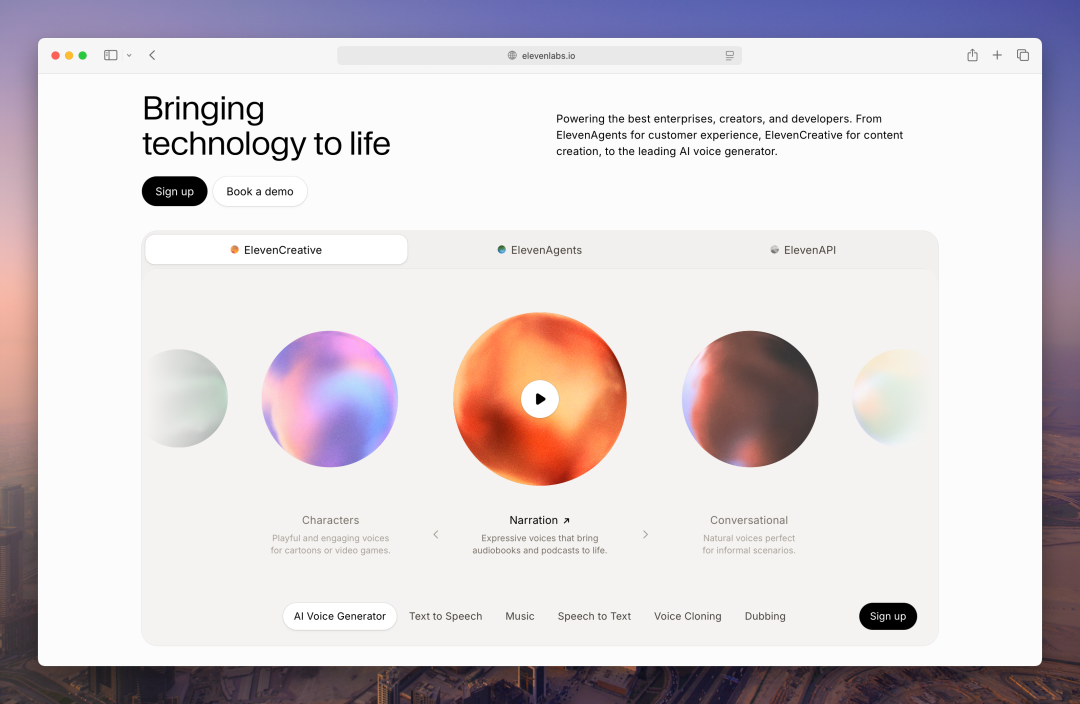
ElevenLabs
Meitu's growth has similarly accelerated thanks to AI. From 2023 to 2025, its paid subscribers grew from 9.11 million to 16.91 million, a nearly 90% increase, with subscription penetration rising from 3.7% to 6.1%, almost doubling. As of June 2026, Meitu's paid subscribers exceeded 18.44 million.
In its latest announcement, Meitu also attributed the profit growth in the first half of the year to the continuous increase in paying subscribers and the rise in average revenue per paying user. In the era of AI applications, user scale does not need to double; as long as the application can continuously provide functions with practical value, users are willing to pay for results and outputs, breaking the revenue scale bottleneck of applications in the mobile internet era.
High-value users have a higher willingness to pay. In the AI era, applications should especially abandon the obsession with user scale and prioritize exploring high ARPU markets. Sensor Tower data shows that India contributes approximately 20% of global generative AI app downloads but only about 1% of in-app purchase revenue. By 2025, Meitu's new paying subscribers will primarily come from markets such as Europe, the Americas, and East Asia, where subscription habits are mature and ARPU is relatively high.
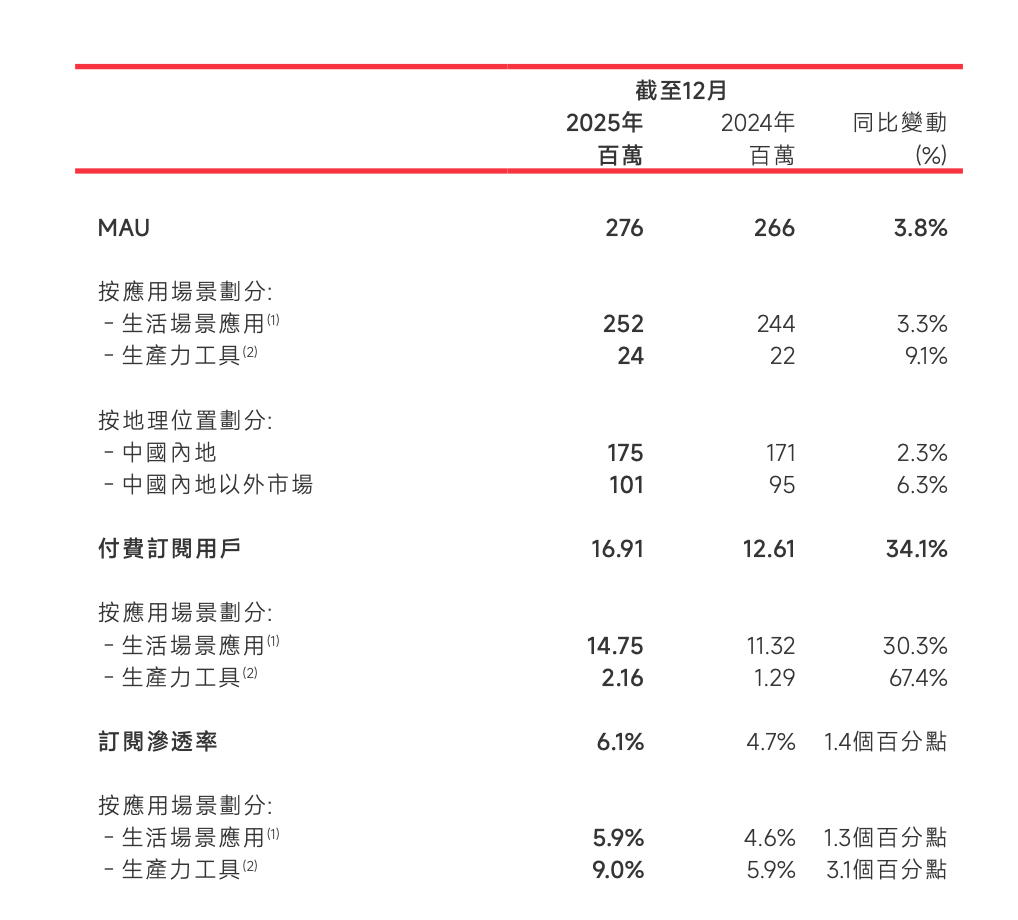
Meitu's 2025 Annual Report
If, in the internet era, the commercial potential of applications was solely tied to the number of subscribers, then in the AI era, application revenue is directly linked to results. Heavy users require more outputs and results and are more willing to pay for computing power.
Beyond subscriptions, Meitu has also started to meet higher-frequency usage demands through AI computing power points. Users can obtain computing power points through subscription plans or recharge based on usage. In the first and second quarters of 2026, the total consumption of AI computing power points by Meitu users increased by over 46% quarter-over-quarter, with the growth rate accelerating further in the second quarter.
This 'subscription + pay-as-you-go' model is becoming a common choice for AI applications. Beyond Creative Cloud subscriptions, Adobe has introduced generation credits for Firefly. In the first quarter of the 2026 fiscal year, the consumption of Firefly credits increased by over 45% quarter-over-quarter, while application subscriptions and credit pack ARR grew by 75% quarter-over-quarter. In the second quarter, related ARR increased by approximately 50% quarter-over-quarter.
However, AI revenue growth also brings cost pressures. In 2025, Meitu's computing power and cloud service costs increased by 16.4% year-over-year to RMB 232 million, with nearly half being inference computing power costs. As a result, the company's gross profit margin declined.
For such application-layer companies, they will need to continuously address how to balance growth and profitability in the future, as well as how to amplify the value of industry know-how and use it to solidify their competitive moat in vertical markets.

All rights reserved by Shanshang. Reproduction without authorization is prohibited.
-
![]()
Two Truths About July's Auto Market: Domestic Focus on Technology, Overseas Focus on Speed | Second Half Kickoff ②
-
![]()
Smartphone Chip Shipments Decline by 15%, While Smartphone Shipments Fall by Less Than 7%: Where Is the Discrepancy?
-
![]()
New Forces Start to Profit from Scale
-
Sluggish Sales: New Policies Step In to Revive the Market
-
![]()
The Changing Tide of Luxury Cars: Why Are Mercedes-Benz Sales Slumping?
-
![]()
Can You Still Identify Intelligent Driving When the Small Blue Light is Off?
-
![]()
The Stronger the Model, the More Valuable the Application Becomes
-
Is Alibaba Using QwenWork to Rival WorkBuddy?