New Forces Start to Profit from Scale
 08/04 2026
 388
388
Scale and Efficiency Are Rewriting New Forces' Profit Formula
Author|Yixiu
Editor|Xiaobai
Illustration|AI-Generated
Produced by|Qiangdiao Next
In July, Leapmotor delivered 101,267 vehicles globally, up 102% year-on-year, becoming the first new-force automaker to exceed 100,000 monthly deliveries. In the same month, Li Auto delivered 30,468 vehicles, 427 fewer than in June, with a slight year-on-year decline.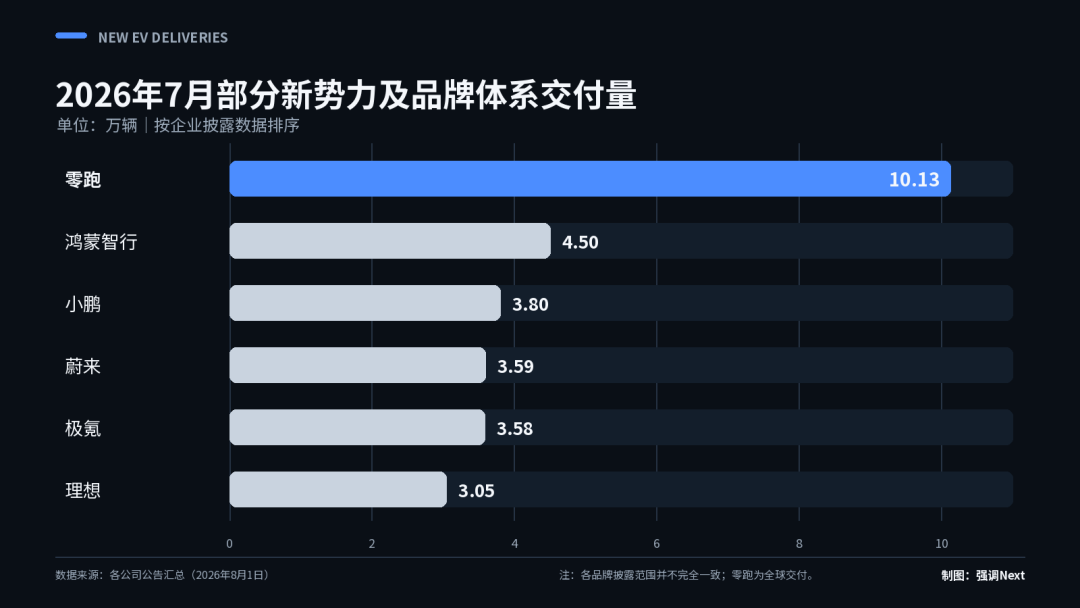
In recent years, the most effective growth strategy for new forces has been to bet on a single model and capture a new segment. Li Auto relied on extended-range technology and large family SUVs to create blockbuster models with high prices but limited volumes. XPENG bet on intelligent driving, while NIO focused on services and branding, each seeking labels that could justify premium pricing.
Today, extended-range technology, smart cockpits, spacious interiors, and advanced driver-assistance systems are being rapidly replicated. It is increasingly difficult for a single product label to justify price gaps of tens of thousands of yuan. Competition among automakers is reverting to the fundamentals of the automotive industry: how many models a technology can cover, how many models a single store can sell, and how sales volume can amortize R&D and supply chain costs.
Leapmotor has been the first to reap these scale benefits. Li Auto, meanwhile, is in an adjustment phase, expanding its product capabilities—previously concentrated on extended-range SUVs—to pure electric models, multiple price bands, and a more comprehensive charging network. While short-term profits are under pressure, the key is whether these investments can create a second wave of economies of scale.
01. Leapmotor Starts Profiting from Scale
“Low prices, high volumes” no longer fully explains Leapmotor’s profitability.
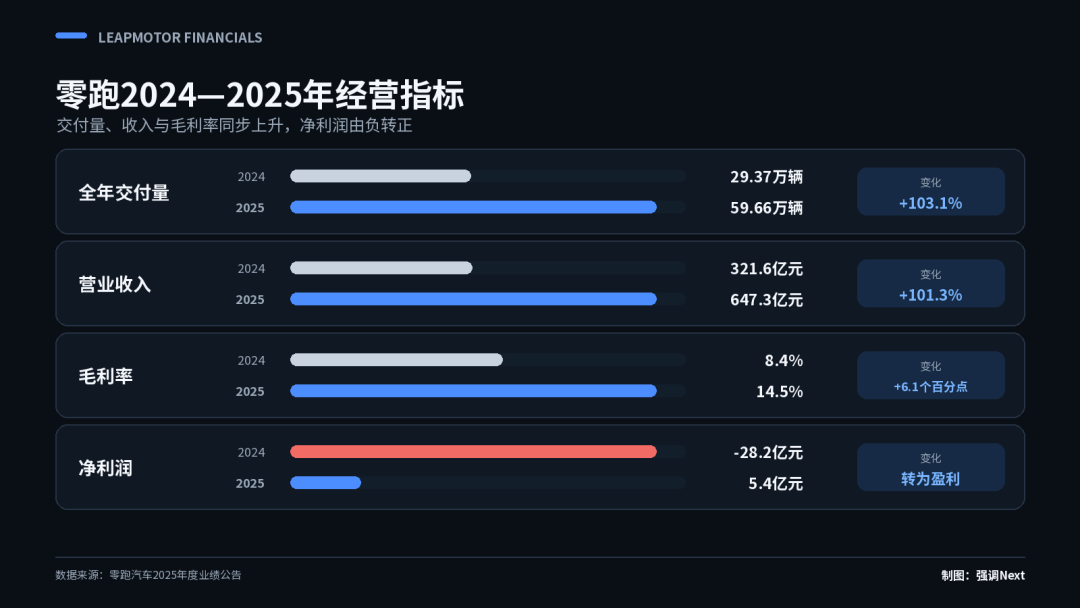
In 2025, Leapmotor delivered 596,555 vehicles, up 103.1% year-on-year. Revenue grew 101.3% to RMB 64.73 billion, gross margin improved from 8.4% to 14.5%, net profit swung from a RMB 2.82 billion loss to a RMB 540 million profit, and free cash flow reached RMB 7.82 billion. While sales doubled, gross margin, profit, and cash flow all improved, indicating that new sales were not entirely acquired through losses.
Supporting 100,000 deliveries is no longer reliant on a single model. Leapmotor now has four major product series—A, B, C, and D—with ten models on sale or soon to be launched, priced from just over RMB 60,000 to nearly RMB 270,000. The A10 targets the entry-level market, the B series enters the RMB 100,000 sedan and SUV segment, the C series retains mainstream family users, and the D19 brings six- and seven-seat large SUVs down to the RMB 219,800–269,800 range.
Behind this product matrix lies Leapmotor’s long-term investment in vertical integration. The company reports that it now self-develops and manufactures high-value core components accounting for about 65% of vehicle costs, including electric drivetrains, battery systems, and a centralized electronic electrical architecture. By reusing technologies across more models, procurement volumes increase, while R&D, tooling, channel, and after-sales systems are shared across greater sales volumes.
Overseas channels further amplify this model. In Q1 2026, Leapmotor delivered 110,155 vehicles globally, including 40,901 overseas, accounting for 37.1%. Thus, July’s 101,300 deliveries include some overseas sales and cannot be directly compared with companies disclosing only domestic or brand-specific deliveries. However, Stellantis’s channels have indeed extended Leapmotor’s cost advantages to more markets.
Of course, not all of this RMB 540 million profit comes from vehicle sales. In 2025, Leapmotor also generated RMB 2.72 billion in service and other revenues, including overseas carbon credits, technology licensing, and export-related services.
While Leapmotor has crossed the annual breakeven line, the profitability of vehicle sales alone remains to be observed. The next challenges are whether the D platform can increase per-unit revenue and whether rising overseas sales will erode gross margins through higher logistics, after-sales, and local manufacturing costs.
02. Platform Efficiency Trumps Blockbuster Models
Blockbuster models were once the most critical capability for new forces. A model selling 20,000–30,000 units per month could sustain a brand, a distribution network, and capital market expectations. As product portfolios grow, the lifespan of blockbusters shortens, while replacement risks become more concentrated. A slowdown in a flagship model can quickly erode cash flow through sunk R&D, factory, and store costs.
In the first half of 2026, 284 new SUV models were launched domestically, accounting for 49.3% of all new models. New models priced between RMB 100,000 and RMB 250,000 made up 46.88% of the total. Consumers now face not just a few distinct new energy vehicles but a dense table of models with highly similar configurations, dimensions, and prices.
In this market, product definition remains important but is no longer exclusive. Features like in-car refrigerators, large screens, and comfortable seating can spread within a single product cycle, while advanced driver-assistance systems are rapidly becoming standard. The truly difficult-to-replicate advantages now lie in backend capabilities, including unified architectures, component commonality, procurement costs, manufacturing yields, and channel turnover.
This is platform efficiency. It does not mean simply launching more models but bringing new models to market faster and at lower cost while minimizing the need for separate R&D and supply chain systems. Only after Leapmotor rolled out its A, B, C, and D series did its 100,000 deliveries translate into procurement leverage and cost amortization. NIO’s spin-off of ONVO and Firefly, and XPENG’s addition of extended-range models and overseas expansion, address the same challenge: a single brand and a few models can no longer sustain rising R&D and channel expenses alone.
New forces are thus entering a new phase—closer to traditional automotive industry dynamics but at a faster pace. Technical labels still drive initial orders, but platform efficiency determines whether subsequent products remain profitable.
03. Li Auto’s Transition Phase
Li Auto still delivered 30,000 vehicles in July, with cumulative sales exceeding 1.76 million units. The L6 is also set to reach 400,000 cumulative deliveries in August. This demonstrates its strong brand recognition and user base among family buyers.
Li Auto is currently more in a product expansion phase than experiencing a simple sales decline. The company is extending from the L-series extended-range SUVs to pure electric models, wider price bands, and a self-built ultra-fast charging network. The trade-off is that R&D, channel, and infrastructure investments come first, while new products take time to generate revenue and profits.
In 2025, Li Auto delivered 406,343 vehicles, down 18.8% year-on-year. Revenue fell 22.3% to RMB 112.3 billion, net profit dropped 85.8% to RMB 1.1 billion, and free cash flow turned negative, with an annual outflow of RMB 12.8 billion.
In Q1 2026, this pressure became more direct. Li Auto delivered 95,142 vehicles, up 2.5% year-on-year, but vehicle sales revenue fell 12.7% to RMB 21.5 billion. The company attributed this to changes in product mix, which lowered average selling prices. Vehicle gross margin fell from 19.8% a year earlier to 6.1%, and free cash flow was negative RMB 7.4 billion.
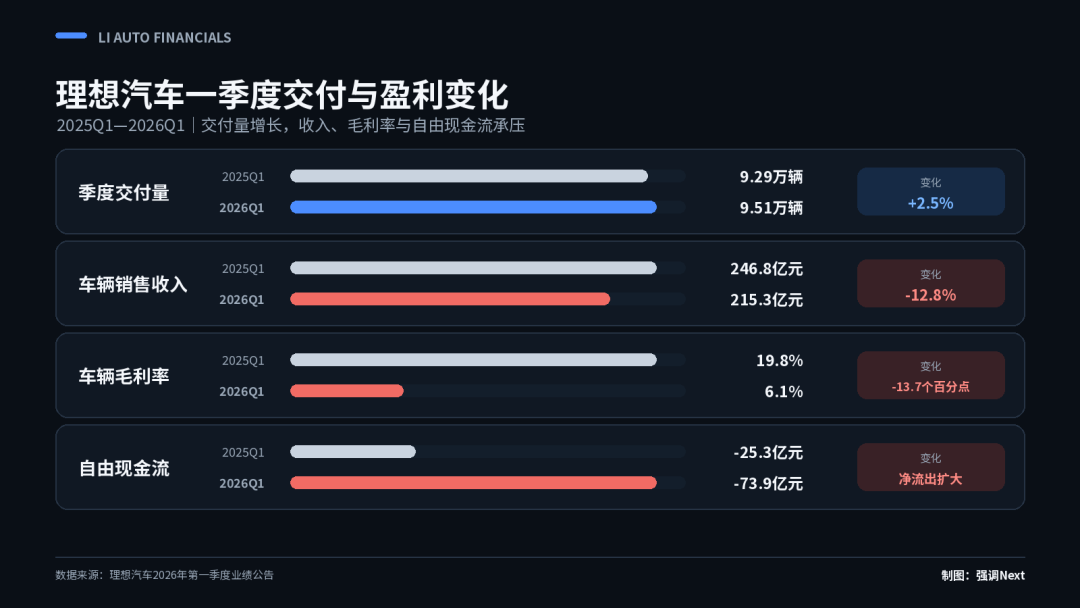
These figures must be viewed in the context of product cycles. Management cited measures related to i6 deliveries, raw material price fluctuations, and model replacement cycles—all temporary factors, so short-term gross margins do not affect long-term prospects. Meanwhile, the higher proportion of L6 sales has lowered average selling prices but expanded Li Auto’s user base from above RMB 300,000 further into the mainstream family market. The key test is whether this larger user base can translate back into revenue and gross margin once new models scale.
Li Auto’s past efficiency came from a small number of models, high average selling prices, and clear positioning. The L7, L8, and L9 shared a logic of family-oriented extended-range SUVs, with few products and high prices, allowing new sales to quickly convert into profits.
Today, the company is expanding into pure electric products and lower price bands while bearing the costs of direct-sales stores, ultra-fast charging networks, and AI R&D. Moving from a single high-potential segment to a multi-product platform requires upfront expansion costs. Long-term value depends on whether new products can share R&D, supply chains, stores, and charging networks.
As of Q1 2026, Li Auto had RMB 94.3 billion in cash reserves, with 4,057 ultra-fast charging stations and 22,439 charging ports in operation nationwide. These assets tie up cash in the short term but lower the barrier to expanding pure electric models. The L6’s 400,000 cumulative deliveries prove Li Auto’s ability to scale products for clear family scenarios. The market will now watch whether, after the new L-series and pure electric models scale, Li Auto can improve channel and platform reuse efficiency and push vehicle gross margins back into double digits.
04. Family Large Vehicles Now Compete on Comprehensive Capabilities
Li Auto’s competition is also shifting from extended-range technology to the comprehensive capabilities of family large vehicles.
Data from the China Passenger Car Association shows that in the first half of 2026, wholesale sales of extended-range passenger vehicles reached 504,000 units, down 13.1% year-on-year. Domestic retail sales totaled 439,000 units, down 19.4%. Extended-range technology was one of the few new energy segments to see declines in both wholesale and retail volumes.
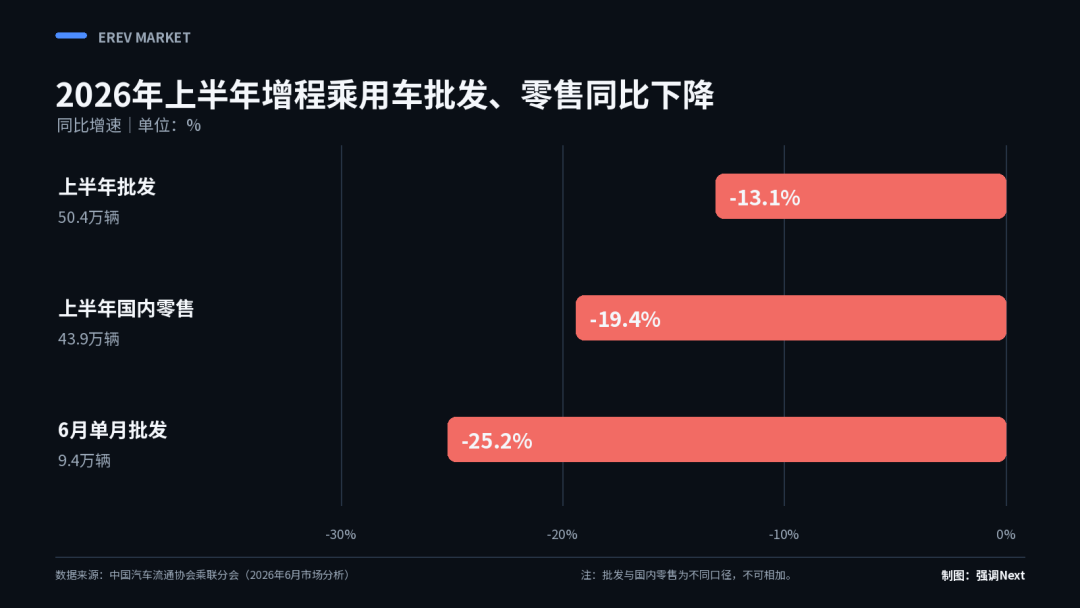
However, the decline was not uniform. During the same period, mid-to-large extended-range SUVs grew by about 12%, increasing their share of the extended-range market to 75%. Demand is concentrating toward larger sizes, longer ranges, and multi-person households. The core reason consumers continue to buy these vehicles is increasingly “large vehicles are more practical,” with the scarcity value of extended-range technology itself diminishing significantly.
While the extended-range market contracts, the family large SUV segment—still growing—is attracting more players. AITO has entered the high-end family market, Leapmotor’s D19 has lowered the starting price of large extended-range SUVs to RMB 219,800, and Xiaomi’s Pengcheng N90 Max is preselling at RMB 299,900, all targeting the space, smart cockpit, and family scenarios that Li Auto knows best.
Increased competition does not mean Li Auto’s accumulated capabilities are obsolete. It was early to break down family needs into specific products like six-seat spacing, in-car interaction, and long-distance charging, thereby building its brand, channels, and user reputation. The change now is that these capabilities must continue to evolve: extended-range technology is no longer the sole differentiator. Li Auto needs to use pure electric products, ultra-fast charging networks, intelligence, and more stable cost control to turn “family vehicles” from a product label into a sustainably delivered system.
This is also what the two sets of July sales figures reveal. Leapmotor used lower prices, a denser product lineup, and global channels to turn scale into profitability improvements. Li Auto, with its brand, user base, and cash reserves, is entering a phase of expanding from a single high-potential segment to a multi-product platform. The former must prove the quality of its scale growth, while the latter must prove efficiency recovery after its investment phase.
The next earnings reports will clarify whether Leapmotor can maintain gross margins above 14% as it approaches one million annual deliveries, and whether Li Auto can push vehicle gross margins back into double digits after sales rebound.
Monthly sales volumes only prove short-term product success. The key to sustainable growth is whether a company can pass on the user, technology, and cost advantages from one model to the next.
- END -
-
![]()
Two Truths About July's Auto Market: Domestic Focus on Technology, Overseas Focus on Speed | Second Half Kickoff ②
-
![]()
Smartphone Chip Shipments Decline by 15%, While Smartphone Shipments Fall by Less Than 7%: Where Is the Discrepancy?
-
![]()
New Forces Start to Profit from Scale
-
Sluggish Sales: New Policies Step In to Revive the Market
-
![]()
The Changing Tide of Luxury Cars: Why Are Mercedes-Benz Sales Slumping?
-
![]()
Can You Still Identify Intelligent Driving When the Small Blue Light is Off?
-
![]()
The Stronger the Model, the More Valuable the Application Becomes
-
Is Alibaba Using QwenWork to Rival WorkBuddy?