Two Truths About July's Auto Market: Domestic Focus on Technology, Overseas Focus on Speed | Second Half Kickoff ②
 08/04 2026
 373
373
By Yang Xuejian Source / Node Auto
Cooling domestic demand and accelerated exports have become defining characteristics of China's auto market in 2026. In this dynamic of slow domestic growth and rapid overseas expansion, the "globalization" goal long pursued by Chinese automakers has finally evolved from a strategy of a few into an industry-wide consensus.
Data from the China Association of Automobile Manufacturers shows that in the first half of this year, China's auto sales reached 15.017 million units, down 4.1% year-on-year; domestic sales stood at 9.921 million units, a 21.1% decline. Meanwhile, auto exports surged to 5.096 million units, up 65.3% year-on-year, surpassing 5 million units for the first time in a half-year period.
In July, traditional automakers like BYD, Geely, Chery, and Great Wall Motors released their latest sales figures. From these numbers, a clear conclusion emerges: in a mature market, those who can boost overseas growth will gain more market share; when simply chasing domestic sales numbers is outdated, those with stronger technological reserves ready for deployment will enjoy healthier sales structures and more initiative in this round of market shakeouts.
01. BYD: Strong Overseas Growth Momentum
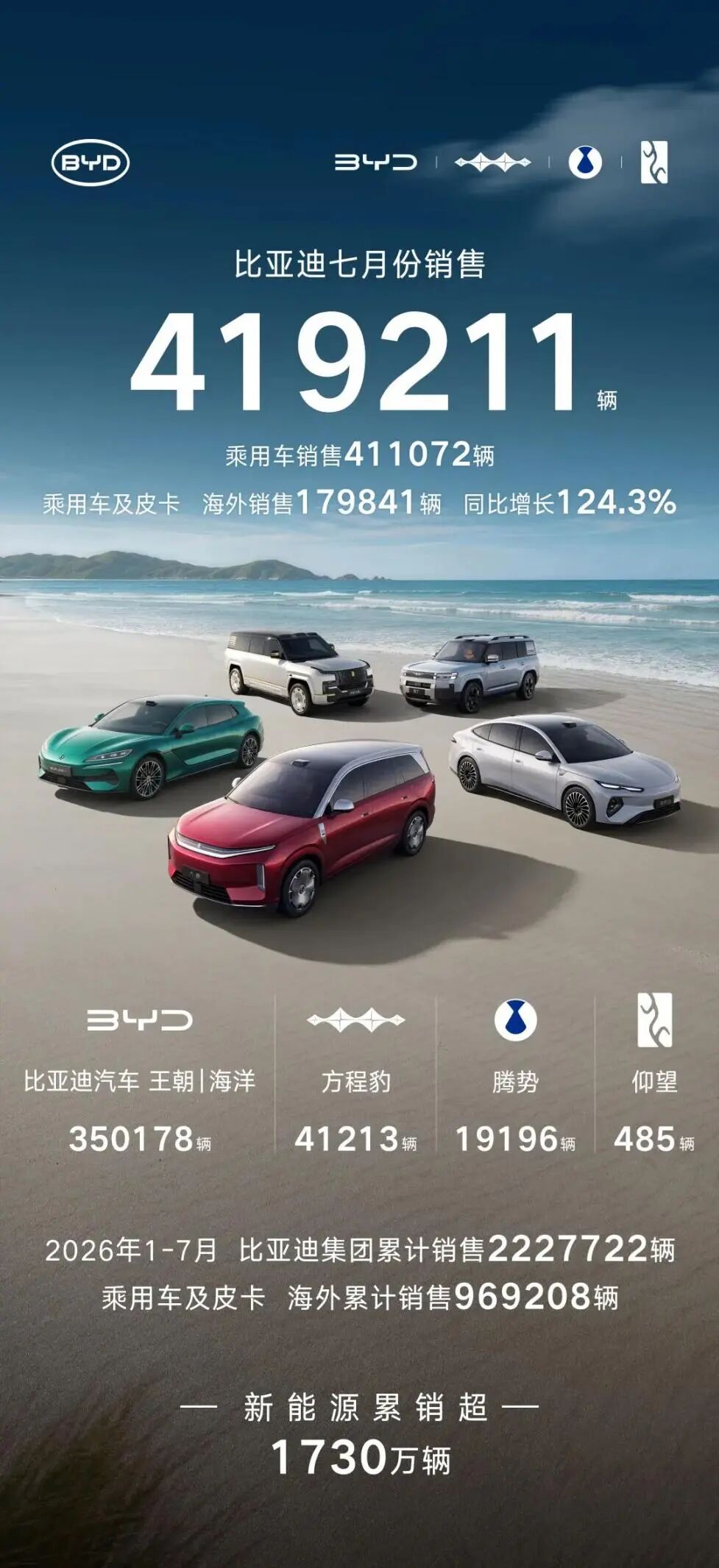
BYD sold a total of 419,211 vehicles in July, up 21.8% from 344,296 units in the same period last year; passenger vehicle sales reached 411,072 units, with 233,105 pure electric models (up ~31% year-on-year) and 177,967 plug-in hybrid models (up ~9.1% year-on-year). However, looking at the longer term, BYD has not fully escaped the pressure of the first half. From January to July 2026, cumulative sales stood at 2.228 million units, still down more than 10% year-on-year at 10.54%; pure electric cumulative sales fell 8.38%, while plug-in hybrid cumulative sales dropped 13.18%.
The coexistence of strong single-month year-on-year growth and annual cumulative decline suggests that July marked the beginning of sales recovery, not the end of pressure. Nevertheless, for the global leader in new energy vehicles, this performance remains a positive sign of rebound.
Behind the over 20% year-on-year growth in July, the biggest driver remains overseas markets.
In July, BYD's passenger vehicle and pickup truck overseas sales reached 179,841 units, up 124.3% year-on-year, accounting for about 42.9% of the group's total monthly sales; cumulative overseas sales from January to July stood at 969,208 units.
A simple calculation by Node Auto reveals that this means more than four out of every ten vehicles BYD sells now come from overseas markets.
At the brand level, BYD's Dynasty and Ocean series sold 350,178 units, remaining the absolute foundation; Fangchengbao sold 41,213 units, Denza sold 19,196 units, and Yangwang sold 485 units. Fangchengbao has become BYD's most significant second growth pole among its premium and personalized brands, but Yangwang's sales show that the million-yuan market cannot be quickly conquered solely through technological hype.
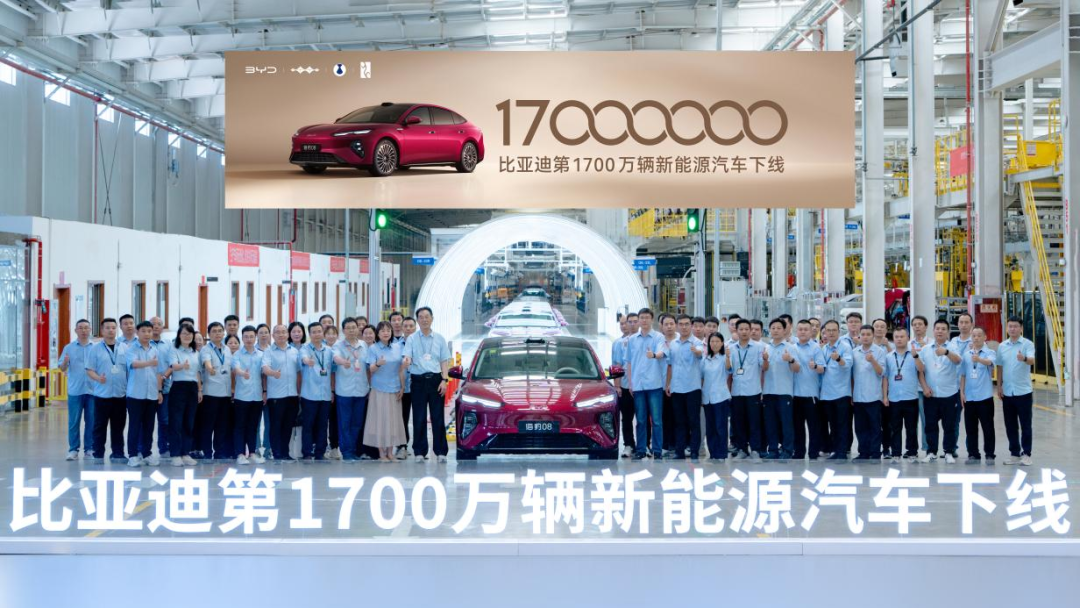
On July 8, 2026, BYD's 17 millionth new energy vehicle rolled off the assembly line at its Xi'an plant, coinciding with the launch of the Seal 08, priced at RMB 196,900-239,900. This model offers a pure electric range of 905 kilometers and features "high-end" configurations like flash charging, Yunjian-A, and rear-wheel steering. From this car, it's clear that BYD is essentially using flagship technologies to penetrate mainstream price segments, continuing to employ "dimensional reduction strikes" through technology to capture more market share.
In Node Auto's view, BYD's core tasks in the second half are not about continuing to prove its sales leadership but rather focusing on three balances:
First, balancing domestic and overseas markets. If domestic sales continue to face pressure, overseas growth cannot rely solely on short-term export surges but also requires local factories, distribution, after-sales, and financial systems to take over. From BYD's strategies in Europe, Japan, and North America, it's clear that the company is already implementing deeper global localization deployments.
Second, balancing pure electric and plug-in hybrid models. Amid market competition, BYD's previous lead in the plug-in hybrid segment established by DM-i is now facing direct competition from products like Geely's Galaxy and Chery's Fengyun. Subsequently, BYD faces greater challenges on both pure electric and hybrid fronts. Balancing product launch rhythms will test BYD's vision and patience.
Third, balancing scale and branding. From specific brand performances, Fangchengbao is gaining momentum, but premium brands Denza and Yangwang still need stable hit products to prove their premium capabilities.
02. Geely: Addressing Shortcomings, Export Growth Takes Off
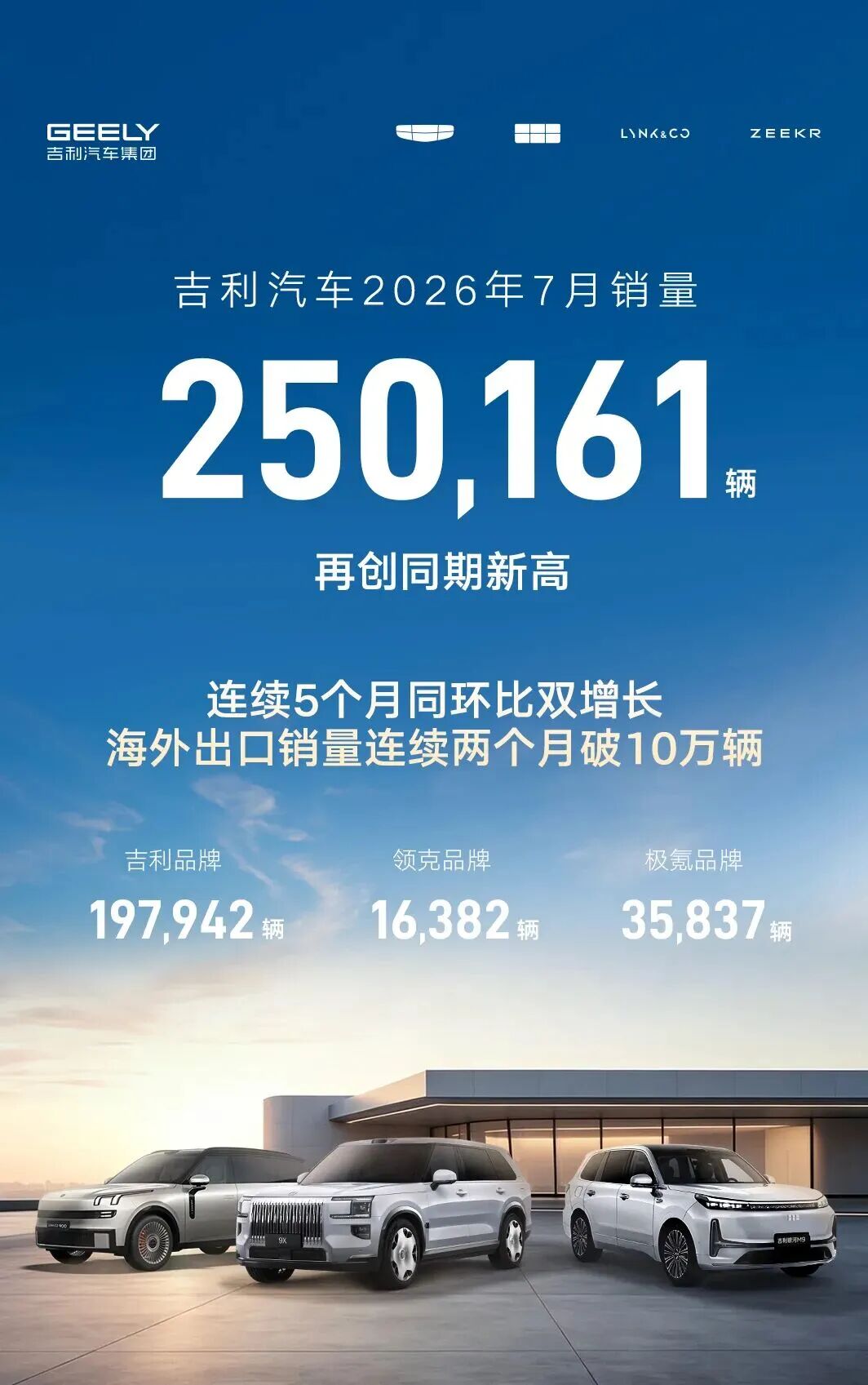
Geely Automobile sold 250,161 vehicles in July, a new record for the same period and marking five consecutive months of year-on-year and month-on-month growth. Compared to June's 240,799 units, July sales rose about 3.9% month-on-month.
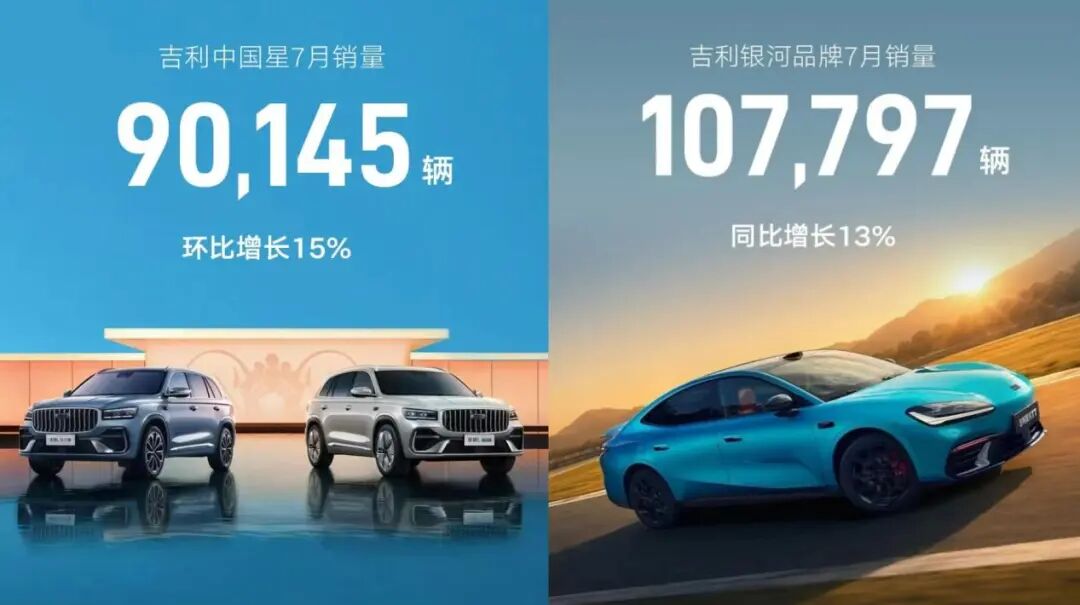
Among these, Geely China Star sold 90,145 units, Geely Galaxy sold 107,797 units, and the Geely brand sold a total of 197,942 units in July.
Specifically, the Geely China Star premium series sold 20,892 units in July, the Geely China Star Boyue sold 16,709 units, and the Geely China Star Bin series sold 31,152 units, up 68% year-on-year. The Geely Xingyue L surpassed 1 million cumulative sales in July, becoming the first Chinese brand premium fuel SUV to achieve this milestone.
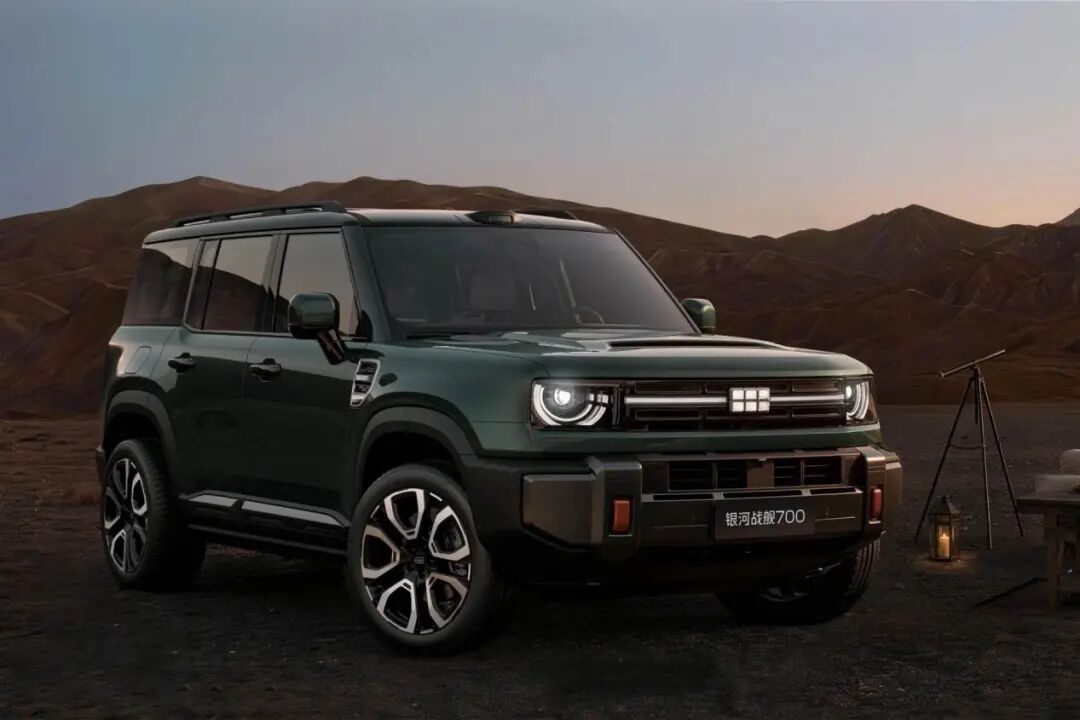
In the new energy segment, Geely's first AI all-terrain hardcore SUV, the Galaxy Warship 700, made its global debut in July, representing another heavyweight "boxy" off-road model launched by Geely in the new energy field. The sales mainstay, the Geely Xingyuan, sold 55,105 units in July, with cumulative sales exceeding 800,000 units.
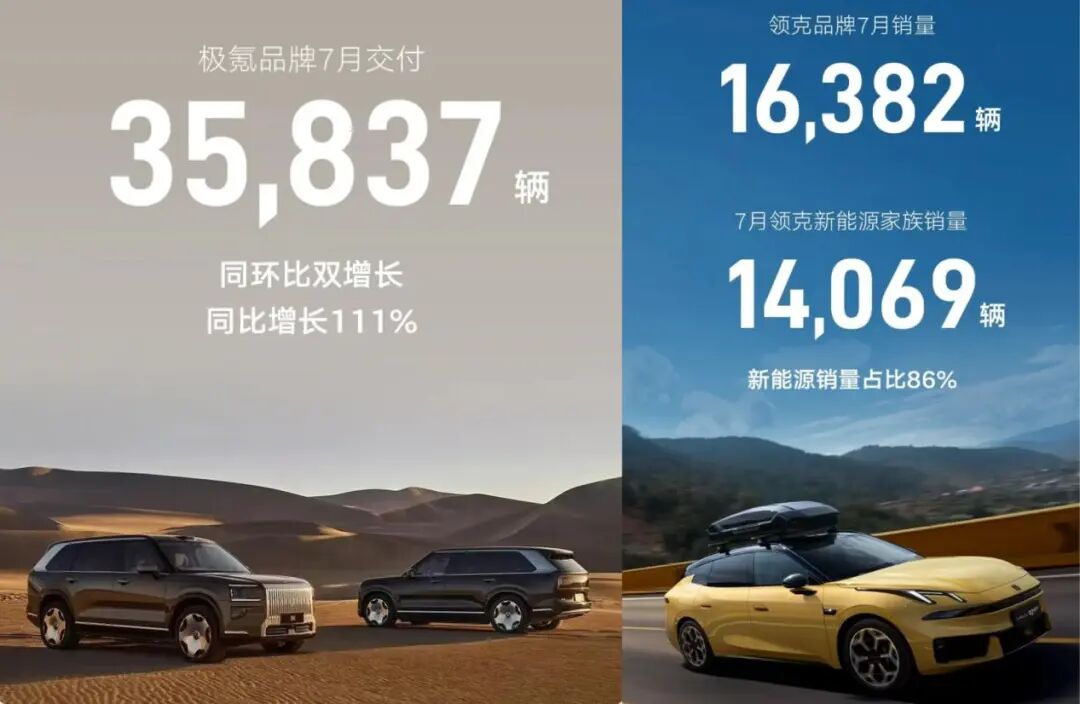
Among premium brands, Lynk & Co sold 16,382 units in July; Zeekr delivered 35,837 units. Lynk & Co's new energy family sales reached 14,069 units, accounting for 86% of its total sales, showing initial success in product transformation. Zeekr achieved strong year-on-year and month-on-month growth at the start of the second half, with year-on-year growth reaching 111%. In terms of product direction, the Zeekr 9X five-seater version launched in July, further covering the premium large five-seater SUV market; deliveries of the Zeekr 8X Qianli Haohan G-ASD H9 variant began, suggesting Zeekr will bring more surprises in the second half.
More notably, Geely's exports stood out. Geely exported 106,663 vehicles overseas in July, up 202% year-on-year, surpassing 100,000 units for the second consecutive month.
However, Geely faces an awkward reality. Its 2026 sales target is 3.45 million units, but after seven months, cumulative annual sales stand at about 1.673 million units, achieving about 48.5% of the target. To meet the full-year goal, average monthly sales for the remaining five months need to reach about 355,000 units, 100,000 more per month than July's record-breaking performance—a challenge that appears extremely difficult to overcome.
Node Auto believes that Geely's biggest focus in the second half should not be on whether it can achieve another sales target number but rather on whether it can stabilize high export growth, eliminate exports as a weakness, and translate Lynk & Co and Zeekr's growth into profitability reflected in financial reports.
03. Chery: Export "Leader"—What's Happening in the Domestic Market?
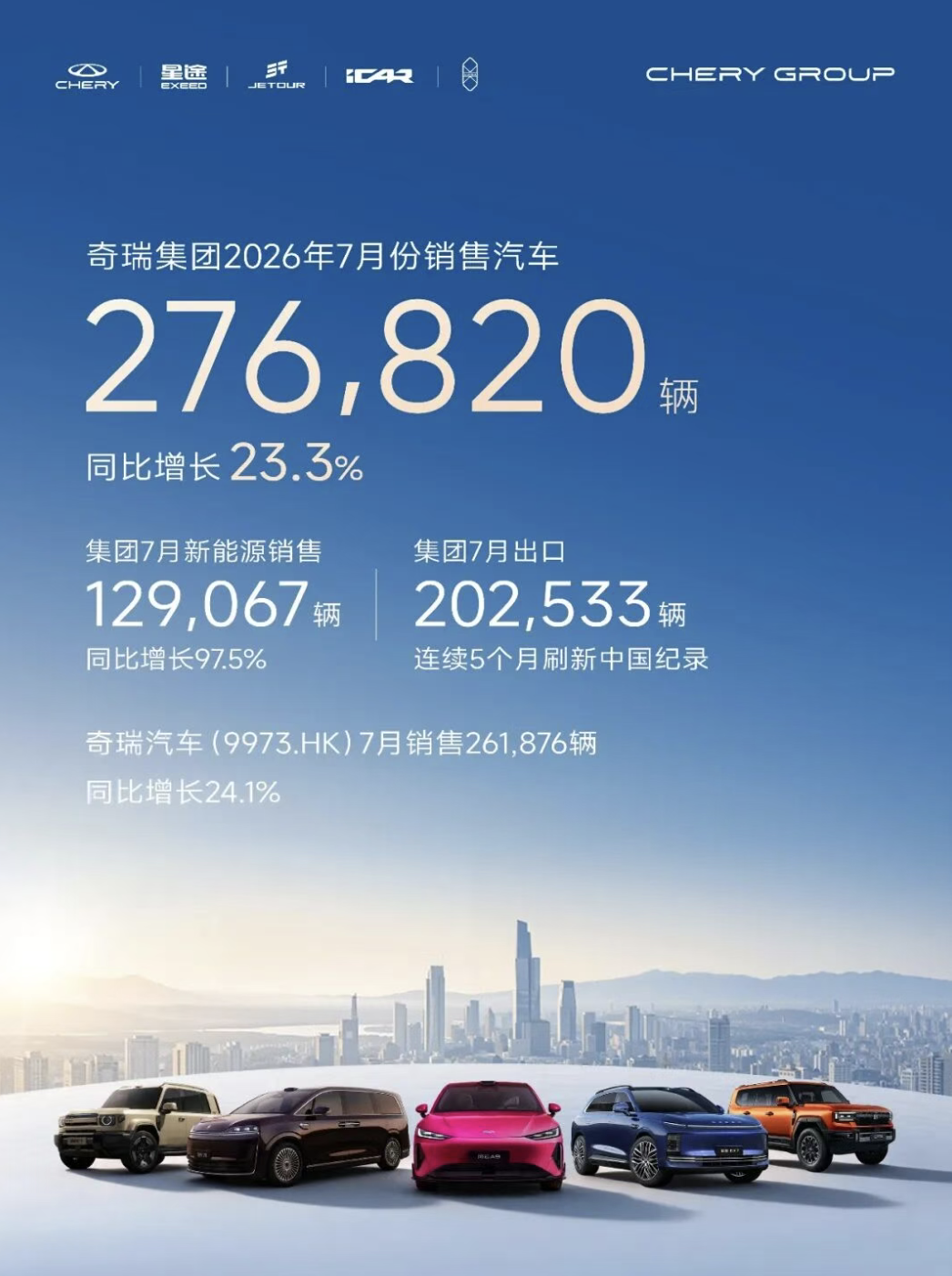
Chery Group sold 276,820 vehicles in July, up 23.3% year-on-year; new energy vehicle sales reached 129,067 units, up 97.5% year-on-year, with new energy models accounting for 46.6% of total sales.
As the export "leader," Chery's overseas sales figures have always been eye-catching: July exports reached 202,533 units, surpassing 200,000 units in a single month for the first time and setting a new record for Chinese automakers' monthly exports for the fifth consecutive month. Exports accounted for about 73.2% of Chery Group's monthly sales. While BYD's overseas growth is faster and Geely's new energy exports are catching up quickly, in terms of absolute scale and global channel depth, Chery remains the benchmark for Chinese automakers going overseas.
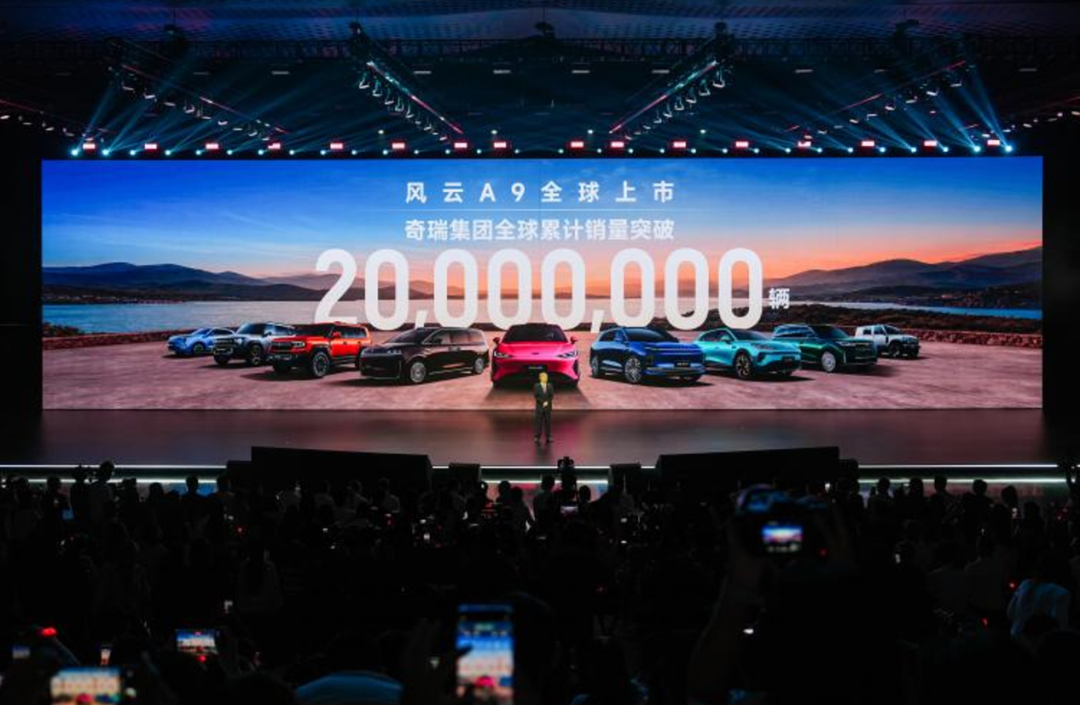
According to Chery's official statistics, QQ3 EV sales exceeded 10,000 units in July, and Smart #7 V9 deliveries also surpassed 10,000 units in the same month. Notably, on July 25, at the launch event for the Chery Fengyun A9, Chery Group's cumulative global sales surpassed 20 million units.
This achievement reflects Chery's global accumulation, but the other side of the data cannot be ignored. Chery's domestic sales in July stood at about 74,287 units, accounting for only about 26.8% of group sales.
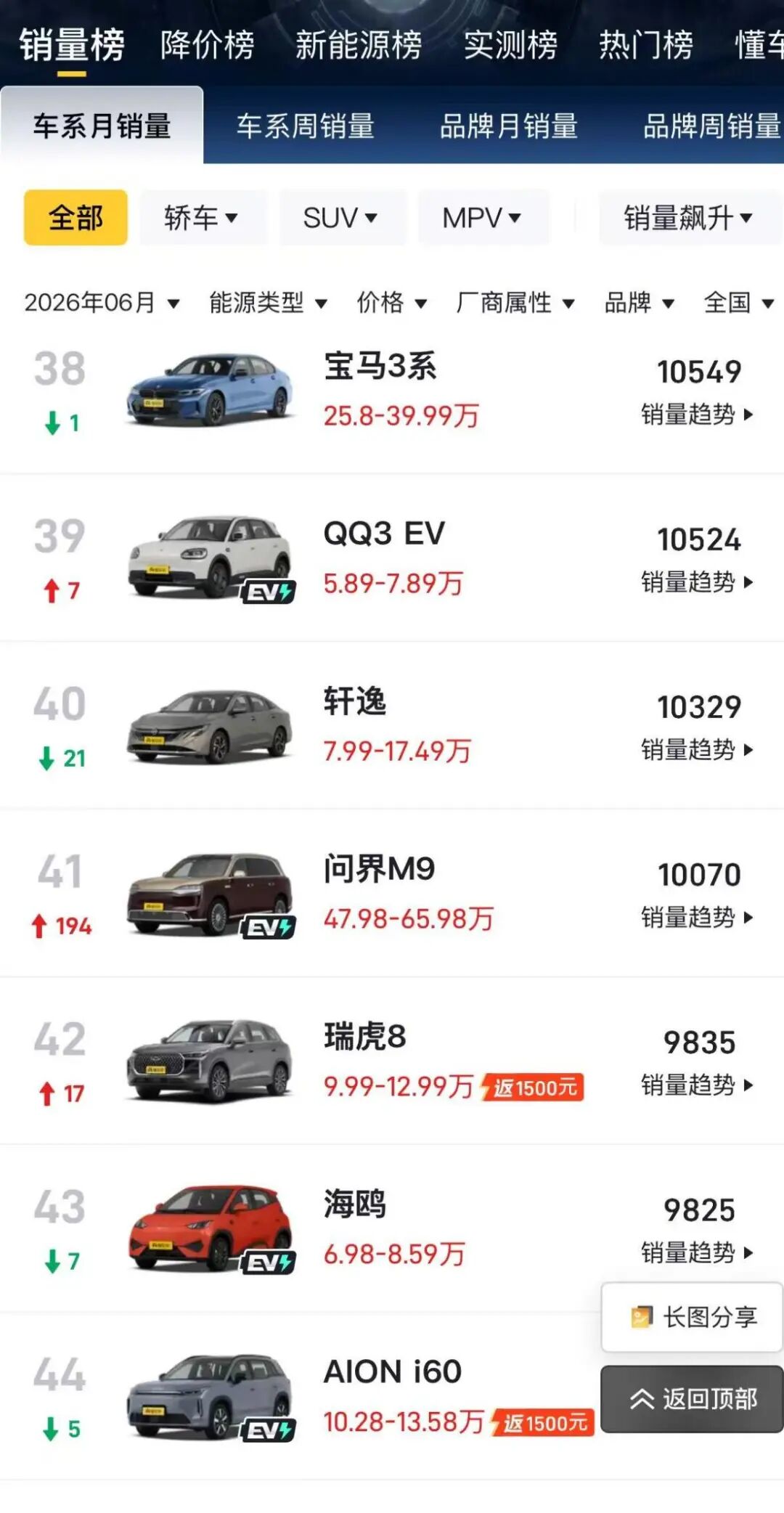
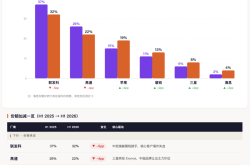
Source: Dongchedi App
Node Auto's rough statistics show that Chery Group's brands—Chery, Exeed, Jetour, iCAR, and Smart #7—offer over 65 models for sale. In the latest June national vehicle sales rankings by a third party, the highest-ranked model was the QQ3 EV, a small pure electric car, at 39th place, with monthly sales exceeding 8,000 units for the past three months and reaching 10,524 units in June. Following the QQ3 EV was Chery's veteran model Tiggo 8, ranked 42nd, with 9,835 units sold in June; then the Arrizo 8, ranked 67th, with just over 7,000 units sold in June.
Chery boasts a complete brand matrix and the most mature overseas channels among domestic automakers. However, in terms of intelligence, design expression, and technology commercialization speed, it must keep pace with the accelerating rhythm of other Chinese auto brands. In Node Auto's view, Chery's challenge in the second half is not about "whether exports can continue to break records" but rather whether it can translate export advantages into brand premium and stem market share losses domestically.
04. Great Wall Motors: Product Counteroffensive Just Beginning
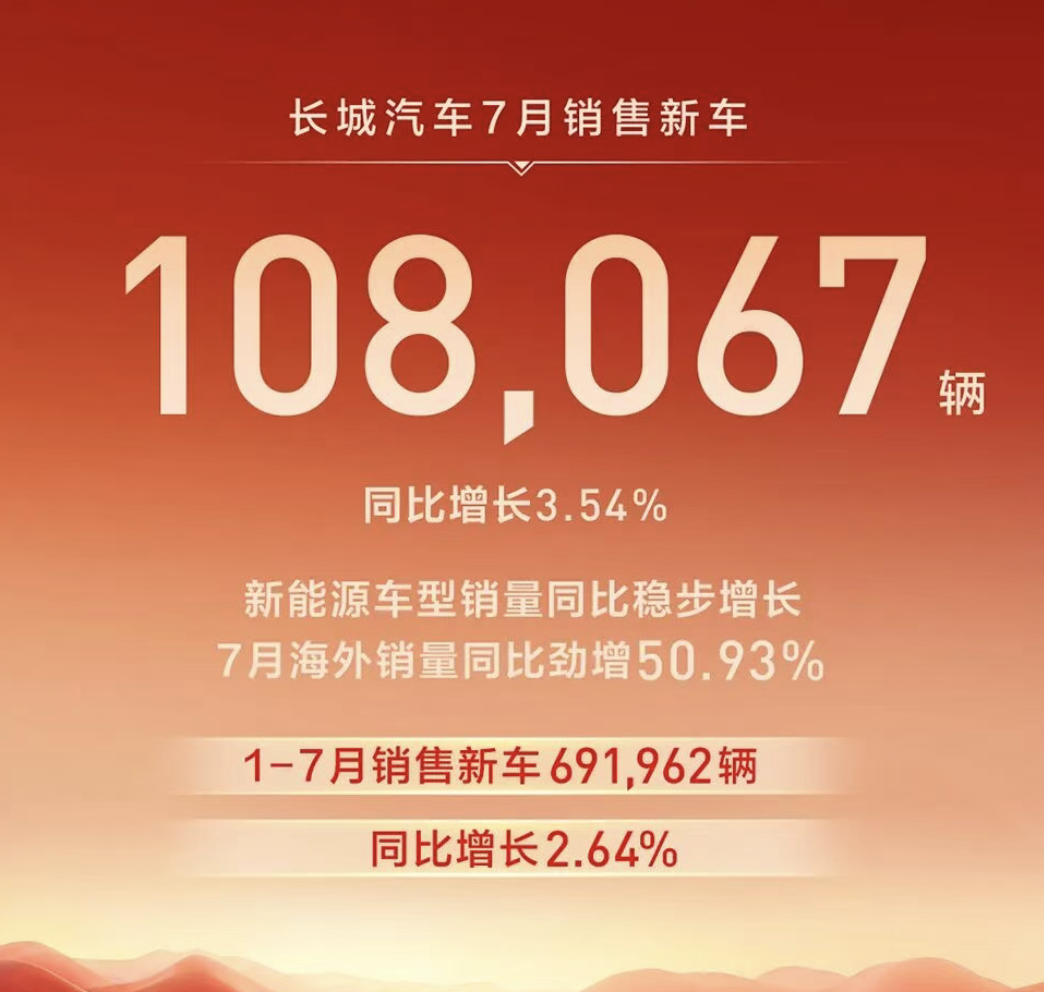
Great Wall Motors sold 108,067 vehicles in July, up 3.54% year-on-year and roughly flat with June's 108,080 units.
By brand, Haval sold 56,272 units, WEY sold 7,725 units, Tank sold 17,228 units, Ora sold 10,820 units, and Great Wall Pickup sold 16,006 units. Great Wall's biggest highlight in July was not in total volume but in product mix.
Ora continued to sell over 10,000 units; WEY and Tank rebounded month-on-month; Great Wall Pickup sales rose from 14,012 units in June to 16,006 units. For Great Wall, which has long emphasized profit and high-value model proportions, the improvements in WEY, Tank, and Pickup are more important than simply expanding sales of low-priced models.
In fact, to lay the groundwork for the second-half market, Great Wall launched a rare wave of product offensives in July. Within a week, the WEY V9X Family Edition went on sale; the Great Wall H10 opened for pre-orders; and the all-new Tank 300 was launched. Notably, the domestic "boxy" benchmark product, the all-new Tank 300, covers fuel, diesel, Hi4-T, and Hi4-Z powertrains, priced from RMB 199,800. Official data shows it received 15,318 orders within 12 hours of launch.
From the market positioning of these three Great Wall products—family luxury, urban boxy, and off-road—it's clear that Great Wall aims to extend its off-road and hybrid strengths into family scenarios.
Node Auto believes that Great Wall's key to success in the second half is clear: new product conversion rates.
Great Wall lacks neither technology nor distinct product and technological labels. Its current challenge is whether it can translate technological advantages into sustained sales and gain wider consumer recognition for its "persistence."
At the product level, Node Auto will watch whether the H10 and Tank 300 create internal competition. Whether these two models complement each other or compete for the same "boxy" user base will test Great Wall Motors' internal coordination capabilities.
05. Shenlan, When Growth Meets Product Transition
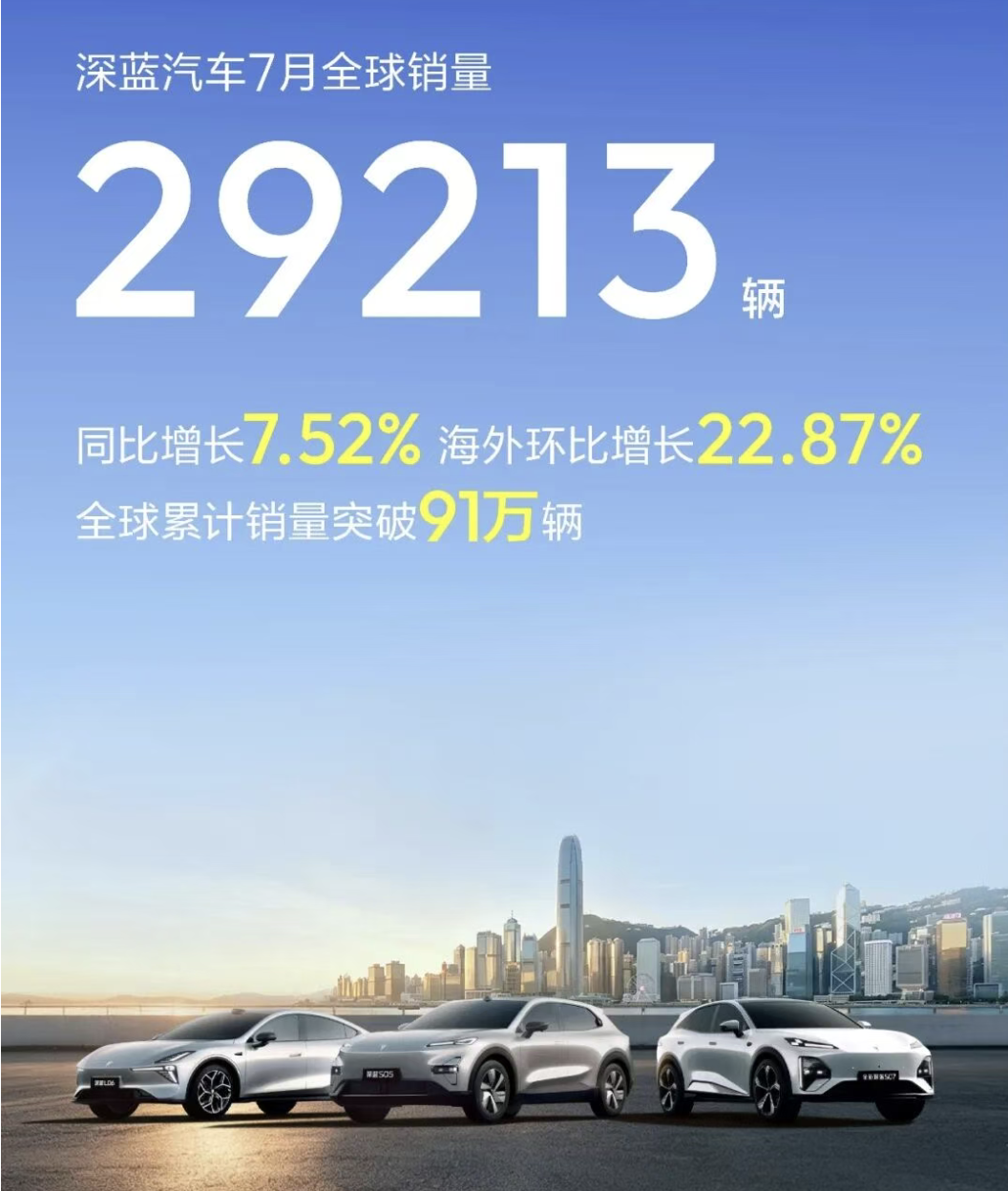
Shenlan Automobile's global sales reached 29,213 units in July, up 7.52% year-on-year, with overseas sales rising 22.87% month-on-month. The brand's cumulative global sales have surpassed 910,000 units. From January to July 2026, Shenlan's cumulative global sales stood at 193,369 units, up 13.48% year-on-year, including 44,508 overseas units, an 87.48% increase year-on-year.
July's performance maintained year-on-year growth, but sales dropped approximately 13.1% from June's 33,625 units. After four consecutive months of sales exceeding 30,000 units, Shenlan experienced a short-term decline in July.
This is not entirely surprising.
Shenlan is currently in a transition phase for its main models. On July 30, the all-new Shenlan S05 opened for pre-sale, offering five versions priced between RMB 119,900 and RMB 151,900, covering 520 km and 620 km pure electric ranges, and including a LiDAR version. The new model is set to officially launch on August 6.
During the product transition cycle, Shenlan has intensified its brand marketing efforts. In July, Shenlan announced its partnership as the global official sponsor of the Portuguese national football team; its Jinzhongzhao battery won the 2025 National Science and Technology Progress Award. The former aligns with the World Cup, July's biggest promotional IP, while the latter serves as a technological endorsement for the brand's products.
However, Shenlan's more pressing issue remains scale.
Compared to BYD, Geely, and Chery, Shenlan lacks a large base of fuel-powered vehicles and overseas exports. Compared to new energy competitors, it needs to prove its independent product and brand value within the Changan system.
Node Auto predicts that the launch of the all-new S05 will directly determine whether Shenlan can re-establish monthly sales of 30,000 units in the second half of the year. Additionally, Shenlan needs to differentiate itself in the RMB 120,000-150,000 market segment. Given the current competitive landscape, the only way to achieve differentiation is through technological innovation rather than simply competing on price. Only then can Shenlan evolve from a "Changan new energy brand" into a truly independent mainstream brand.
06. In Conclusion
The July sales figures of the five automakers, while seemingly varied, actually point to the same industry trend: the domestic market is shifting from scale expansion to Stock competition (market share competition), with overseas markets becoming the primary growth driver, and new energy technology advancing from basic availability to high-end decentralization in technological competition.
BYD is leveraging overseas markets to restore growth, Geely is actively addressing its weaknesses, and Chery continues to push its export records higher, though it cannot mask the slowdown in the domestic market. Great Wall is launching a dense ( dense means dense , here it should mean ' dense 推出' - dense 地推出) of new products for the second half of the year, while Shenlan faces the challenge of transitioning its main models.
July marks the first whistle of the second half.
For Chinese automakers, exports can offset domestic declines, and new vehicle marketing can generate short-term buzz. However, the ultimate determinant of how far a company can go still lies in the balance between its domestic foundation, global operational capabilities, and sustainable profitability.
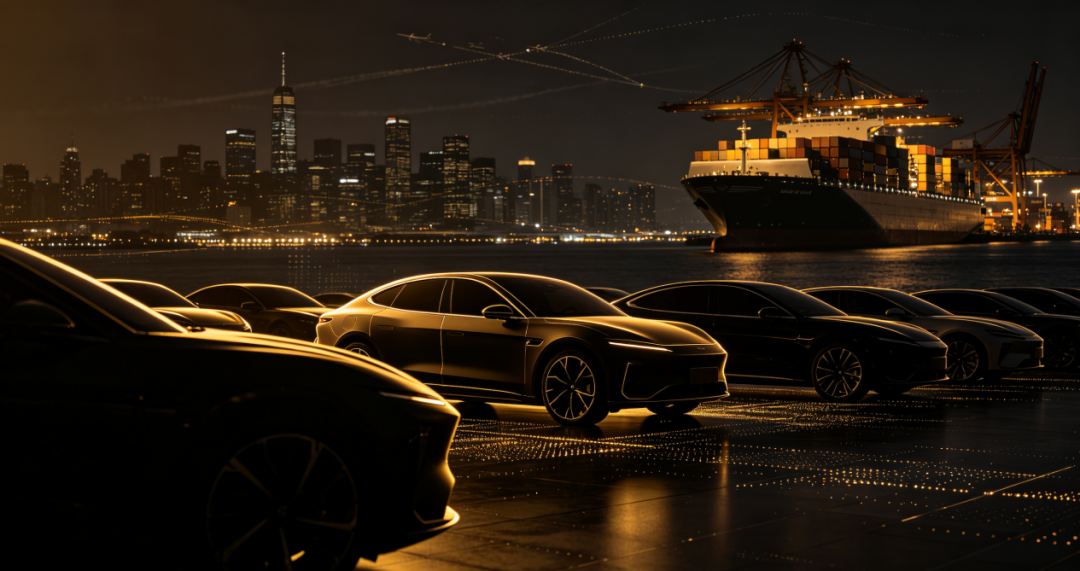
*The featured image was generated by AI.


-
![]()
Two Truths About July's Auto Market: Domestic Focus on Technology, Overseas Focus on Speed | Second Half Kickoff ②
-
![]()
Smartphone Chip Shipments Decline by 15%, While Smartphone Shipments Fall by Less Than 7%: Where Is the Discrepancy?
-
![]()
New Forces Start to Profit from Scale
-
Sluggish Sales: New Policies Step In to Revive the Market
-
![]()
The Changing Tide of Luxury Cars: Why Are Mercedes-Benz Sales Slumping?
-
![]()
Can You Still Identify Intelligent Driving When the Small Blue Light is Off?
-
![]()
The Stronger the Model, the More Valuable the Application Becomes
-
Is Alibaba Using QwenWork to Rival WorkBuddy?