Smartphone Chip Shipments Decline by 15%, While Smartphone Shipments Fall by Less Than 7%: Where Is the Discrepancy?
 08/04 2026
 556
556
Produced by Zhineng Zhixin
According to data from Counterpoint, global smartphone SoC shipments in the first half of 2026 saw a 15% year-on-year decrease, with MediaTek and Qualcomm experiencing declines exceeding 25%.
The Chinese smartphone market shipped approximately 134 million units, with IDC reporting a 4.2% year-on-year decline and Counterpoint reporting a 3% decrease. In the global smartphone market, IDC reported a 6.7% decline in the second quarter.
The 6.7% drop in smartphone shipments starkly contrasts with the 15% decline in SoC shipments. During this period, the decline in the Chinese market was less pronounced than the global decrease. Where did the lost shipments from chip manufacturers go?
Part 1: Changes in Smartphone SoC Market Share 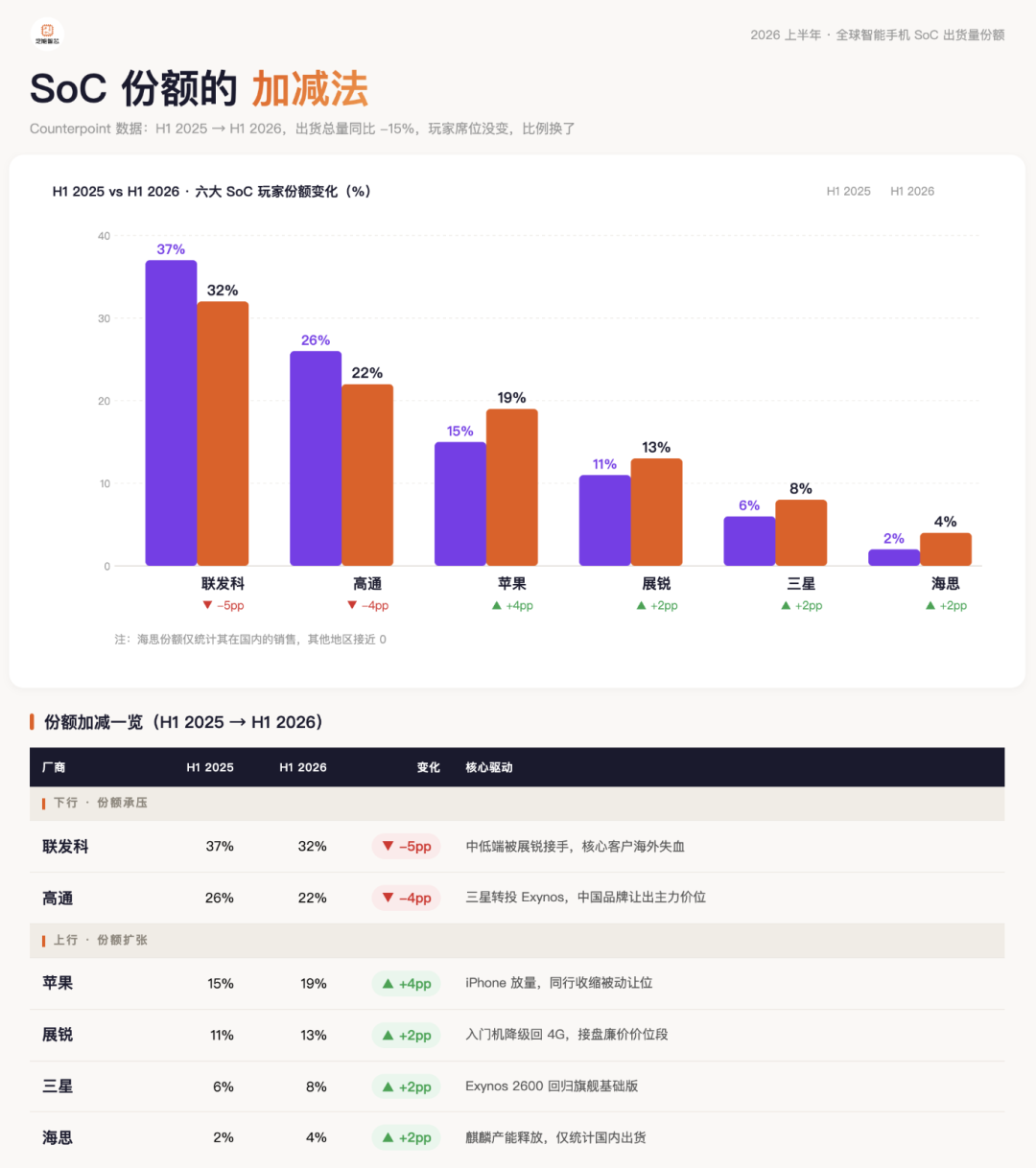
The global smartphone SoC market share distribution in the first half of 2026 is as follows: MediaTek 32%, Qualcomm 22%, Apple 19%, Unisoc 13%, Samsung 8%, and the remaining 5% (HiSilicon approximately 4%).
Comparing to the first half of 2025: MediaTek approximately 37%, Qualcomm approximately 26%, Apple 15%, Unisoc approximately 11%, Samsung approximately 6%.
◎ MediaTek's share declined by about 5 percentage points, while Qualcomm's decreased by 4 to 5 percentage points.
◎ Apple's share increased by 4 percentage points, a judgment made by Counterpoint senior analyst Shivani Parashar in the report.
◎ Samsung's share increased by 2 to 3 percentage points, while Unisoc's rose by 1 to 2 percentage points.
The two companies experiencing declines are the world's two largest pure commercial chip suppliers, selling only chips and not manufacturing smartphones themselves.
Among the three companies with rising shares, Apple and Samsung both sell their own smartphones and use their own chips.
Although Unisoc also only supplies chips, its growth trajectory differs from Apple and Samsung, with incremental growth primarily coming from orders for mid-to-low-end models.
◎ Apple's 4 percentage point gain comes from the iPhone 17 series. According to IDC, Apple shipped 55.8 million units globally in the second quarter, a 15.3% year-on-year increase, setting a new record for the same period in a traditionally slow season without new product launches.
The stronger Apple's sales, the more its demand for externally purchased SoCs contracts. The A19 is its in-house chip and is not included in the shipments of any third-party chip manufacturers.
◎ Samsung is the primary beneficiary of self-developed chip substitution, with Qualcomm being the affected party.
The base version of the Galaxy S26 series switched to the self-developed Exynos 2600 in some regions, while the previous generation S25 exclusively used Snapdragon. Samsung shipped 62.7 million units globally in the second quarter, an 8.1% year-on-year increase. Exynos's market share rose from 6% to 8%, with most of Qualcomm's lost flagship orders coming from here. The Xiaomi 17 series performed moderately, further eroding Qualcomm's flagship SoC market share.
◎ Unisoc's growth logic is entirely different from the previous two. A significant number of entry-level models are migrating back to Unisoc's 4G platform to reduce BOM costs.
Downgrading from 5G to 4G and adjusting configurations downward are cost-cutting measures taken by smartphone manufacturers in response to rising memory prices. At the same time, Unisoc has made progress in entry-level 5G through its cooperation with Pocophone and Redmi.
All three companies' market shares are rising, but none are driven by growth in chip shipments themselves.
Part 2: Memory Reshapes BOM Cost Structure 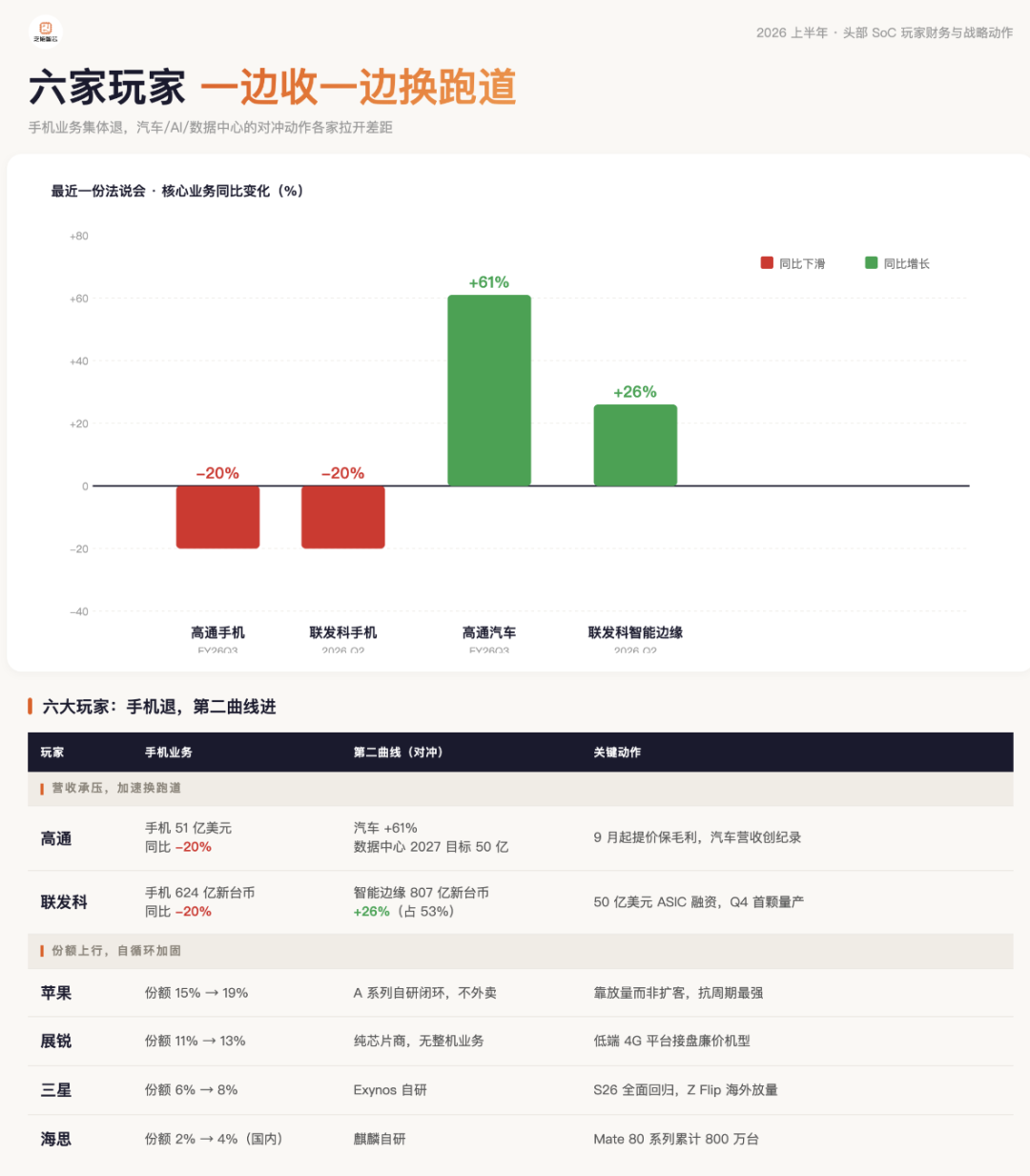
In the second quarter of 2026, smartphone memory prices surged by over 300% year-on-year. IDC's segmented data is even more striking: in low-end models, memory costs accounted for over 65% of the total BOM. In the first half of the year, memory costs exceeded SoC costs across all price segments. For the first time, the most expensive chip in smartphones became memory.
This pressure is directly reflected in the financial reports of two companies.
◎ Qualcomm's FY26Q3 smartphone business revenue was $5.1 billion, a 20% year-on-year decline. The previous quarter's financial report already pointed out that the decline in smartphone chip revenue was mainly due to major OEMs adjusting production plans and reducing inventory levels due to limited memory supply and price hikes. CEO Cristiano Amon stated more directly that cost increases were not limited to memory but affected the entire supply chain. Qualcomm raised prices starting September 1 to restore gross margins to historical levels.
◎ MediaTek's second-quarter smartphone revenue was NT$62.4 billion, a 20% year-on-year decline and a 14% quarter-on-quarter decline, accounting for 41% of total revenue, surpassed for the first time by the intelligent edge business (53%). Gross margin was 46.2%, 2.9 percentage points lower year-on-year.
The decline is still widening.
In FY26Q2, Qualcomm's smartphone chip revenue was $6.024 billion, a 13% year-on-year decline, which widened to 20% a quarter later. Chip manufacturers are in the middle of the industrial chain. Upstream foundries raise prices first, midstream memory squeezes customers' procurement budgets, and downstream customers cut orders to reduce inventory. The loss in gross margin is ultimately borne by the chip manufacturers themselves.
Bernstein's calculations show that DRAM contract prices surged by 85% to 100% quarter-on-quarter in the first quarter of 2026 and will rise by another 60% in the second quarter. NAND contract prices rose by 70% to 75% quarter-on-quarter. Omdia's data shows DRAM prices rising by over 50% quarter-on-quarter and NAND prices rising by over 90% in the first quarter. The figures differ, but the direction is consistent.
While the overall market is declining, only one line is still rising: smartphone SoCs supporting generative AI, with shipments increasing by 24% year-on-year in the first half of the year. Demand for high-end and on-device AI remains, and chips in the mid-to-high-end to flagship segments have not contracted along with the overall market.
This explains why MediaTek's Dimensity 9500 is smoothly being adopted in designs by vivo, OPPO, Pocophone, and Redmi, while its mid-to-low-end and entry-level 5G chips are contracting.
The two most affected manufacturers are also highly aligned in seeking new growth points, both looking beyond the smartphone business.
◎ Qualcomm's FY26Q3 automotive business revenue was $1.59 billion, a 61% year-on-year increase, setting a record. FY26Q2 automotive chip revenue was $1.326 billion, a 38.27% year-on-year increase. Amon's public logic is to use the data center business to make up for the loss of Apple orders, with a FY2027 data center target of $5 billion.
◎ MediaTek's intelligent edge business revenue was NT$80.7 billion in the second quarter, a 26% year-on-year increase, accounting for 53% of total revenue, surpassing smartphones as the largest segment for the first time. The board approved a $5 billion financing framework, with the first AI accelerator ASIC scheduled for mass production in the fourth quarter of 2026.
Smartphone SoCs remain the core business for both companies, but their resource focus is shifting outward. In-cabin systems, ADAS, and data centers have become new investment directions.
Part 3: The Chinese Market Requires Separate Accounting
The mismatch in decline rates needs to be analyzed within the context of Chinese manufacturers' global布局.
China's smartphone market shipped approximately 134 million units in the first half of the year, compared to a global total of approximately 550 million units, with China accounting for 24%.
Looking at Qualcomm's FY2025 financial report: China (including Hong Kong) contributed $20.34 billion in revenue, accounting for 45.93% of total revenue.
The 24% share in China versus the 46% share in total revenue indicates that the difference comes from Chinese brands selling to other global markets.
When Xiaomi sells a smartphone in Europe using a Snapdragon chip, the revenue is counted in the Chinese region because Xiaomi is headquartered in Beijing. Nearly half of Qualcomm's revenue comes from the global expansion of Chinese smartphone brands. Therefore, to assess the impact of the Chinese market on this round of SoC changes, simply looking at the 134 million units shipped domestically is insufficient.
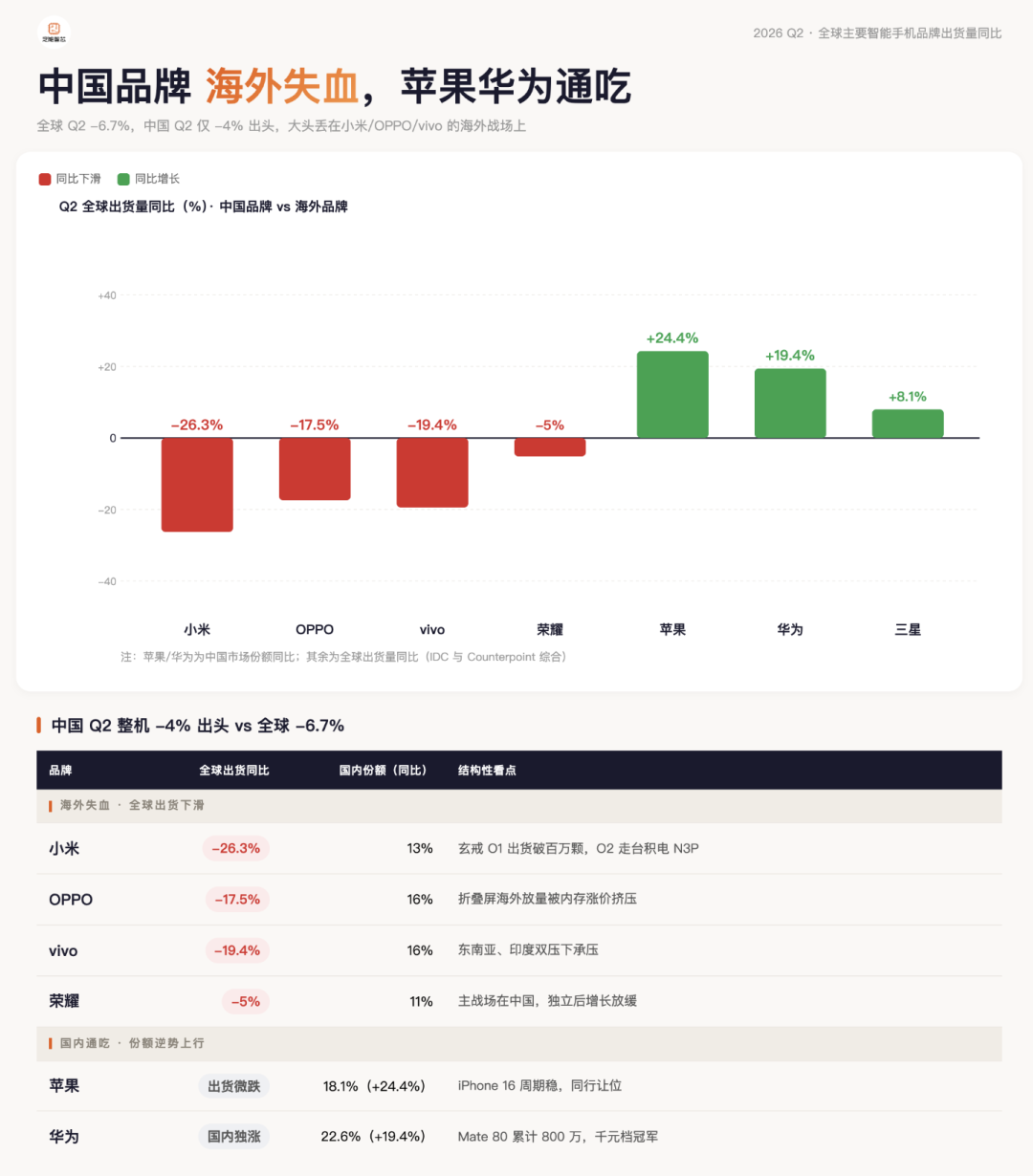
This round of demand contraction for SoC manufacturers cannot be simply attributed to the shrinking Chinese market. Looking at IDC's second-quarter data: Xiaomi shipped 31.2 million units globally, a 26.3% year-on-year decline; OPPO shipped 28.8 million units, a 17.5% decline; and vivo shipped 21.2 million units, a 19.4% decline. The three companies shipped a total of 81.2 million units, a 22% year-on-year decline.
In the same quarter, the Chinese market only declined by 4.3%.
The Chinese market is one of the basic markets for these three companies, but it is not where they have lost the most market share. The lost volume is concentrated in the sub-$150 price segments in India, Southeast Asia, Latin America, and Africa, which are the most vulnerable to memory price hikes. Counterpoint expects full-year declines in the entry-level segment to exceed 30%, referring to this segment.
There are also reasons why the Chinese market has declined less.
◎ Huawei's domestic market share in the second quarter was 22.6% to 23%, a 19.4% year-on-year increase, setting a new record since the fourth quarter of 2020. The Enjoy 90 Pro Max, priced starting at RMB 1,699, became the champion in the sub-RMB 1,500 price segment. The Pura X Max supported the foldable phone line, and the Mate 80 series surpassed 8 million cumulative sales by late July.
Huawei's complete product matrix, ranging from sub-RMB 1,500 smartphones to RMB 10,000 foldable phones, is its most stable support in this round.
◎ Apple's domestic market share in the second quarter was 18.1%, a 24.4% year-on-year increase. Android manufacturers generally raised prices due to cost increases, while iPhone pricing remained unchanged, narrowing the price gap. The market widely expects new iPhones to also raise prices in the third quarter, prompting some users to upgrade early.
◎ The remaining four Android brands all saw their market shares decline. OPPO and vivo each had 16%, Xiaomi had 13%, and Honor had 11%. Xiaomi's domestic shipments declined by 21.7% year-on-year, as it actively reduced low-priced models to protect profits.
Guo Tianxiang, IDC China's research manager, stated that high-end brands have significantly better risk resistance than mid-to-low-end brands.
This round of cost shocks has primarily affected volume-driven price segments. HiSilicon's smartphone market share in China is around 23%, but its global SoC market share is only 4%. Kirin chip production has gradually increased over the past two years, covering smartphones from sub-RMB 1,500 models to RMB 10,000 foldable phones, allowing Huawei to achieve self-sufficiency in chip supply. This is why it can maintain price stability during this price hike cycle.
For Xiaomi, the Xuanjie O2, according to Lu Weibing, will definitely iterate this year, continuing to use TSMC's 3nm N3P process. It will debut in a new domestic model before being rolled out to overseas models.
Xuanjie O1 shipments exceeded 1 million units by April 2026, with cumulative investment exceeding RMB 13.5 billion and a research and development team of over 2,500 people. While the 1 million unit volume does not yet pose a substantial threat to Qualcomm and MediaTek, the direction is clear: Chinese manufacturers are following the path taken by Apple and Samsung, using self-developed SoCs to regain control over the most expensive part of the BOM.
Apple gained 4 percentage points with its A-series chips, while Samsung regained 2 percentage points from Snapdragon with its Exynos 2600.
Summary
The SoC market share landscape in the first half of 2026 has been reshaped by memory prices.
MediaTek and Qualcomm experienced declines exceeding 25%, primarily due to their customer structures. Xiaomi, OPPO, and vivo, the three largest buyers of commercial SoCs, simultaneously lost market share in overseas entry-level and mid-range markets. In the domestic market, Huawei and Apple, the two companies that purchase the fewest commercial SoCs, propped up the market.
Global smartphone SoC shipments are expected to decline by 14% in 2026, with memory supply not returning to normal until the second half of 2027. This round of price hikes, which began in the second quarter of 2025, may last until the end of 2027, nearly three years. IDC expects the year-on-year decline in Chinese smartphone shipments to widen to around 20% in the second half of 2026.
In the first half of the year, manufacturers were still digesting the low-priced memory inventory stockpiled at the end of last year, and the cost shock had not fully passed on to end consumers. In the second half of the year, new models equipped with high-priced memory will be launched, and a second round of price adjustments has already begun. Chip manufacturers are now competing on the risk resistance of their customer structures rather than just processor performance.
For Chinese smartphone manufacturers, the speed at which the Xuanjie O2 and Kirin self-developed chip lines progress will determine whether they have any cards to play when the next cost storm hits.
-
![]()
Two Truths About July's Auto Market: Domestic Focus on Technology, Overseas Focus on Speed | Second Half Kickoff ②
-
![]()
Smartphone Chip Shipments Decline by 15%, While Smartphone Shipments Fall by Less Than 7%: Where Is the Discrepancy?
-
![]()
New Forces Start to Profit from Scale
-
Sluggish Sales: New Policies Step In to Revive the Market
-
![]()
The Changing Tide of Luxury Cars: Why Are Mercedes-Benz Sales Slumping?
-
![]()
Can You Still Identify Intelligent Driving When the Small Blue Light is Off?
-
![]()
The Stronger the Model, the More Valuable the Application Becomes
-
Is Alibaba Using QwenWork to Rival WorkBuddy?