Is Qwen3.8 the 'Zelda' for Qianwen Office?
 08/06 2026
 449
449
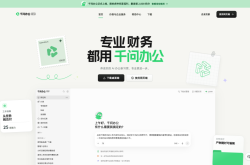
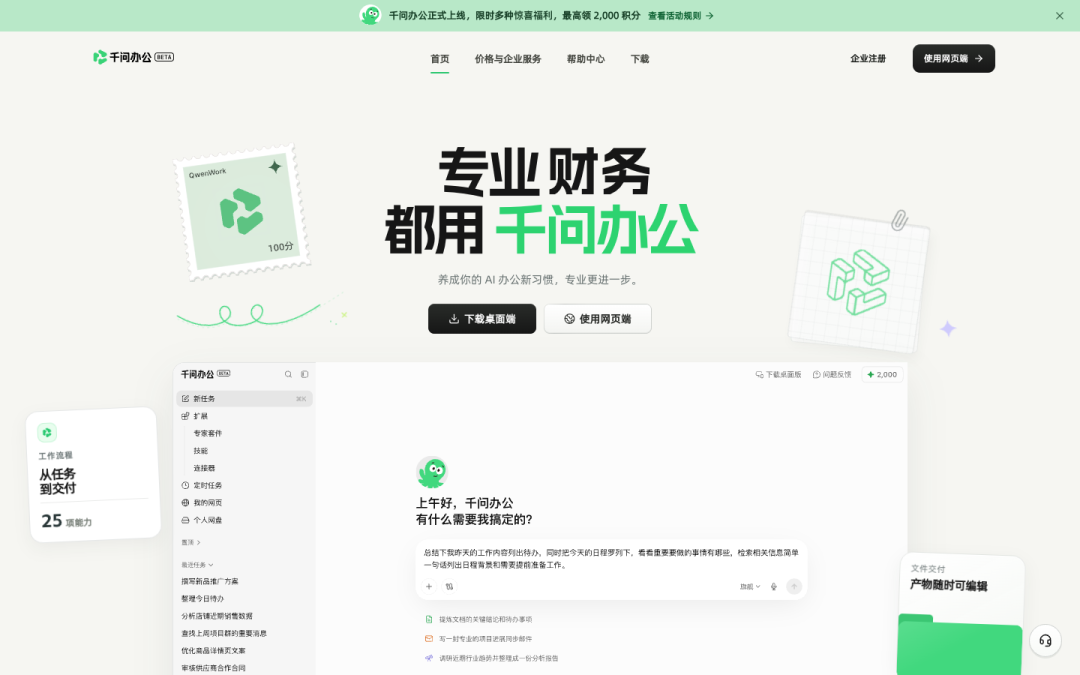
In recent days, Qianwen Office has officially launched its public beta phase.
From my hands-on experience over the past few days, Qianwen Office proves to be a user-friendly product. However, at this stage, when considering just the product interface, there is not a significant disparity among various offerings. The competition now centers around securing a strategic position, expanding ecosystems, and standardizing the operation of large models through diverse Agents and Skills.
This scenario is quite familiar to gamers. The decision to purchase a Switch, PS5, or Xbox often hinges on the gaming ecosystem each platform supports. Users typically prioritize consoles that offer exclusive games.
Alibaba has prominently featured Qwen3.8. By aligning the model with the product, it's akin to pairing a console with its flagship launch title: Qwen3.8 serves as the 'Zelda' masterpiece (a blockbuster title) safeguarding Qianwen Office, while Qianwen Office represents Alibaba's 'Switch' designed specifically for Qwen.
Launch titles play a pivotal role in influencing user choices—a console can transform gaming capabilities into user relationships, content ecosystems, and paid habits. Over the past two years, large models have primarily functioned as plugins for office software. Now, they aim to break free from the menu bar and establish a significant presence in the office environment.
Around Qianwen Office, Alibaba is clearly intent on revolutionizing the delivery of AI services.
Models begin to find their 'physical form'
On July 19th, Alibaba announced that the Qwen3.8-Max preview version, boasting a total parameter scale of 2.4 trillion, has been integrated into the Qianwen Token Plan, Qoder, and QoderWork. On August 3rd, Alibaba further released Qwen3.8 and announced the impending availability of its weights, with Qianwen Office officially launching on the same day.
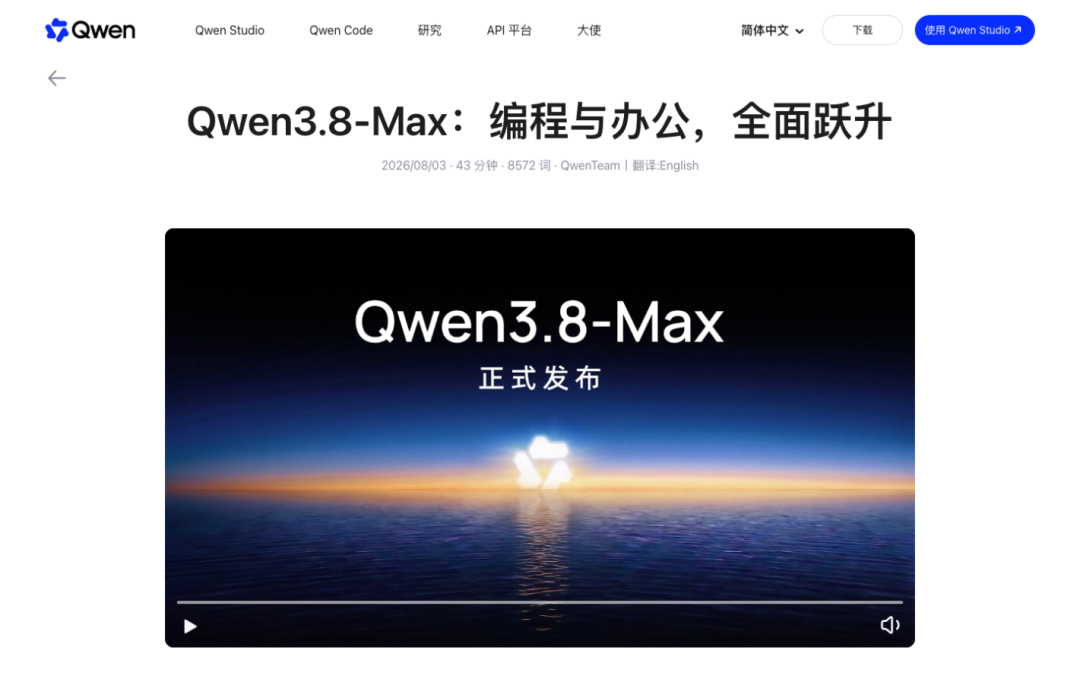
In the Qianwen Office client I examined, several tiers—Advanced, Basic, and Economy—are densely packed into the model dropdown menu, with Qwen3.8-Max being the sole model with a distinct name. Officials state that other models will be integrated in the future, so this does not yet confirm that Qianwen Office exclusively utilizes Qwen; however, the product hierarchy is evident: other models provide capabilities, while Qwen3.8 handles branding.
It's the exclusive title prominently displayed on the shelf.
Behind this are two distinct approaches to office AI. Feishu, DingTalk, and WPS integrate existing office systems with models, already possessing files, workflows, and organizational relationships. On the other hand, Claude Cowork, Kimi Work, and Qianwen Office evolve from models to develop files, tools, and delivery capabilities.
Qianwen Office currently leans more towards the latter path. Alibaba must first verify whether Qwen3.8 can handle a complete task, with the product serving as the model's 'physical form.' The so-called co-work battle ultimately hinges on the model battle.
Alibaba positions Qwen3.8 in the starting (launch) position, valuing its capabilities in code, multimodality, reasoning, and long contexts. An office Agent often needs to read numerous documents, write scripts, call browsers, and then revise PPTs. A weaker model would struggle during task decomposition; only a sufficiently robust model allows subsequent tools and workflows to connect seamlessly.
However, a strong model only addresses the task's upper limit; the lower limit depends on Agent-model coordination.
On July 27th, when Zhidx tested QwenWork, it took approximately 7 minutes to generate a 12-page PPT for Alphabet's Q2 earnings report, with key data matching official materials and the file remaining editable. Switching to an 'NOVA Digital' e-commerce website task extended the time to 1 hour and 8 minutes; another task converting a WeChat Official Account article into a Feishu document resulted in full-text garbled text and failed delivery. This set of three tests consumed approximately 1,000 credits.
Another tester had Qianwen Office develop a 3D rocket simulation webpage, encountering three errors over two hours before producing a usable result, exhausting 2,000 credits. On social media, Qwen3.8's performance was inconsistent: some praised its single-page HTML generation on V2EX, while others found it misjudged a project's installation of Tailwind based solely on CSS class names; on Reddit, a user said it fixed complex issues involving llama.cpp and Godot plugins in 10 minutes, yet the same individual encountered repetitive loops after two or three conversation rounds.
The same engine exhibits vastly different upper and lower limits. In gaming, frame drops allow reloading; in office tasks, an interruption after 50 minutes might mean losing a deliverable webpage and wasted credits.
Once models are integrated into products, there's no one else to blame. Long tasks require checkpoints to resume after failure, critical operations necessitate user confirmation, and delivery demands final inspection. Qwen3.8 attracts users to the console, but it's unclear whether Qianwen Office can retain them.
Yet Qianwen Office undoubtedly shoulders this responsibility: ensuring Tokens are continuously consumed and demonstrating to Alibaba what results users are willing to pay for. Qwen3.8 provides capabilities, while Qianwen Office creates tasks. Token Foundry truly comes into play here.
Let Tokens start finding work
Over the past six months, Alibaba has given this business three somewhat confusing names.
In March, Alibaba established the Alibaba Token Hub business group, setting goals to 'create Tokens, deliver Tokens, and apply Tokens.' In June, the Tongyi Large Model Business Unit merged with the Future Living Lab to form the Token Foundry Business Unit, directly led by Wu Yongming. The former oversees the entire Token chain, while the latter supplies capabilities for models and next-gen AI products.
Alibaba Cloud handles commercialization. Computing power, BaiLian MaaS, model APIs, Agent platforms, and enterprise contracts all generate revenue under the cloud's accounts.
Alibaba's latest earnings report clarifies the direction. For the quarter ending March 2026, Alibaba Cloud's external revenue grew 40% year-over-year, with AI-related products accounting for 30% of external cloud revenue. Wu Yongming expects this share to exceed 50% within the next year.
Token Foundry decides what to create, Alibaba Cloud handles sales, and Token Hub connects the two.
Qianwen Office sits at the application end of this chain. Qwen3.8 generates Tokens, Agents extend a single answer into a task, and Qianwen Office packages consumption into seats, credits, and editable PPTs. It's the product-side implementation of Token Foundry's strategy and Alibaba Cloud's experiment in shifting MaaS from model wholesale to task retail.
Chatbots halt Token consumption after a single response. Agents, however, continuously search for information, read files, write code, call tools, check results, and iterate based on user feedback. The longer the chain, the faster Tokens are consumed. High-frequency, long-chain office tasks are ideal for putting Tokens to work.
However, burning Tokens and earning revenue involve three hurdles: user acceptance of results, willingness to pay, and willingness to renew. Internal calls to Qwen3.8 within Qianwen Office don't generate cloud revenue out of thin air. Only when individuals purchase credits, enterprises buy seats, or external clients call models and Agent services via Alibaba Cloud does external commercialization revenue materialize.
Alibaba needs to consolidate its 'AI office armies.' QoderWork accesses local files and applications, MuleRun handles cloud execution and skill supply, and DingTalk Wukong possesses contacts, permissions, workflows, data, and clients. Public reports indicate that in early July, Alibaba began integrating these three lines under new DingTalk CEO Chen Yusen.
On Chen Yusen's desk lie several controllable resources: models, tools, organizational permissions, enterprise clients, and commercialization interfaces. These once had separate entry points and metrics but now must align toward a single task.
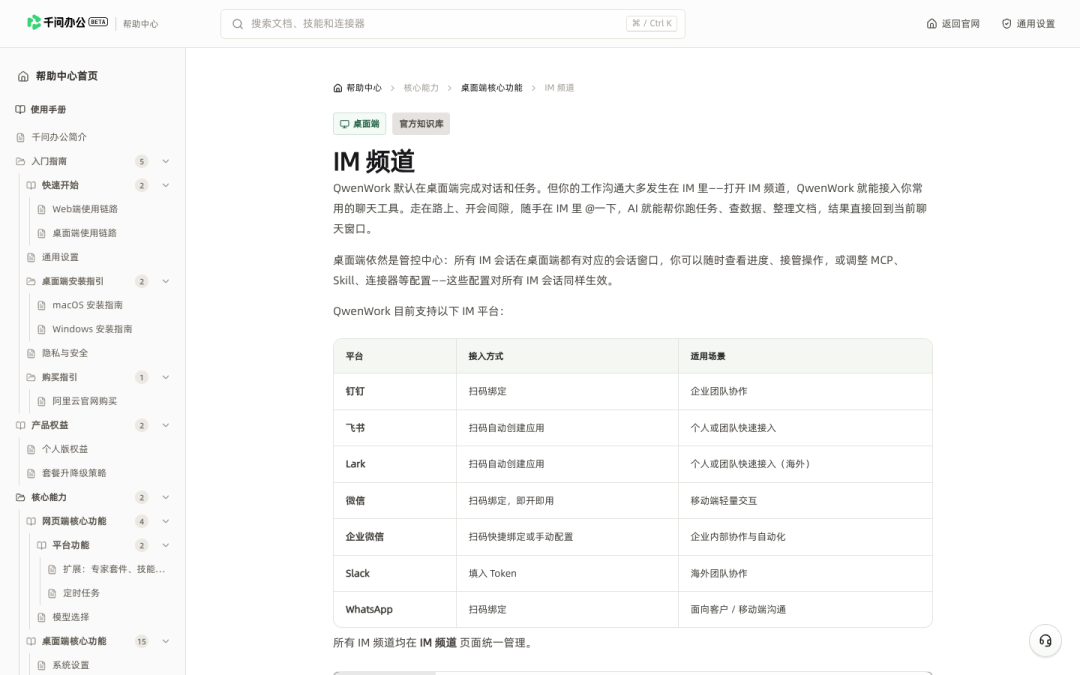
Rapid integration with Feishu and WeChat aligns with this business model. Enterprise knowledge won't automatically migrate to Qianwen Office: documents may reside in Feishu, customer data in Salesforce, and files on employees' hard drives. For Qwen3.8 to keep working, Qianwen Office must access others' repositories.
The cloud begins selling work
The organizational structure is in place, but pricing remains undecided. The three-part model appears closed on paper, yet the issue lies in the final link: consoles and games are on display, but Alibaba's price tags aren't unified.
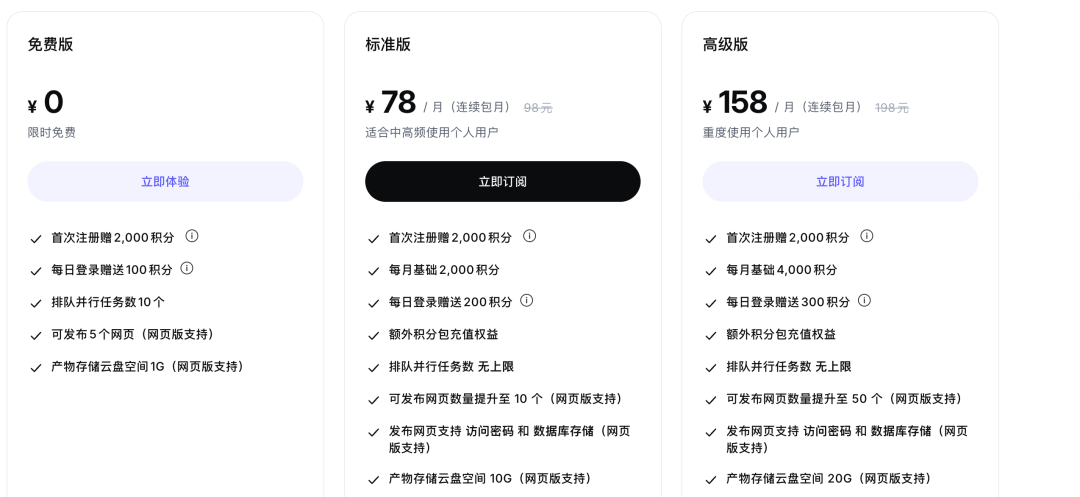
Qianwen Office Personal Edition offers free, 98 RMB, and 198 RMB tiers, while the Enterprise Standard Edition costs 198 RMB/month/seat, all using a 'subscription + credits' model. Credits convert underlying Tokens into a front-end currency: users don't need to research Token pricing per million or see how much a failed retry burns. The aforementioned 3D rocket webpage test exhausted 2,000 credits, leaving users with a final webpage but little insight into how many credits were spent on effective work versus errors.
Currently, Alibaba has four pricing models for large models: ES Agent charges by Tokens, web retrieval Agent by calls, DataBridge Agent by specifications, and Qianwen Office by seats plus credits. The coexistence of Tokens, calls, specifications, and seats indicates Agent commercialization has begun, but pricing methods are still experimental.
However, the convergence direction is relatively clear. The official documentation for the BaiLian Token Plan Team Edition now states: Credits serve as a unified metric, usable across multiple AI tools within the same subscription, integrating Qianwen and third-party models while being compatible with Claude Code and OpenClaw. Qianwen Office's credits follow the same design—model calls, tool calls, multimodality, and searches all convert into a single currency, with users purchasing a 'model + Agent' hybrid. One detail: Token Plan Standard Seats cost 198 RMB/month, the same as Qianwen Office Enterprise Edition, suggesting the two product lines' pricing is aligning.
This pricing route aligns well with Alibaba's strategic direction. During the May 13th earnings call, Wu Yongming reported 'AI model and application services' as a consolidated revenue line, stating it's 'a new revenue engine driven by both underlying model services and upper-layer AI-native software.' He expected annual recurring revenue (ARR) to exceed 10 billion RMB in the June quarter and 30 billion RMB by year-end, with margins higher than traditional cloud businesses. Accounting-wise, Alibaba no longer separates model and application revenue. The 'model + Agent bundled pricing' isn't speculation—it's a direction enshrined in earnings report language.
Responsibility for revenue also becomes more specific. Traditional SaaS bugs incur rework costs for vendors; Agents consume credits per process, with infinite loops and failed retries directly burning users' money. The more unstable the product, the worse the bill looks. Switching to monthly seats shifts risk back to Alibaba: while the market generally expects Token prices to decline, Wu Yongming denied this at the earnings call, arguing that model and cloud service prices will rise over the next one to two years due to new server deployment costs doubling since last year (Alibaba has raised prices multiple times since March). Both claims coexist, but the utility of bundled pricing lies here: by packaging credits, whether Token prices rise or fall is absorbed by the front-end 'credits' currency, remaining invisible to users. This isn't intuitive, but for a path binding Tokens and Agents for sale, it offers product premium space.
Qwen3.8 gives users a reason to try Qianwen Office, but several old questions remain: Is Agent-model coordination effective? Can the somewhat obscure payment model continue attracting users? And can Qwen maintain its lead?
After all, the shelf life of leading large models is indeed too short.
-
![]()
Traditional Fuel Vehicle Market Base Dwindles: BBA Vehicles Struggle Despite 300,000 Yuan Price Cuts, Prompting Closure and Absconding of Several 4S Dealerships
-
![]()
Largan Precision Makes Another Attempt at Hong Kong Stock Exchange IPO Amid High Growth, Raising Concerns Over 'Apple Dependency' and Operational Independence
-
![]()
From "Tongyi" to "Qianwen", and on to "Qianwen Office": A Showcase of Alibaba's Astute Leadership Decision-Making
-
![]()
Is Qwen3.8 the 'Zelda' for Qianwen Office?
-
![]()
Why Did Musk Remove Chinese Elements Post-Delivery of 10GW Photovoltaic Gear?
-
![]()
Five-Year Market Share Dive: 65% Drop Sees Japanese Automakers Falter in China
-
![]()
Innovative ‘Large Family Box-Shaped’ Model, Great Wall H10, Officially Launches with Limited-Time Trade-In Price Starting at 201,800 Yuan
-
![]()
Google No Longer Lets Top Scientists 'Call the Shots'