Why Did Musk Remove Chinese Elements Post-Delivery of 10GW Photovoltaic Gear?
 08/06 2026
 333
333
We're truly living in an era of profound transformation. We're privileged to witness and partake in it, yet we're also driven to engage.
Lately, each of us has likely noticed shifts in the external environment. Today, it's optical modules; previously, it was inverters, robots, drones... The recent US policies targeting Chinese firms have evolved from targeted restrictions to broader, more aggressive industrial blockades.
Amidst major power geopolitical rivalry, characterized by confrontation and conflict, Chinese companies, including those in the photovoltaic and energy storage sectors, have no choice but to stand firmly with their powerful homeland. Especially during industry downturns, photovoltaic firms must resist the lure of short-term gains and avoid exporting entire production lines, core technologies, and technical teams at bargain prices to assist hostile competitors with unpredictable policies in filling their industrial voids.
For without the collective, there can be no individual. Without a robust industrial and supply chain, there can be no truly secure enterprises; without a strong nation, there can be no long-term stable overseas markets for Chinese companies. Thus, the path for photovoltaic energy storage companies in their future overseas expansion is clearer than ever.
Musk and his SpaceX have provided us with a vivid lesson.
01
10GW Delivered, 50GW Abruptly Stopped
Just six months ago, Musk's team was meticulously evaluating photovoltaic equipment companies in China, aiming to swiftly establish domestic photovoltaic manufacturing capabilities in the US by leveraging Chinese equipment, processes, and engineering personnel. Now, SpaceX has begun scrutinizing Chinese citizens, components, and equipment in its suppliers' facilities, leaving no stone unturned, including surveillance cameras and routers. What changed in between?
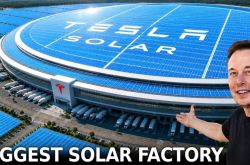
In March of this year, international authoritative media confirmed that Tesla was negotiating a device procurement deal worth approximately $2.9 billion (about RMB 20 billion) with several Chinese photovoltaic equipment companies. Potential suppliers included Maxwell Technologies and Laplace. The equipment was earmarked for Texas, USA, to support Musk's ambition to build 100GW of photovoltaic manufacturing capacity in the US, with part of the production dedicated to SpaceX satellites. Some high-end equipment required export licenses from Chinese authorities.
In fact, GanTan has been closely monitoring and reporting on this matter, urging relevant equipment companies not to jeopardize the future of China's photovoltaic industry.
According to a photovoltaic equipment company executive who spoke to GanTan, Musk's team's initial 10GW photovoltaic manufacturing project encompassed key production processes such as crystal pulling, slicing, cell, and module manufacturing. Since no explicit restrictions were imposed on the project at the time of contract signing, the first batch of equipment has already been delivered.
Informed sources revealed that, taking the crystal pulling process as an example, the bidding proposal involving Jingsheng Mechanical and Electrical was not confined to hardware equipment like single crystal furnaces but also encompassed process technology packages and support services such as installation, debugging, and capacity ramp-up provided by Chinese technicians.
According to information previously obtained by GanTan, after the initial 10GW, Musk's team originally planned to proceed with approximately 50GW of photovoltaic equipment procurement. However, the project has now been fully halted. In addition to commercial regulatory authorities, it is reported that relevant security departments have also intervened and held discussions with the companies involved. Not only new equipment but also used equipment is prohibited from being exported to specific markets without authorization.
In June, The Washington Post cited informed sources stating that China had requested Maxwell Technologies to suspend equipment negotiations with Tesla and SpaceX in March of this year and to temporarily halt the sale of related equipment.
Moreover, another incident occurred recently.
In early July, multiple photovoltaic media outlets reported that Musk's team planned to build a 400,000-ton polysilicon project, with the equipment contract potentially awarded to Shanghai Senxuang and the design involving Xi'an Hualu.
According to the latest information obtained by GanTan, this project has also been recently halted. Given that Senxuang International and related parties have not officially disclosed this information, this article will not treat it as a confirmed fact for now.
02
Why Is SpaceX Removing Chinese Elements?
According to an investigative report by Nikkei Asia, SpaceX has dispatched specialized teams to conduct detailed audits of its existing and potential suppliers. If a factory produces products for SpaceX, the managers, engineers, and other employees involved in the project may be subject to nationality checks. If Chinese citizens are found to be involved, suppliers are required to adjust their personnel; refusal to comply may affect subsequent orders.
The scope of this review also extends to components and factory equipment.
Products supplied to SpaceX must not use relevant components produced by Chinese companies, and engineers providing project support must be non-Chinese nationals. SpaceX reviewers also inspect the surveillance and network systems in factories, with some overseas factories required to replace equipment produced by Chinese companies such as Hikvision and TP-Link.
While seeking Chinese companies to provide entire photovoltaic production lines, SpaceX is simultaneously demanding that suppliers eliminate Chinese personnel and equipment. Is this a drastic reaction to obstacles encountered in photovoltaic equipment procurement?
The underlying business logic is straightforward. Musk urgently needs a batch of Chinese photovoltaic equipment now but will never rely on China in the long term.
SpaceX undertakes numerous US government and defense projects, and its supply chain is subject to security reviews far stricter than those of ordinary commercial companies. Once Chinese equipment, engineering personnel, and technical services become critical dependencies for its US photovoltaic manufacturing plans, the US, after generalizing so-called national security concerns, will perceive supply chain security risks.
The actions of the US Federal Communications Commission (FCC) over the past year have been fueling these concerns.
In December 2025, the FCC added foreign-produced drones and key components to the Covered List; in March 2026, it added foreign-produced consumer-grade routers; and on July 28, it simultaneously added foreign-produced networked power inverters and advanced robotics equipment to the list. New models of these products will, in principle, be unable to obtain FCC equipment authorization unless conditionally approved by relevant US departments.
The US regulatory approach has changed:
Previously, the list mainly targeted specific companies such as Huawei, ZTE, and Hikvision. Now, the control targets have expanded to entire categories of foreign-produced equipment.
The restriction plan for optical modules follows the same path. The US hopes to prevent new Chinese optical module models from entering US data centers before they become deeply embedded in AI infrastructure. The report cited relevant sources as saying that policymakers are unwilling to repeat the costly mistake of deploying Huawei equipment on a large scale and then having to remove it.
SpaceX's actions are actually even more "stringent" than those required by the US: it is preemptively excluding equipment not yet explicitly prohibited by US law, isolating personnel not yet on sanctions lists, and replacing cameras and routers not directly related to the final product according to the strictest standards.
GanTan believes that China's cautious attitude towards the export of advanced photovoltaic equipment may have also accelerated SpaceX's search for alternative supply chains.
SpaceX's military-industrial attributes, the US domestic supply chain localization requirements, and the FCC's continuously expanding restriction scope have long determined that it will gradually reduce Chinese factors.
03
Which Companies Are Affected?
From public reports, Maxwell Technologies and Laplace are the companies directly named by authoritative media in Musk's photovoltaic equipment procurement.
Maxwell Technologies boasts strong competitiveness in screen printing, HJT equipment, and entire production line solutions; Laplace's boron diffusion, LPCVD, and other equipment are closely related to TOPCon production line construction. Both companies originally had the opportunity to secure significant orders from Musk's gigawatt-scale expansion plans. In addition, there are also Jingsheng Mechanical and Electrical, a supplier of single crystal furnace equipment, and Gaoce Group, a supplier of slicing machine equipment.
Blue Technology stated in its 2025 annual report that its commercial aerospace business is progressing from the ground segment to the satellite segment and plans to expand into low-orbit satellite assembly, solar array module assembly, and aerospace-grade UTG businesses. In non-public settings, Blue Technology hinted that SpaceX is a relevant potential customer.
Fustt possesses photovoltaic film technology and a global customer base. There has been long-standing speculation in the capital market that its products are used in space photovoltaic projects, suggesting that it will supply film to SpaceX in bulk.
Similar situations also exist among 3D printing, titanium alloy, satellite communication, and structural component companies. Many companies have indeed entered the commercial aerospace industrial chain. Whether their ultimate customers are SpaceX, where their supply locations are, and whether their products are affected by the latest supply chain rules still depend on the official disclosures of the relevant listed companies.
Once SpaceX fully implements the new rules, the risks will not be limited to photovoltaic equipment.
Even if Chinese companies set up factories in Mexico, Southeast Asia, or Europe, they may still lose orders as long as Chinese engineers are involved in SpaceX projects, key components manufactured in China are used, or Chinese network and surveillance equipment identified by SpaceX are deployed in the factories.
The overseas manufacturing systems previously used to avoid tariffs have now completely failed.
04
Will Tesla's Supply Chain Be Synchronously "Cleansed"?
Will SpaceX's approach spread to Tesla's supply chain?
GanTan believes that the regulatory environments for the two companies differ. SpaceX is deeply involved in US government and defense projects, so its supply chain reviews are naturally stricter. Tesla's automotive business targets ordinary consumers, and its Chinese factory is highly dependent on the local industrial chain. It will be difficult to fully replicate SpaceX's personnel and equipment exclusion standards in the short term.
The localization rate of components at Tesla's Shanghai factory has exceeded 95%, with over 400 Chinese suppliers, of which more than 60 also serve Tesla's global supply chain. The Chinese manufacturing system remains a crucial pillar for Tesla's cost, efficiency, and global delivery capabilities.
However, changes are occurring in Tesla's US business.
In November 2025, The Wall Street Journal cited informed sources stating that Tesla has requested suppliers to gradually exclude Chinese-made components from cars produced in the US and hopes to complete more replacements within one to two years. Tesla China subsequently stated that it values Chinese suppliers and will not exclude them based on their origin. In other words, Tesla China can continue to rely on the Chinese supply chain to serve its Chinese factory, but Tesla's US factory operates under a separate supply system.
Therefore, a clear business division may emerge in the future:
The Chinese factory will continue to use the Chinese supply chain to serve the Chinese and some overseas markets; cars, energy storage, robots, and AI infrastructure produced in the US will gradually reduce their reliance on Chinese components and technologies.
Optimus robots, data center hardware, networked energy storage systems, inverters, and projects sharing technology and procurement channels with SpaceX are particularly likely to face strict reviews.
The FCC has already added advanced robots and power inverters to the Covered List. Tesla's robotics and energy businesses are certainly within the regulatory scope.
05
Photovoltaic Exports: No Longer "The Bigger the Waves, the Pricier the Fish"
While Musk's team was procuring entire photovoltaic production lines in China, the US was using subsidies, tariffs, market access, and so-called national security rules to gradually drive Chinese photovoltaic companies out of this most profitable market.
A considerable number of Chinese companies have been forced to adjust their equity stakes or even withdraw from battery and module production capacities they had established in the US. Before the US can fill its domestic photovoltaic manufacturing gaps, it is attempting to introduce China's most mature equipment, technologies, and engineering teams at a lower cost.
Equipment companies certainly have the right to pursue profits, but such transactions cannot only consider the companies' own interests. Photovoltaic companies must continue to expand overseas. Closing doors cannot solve the issues of production capacity, markets, and global energy transition, nor does it align with China's direction and requirements for maintaining high-level openness.
What truly needs to change are market selection and overseas expansion methods.
Regions such as the Middle East, Southeast Asia, Latin America, and Africa, along with countries and regions that uphold the sanctity of commercial contracts and are keen on forging long-term collaborations with Chinese enterprises, should be allocated more resources. Chinese companies, in tandem with their partners, can broaden the horizons of the clean energy market through diverse strategies including investments, joint ventures, equipment sales, and localized operational models.
For projects of a highly sensitive nature, particularly those involving military, aerospace, and AI infrastructure, it is imperative to conduct rigorous evaluations concerning end-users, end-uses, and potential technology spillovers.
Gan Tan posits that industrial policies ought to extend reasonable support to companies that suffer substantial order losses due to national security reviews. Domestic technological advancements, upgrades of outdated equipment, transitions in semiconductor technology, commercial aerospace endeavors, and next-generation photovoltaic technology demonstration projects hold the potential to generate fresh demand for equipment companies.
Ensuring industrial security cannot rest solely on the shoulders of corporate self-regulation; similarly, serving the national interest should not be a burden borne by individual companies in isolation.
Postscript
SpaceX has imparted a valuable lesson to Chinese companies.
In scenarios where commercial efficiency clashes with national security, it unflinchingly opts to forsake cost-effective and mature Chinese equipment, mandating suppliers to replace Chinese engineers and expunge Chinese cameras and routers from their manufacturing facilities.
Chinese photovoltaic companies must glean insights from this incident: we are now in an era where industrial boundaries are being redefined. Within this expansive framework, Chinese photovoltaic companies cannot afford to remain bystanders; they must align themselves with their formidable motherland, uphold industrial standards, safeguard core technologies, and ultimately secure the future of Chinese enterprises.
Editor: Zhen Tan
We welcome your likes, comments, and shares! For reprint requests, please reach out to our backend team for authorization.
-
![]()
Traditional Fuel Vehicle Market Base Dwindles: BBA Vehicles Struggle Despite 300,000 Yuan Price Cuts, Prompting Closure and Absconding of Several 4S Dealerships
-
![]()
Largan Precision Makes Another Attempt at Hong Kong Stock Exchange IPO Amid High Growth, Raising Concerns Over 'Apple Dependency' and Operational Independence
-
![]()
From "Tongyi" to "Qianwen", and on to "Qianwen Office": A Showcase of Alibaba's Astute Leadership Decision-Making
-
![]()
Is Qwen3.8 the 'Zelda' for Qianwen Office?
-
![]()
Why Did Musk Remove Chinese Elements Post-Delivery of 10GW Photovoltaic Gear?
-
![]()
Five-Year Market Share Dive: 65% Drop Sees Japanese Automakers Falter in China
-
![]()
Innovative ‘Large Family Box-Shaped’ Model, Great Wall H10, Officially Launches with Limited-Time Trade-In Price Starting at 201,800 Yuan
-
![]()
Google No Longer Lets Top Scientists 'Call the Shots'