Largan Precision Makes Another Attempt at Hong Kong Stock Exchange IPO Amid High Growth, Raising Concerns Over 'Apple Dependency' and Operational Independence
 08/06 2026
 438
438
Writer | Xingxing
Source | Beiduo Business & Beiduo Finance
In the expansion history of consumer electronics giant Luxshare Precision (SZ: 002475, HK: 02475), the acquisition of Lite-On Technology's camera module business in 2018 marked a pivotal move. From this starting point, Largan Precision, steered by the Wang family, rose to become a leading global player in consumer electronics optical modules in just a few years.
Now, this rising star in the 'Apple supply chain' is knocking on the door of the Hong Kong Stock Exchange, riding the wave of AI optics. After its initial application lapsed in November 2025, Largan Precision recently resubmitted its listing application to the Hong Kong Stock Exchange, with CITIC Securities and CICC serving as joint sponsors.

However, behind the glamorous growth story lie concerns over Largan Precision's long-term dependency on Apple, its single largest client, and the lingering worry that emerging businesses such as automotive electronics and smart office applications—which carry the hope of a 'second growth curve'—still contribute less than one-tenth of its revenue. These factors inject a note of sobering caution into the capital market celebration.
For Largan Precision, this IPO is not only a battle to 'replenish its capital and production capacity' but also a coming-of-age ritual to prove to the market that it can evolve from a 'beneficiary of the Apple supply chain dividend' into an 'independent optical giant.'
Largan Precision's growth journey is inseparable from the strategic layout (layout) of Luxshare Precision.
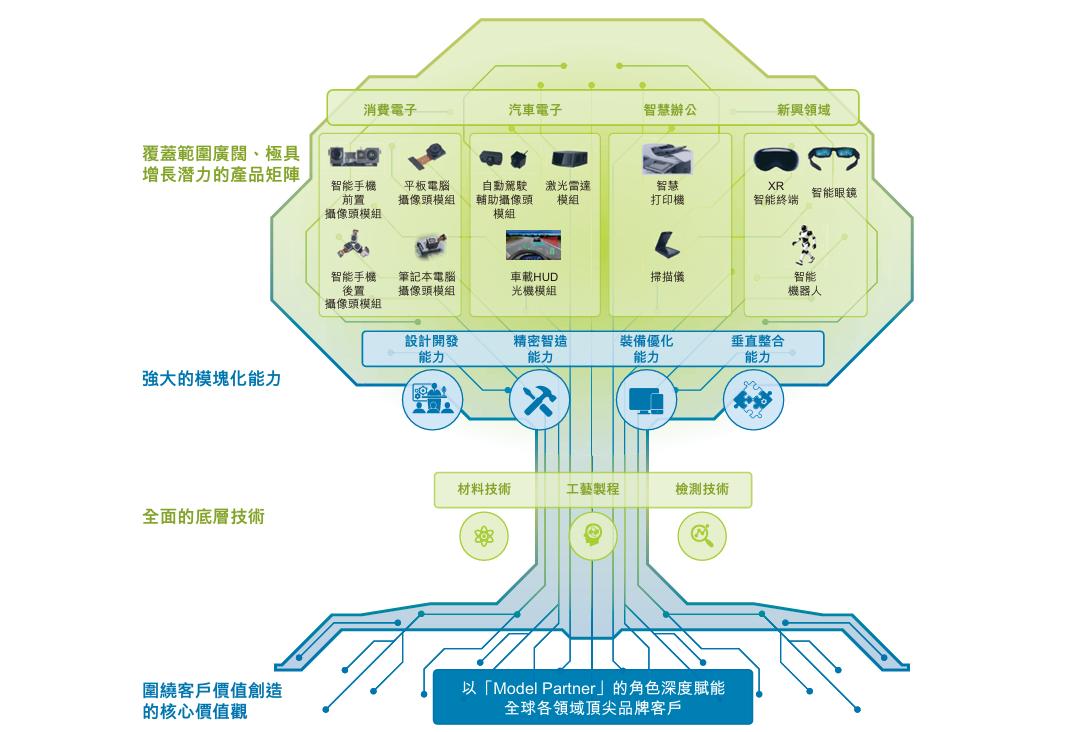
Combining information from Tianyancha App and the prospectus, in 2018, Luxshare Precision acquired Taiwan-based Lite-On Technology's Camera Module (CCM) division for $360 million, gaining mass production lines, customer resources, and technical patents. On this foundation, it established Largan Precision, entering the consumer electronics camera module Track (sector).
In the following years, Largan Precision undertook a series of industrial integrations: acquiring Cowell in 2021 to enter the Apple supply chain; incorporating Lite-On Group's imaging division the next year, integrating businesses such as printers and scanners; and merging with Konica Minolta's Shanghai factory in 2023, further expanding into the upstream optical lens sector.
Today, Largan Precision has developed into a precision optical solutions provider with capabilities in optical design, image algorithms, micro-packaging, and other innovative fields. It supplies products to over 340 global clients, covering mainstream brands across multiple segments, including consumer electronics, automotive electronics, and smart office applications.
Largan Precision disclosed in its prospectus that it developed and mass-produced the world's first triple-camera module for smartphones, a 'dual-lens in one' dual-focal-length switching telephoto module, and employed a multi-refraction periscope lens module to achieve 10x optical zoom with an ultra-long back focal length, participating in the innovative iteration of high-end optical modules for global brands.
According to Frost & Sullivan, Largan Precision is a primary supplier to the world's leading mid-to-high-end smartphone brands and the only precision optical solutions provider globally capable of serving two major smartphone system ecosystems in the camera module field.
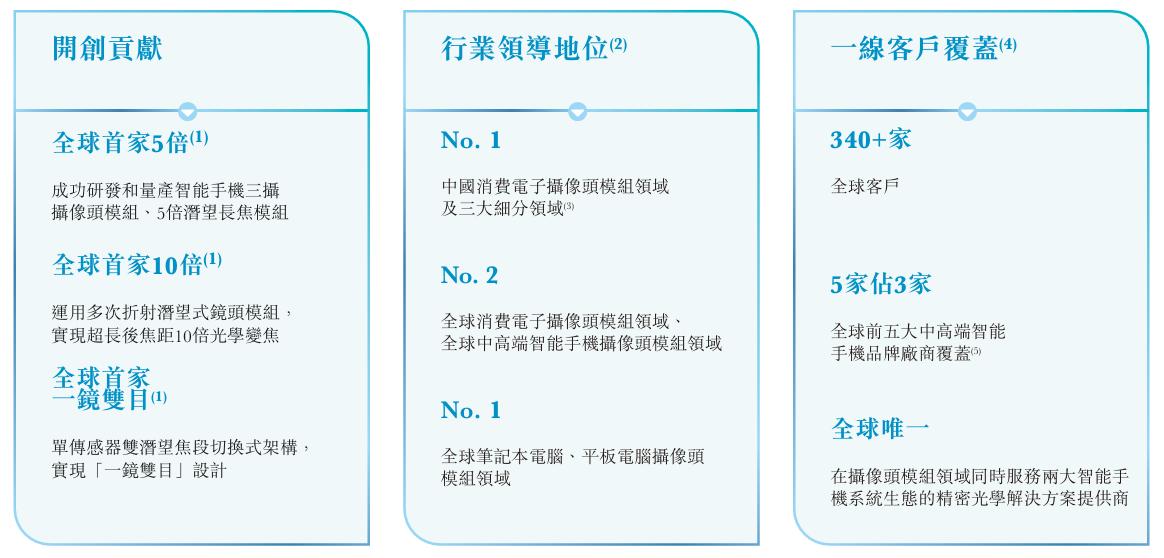
Based on shipment volume in 2025, one in every six notebook computers globally is equipped with Largan Precision's camera module. In terms of revenue scale, the company ranked second among global consumer electronics camera module suppliers in 2025 and held the top spot among Chinese manufacturers.
Benefiting from the surge in demand for AI optics, Largan Precision delivered a 'three-year consecutive growth' performance curve. Its revenue rose from RMB 15.248 billion in 2023 to RMB 27.914 billion in 2024 and further to RMB 34.755 billion in 2025, more than doubling over three years, with a compound annual growth rate (CAGR) of 51.0%.
Profitability performed even more impressively. From 2023 to 2025, Largan Precision achieved net profits of RMB 588 million, RMB 1.052 billion, and RMB 1.690 billion, respectively, with a CAGR of approximately 69.6%, nearly 19 percentage points higher than revenue growth, indicating a healthy development pattern of simultaneous scale and profitability expansion.
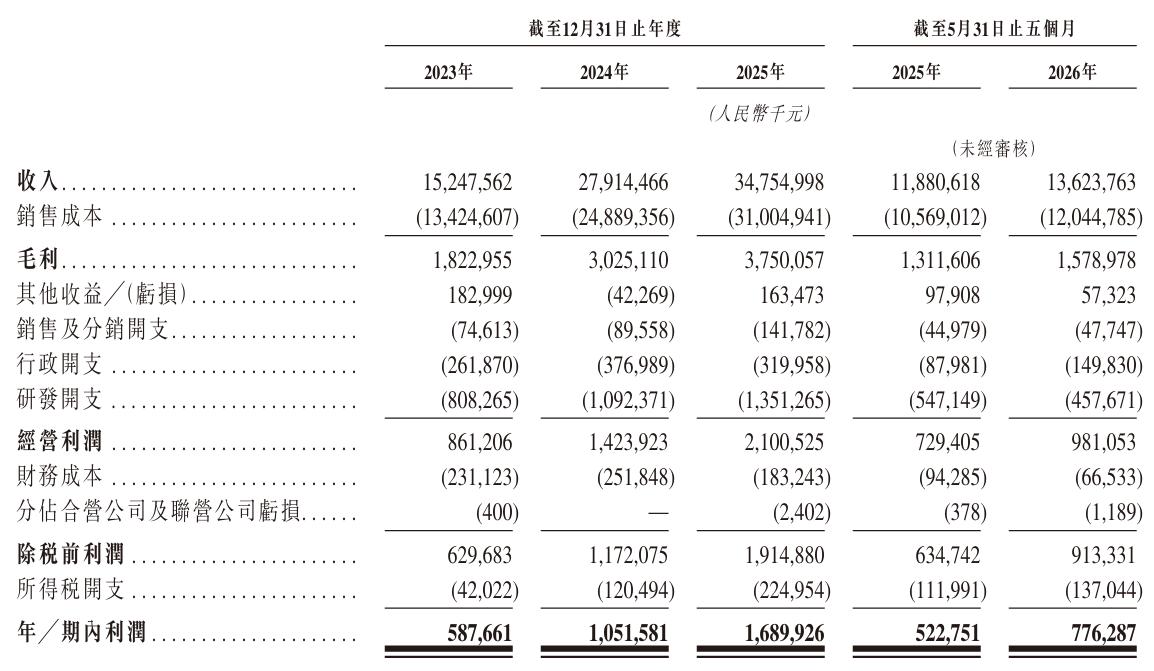
In 2026, Largan Precision's growth momentum continued unabated. Revenue in the first five months grew 14.7% year-on-year to RMB 13.624 billion, while net profit surged 48.5% to RMB 776 million. According to the prospectus, supported by increased client demand for consumer electronics, the company's revenue in the first half of 2026 also expanded steadily compared to the same period in 2025.
A breakdown of Largan Precision's revenue structure reveals a rapidly increasing concentration of core products. The revenue share from the consumer electronics segment rose from 78.2% in 2023 to 90.0% in 2025 and further to 91.2% in the first five months of 2026, with a single business segment exceeding 90%.
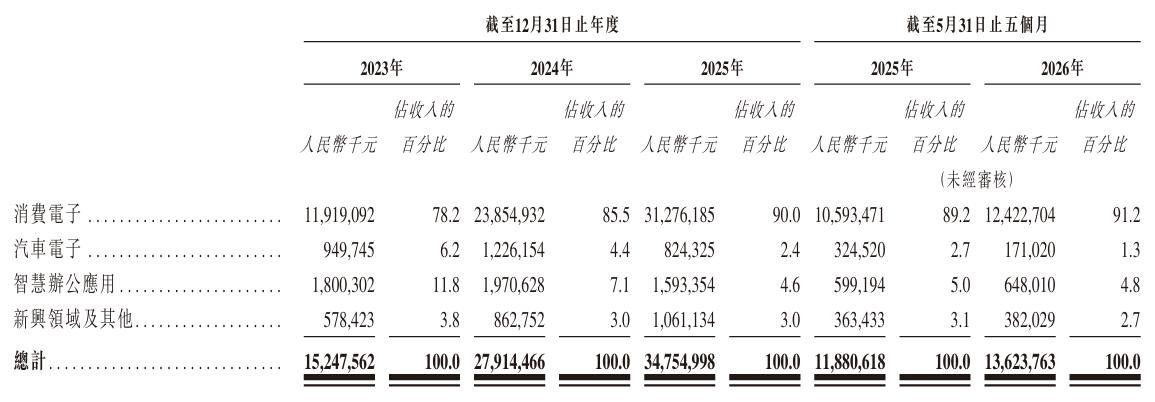
On the flip side of this trend lies a lagging process of business diversification. Although Largan Precision has made inroads into emerging fields such as automotive electronics, smart offices, intelligent robots, and XR smart terminals in recent years, as of the end of May 2026, the revenue share from smart office applications, emerging sectors, and other segments each accounted for less than 5%.
Notably, the automotive electronics business, on which Largan Precision had pinned high hopes, experienced a significant decline. Revenue from this segment reached RMB 824 million in 2025, down 32.8% year-on-year; the downward trend persisted in 2026, with revenue in the first five months at RMB 171 million, nearly halved from RMB 325 million in the same period of 2025.
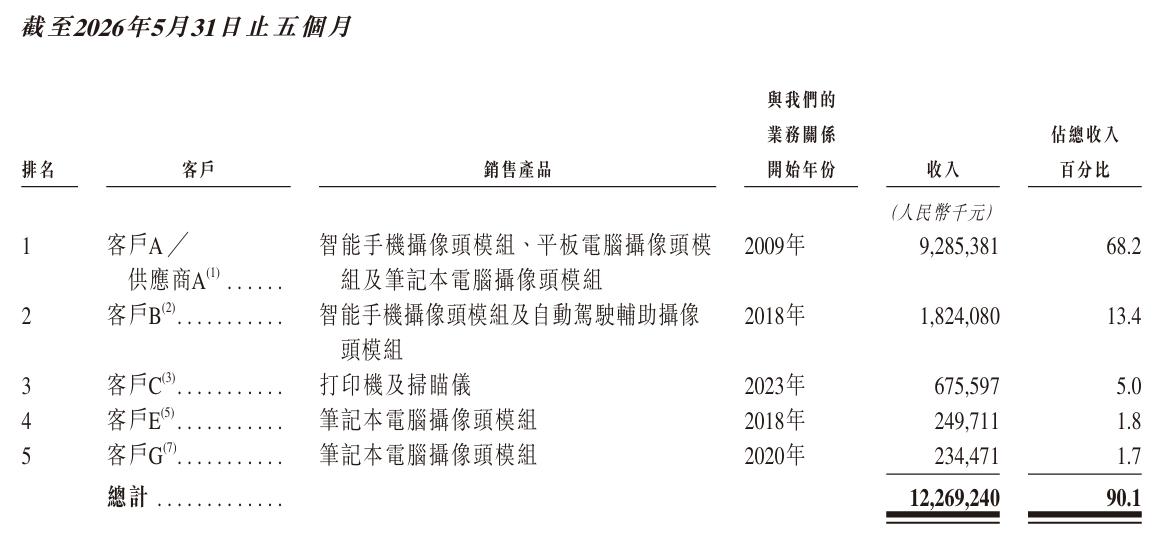
Even setting aside the nascent emerging businesses, the risks in Largan Precision's core consumer electronics segment cannot be overlooked. From 2023 to the first five months of 2026 (the 'reporting period'), revenue from its top five clients accounted for 77.9%, 88.7%, 90.0%, and 90.1%, respectively, showing a continuous upward trend.
Among them, a single largest client, referred to as 'Client A,' contributed 39.9%, 61.6%, 71.0%, and 68.2% of Largan Precision's revenue during the reporting period. In just three years, its share surged from less than 40% to nearly 70%, with Largan Precision's revenue base increasingly concentrated in the hands of this single client.
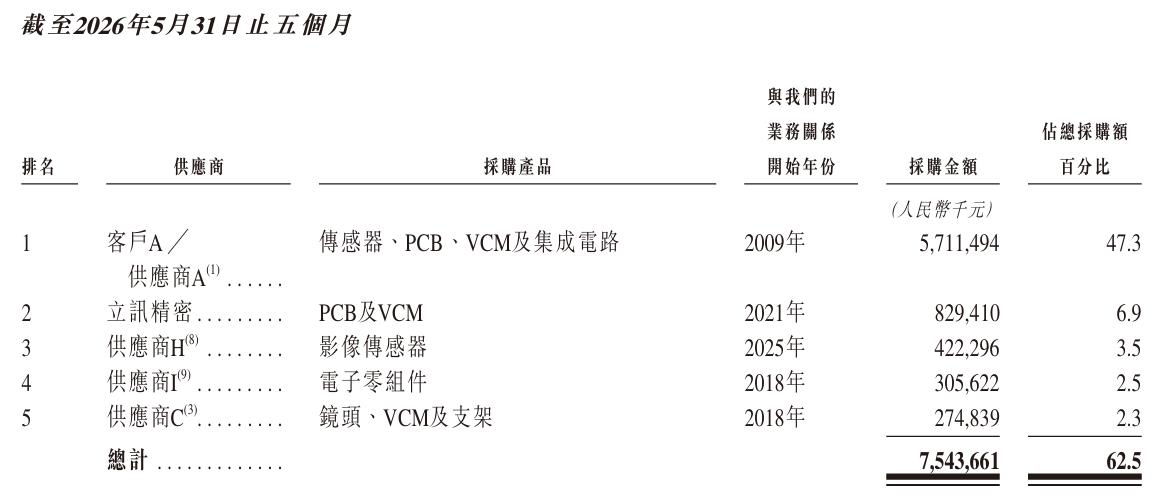
More notably, this 'Client A' not only dominates Largan Precision's revenue but also serves as its largest supplier. During the reporting period, procurement from 'Client A' accounted for 20.7%, 36.5%, 48.5%, and 47.3% of Largan Precision's total purchases, respectively.
Market consensus identifies 'Client A,' which holds a dominant position in both procurement and sales for Largan Precision, as Apple Inc. This dual role of 'major client and major supplier' has opened a rapid growth channel for Largan Precision tied to the 'Apple supply chain,' but it also acts as a double-edged sword, directly challenging the company's bargaining power and risk resistance.
Additionally, Largan Precision's operational independence and the fairness of related-party transactions have drawn significant market attention. The company remains inextricably linked to Luxshare Precision in terms of equity and personnel. Before the IPO, Wang Laixi, Wang Laichun, Wang Laisheng, and Wang Laijiao, acting as persons acting in concert, collectively held a 48.06% stake in Largan Precision through Largan Limited, making them the controlling shareholders.
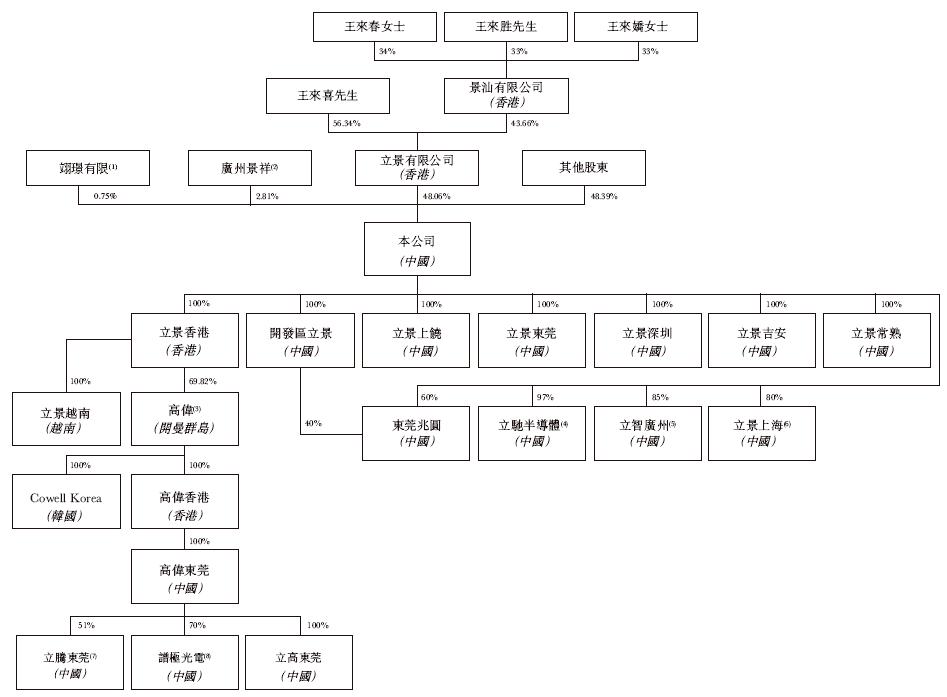
Among them, Wang Laichun serves as both chairman of Largan Precision and founder and chairman of Luxshare Precision; nearly all key personnel in Largan Precision's marketing, finance, and production departments hail from Luxshare Precision, imbuing the entire senior management team with a strong 'Luxshare identity.'
From 2024 to the first five months of 2026, Largan Precision's procurement from Luxshare Precision amounted to RMB 1.547 billion, RMB 2.019 billion, and RMB 829 million, respectively, accounting for 6.2%, 6.9%, and 6.9% of total purchases. The scale and proportion of related-party transactions continued to rise.
Largan Precision acknowledged that it would continue to engage in transactions with Luxshare Precision, with annual caps for product and machine procurement framework agreements with related parties set at RMB 3.299 billion, RMB 3.633 billion, and RMB 3.980 billion from 2026 to 2028, respectively. The cap for product sales to Luxshare Precision will increase from RMB 1 billion in 2026 to RMB 1.210 billion in 2028.
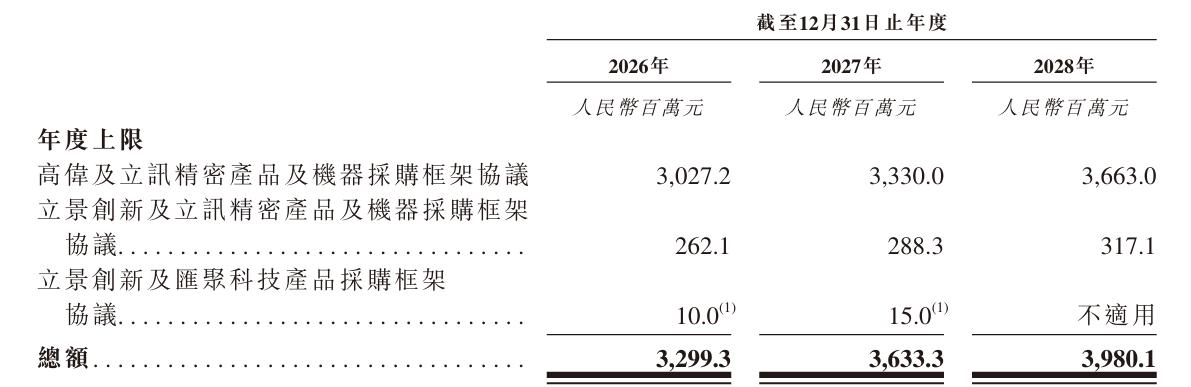
Although Largan Precision emphasized in its prospectus that its related-party transactions are priced based on market principles, the sheer volume of procurement, amounting to billions of yuan, fails to dispel market concerns over its independence. To secure approval for listing on the Hong Kong Stock Exchange, the fairness of related-party transactions, operational independence, and governance effectiveness will likely be three unavoidable questions during the hearing.
-
![]()
Traditional Fuel Vehicle Market Base Dwindles: BBA Vehicles Struggle Despite 300,000 Yuan Price Cuts, Prompting Closure and Absconding of Several 4S Dealerships
-
![]()
Largan Precision Makes Another Attempt at Hong Kong Stock Exchange IPO Amid High Growth, Raising Concerns Over 'Apple Dependency' and Operational Independence
-
![]()
From "Tongyi" to "Qianwen", and on to "Qianwen Office": A Showcase of Alibaba's Astute Leadership Decision-Making
-
![]()
Is Qwen3.8 the 'Zelda' for Qianwen Office?
-
![]()
Why Did Musk Remove Chinese Elements Post-Delivery of 10GW Photovoltaic Gear?
-
![]()
Five-Year Market Share Dive: 65% Drop Sees Japanese Automakers Falter in China
-
![]()
Innovative ‘Large Family Box-Shaped’ Model, Great Wall H10, Officially Launches with Limited-Time Trade-In Price Starting at 201,800 Yuan
-
![]()
Google No Longer Lets Top Scientists 'Call the Shots'