Comparing Domestic Open-Source Large Models Zhipu, Minimax, and Kimi: Which Excels in Coding, Multimodality, and Long-Text Processing?
 08/09 2026
 569
569
The three major domestic open-source large models, Zhipu, MiniMax, and Kimi, are intensely competitive, each excelling in different areas while also having their shortcomings.
According to Time Finance, OpenRouter revealed the global large model Token usage rankings for last week (July 27 to August 2), with the top five spots all occupied by Chinese domestic AI products for the first time. This marks the 14th consecutive week that China's large models have surpassed the United States in weekly usage, solidifying their global leadership.
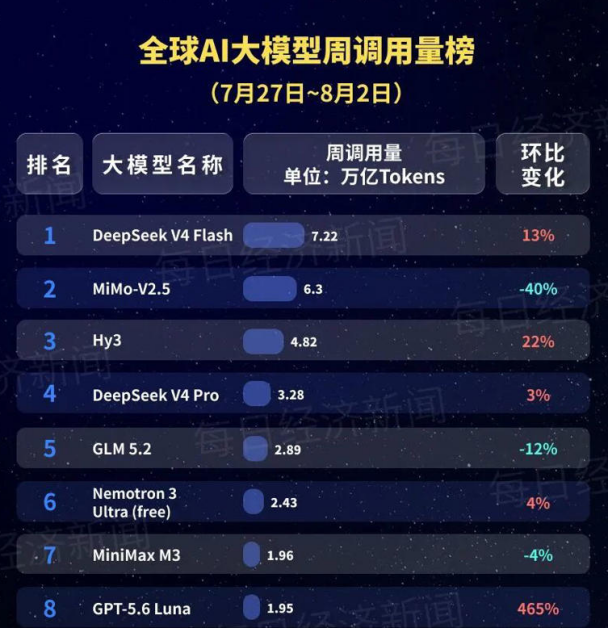
Image Source: National Business Daily
Domestic large models continue to dominate the global market with their collective rise, and the ultra-long context capability of millions of Tokens has evolved from a simple industry highlight to a standard feature of high-end open-source models, supporting complex engineering development, multimodal intelligent processing, and large-scale professional document applications.
In particular, Zhipu's GLM-5.2, MiniMax M3, and Kimi K3 have overcome the limitations of traditional standard Transformers, such as exponential computational expansion in long sequences and rapid information decay, by using proprietary sparse attention mechanisms. They have successfully established themselves at the forefront of the industry in terms of million-Token context capability.
As the three major independent vendors of domestic open-source AI large models, they have not yet reached the top tier in terms of user base, but they are technically robust and even stronger in certain specialized areas.
Today, these three large models have carved out their niches in the open-source model landscape, but their research and development focuses and technological evolution paths differ significantly.
1. GLM-5.2 Excels in Engineering Code, MiniMax M3 Specializes in Multimodal Fusion, and Kimi K3 Leads in Ultra-Long Text Capabilities
GLM-5.2 employs the IndexShare sparse index reuse mechanism, which implements a four-layer DSA module to share a single Top-K index filter, reducing computational load by two-thirds when processing millions of words.
It also optimizes text continuation logic, enabling the generation of longer, complete code in a single pass, specifically trained for continuous long-term coding and debugging scenarios.
This technical framework allows GLM-5.2 to rank among the top tier of open-source models in three long-sequence software engineering benchmarks: FrontierSWE, PostTrainBench, and SWE-Marathon, with scores only slightly behind Claude Opus 4.8 and outperforming GPT-5.5 and Gemini 3.1 Pro.
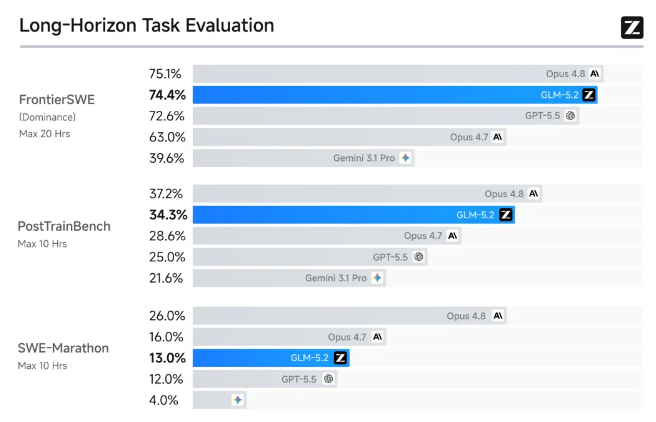
Additionally, GLM-5.2 scored 81.0 in the Terminal-Bench 2.1 terminal practical evaluation, approaching the practical capabilities of leading closed-source products.
GLM-5.2 adopts a 744B total parameter and 40B activated MoE hybrid expert architecture, supporting BF16 and FP8 precision weights, and natively adapts to vLLM, SGLang, and Huawei's domestic NPU. However, its pre-training is based solely on text corpora, lacking an integrated native cross-modal fusion Bottom structure (bottom-layer structure), requiring additional external processing modules for image and video inputs.
MiniMax M3, through its proprietary MSA block sparse algorithm, divides long content into smaller chunks for key information screening, reducing overall computational load in million-context scenarios to 1/20th of the previous generation. Prefill and Decode speeds are increased by 9x and 15x, respectively, with optimized continuous memory access at the operator layer, outperforming general open-source sparse attention solutions in inference efficiency.
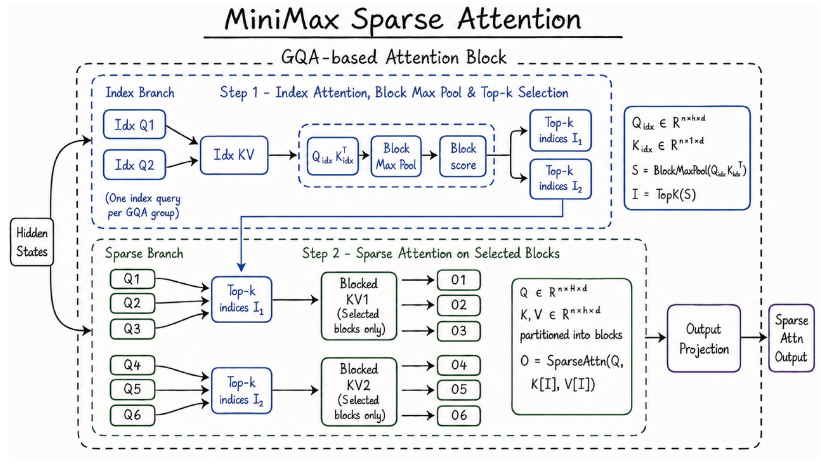
MiniMax M3 is also the only model among the three capable of simultaneously learning text, image, and video data, allowing for unified understanding of multimodal information without the need for additional multimedia plugins.
In SWE-bench Pro code repair, MiniMax M3 scored 59.0, and in BrowseComp's autonomous web agent evaluation, it scored 83.5, surpassing Opus 4.7. It also demonstrates better control over generating false information in Chinese scenarios.
However, MiniMax M3 is designed for lightweight operation, and its detail memory and output stability may decline during prolonged tasks or when processing hundreds of thousands of words of high-density professional materials in a single session.
Kimi K3 employs KDA incremental Delta attention with a cross-layer residual compensation module, addressing the issue of forgetting earlier information in long texts. Its 2.8T-scale MoE architecture supports dynamic expert routing, reducing KV cache usage by 75% and lowering the memory threshold for running million-length texts.
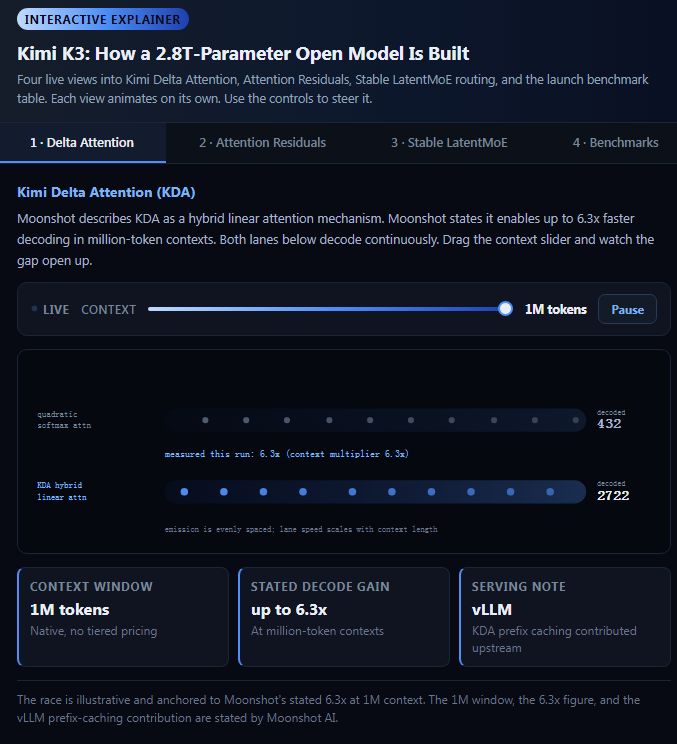
K3 excels in specialized evaluations of finance, law, and mathematics by Vals AI, making it more adept at handling static long documents. Its weakness lies in prolonged and multi-round autonomous tasks, where it performs generally and may experience logical inconsistencies during sustained multi-round interactions.
2. Zhipu GLM-5.2 is Ideal for Long-Term Intelligent Development, MiniMax for Lightweight Office Work in Small and Medium Teams, and Kimi K3 for Financial, Enterprise, and Research Institutions
Currently, Zhipu GLM-5.2 is primarily aimed at industrial R&D for government and enterprise as well as localized isolated clusters, making it suitable for long-term intelligent development tasks requiring continuous operation and multi-tool integration.
Application scenarios include large-scale front-end and back-end project restructuring, operating system kernel and compiler development, server automation and operation and maintenance system construction, long-term fine-tuning based on massive code datasets, and local private deployment for confidential units.
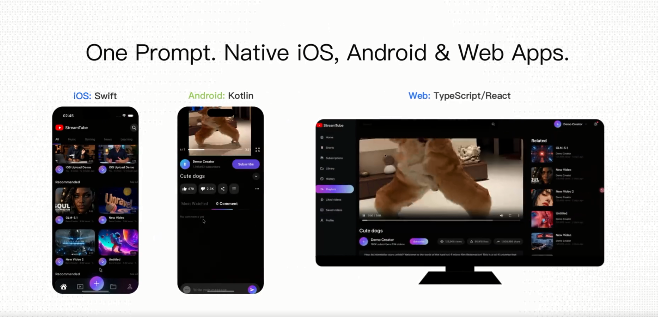
According to GLM's official introduction, in practical use, GLM-5.2 can complete development, debugging, testing, packaging, and deployment of a multi-platform application covering Web, mobile, and mini-programs, processing a cumulative 880,000 tokens and nearly utilizing a 1M context window. Such large-scale projects previously required weeks of team collaboration, but GLM-5.2 can now complete them in a single long-term task.
Zhipu also provides the ZCode desktop agent tool, supporting continuous development on remote servers. Its cloud API differentiates pricing for peak and off-peak hours, offering lower costs during non-peak times, and supports importing internal enterprise code datasets for targeted fine-tuning.
However, due to its text-only architecture, GLM-5.2 cannot directly handle composite R&D tasks involving images and videos, which may require users to build additional image parsing modules, increasing project implementation cycles and costs.
MiniMax M3 is more suitable for independent developers, small and medium teams, and daily lightweight office work in enterprises, supporting mixed inputs of text, images, and videos. Typical use cases include interpreting scientific research charts, CUDA operator visualization debugging, converting design drawings into code, organizing multi-table batch data, and rapid development of small web pages and tools.
Regarding the applicability and functionality of MiniMax M3, MiniMax officially replied to Xinshi Research Institute, stating that specifics can be found in the official introduction.
In MiniMax M3's official introduction, after being given a paper on "learning dynamics" in fine-tuning large language models, M3 independently reproduced the experiments, running for nearly 12 hours, autonomously producing 18 commits and 23 experimental charts, and successfully completing the core experiments in the paper.
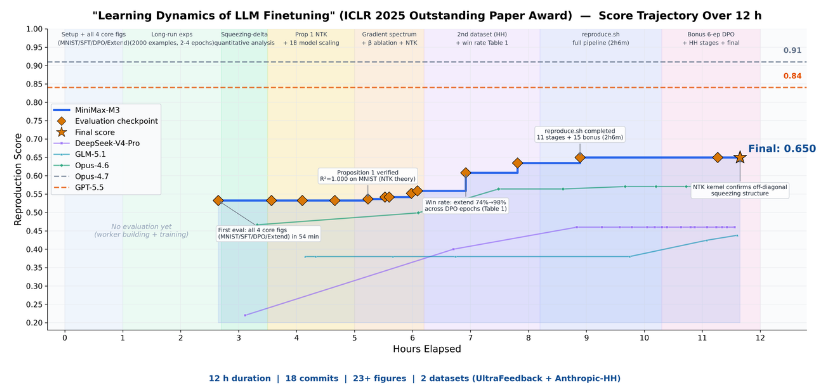
This process required multimodal capabilities to understand curves, data, and formulas in the paper, while long context ensured that the paper, code, and experimental logs could be processed in a single window. Strong programming and agent capabilities were essential for completing the reproduction in a long-thread or even concurrent manner, all of which M3 achieved.
MiniMax also supports MiniMax Code, enabling direct control of various software in the computer for automated workflows. The platform offers multiple monthly subscription plans with relatively low entry thresholds.
However, MiniMax M3 is more suitable for short-term tasks. For long-term projects like developing operating system kernels or Refactoring (restructuring) large codebases, M3's code vulnerabilities and oversight issues may increase with continuous iteration, making it difficult to independently support complete production-level development processes.
Kimi K3 is suitable for document analysis needs in financial institutions, research units, and enterprise compliance departments, capable of parsing million-word-level or multi-file professional materials at once. Common scenarios include batch interpretation of annual reports from listed companies, horizontal comparison of patent texts, risk screening of commercial contracts, and cross-extracting key information from multiple research reports.
Regarding specific adaptations and main application scenarios, Kimi's official introduction states that K3 is suitable for independent developers quickly building AI-driven personal projects or tools, enterprise technical teams embedding AI capabilities into products to enhance user experience and business efficiency, and startups acquiring top-tier AI capabilities at low cost to accelerate product iteration.
In terms of main application scenarios, K3 is suitable for intelligent customer service, enabling automatic Q&A based on context understanding to improve service efficiency and user satisfaction. It is also ideal for content generation scenarios such as article writing, marketing copy, and code generation, as well as data analysis tasks like document interpretation, report analysis, knowledge extraction and summarization, and knowledge Q&A through intelligent retrieval based on private document libraries.
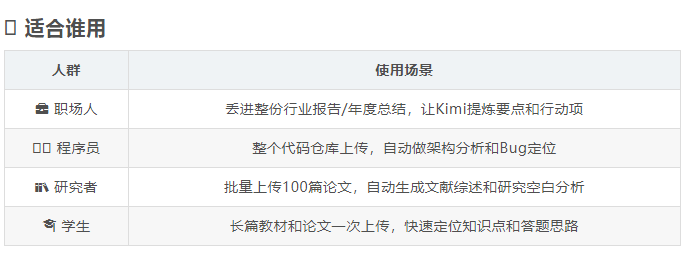
Image Source: PinAI
According to PinAI's practical testing, K3's most impressive feature is its ability to "retain information" in long texts. When using other AI tools to process documents exceeding 30,000 words, key paragraphs were often missed, but K3 achieved a near-100% information recall rate within 400,000 words.
Additionally, K3 has shown promising Chasing situation (catch-up momentum) in programming and software engineering, demonstrating capabilities in large codebase reading, front-end development, writing code based on screenshots, and long-term autonomous engineering debugging.
It can also generate simple visual code for creating display pages, but its architecture is primarily designed for one-time static text analysis, making it unsuitable for development tasks requiring cyclic debugging and repeated optimization. Therefore, when tasks involve continuous tool usage and multi-round code modifications, K3's outputs may easily deviate from the initial requirements, making it difficult to form an autonomous iterative work loop.
3. GLM-5.2 Focuses on Long-Sequence Engineering Base, MiniMax M3 Specializes in Multimodal Scenarios, and Kimi K3 Excels in Ultra-Long Text Organization
GLM-5.2 is suitable as a dedicated base for long-sequence engineering agents. Its IndexShare index reuse architecture ensures stable inference speeds under ultra-long text conditions, reducing the likelihood of context logic breaks during continuous multiple tool calls. Its output code complies with industrial development standards, demonstrating outstanding stability in various code benchmark tests.
According to GLM's official records, a developer used Rust to recreate the computer that sent humans to the moon, transplanting the original 65,000-line, unmodified lunar landing flight control program into Rust, with the entire process autonomously completed by an agent.
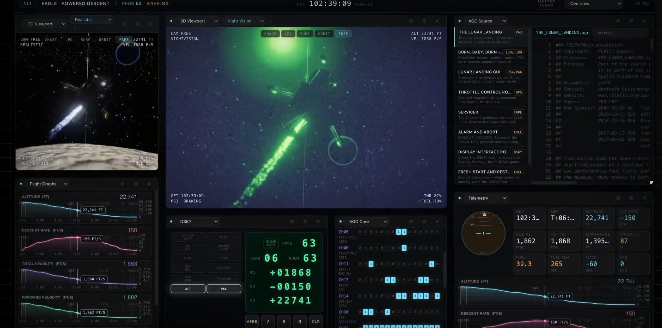
GLM-5.2 is compatible with mainstream inference frameworks and domestic computing hardware, significantly improving overall cluster processing efficiency for million-length texts compared to previous versions. It also adopts the MIT open-source license, allowing enterprises to freely download weights for local deployment or secondary modification and commercial use without major constraints.
The Slime asynchronous reinforcement learning framework enables GLM-5.2 to quickly complete multi-model fusion training, with built-in detection mechanisms ensuring the practical value of long-term engineering tasks.
MiniMax M3 tends to serve as a lightweight native multimodal general-purpose base. Its proprietary MSA block sparse attention has lower hardware requirements, allowing ordinary consumer-grade graphics cards to smoothly run million-level context tasks without the need for expensive high-end computing equipment.
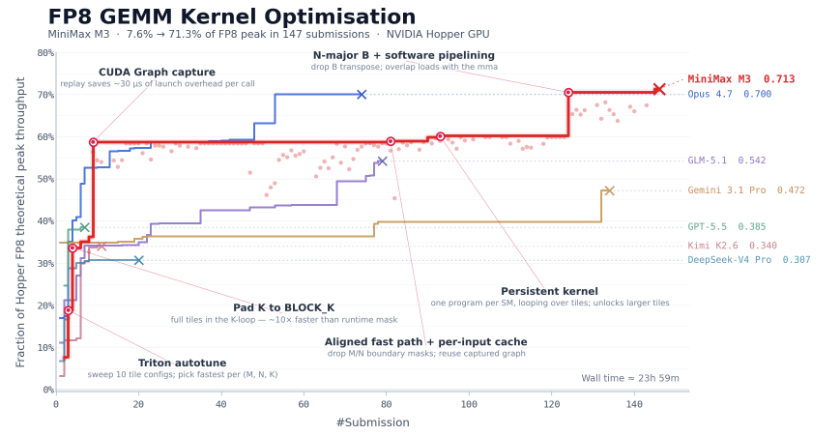
Similarly, among these three models, only MiniMax M3 can simultaneously learn text, image, and video data during training, enabling direct intercommunication between text and multimedia information. When enterprises build Image text hybrid business (text-image mixed businesses), they can save on developing image and video parsing components.
MiniMax M3 can simulate real office scenarios involving multiple communication adjustments during training, performing relatively evenly in daily bug fixing and automated office tasks. It generates less false content and provides computer-wide automation tools, allowing developers to easily achieve software interoperability without writing complex scripts, offering significant advantages in rapidly deploying small-sample text-image businesses.
According to Cww.net.cn's actual test, when using MiniMax M3 to create an HTML single-page for an AI website aggregation platform, M3 proactively conducts multiple rounds of tool calls, including searching for information, organizing data, generating page code, checking files, fixing issues, etc. The entire process resembles that of a normally functioning agent, rather than merely stopping at the level of 'providing a piece of code.'
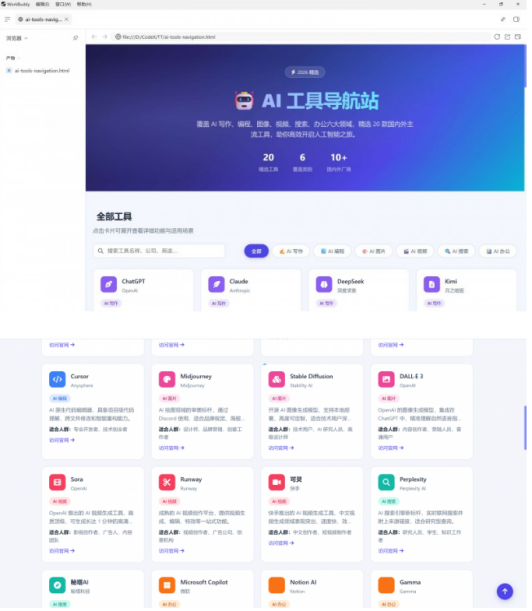
Image source: Cww.net.cn
The likelihood of tool call failures during the testing process was minimal, though not entirely absent. Even when tool calls failed, it did not affect the final result generation; the model would continue execution and complete the page. From the results, M3 demonstrated relatively complete data integrity, page structure, and interactive functionality. It did not particularly pursue visually flashy elements but excelled in process stability and clear task comprehension.
Kimi K3's strength lies in ultra-long static text reasoning. Its KDA incremental attention mechanism can mitigate the issue of detail loss in ultra-long texts, capturing implicit associated information scattered across different chapters. Meanwhile, its dynamic MoE expert architecture can invoke corresponding specialized modules based on the question type, balancing analytical precision and response speed.
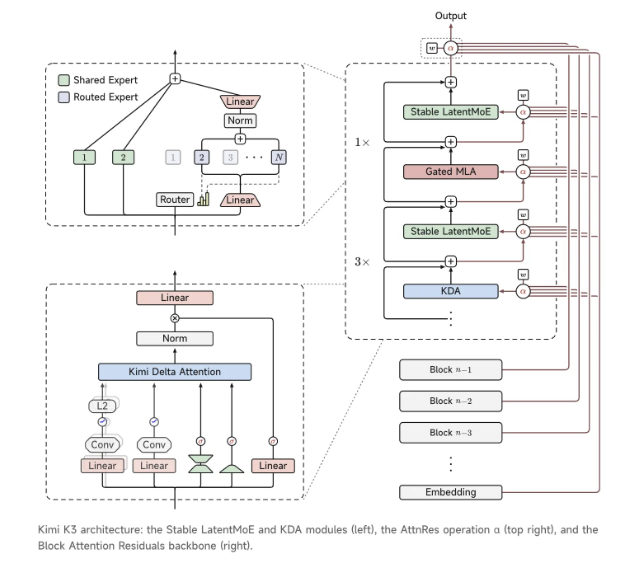
Additionally, K3 has optimized KV cache usage, enabling ordinary servers to process million-word documents in bulk. It has achieved impressive results in third-party evaluations in vertical domains such as finance and law and can be specifically optimized for mathematical derivations and professional literature organization.
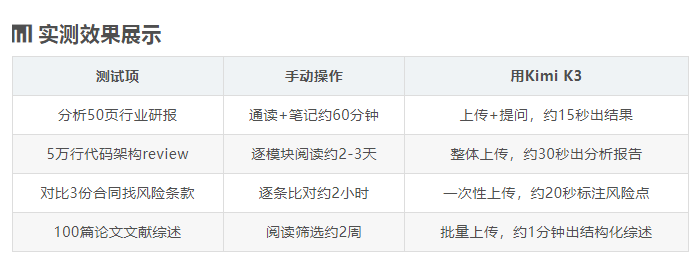
Image source: PinAI
For tasks involving data summarization, comparison, and interpretation, users can produce complete analytical conclusions without needing to invoke complex tools.
IV. GLM-5.2 Lacks Multimodal Capabilities, MiniMax M3 Exhibits Severe Specialization in Text and Long Code Scenarios, and Kimi K3 Has Weak Engineering Iteration Capabilities
GLM-5.2's training material consists solely of pure text content and lacks the ability to recognize images and videos. Therefore, processing multimedia materials requires external third-party visual modules, potentially lengthening project development timelines and incurring additional costs.
Furthermore, GLM-5.2's computational resource scheduling prioritizes long-duration development tasks. If users employ it merely for quick short-answer tasks, it results in inefficient hardware resource utilization.
GLM-5.2 is also less efficient than Kimi K3 in pure textual close reading and lacks targeted optimizations for code-free text review scenarios in finance and law. When faced with dense professional terminology and complex contractual terms, GLM-5.2 exhibits certain shortcomings in detail dissection capabilities, making it unsuitable for lightweight document review tasks alone.
MiniMax M3 demonstrates insufficient stability in performing long-duration tasks such as continuous development of underlying kernels and large-scale codebases. After multiple rounds of tool calls, it is prone to logical defects and thus cannot independently complete the entire rigorous development process.
When dealing with high-density legal and financial documents, M3's ability to remember cross-document associated information is noticeably weak, making it difficult to meet the high-precision standards required for compliance reviews. Therefore, it is only suitable for lightweight document browsing and not directly applicable for batch risk screening tasks.
Although M3 excels in multimodal capabilities, its ability to globally link logic in pure ultra-long texts is average. When dissecting million-word reports individually, it is prone to overlooking critical constraints, limiting its competitiveness in the pure text long-document sector.
Kimi K3's architectural focus is primarily on single static text reading, lacking deep optimization for multi-round chained tool interactions. When continuously debugging code and independently conducting long-term development work, it often exhibits conflicting conclusions.
Additionally, its capabilities in kernel debugging and standardized engineering code writing are weak, resulting in a higher probability of errors in producing underlying debug code. Its engineering development capabilities are inferior to those of GLM-5.2.
K3 also lacks supporting long-trajectory reinforcement learning tools, preventing it from autonomously completing the entire process from project decomposition to step-by-step verification and iterative optimization. It serves better as a supplementary tool for document reading rather than as the core foundation for an automated research and development platform.
Moreover, K3 does not support image-text parsing and must be used in conjunction with visual models for analysis involving images and videos, increasing the implementation difficulty for composite tasks.
V. Conclusion
GLM-5.2, built on the stability of long-duration engineering agents and domestic private deployment, has established its advantages in large-scale code repository reconstruction, backend engineering, automated agents, and multi-step complex mathematical reasoning, making it a well-rounded player in both liberal arts and sciences.
MiniMax M3 chooses to moderately compress the upper limits of high-end engineering performance to gain lightweight native cross-modal reasoning advantages, enabling it to establish a foothold in content creation fields such as image-text Linkage analysis, short video scripts, and screenplays.
Kimi K3, while retaining Kimi's traditional strengths in ultra-long text, has made inroads into logical reasoning, engineering code, and other science-oriented domains, achieving notable success. It is suitable for tasks involving reading and writing large volumes of materials, quantitative modeling, and lightweight code engineering.
Each has its strengths and weaknesses, with no absolute winner. Users can make adaptive choices based on their specific usage scenarios, as the most suitable option exists, but not necessarily the most perfect one.
-
![]()
Comparing Domestic Open-Source Large Models Zhipu, Minimax, and Kimi: Which Excels in Coding, Multimodality, and Long-Text Processing?
-
Let's Discuss DeepSeek's Price Increase: Low Prices Are a Strategy, Not a Goal
-
No Fear of Backlash: Wei Jianjun Calls Out Marketing Hype in China’s Auto Industry
-
Why Did Zhang Yiming Personally Voice His Opinions This Time?
-
![]()
Wang Huiwen, Former Meituan Executive, Achieves 20-Fold ROI, Supports 24 AI Startups
-
![]()
Another AI Computing Power Unicorn Launches IPO! Founded by a Changjiang Scholar
-
![]()
OFILM Holdings Secures Zhongke Daojing, Marking a Significant Leap in the Optical Communication Industry!
-
What Will Be the Next Key Battleground for Large Models After AI Coding?