Gemini Falls Out of Global Top Ten, Hassabis Out, Google Sells Computing Power to Its Arch-Rival
 08/11 2026
 454
454
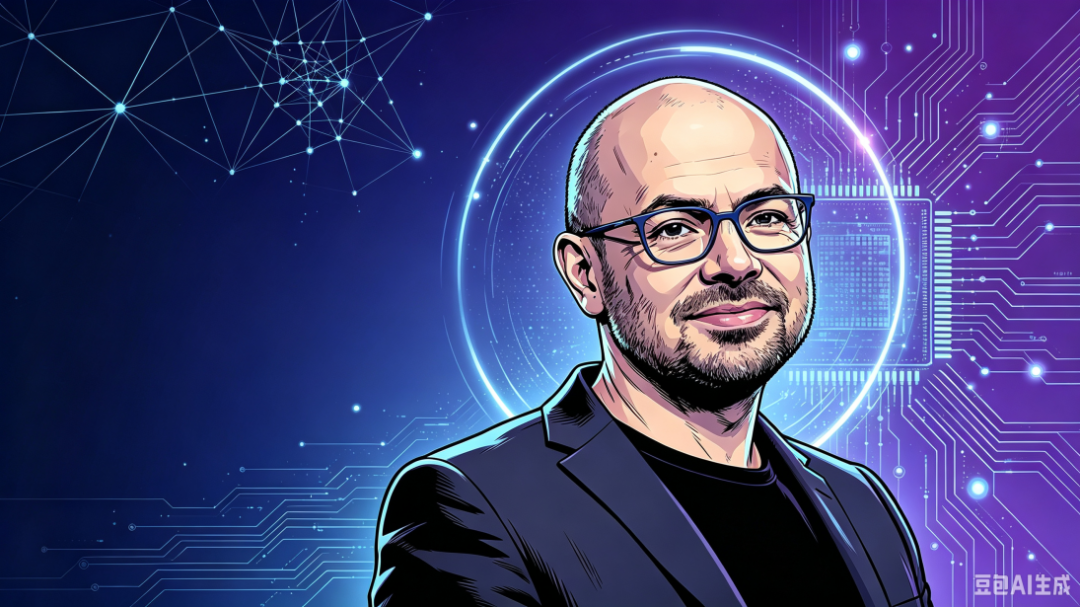
Google Makes a Choice: Sell Computing Power or Build AI?

A major personnel shakeup reveals a significant strategic shift at tech giant Google.
On August 5, 2026, Google CEO Sundar Pichai informed the Google DeepMind team of multiple personnel changes via an internal email. DeepMind founder Demis Hassabis stepped down as CEO to become Chairman and Chief Scientist of Alphabet; Jeff Dean, Chief Scientist at Google for 27 years, officially left to co-found Discovery Loop with Sanjay Ghemawat, Oriol Vinyals, and Ke Guo.
The founder was 'pushed out' of the lab he built, less than two years after winning the Nobel Prize in Chemistry.
Amid the personnel turmoil, another hidden story emerged. The Financial Times revealed that Google had packaged and sold hundreds of billions of dollars in AI computing power to Anthropic, Gemini's biggest rival. The $200 billion computing power deal is rewriting Google's future.

Gemini's Fall from Grace: Rooted in Talent Drain
In November 2025, Gemini 3 Pro was globally recognized as the strongest model, once prompting Sam Altman to sound a 'red alert' within OpenAI. That was Google AI's moment in the spotlight.
Then came the freefall.
Gemini 3.5 Flash was deemed a complete failure, and Gemini 3.5 Pro was canceled internally before release. The hastily assembled Gemini 3.6 Flash performed even worse than Grok 4.5 and China's open-source GLM 5.2.
Research firm SemiAnalysis bluntly stated: DeepMind no longer belongs among cutting-edge AI labs.
SemiAnalysis estimates that Gemini has fallen to 8th or 9th place in large model rankings. Data from AI model evaluation platform Arena.ai shows Gemini 3.6 Flash ranked 12th with 1537 points in the frontend code arena.
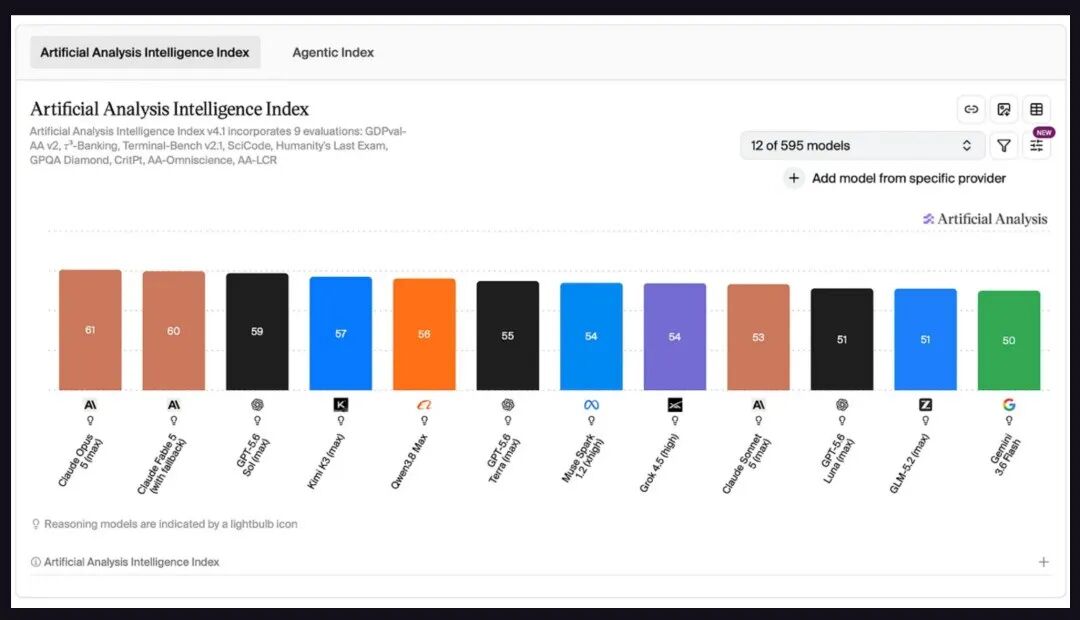
Source: Artificial Analysis
Commercial metrics declined alongside rankings. While token processing volume for Gemini's first-party API continued to grow, the growth rate plummeted from 60% in Q1 to 38% in Q2. Usage was still rising, but the momentum had stalled.
The direct cause of the collapse was talent drain. Over the past few months, John Jumper, who shared the Nobel Prize with Hassabis, joined Anthropic. Tibo, a nine-year Google/DeepMind veteran who left in July 2024, now leads OpenAI's Codex. Most of Gemini's top reinforcement learning talent has recently departed.
The root problem isn't individual departures but systemic collapse. The Transformer architecture was born at Google Brain, and foundational papers on diffusion models came from DeepMind. But now these minds are scattered across OpenAI, Anthropic, and new labs they founded.
SemiAnalysis points out that Google's issue isn't Jeff Dean or Noam Shazeer but its extremely bureaucratic, slow-moving, and strategically timid corporate culture.
A frequently cited fact is that DeepMind had an AI chatbot a year before ChatGPT's release but was banned from launching it over fears of disrupting core businesses.
When top talent no longer believes in internal breakthroughs, leaving becomes the only option. And the two most symbolic departures happened on the same day.

Founder and Technical Soul Both Out
Hassabis stepped down as CEO to become Chairman and Chief Scientist of Alphabet. His title rose, but his responsibilities shrank.
People familiar with him reveal that the idea of stepping down had been brewing for at least a year. After DeepMind merged with Google Brain in 2023, Hassabis became bogged down in management and commercial negotiations. The technical details that once excited him gradually gave way to budget approvals and cross-departmental coordination.
In his public letter, he said: 'Humanity has reached a critical moment for AGI breakthroughs, and my life's pursuit is nearing reality.' He then retreated to the top level to focus on 'long-term strategy' and 'cutting-edge scientific breakthroughs.'
He was succeeded by former CTO Koray Kavukcuoglu, a more commercially oriented manager.
Jeff Dean's departure represents a different kind of loss. He was the soul of Google's technical ecosystem. Joining Google in 1999, he co-developed GFS, MapReduce, and BigTable with Sanjay Ghemawat, laying the foundation for Google's massive data processing; led the creation of Google Brain, oversaw the implementation of the TensorFlow framework and TPU chips, and was deeply involved in the top-level design of the Gemini large model. He is widely regarded as Google's 'greatest engineer of all time,' an assessment with little internal dispute.
Sanjay Ghemawat and Ke Guo, who left with him, are both Google Fellows—a title awarded to only the top dozen technical contributors. Oriol Vinyals was co-lead of Gemini. The four had served at Google for 13 to 27 years, totaling over 80 years combined. Their simultaneous departure was no coincidence.
The exit of core figures corresponds with the reallocation of core assets. With Hassabis no longer controlling computing power distribution and Dean taking top talent elsewhere, computing resources originally belonging to DeepMind began flowing elsewhere, including to Gemini's direct competitors.

Google Sells TPUs to Anthropic, Cloud Platform Becomes Biggest Winner
While Gemini struggles, Google Cloud tells a very different story.
In Q2 2026, Google Cloud revenue surged 82% YoY to $24.768 billion, far exceeding market expectations of $22.4 billion. Cloud backlog reached $514 billion, with over $50 billion added in a single quarter. Operating profit jumped from $2.826 billion to $8.814 billion, with profit margins expanding from 20.7% to 35.6%.
Bigger variables hide in the financial details. Alphabet began delivering complete TPU systems to customer data centers. SemiAnalysis estimates that TPU system sales, recognized on a gross basis, amount to about $35 billion per GW, with about $1.2 billion confirmed in Q2 2026.
The real shock lies in backlog. According to the Financial Times, Google has created one of history's largest infrastructure financing plans, bundling about $200 billion in contracts to sell over $150 billion in AI chips to Anthropic.
In June, the first TPU hardware was delivered. A special purpose entity named Compute SPV paid $35 billion for about 1 GW of AI hardware, equivalent to roughly 1 million TPUs. In April, Google agreed to sell Broadcom 3.5 GW of TPU hardware for Anthropic's deployment. Broadcom disclosed total purchase commitments of $128 billion.
SemiAnalysis estimates that from Q3 2026 to Q4 2027, over 20% of Google's TPU shipments will go directly to Anthropic. This doesn't include hundreds of thousands already leased to Anthropic and hundreds of thousands promised to Meta in the future.
The trend of shifting computing power from 'internal use' at DeepMind to 'external sales' is clear. SemiAnalysis data shows DeepMind's share of Google's total AI computing power dropped from about 40% in 2024 to about 33% in 2026, and is expected to fall to 17% by the end of 2027.
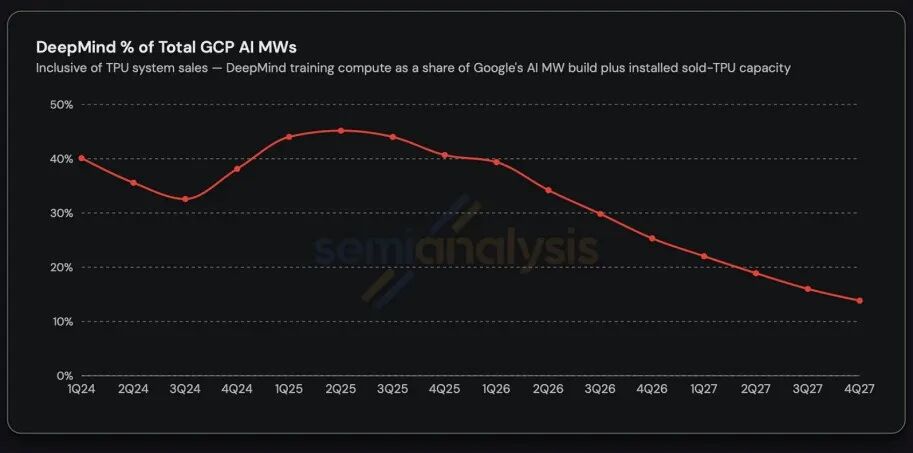
Figure: Trend of DeepMind's Computing Power Share
Source: SemiAnalysis Tokenomics Model
The scale of this 'computing power export' far exceeds temporary reallocation—it's a systemic strategic choice. Who drove this shift?

The $200 Billion Computing Power Deal's Cost: Abandoning Cutting-Edge AI
The biggest beneficiary of this personnel earthquake isn't Anthropic or OpenAI but Google Cloud head Thomas Kurian.
Previously, Gemini and GCP fiercely competed for computing power allocations. Hassabis needed it to train next-gen models; Kurian wanted to sell it to external clients for profit. Now the winner is clear. Kurian stated in a podcast that TPUs should become 'universal infrastructure' serving Citadel, the Department of Energy, and various enterprise clients. When asked why computing power was sold to Gemini's direct rival, he replied: This is the inevitable result of Google being a 'platform company.'
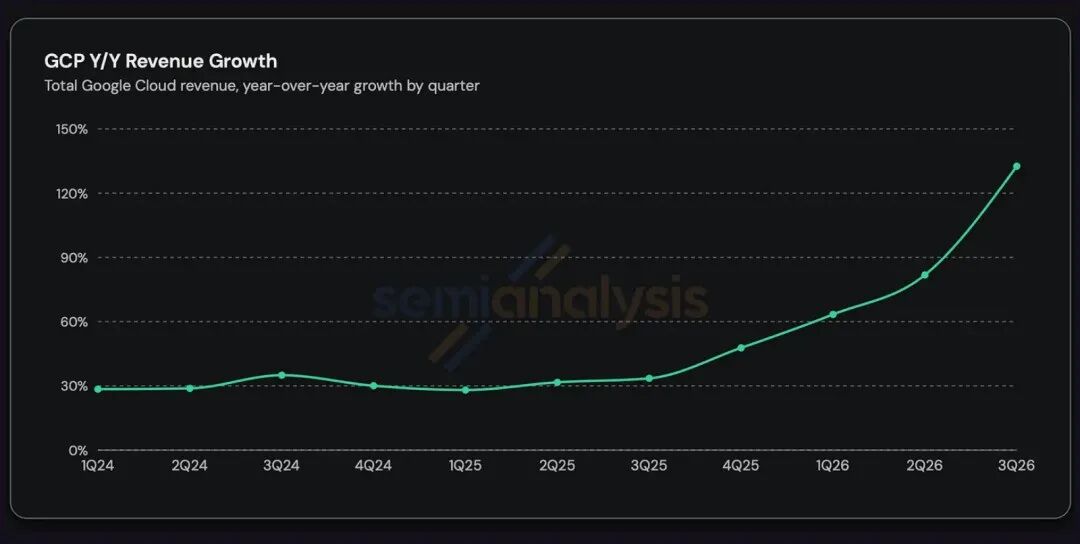
Figure: Trend of Google Cloud Revenue Growth
Source: SemiAnalysis Tokenomics Model
Financial logic underpins his victory. SemiAnalysis estimates Gemini's annual recurring revenue at about $12 billion in Q2 2026. By the end of 2027, GCP's total external sales are expected to reach the $200 billion range, with EBIT margins exceeding 30%. For Google's management, the priority allocation of computing resources between $200 billion in expected external sales and $12 billion in annual Gemini revenue needs no explanation.
More ironically, after Jeff Dean and others founded Discovery Loop, Google not only became its founding investor but also committed to providing computing power as a cloud services partner. In other words, Google sells TPUs to Anthropic while supplying computing power to its former employees' new company. The computing power remains, the people remain, but it no longer serves Gemini.
SemiAnalysis argues: Google's management has made a clear choice to shift GCP's focus toward computing power commercialization for short-term high returns, even if it means abandoning long-term competitiveness in cutting-edge AI models.
When DeepMind was acquired, Google's vision was 'to make AI benefit everyone.' Twelve years later, the company is massively selling AI's lifeblood to competitors while its own models lose to rivals.
The true meaning of this personnel earthquake may not be Gemini's failure but Google's covert strategic shift: from 'building the best AI models' to 'selling the best AI shovels.'
As for which path is correct, time will tell.
Information Source Notes:
Data Source: Alphabet Q2 2026 Earnings Release
Research Report Source: SemiAnalysis, 'Gemini is Cooked but GCP is Cooking', August 7, 2026
News Source: Financial Times, 'Google assembles record $200bn infrastructure financing to sell over $150bn of AI chips to Anthropic', August 4, 2026
Disclaimer: This article is for reference only and does not constitute investment advice.
THE END
Copyright and Disclaimer
1. Content Copyright: Except for the use of publicly available data, policies, and cases, all content in this article is original. Professional data is sourced from authorized databases and official government websites, and cases are compiled from real events.
2. Image Licensing: Some of the images in this article are owned materials or officially licensed, as well as AI-generated; for network images with unclear copyright, the copyright belongs to the original author, and any infringement will be removed upon notification.
3. Reprinting Guidelines: Reprinting is prohibited without permission; when reprinting, the complete source and author must be retained.
4. Liability Statement: This article represents the author's observations on business figures and industry commentary compiled from publicly available information. The content is for reference only and does not constitute professional advice. Any risks arising from its use shall be borne by the user. Xin Zhi Dong Neng reserves the final right of interpretation for this article.
-
![]()
Reversal! Apple's Major iPhone Redesign for 20th Anniversary Not Cancelled: New Glass Design to Debut in 2027
-
![]()
Zhong Shanshan Criticizes E-commerce Platforms as Intermediaries: Is His Stance Accurate or Biased?
-
![]()
Three Tech Titans Make Big Bets on AI Agents: Will Office Settings Become the Primary Arena for AI Adoption?
-
![]()
Gemini Falls Out of Global Top Ten, Hassabis Out, Google Sells Computing Power to Its Arch-Rival
-
![]()
The 'New Car Death Effect' Hits Series 9 Flagship SUVs
-
![]()
Seres Faces a New Crossroads: AITO’s Shift and the Uncertainty Surrounding Saidou’s Arrival
-
![]()
Buying Huawei’s Intelligent Driving Six-Seater for 100,000 Yuan: Can Fengxing Emulate the Success of Huawei-Powered S Model? | Mingjing Pro
-
![]()
The Tipping Point for AI Computing Power Domestic Substitution in China