Three Tech Titans Make Big Bets on AI Agents: Will Office Settings Become the Primary Arena for AI Adoption?
 08/11 2026
 502
502
In a mere two weeks, Tencent, ByteDance, and Alibaba have all undergone organizational restructuring, propelling AI-driven office tools into the realm of 'automation'. However, with 88% of companies experimenting with AI agents but only 24% seeing profits, the question of whether AI-powered office tools can become the next major gateway remains a costly proposition that still needs time to validate. Original Content by Xinshang AI New Tech Team
From July 20 to August 3, Tencent, ByteDance, and Alibaba successively integrated their AI-driven office products and organizational structures. Tencent incorporated QClaw into the WorkBuddy system; ByteDance CEO Liang Rubo announced the split of Feishu in an internal email, merging the product team with Doubao and transferring the sales system to Volcano Engine; Alibaba launched the public beta of 'Qianwen Office,' which integrates three products: QoderWork, MuleRun, and Wukong. In just two weeks, these three internet giants have collectively shifted focus, moving AI from collaborative office tools to automated office solutions. This seems to signal that AI is one step closer to becoming actual productivity. However, is the reality truly that straightforward?

Why Are the Three Titans Collectively Shifting Focus?
Over the past two decades, the business logic of these tech giants has been built on the premise that 'users equal assets,' with massive daily active users (DAUs) serving as a key pillar of their valuations. Entering the era of large language models, the value measurement system is being reconstructed. AI products no longer adhere to the internet's iron law of lower marginal costs with more users. After all, every invocation represents tangible computational consumption. The LatePost conducted a notable calculation on Doubao: as of the first half of 2026, despite over 200 million daily users, Doubao's daily revenue was less than RMB 1 million. In contrast, based on the public API prices of Volcano Engine, Doubao's daily computational costs amounted to tens of millions of yuan. 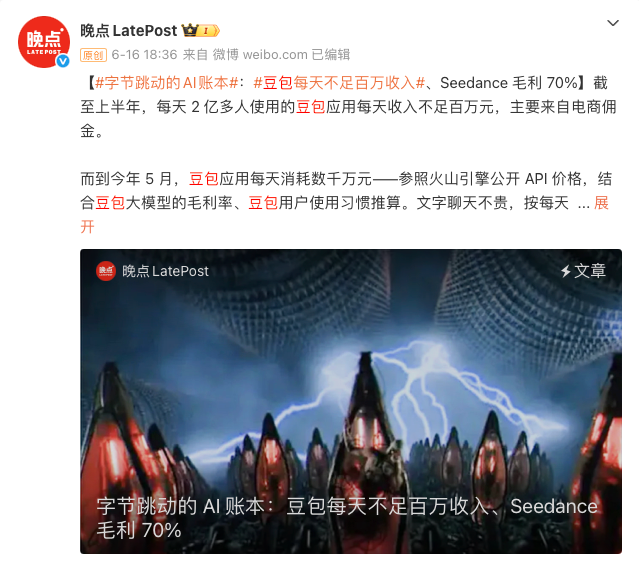 ▲Photo/Source: Internet
This contrasting data reveals the financial pressure faced by consumer-end (C-end) AI applications: the larger the user base, the greater the computational consumption, and revenue struggles to cover costs. This is not a unique challenge for ByteDance but a new test for the entire industry.
Tencent's Q1 2026 earnings report listed the financial impact of its new AI products separately for the first time: after excluding the costs of five new AI products, including Yuanbao, Hunyuan, and CodeBuddy, the company's Non-IFRS operating profit growth rate would have been 17%, but the actual rate was only 9%, representing a difference of approximately RMB 8.8 billion. Tencent officially stated that 'costs are controllable and calculable,' while Ma Huateng used the metaphor of 'boarding a ship' to describe the current situation—'A year ago, we thought we had boarded the ship, but later realized it was leaking. Now, we feel like we're standing on it but can't sit down comfortably.' Realizing that continuing to burn money on C-end conversational scenarios is unsustainable, Tencent quickly shifted resources toward WorkBuddy, explicitly naming it in its earnings report as 'currently the most widely used AI efficiency agent service in China.'
Unlike ByteDance and Tencent's C-end battles, Alibaba's internal positioning of AI-driven office tools has been exceptionally clear from the start. According to an exclusive report by Huxiu, Alibaba's decision-makers explicitly defined Qianwen Office as an AI productivity platform for enterprise organizations, rather than just a personal AI office tool for C-end users. Alibaba simultaneously released its flagship model, Qwen 3.8, to serve as the foundational model for Qianwen Office, with a clear focus on the enterprise market, aiming to fully connect with enterprises' real databases and workflows. The three companies started from different points but converged on the same judgment: office scenarios are the closest among various AI application scenarios to achieving a commercial closed loop for tokens. 
Do Users Care About the Directions the Tech Titans Are Pursuing?
While the tech titans are convinced that AI-driven office tools will be the next major gateway, user attitudes remain unclear. According to data from iiMedia Research, the primary use cases for AI office agents are automatically generating PPT presentations (51.8%), analyzing and visualizing spreadsheet data (38.2%), and batch organizing and archiving files (37.1%).
These scenarios represent fundamental work tasks applicable across industries and positions, with a large user base and high frequency of use. However, they are also standardized, making it easy for agents to be implemented and representing capabilities that free tools like WPS have long covered. Is there really a need to charge users for these features?
Unless paid AI can significantly enhance users' work capabilities and generate substantial income, it seems that AI applications have not yet brought significant economic benefits to enterprises. KPMG's '2026 Global Technology Report' revealed that based on survey data from 2,500 tech executives across 27 countries, 88% of respondent companies have begun integrating Agentic AI into their systems, but only 24% have achieved a return on investment across multiple AI use cases.
Addressing this phenomenon of 'high penetration but low returns,' Liu Xiaoguang, the managing partner of KPMG China's AI Transformation Office, pointed out that achieving ROI does not depend on how many agents are deployed but on whether agents truly integrate into core business processes.
This is closely related to the unstable quality of AI-generated content. After all, no enterprise dares to use AI-generated bids for competitive tendering. In such core business scenarios, AI's error tolerance is too low. If AI can only create PPTs, it's just a tool; if it can handle a client's due diligence report, that's true value. 
Divergent Paths Stem from Corporate DNA
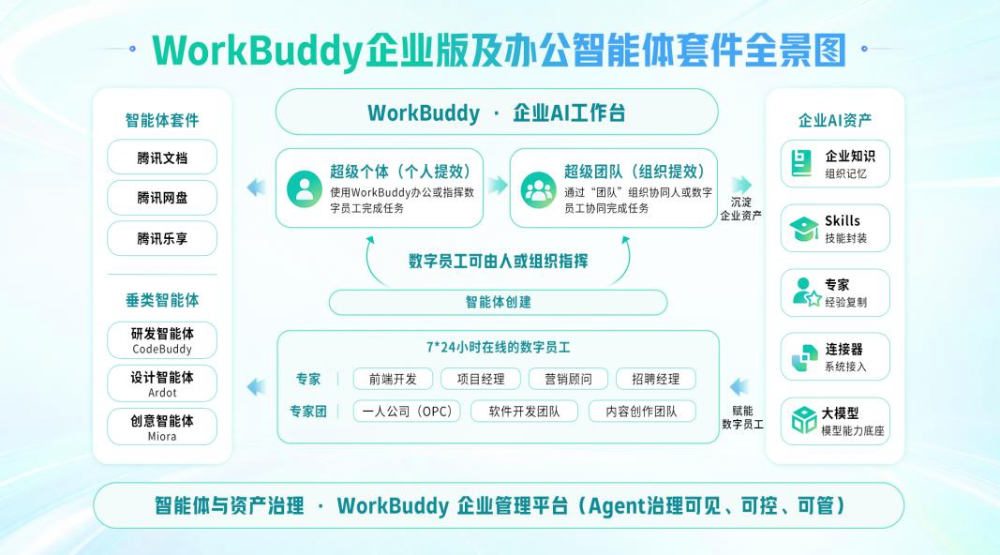
Given the value gap between 'creating PPTs' and 'handling due diligence reports' in AI-driven office tools, how do the three tech titans plan to bridge this gap? Tencent continues to break down barriers between WeChat and WorkBuddy, leveraging its massive user base to drive adoption of AI-driven office tools.
WorkBuddy adopts a 'membership + points' usage-based pricing model, with its human-machine co-writing feature allowing users, colleagues, and AI to collaboratively edit the same document, supporting Tencent Docs as well as local Word, Excel, PPT, and Markdown files. Tencent's approach aligns with its consistent product philosophy: first cover as many scenarios as possible with a product matrix, then reduce customer acquisition costs through the distribution capabilities of the WeChat ecosystem.
 ▲Photo/Source: Internet
Alibaba leverages its technical accumulation in the Qianwen large model, giving it strong competitiveness in model capabilities. As the industry's first product to simultaneously support desktop agents, cloud agents, and enterprise collaboration agents, Qianwen Office's greatest differentiation lies in its comprehensive focus on the enterprise market.
According to a case study disclosed by Alibaba, a 20-person law firm used Qianwen Office to complete its first M&A due diligence report through multiple interactions with a senior lawyer. The entire process could then be one-click saved as an 'organizational-level Skill' and shared with the entire team. When a new employee encounters a similar case, they can simply invoke this Skill and select an execution path to generate a report. This represents Alibaba's B-end path, built on the accumulation of 26 million enterprise organizations on DingTalk.
As for ByteDance, it combines the strengths and weaknesses of Doubao and Feishu. According to a report by Caijing, Feishu's revenue exceeded RMB 3 billion in 2025, with Q2 2026 revenue growing by over 100% year-on-year. More than 90% of new customers simultaneously purchased Feishu's AI products—Feishu has accumulated enterprise customers, organizational context, and a sales system; Doubao boasts a C-end traffic advantage with 382 million monthly active users.
ByteDance's strategy is 'buy Doubao, get Feishu for free.' The enterprise version of Doubao, deeply developed with involvement from the Feishu product team, has already begun internal testing among some Feishu customers, attempting to reconstruct office workflows. All three companies' products are still evolving, and the question of who will be the first to achieve 'full-process automated office' remains unanswered. 
The Challenges of AI-Driven Office Tools Remain Unsolved
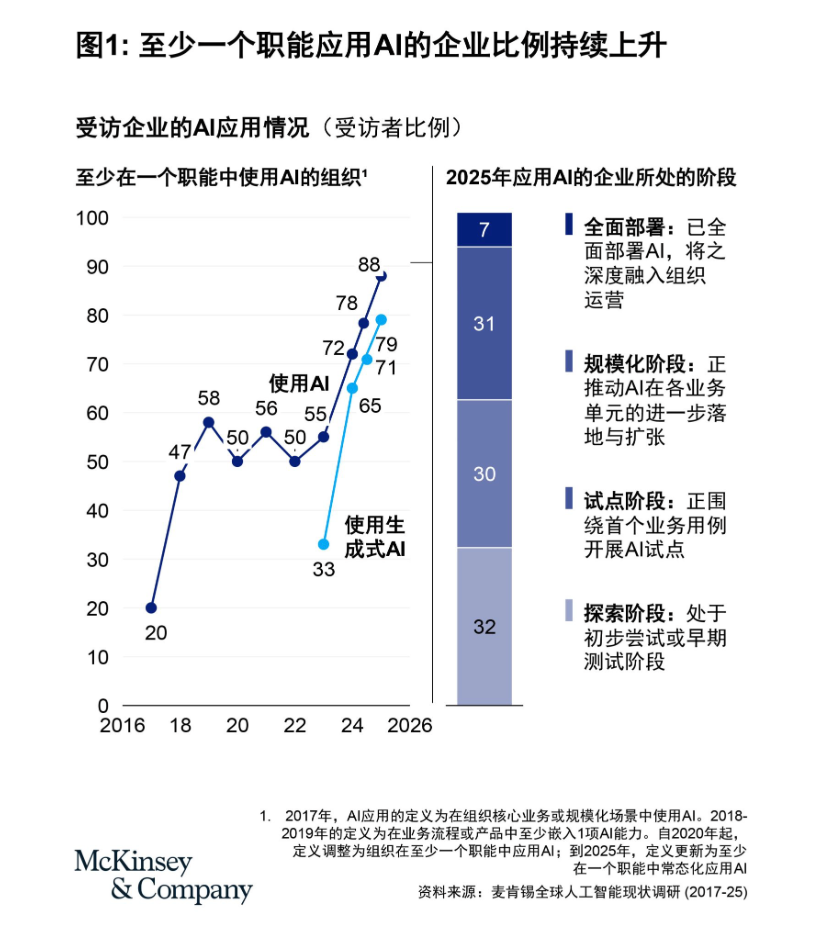
Currently, agents primarily handle single-threaded tasks (e.g., single-document processing) and are still far from true multi-agent collaboration and long-term task autonomy. McKinsey's industry research data shows that only 5%-7% of AI-adopting enterprises in China have achieved significant financial benefits, with 88% still stuck at shallow tool applications like single-point document processing and intelligent Q&A.
 ▲Photo/Source: Internet
Coupled with the low symbolization and standardization of processes in Chinese enterprises, along with high decision-making flexibility that often requires human judgment, AI alone struggles to drive all office decisions. Even if automated processes are achieved, which business model—subscription-based, token-consumption-based, or private deployment—can succeed? From the current situation, AI commercialization at the enterprise level remains slow.
According to iiMedia Research data, 50% of enterprises primarily adopt a hybrid pricing model of 'basic subscription + excess usage,' while 51.5% of enterprises can accept an annual cost per employee for using agents of RMB 300-599. This indicates that most enterprises have relatively limited budgets in this area.
Large enterprises, with high data security requirements, tend to prefer private deployments. Especially in the finance and government sectors, core data is unlikely to be entrusted to public cloud AI. The inherent contradiction between the logic of open, connected general-purpose large models and the ironclad rule of 'data not leaving the domain, auditable, and traceable' in government and enterprise data poses a major test for the penetration depth of AI-driven office tools.
Overall, AI-driven office tools are not a false proposition, but 2026 seems more like a beginning. After facing difficulties in monetizing C-end conversational AI, the tech titans are collectively targeting office scenarios, which are closest to achieving a commercial closed loop for tokens. However, true value realization depends on the stability of AI-generated content quality and the maturity of enterprise willingness to pay. The journey from pilot projects to monetization remains long, and this battle has only just begun.
Data Sources:
Tencent Q1 2026 Earnings Report, KPMG '2026 Global Technology Report,' McKinsey '2025 AI Application Status Survey,' Caijing 'Feishu's 2025 Revenue Exceeds RMB 3 Billion,' iiMedia Research '2026 China AI Office Agent Industry Development White Paper,' Huxiu Exclusive 'Alibaba's Two Secret Teams and Wukong Restructuring: The Target Is Not WorkBuddy,' The LatePost 'ByteDance's AI Ledger: Doubao Generates Less Than RMB 1 Million in Daily Revenue, Seedance Has a 70% Gross Margin'
-
![]()
Reversal! Apple's Major iPhone Redesign for 20th Anniversary Not Cancelled: New Glass Design to Debut in 2027
-
![]()
Zhong Shanshan Criticizes E-commerce Platforms as Intermediaries: Is His Stance Accurate or Biased?
-
![]()
Three Tech Titans Make Big Bets on AI Agents: Will Office Settings Become the Primary Arena for AI Adoption?
-
![]()
Gemini Falls Out of Global Top Ten, Hassabis Out, Google Sells Computing Power to Its Arch-Rival
-
![]()
The 'New Car Death Effect' Hits Series 9 Flagship SUVs
-
![]()
Seres Faces a New Crossroads: AITO’s Shift and the Uncertainty Surrounding Saidou’s Arrival
-
![]()
Buying Huawei’s Intelligent Driving Six-Seater for 100,000 Yuan: Can Fengxing Emulate the Success of Huawei-Powered S Model? | Mingjing Pro
-
![]()
The Tipping Point for AI Computing Power Domestic Substitution in China