The 'New Car Death Effect' Hits Series 9 Flagship SUVs
 08/11 2026
 427
427
"From Booming Orders to Sparse Monthly Sales"
Author | Zhen Yao
Editor | Li Guozheng
Produced by | Bangning Studio (gbngzs)
Series 9 flagship SUVs represent the most competitive segment in today's new energy vehicle market.
On one hand, new models are being launched in rapid succession, creating significant market buzz.
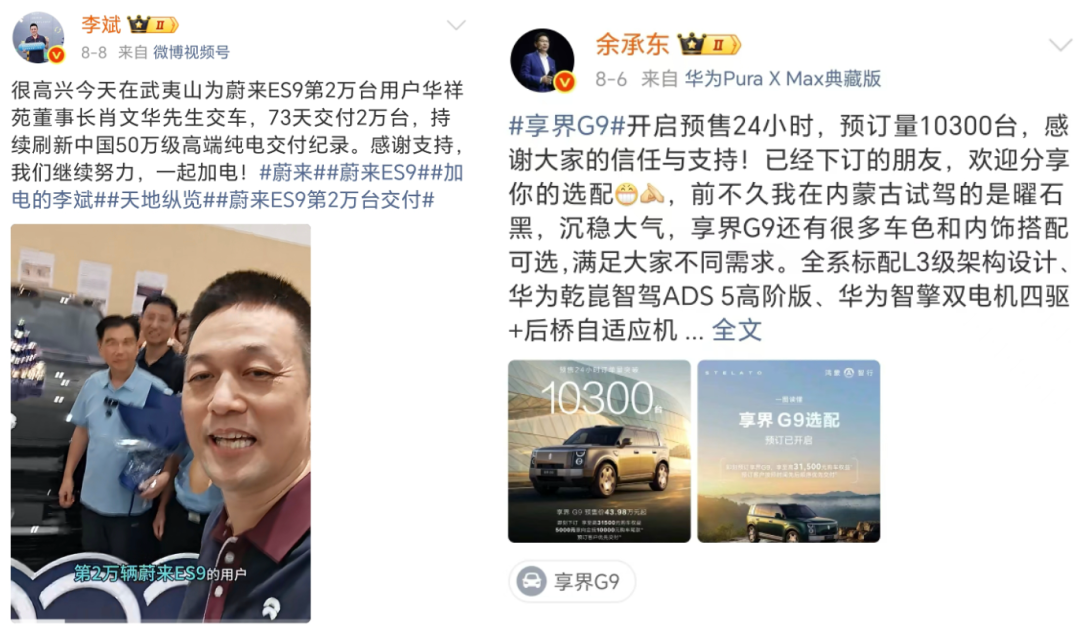
"NIO ES9 delivered its 20,000th unit in just 73 days," announced Li Bin, NIO's founder, chairman, and CEO, in a short video on August 8.
On Weibo, Yu Chengdong, Huawei's Executive Director, Director of the Product Investment Review Committee, and Chairman of Terminal BG, highlighted the orders for the Xiangjie G9: over 10,000 in 24 hours and 15,000 in 72 hours, with 90% of these being high-end trims.
After Xiaomi's Pengcheng series N70 Max and N90 Max opened for pre-orders, long queues formed at stores to experience the display vehicles. Although Lei Jun, Xiaomi Group's founder, chairman, and CEO, did not disclose sales figures, industry insiders estimate around 70,000 pre-orders in 72 hours.
On the other hand, sales of most previously popular Series 9 SUVs have drastically declined.
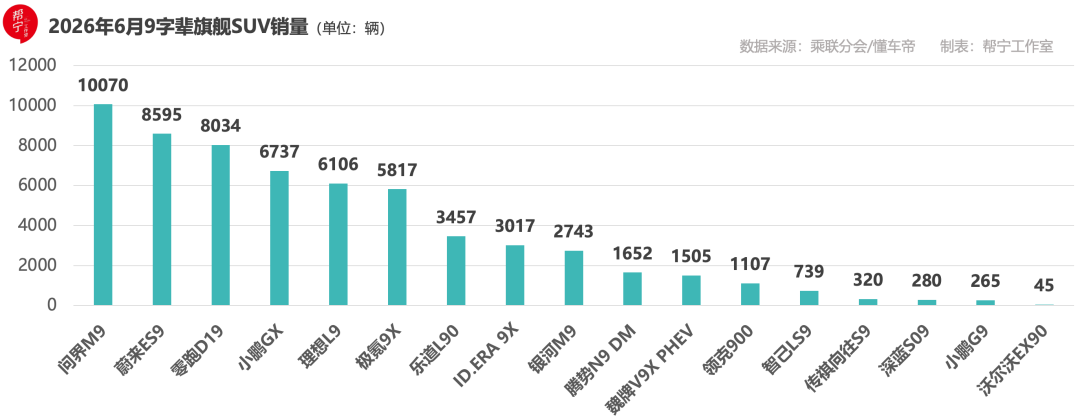
The Zhiji LS9, offering up to RMB 30,000 in trade-in discounts, saw its peak monthly sales drop from nearly 5,000 units to just 739; the Seres S09 fell from a high of 3,200 units to 280; the Lynk & Co 900 dropped from 7,300 units to 1,107; the ID.ERA 9X declined from 5,000 units to 3,000; and the Volvo EX90 sold only 45 units per month...
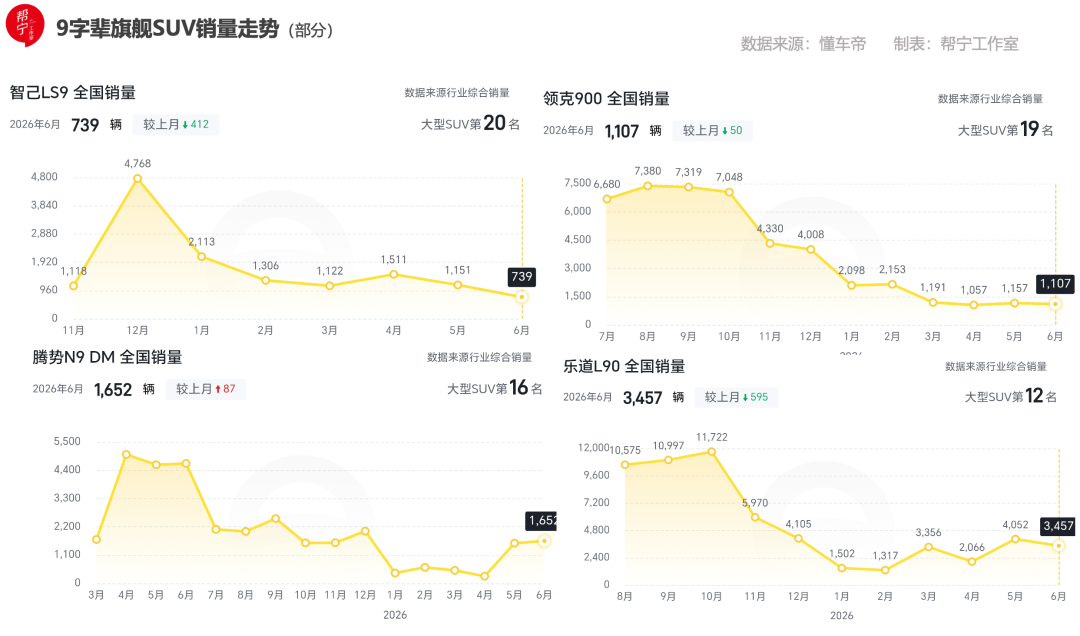
Initially, these flagship products were expected to elevate brand status and delivered impressive results. However, within months, they faced the dilemma of poor sales despite price reductions.
Only a few leading models, such as the Aito M9, NIO ES9, and Li Auto L9, consistently maintain monthly sales above 5,000 units.
What has gone wrong with the polarized Series 9 flagship SUV segment, seen as the essential path for brand elevation?
▍01 High Launch, Low Sustainability
"There are now too many large six-seater Series 9 models, and consumers are overwhelmed by choices," said a sales manager at a Beijing-based Wey V9X dealership, expressing frustration. He noted that users are now highly selective about configurations and experiences, with the model currently selling around 1,000-2,000 units per month, which he considers acceptable for now.
After visiting multiple new energy vehicle stores in Beijing, Bangning Studio found that many once-premium, hard-to-get Series 9 flagship SUVs now offer steep discounts, with benefits like five-year zero-interest financing and tens of thousands of yuan in cash reductions, amounting to over RMB 30,000 in total savings for several models.
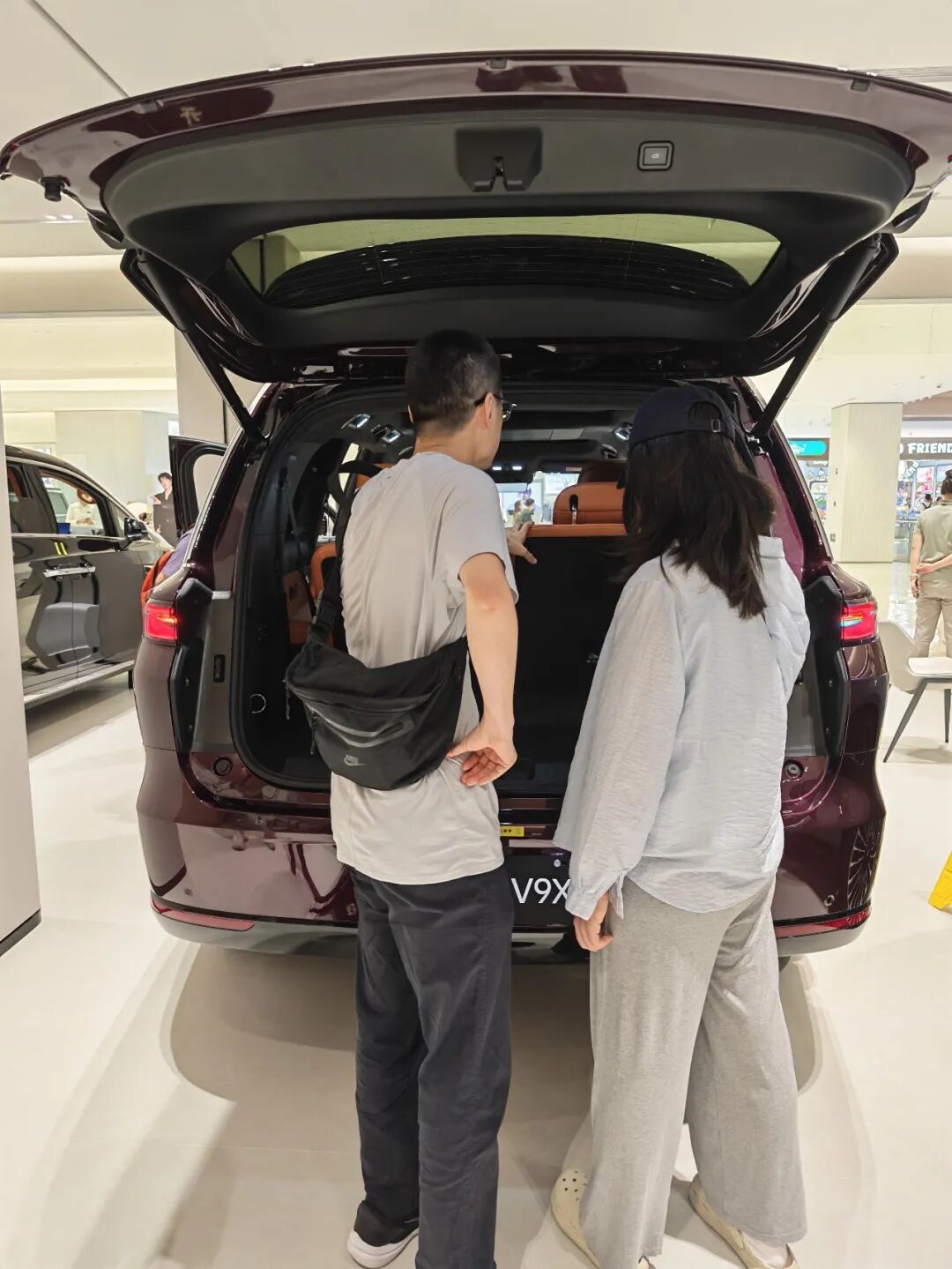
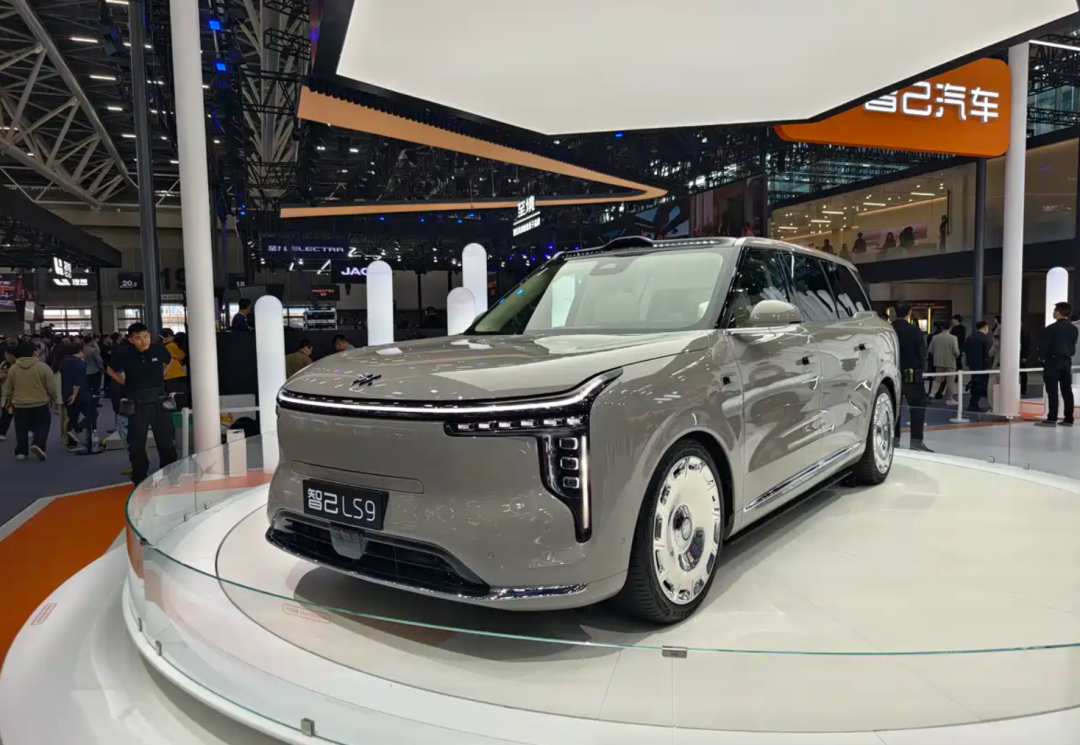
"Six months ago, when the Zhiji LS9 first launched, orders exploded, and everyone was willing to wait in line," recalled a sales manager. "Now, just a few months later, the hype has completely faded. With so many similar large six-seater flagships launching and undercutting prices, users are holding onto their money."
From late 2025 to early 2026, Series 9 new energy SUVs were at the peak of their popularity. Back then, large five-seater and six-seater flagship SUVs priced between RMB 300,000-500,000 were seen as the dream vehicles for Chinese automakers to break into the premium market, shatter brand pricing ceilings, and elevate brand image.
The industry witnessed an unprecedented wave of Series 9 model launches, with the Li Auto L9, Aito M9, NIO ET9, Leitao L90, Geely Galaxy M9, Seres S09, Lynk & Co 900, Zeekr 9X, Zhiji LS9, and Xiangjie S9 all hitting the market in quick succession.
These new models featured ultra-large body space, full-stack advanced intelligent driving, luxurious immersive cabins, and fully equipped hardware specifications, quickly capturing attention and heat as they competed in the high-end new energy market.
In its early days, the Zhiji LS9 rapidly gained market share with its solid hardware chassis, full-domain intelligent driving, and superior cabin quality, achieving nearly 5,000 monthly deliveries and sustained production ramp-up. Market sentiment was bullish, viewing it as a masterpiece for brand elevation.
The same applied to the Denza N9. After launch, it became a popular choice for mid-to-high-end family SUVs with its balanced product strength, achieving monthly sales around 5,000 units.
The SAIC Volkswagen ID.VER 9X also saw high initial popularity and strong sales performance, leveraging its joint-venture brand heritage.
Nearly all automakers were convinced that Series 9 flagship SUVs were the essential path to new energy premiumization.
The reversal came suddenly.
After the 2026 Spring Festival, market sentiment tightened, and Series 9 model sales collectively plummeted. Once-popular models selling 5,000 units per month generally fell below 1,000 units.
Despite multiple discounts, the Zhiji LS9 sold fewer than 800 units in June; the Denza N9, after headlight upgrades, configuration optimizations, and high-value option subsidies, barely regained four-digit sales; the SAIC Volkswagen ID.VER 9X saw sales decline after its initial popularity faded; and the Leitao L90, once selling over 10,000 units for three consecutive months, dropped to 3,000-4,000 units.
▍02 Flagship Oversaturation
Is the market no longer in need of large six-seater flagships because Series 9 SUVs are collectively struggling? The answer is no.
In the past two years, "Series 9" has become the most overused label in the automotive industry. More and more automakers have fallen into a simple logical trap—assuming that enlarging the body, fully equipping configurations, and raising prices automatically make a flagship Series 9 model.
However, a true flagship should represent the brand's highest standards in technology, craftsmanship, experience, and architecture, serving as a generational product distinct from ordinary models and the ultimate carrier of brand value.
Today, most Series 9 SUVs on the market are merely enlarged Series 8 models.
"After the first launch of the (Aito) M9, every Chinese automaker started learning from the M9," Yu Chengdong admitted at a launch event.
Some netizens on automotive forums noted that a certain Series 9 SUV costs RMB 90,000 more than its secondary flagship Series 8 model but offers no overwhelming or generational advantages in core product strength, especially in terms of space, range, intelligent driving, and cabin experience, which are highly similar. Ordinary users find it hard to perceive where the extra RMB 90,000 in value lies.
For average family users, RMB 300,000 is the mainstream budget range, and more cost-effective secondary flagship models generally suffice for travel needs. Relatively fewer high-end users are willing to pay purely for flagship texture and top-tier brand experience.
This leaves most Series 9 SUVs in an awkward position: mid-range users find them too expensive, while high-end users do not recognize their value.
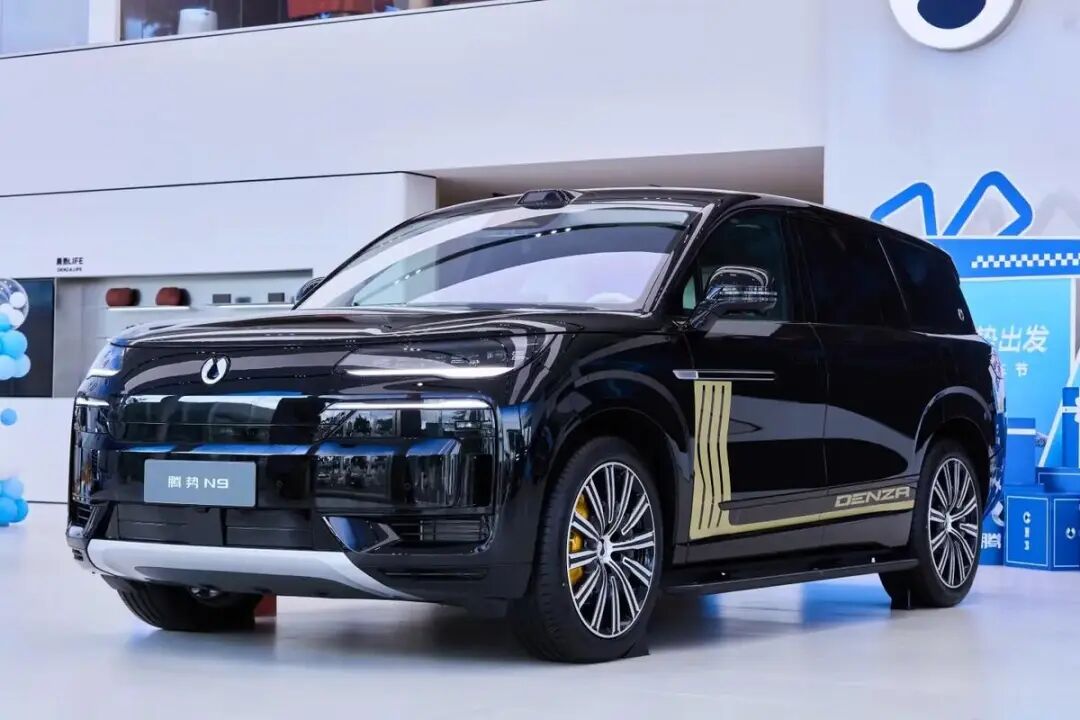
"Most mid-tier brands' Series 9 models share a common issue: the brand simply cannot support this price point," said an industry insider. "Many brands suddenly launch a flagship model priced over RMB 400,000, leaving consumers confused because it doesn't align with their brand impression."
In his view, these brands have not cultivated many high-end users, nor have they established high-end dealership services, exclusive user communities, or premium reputation. Expecting users to pay RMB 400,000 for a newly launched model packed with configurations is unrealistic.
Additionally, the segment is highly polarized, with a solidified Matthew effect.
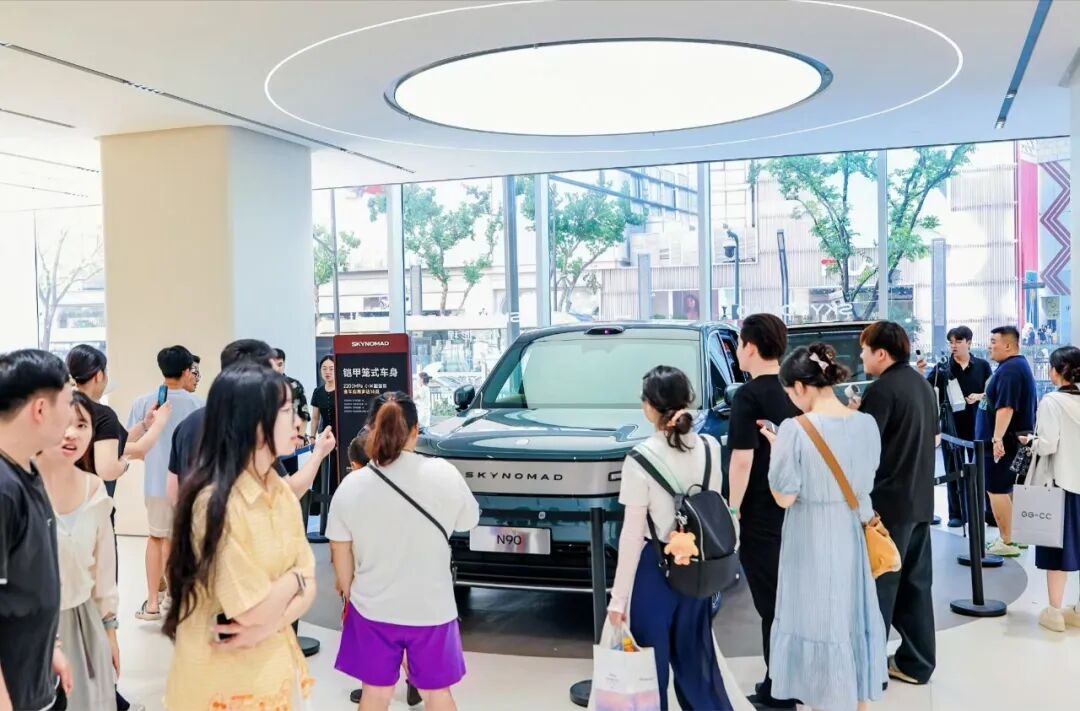
Nearly all stable customers in the high-end flagship SUV segment are locked in by a few leading brands. Models like the Li Auto L9, Aito M9, NIO ES9, and Zeekr 9X maintain their positions with mature brand premium perception, complete service systems, and differentiated core product strengths, consistently selling over 5,000 units per month and dominating the mainstream market share.
The remaining dozens of follow-up Series 9 models can only compete for a tiny remaining market share.
The high-end car-buying population is inherently limited, extremely discerning, and highly loyal. When choosing models priced around RMB 400,000, they value not just size and configurations but also brand endorsement, user reputation, long-term services, residual value, and product maturity.
This explains why most Series 9 SUVs are short-lived.
▍03 Is It Worth Persisting?
An emerging voice in the industry suggests that the Series 9 SUV segment is outdated and automakers should no longer obsess over high-end flagships.
This is not the case. Series 9 flagship SUVs remain a battleground that all automakers must conquer.
First, they raise the brand's pricing ceiling, with all cutting-edge new technologies debuting on these models. Second, they retain high-end family users. Third, they help automakers avoid the fierce price wars in the RMB 200,000-300,000 mid-range market and stabilize overall profits.
Abandoning the Series 9 product line would trap brands in an involuted red ocean, preventing them from moving upward.
Despite fierce competition, new entrants continue to join the fray.
On August 7, the Ministry of Industry and Information Technology's 410th batch of "New Road Motor Vehicle Production Enterprises and Products" announcement included the Fangchengbao Titanium 9, a large six-seater plug-in hybrid SUV and the flagship of Fangchengbao's Titanium series.
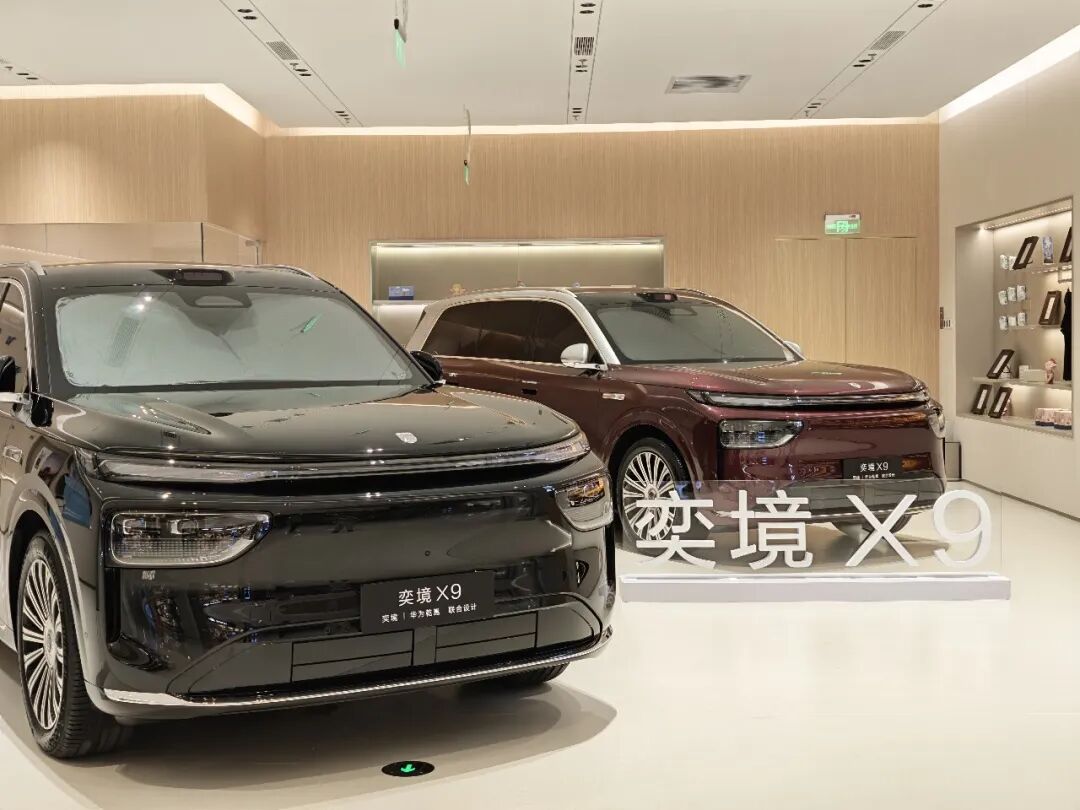
On August 18, the Yijing X9, jointly developed by Huawei and Dongfeng, opened for pre-orders. Positioned as a high-end six-seater flagship, it features top-tier hardware across the lineup and Huawei's Qiankun intelligent driving system.
Li Auto is also set to launch the Ideal i9, a family-oriented battery electric flagship SUV...
"I believe there are still significant opportunities because relatively few truly premium home-use flagship products exist in this market," Zeng Qinglin, Yijing Auto's brand general manager, told Bangning Studio in an exclusive interview.
In fact, the industry should abandon a misconception: a flagship is not defined by size, nor does a low price confer core advantages.
Multiple industry insiders believe that the upcoming Series 9 market will no longer focus on comparing dimensions, large screens, or seat counts—ubiquitous configurations—but instead on competing in core values that others cannot replicate, such as exclusive vehicle architectures, precisely targeted family scenarios, deeply ingrained high-end brand perception, and comprehensive high-end user services.
The Series 9 flagship SUV segment has not cooled down; the era of wild growth dividends has ended, and the age of value competition has arrived. The Series 9 flagship SUVs that can stabilize in the high-end market will not compete on being cheaper but on being more worthwhile.
(Featured image generated by AI)
-
![]()
The 'New Car Death Effect' Hits Series 9 Flagship SUVs
-
![]()
Seres Faces a New Crossroads: AITO’s Shift and the Uncertainty Surrounding Saidou’s Arrival
-
![]()
Buying Huawei’s Intelligent Driving Six-Seater for 100,000 Yuan: Can Fengxing Emulate the Success of Huawei-Powered S Model? | Mingjing Pro
-
![]()
The Tipping Point for AI Computing Power Domestic Substitution in China
-
![]()
Industry Projection: Will Xiaomi Auto Surpass 1 Million Annual Sales by 2028?
-
![]()
Qianwen App Rolls Out Paid Office Membership: A 'Dual-Track' Strategy with Qianwen Office?
-
![]()
Stocking 10 Million Units, Pushing Thickness Limits: Can Apple's First Foldable Break the Market Stalemate?
-
Has the Token Price War Come to an End with DeepSeek's Substantial Price Increase and QianWen's Potential Partial Fees?