Seres Faces a New Crossroads: AITO’s Shift and the Uncertainty Surrounding Saidou’s Arrival
 08/11 2026
 410
410
By: Xiangshan Finance and Economics
After a hiatus of three years, the "HUAWEI" sign has made its comeback in the automotive commercial district.
In early July, the "HUAWEI ADS" sign was reinstalled at the urban commercial district experience center.
For Seres, this scene is both familiar and striking. Three years ago, it was the "HUAWEI" letters that marked AITO’s debut, granting it exclusive access to this prestigious branding and heralding the start of its aspirations.
However, that dream was short-lived. On March 31, 2023, Ren Zhengfei issued a resolution titled "Huawei Will Not Build Cars," drawing a clear line that strictly prohibited the use of "Huawei/HUAWEI" in vehicle promotion and exterior design. The resolution specifically pointed out that terms like "Huawei AITO" should not be used for promotional purposes.
That very night, Yu Chengdong ordered the removal of Huawei branding from all AITO stores nationwide.
Three years on, the sign has returned, but Seres might wish it hadn’t come back so emphatically.
This time, the "branding" plaque is not exclusive to AITO. Brands like Qijing, Yijing, Avatr, and others have also moved into the HUAWEI ADS authorized experience centers.
Huawei’s brand is making its way to the retail frontline like never before, but it’s no longer Seres’ exclusive asset.
From "exclusive possession" to "shared among many," Seres may be the one with the most complex emotions about this return.
Is AITO’s “Dominance” Coming to an End?
Seres recently released its July sales report, revealing a concerning trend.
In July, Seres’ new energy vehicle sales reached 24,229 units, marking a 45.65% year-over-year (YoY) decrease.
Sales of the core AITO series (Seres vehicles) were 20,480 units, a 50.86% drop.
Additionally, cumulative sales from January to July stood at 203,006 units, while it’s rumored that Seres set an annual target of 500,000 units at the beginning of the year.
This means the completion rate is around 40%.
To turn things around, Seres would need to consistently achieve monthly sales of 40,000 units; otherwise, "meeting the target" seems almost unattainable.
The performance of its peers is even more striking. During the same period, Leapmotor delivered 101,267 units in July, a 102% YoY increase. NIO delivered 35,934 new vehicles in July, a 71.0% YoY increase. Even Xpeng, with a relatively modest growth rate, steadily moved forward with 38,000 units and a 4% YoY increase.
While the tide is rising for others, AITO appears to be retreating.
The financial situation is equally troubling. Seres’ 2026 interim results announcement revealed an expected net loss attributable to shareholders of between RMB 1.5 billion and RMB 1.8 billion for the first half of the year, with a loss range for non-recurring profit and loss between RMB 2.2 billion and RMB 2.5 billion.
The capital market’s reaction has been even harsher. When Seres listed on the Hong Kong Stock Exchange last November, its stock price surged to RMB 129, but it has now fallen to around RMB 43, marking a nearly 70% drop in market value.
Group after group of data and signals point to the same conclusion: Is AITO really losing its momentum?
This brings us back to a recurring issue: AITO’s "Huawei factor" is constantly declining.
But in the past, when discussing AITO’s diminishing "Huawei factor," the market mostly viewed it as a long-term concern. After all, AITO’s sales were still holding up.
However, now the concern is materializing, and it seems less like an accident and more like a deliberate reshuffling.
One set of data is particularly noteworthy:
In the first seven months of this year, Seres’ cumulative sales were 203,006 units, a 6.31% YoY decrease.
Two days ago, Harmony Intelligent Mobility announced cumulative deliveries of 286,000 units in the first seven months, a 13.7% YoY increase.
In the past, AITO’s sales almost accounted for all of Harmony Intelligent Mobility’s deliveries.
Now, while AITO’s sales are declining, Harmony Intelligent Mobility as a whole is growing.
More notably, in the first half of the year, AITO delivered approximately 160,800 units, still accounting for 67% of Harmony Intelligent Mobility’s deliveries, remaining the "crown prince."
But in July, the situation changed dramatically. AITO’s share in Harmony Intelligent Mobility fell from 67% to 45.46%.
The narrative of "one brand dominating" seems to be gradually coming to an end.
A deeper reason might lie in the shifting positioning of Huawei’s five brands.
Initially, the division of labor among the five brands was clear: AITO focused on mid-to-high-end home SUVs, Xiangjie targeted high-end executive sedans, Zunjie established itself as an ultra-luxury flagship, Shangjie filled the mainstream market of RMB 150,000-250,000, and Zhijie focused on sporty tech coupes.
Each brand stayed in its lane without encroaching on others.
But now, this boundary seems to be blurring.
Zhijie has long been unsatisfied with just coupes. In 2024, the R7 will directly enter the mid-to-large SUV segment, clashing head-on with AITO M7. Both have highly overlapping price ranges (RMB 249,800-339,800), both follow extended-range/hybrid routes, and target the same group of family and young users.
Zunjie just stepped into the MPV market with the V800, and there are rumors that it might launch an SUV next, potentially clashing with AITO M9.
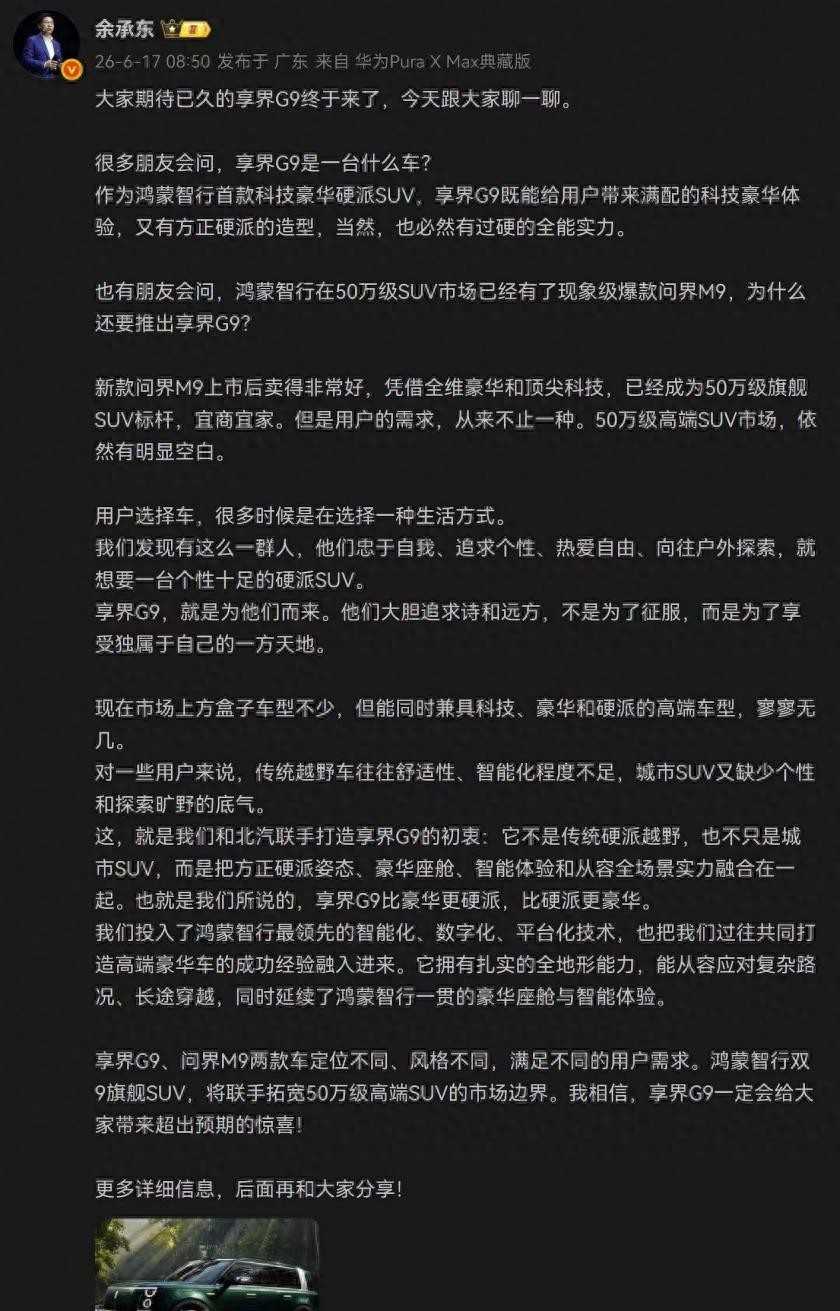
If Zunjie’s move is just speculation, Xiangjie is openly no longer sticking to executive sedans. On August 5, the Xiangjie G9 debuted as a boxy SUV with a pre-sale price of around RMB 500,000, directly encroaching on AITO M9’s territory.
Notably, Yu Chengdong specifically explained the differences between AITO M9 and Xiangjie G9, stating that their consumer profiles are different.
However, despite these differences, the current Chinese automotive market has fully entered a mature phase, with the high-end electric SUV segment above RMB 500,000 showing a high degree of concentration.
Counting the competitive models, there are only a few: AITO M9, Zeekr 9X, Li Auto L9, and NIO ES9.
For every G9 sold, it means one less sale for other models.
One of the most pressured models is undoubtedly AITO M9.
After all, both share the same core capabilities in intelligent driving; the real differences lie only in superficial aspects like design and brand narrative.
From "each staying in its lane" to "SUVs from all directions," AITO now faces not external enemies but increasing pressure from its own siblings.
Interestingly, AITO was clearly Huawei’s first "legitimate son" in its smart vehicle selection program, but it has ended up with the fewest models and the narrowest path.
Zhijie, Xiangjie, and Zunjie all have SUVs, sedans, and MPVs taking turns on the battlefield; only AITO is still stubbornly focusing on SUVs, with no sign of a sedan yet.
From a business perspective, given AITO’s previous brand momentum, if it had launched a sedan earlier, it would likely have further boosted overall sales, or at least avoided the current sales decline.
In simple terms, this is like favoritism from parents with many children—seeing the eldest son as independent and capable, they naturally shift their attention and resources to the younger ones.
But this favoritism essentially means taking from the eldest son.
Outsiders believe Seres is de-Huaweifying, especially since Saidou Cars is partnered with Doubao, but isn’t Harmony Intelligent Mobility also gradually reducing its reliance on AITO?
In the past, concerns about AITO’s declining "Huawei factor" were just worries, but now it’s affecting the core sales base, making the future situation even more worrying.
Tesla Partners with Doubao: How Much "Doubao Factor" Will Seres Have?
From this perspective, Seres’ partnership with ByteDance to bet on "Saidou Technology" and attempt to open a second growth curve is an extremely strategic move.
AITO’s nearly 50% sales decline now confirms the same fact: relying solely on Huawei is no longer enough to support Seres’ future aspirations.
But the problem is, timing doesn’t seem to be entirely on Seres’ side.
Theoretically, if AITO’s core business could have remained more stable, Seres could have calmly refined Saidou’s product, channel, and brand systems.
However, the reality is that AITO’s cooling speed has far exceeded expectations, while Saidou Technology is still in its infancy, with its first model not even officially launched yet, and AITO is already showing signs of fatigue.
This means Seres is likely experiencing a period of "transition pain": the old engine is gradually cooling, while the new engine hasn’t ignited yet.
For Saidou, the impact of this situation is direct—its room for error is compressed, with little margin for trial and error.
But then again, with tight time and heavy tasks, can Saidou truly take over from AITO and become Seres’ second pillar?
Objectively speaking, Saidou faces enormous challenges in replicating AITO’s past success.
In fact, Saidou Technology’s predecessor, Landian Technology, had already attempted to break through.
In 2023, Landian launched the Landian brand, targeting the market below RMB 200,000.
But the problem is, this price range is precisely the most fiercely competitive red ocean in the industry—BYD, Geely, Leapmotor, and other established and emerging players are engaged in close combat here.
Coupled with AITO already taking up most of the group’s resources, Landian has never achieved a meaningful breakthrough.
Now, rebranded as Saidou and paired with Doubao, aiming for the market above RMB 200,000, can it truly transform?
From an external market perspective, the new energy market above RMB 200,000 is far from a blue ocean.
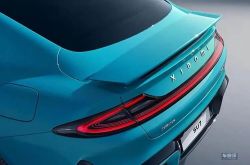
Xiaomi SU7, Tesla Model 3, Xpeng P7+, and Zeekr 007 all carry the "young tech" label, each with a distinct brand personality and a solid user base.
For Saidou to squeeze into this circle with the "ByteDance concept" will be no easy feat.
More challenging is that Saidou hasn’t even officially started yet but is already facing pressure on its "Doubao factor."
Recently, Tesla announced its AI cockpit collaboration with Doubao in China.
Tesla’s value needs no introduction, and with FSD as its trump card, how Saidou will handle this dimensionality reduction strike in the market above RMB 200,000 is a real challenge.
Now, let’s look at ByteDance’s role.
Its advantages are indeed dazzling: AI large models, online content traffic, first-tier in China.
But compared to Huawei, its shortcomings are equally obvious: ByteDance understands software and algorithms but lacks any hardware accumulation in vehicle manufacturing, not to mention Huawei’s mature automotive sales channels and user operation systems.
Huawei’s approach to car-making involves a closed-loop integration of software and hardware across the entire chain, while ByteDance’s foray into cars is currently still stuck at the software AI level—this is the most fundamental gap.
In other words, Saidou "borrowing strength" from ByteDance to build cars is far inferior to the momentum Huawei previously provided.
Moreover, the market climate has changed.
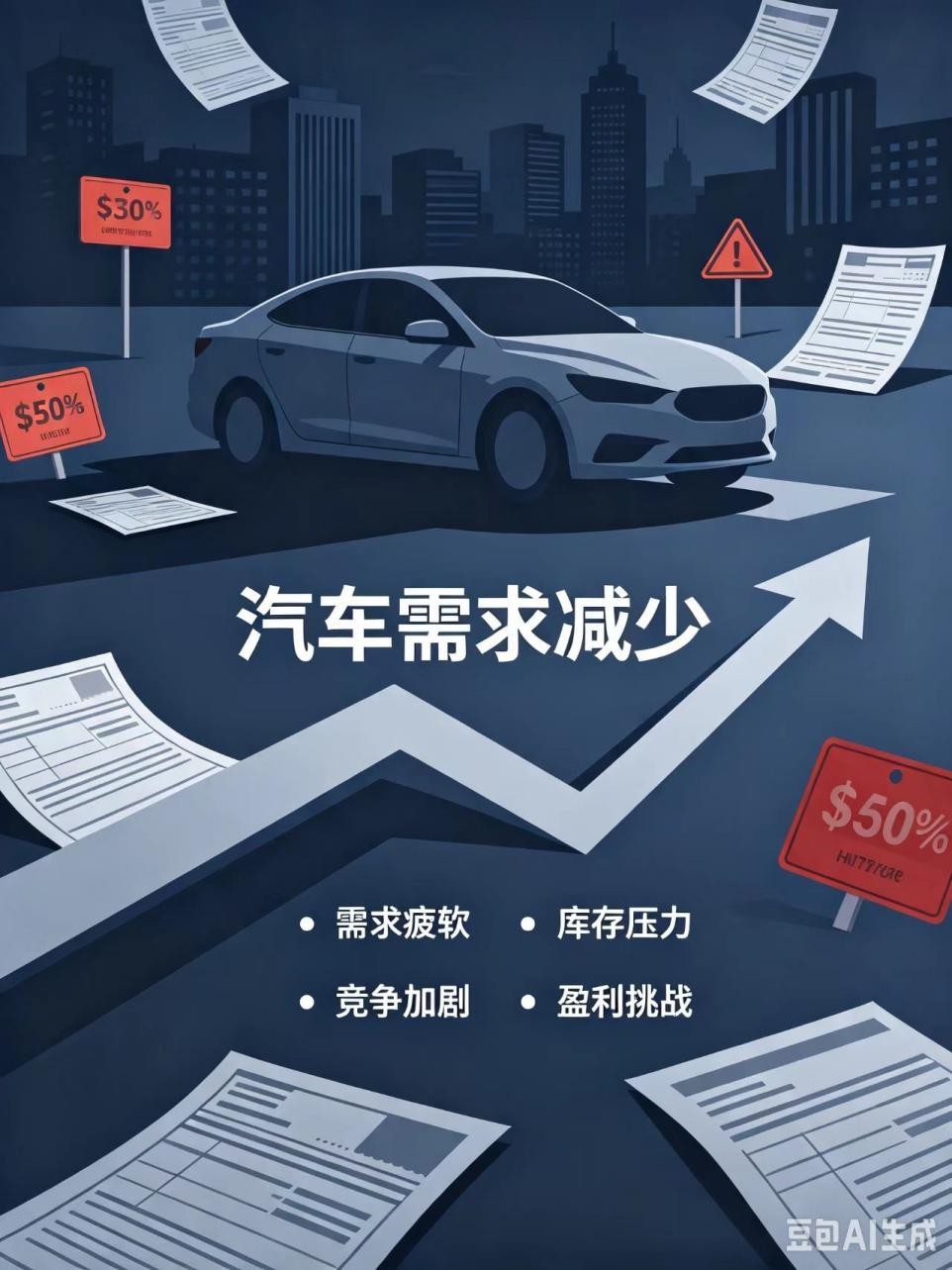
According to the China Association of Automobile Manufacturers, domestic automobile sales in the first half of 2026 reached 9.921 million units, a staggering 21.1% YoY drop.
AITO and Xiaomi were able to break through back then by riding the wave of intelligent driving narratives, relying on founder Lei Jun’s personal reputation and all-in determination, and most importantly, an upward-trending market.
Today, Saidou faces a battlefield of mature market competition, consumer contraction, and intensified competition—the same script, but with exponentially higher difficulty.
Against this backdrop, Saidou Technology’s breakthrough seems hard to imagine.
One brand needs to defend, the other needs to attack; one needs to keep the old engine running, the other needs to ignite the new engine. But the window of opportunity is closing at a visible pace.
Objectively speaking, Saidou faces enormous challenges in replicating AITO’s past success. It’s not a simple game of replacing Huawei with ByteDance but fighting a tougher battle with fewer resources in a worse market environment.
However, the market always needs new stories. We still hope Saidou can break through and that Seres can navigate this period of transition pain—after all, finding a new fulcrum before the old order collapses has always been the most difficult yet precious proposition for enterprises.
Disclaimer: The information cited in this article is sourced from the company’s statutory disclosures and publicly available materials. The author makes no guarantees regarding its completeness or timeliness. Stock market investments involve risks; please exercise caution. The content herein is solely commentary and does not constitute any investment advice. Whether to participate in investments is for you to judge and bear the risks yourself.
-
![]()
The 'New Car Death Effect' Hits Series 9 Flagship SUVs
-
![]()
Seres Faces a New Crossroads: AITO’s Shift and the Uncertainty Surrounding Saidou’s Arrival
-
![]()
Buying Huawei’s Intelligent Driving Six-Seater for 100,000 Yuan: Can Fengxing Emulate the Success of Huawei-Powered S Model? | Mingjing Pro
-
![]()
The Tipping Point for AI Computing Power Domestic Substitution in China
-
![]()
Industry Projection: Will Xiaomi Auto Surpass 1 Million Annual Sales by 2028?
-
![]()
Qianwen App Rolls Out Paid Office Membership: A 'Dual-Track' Strategy with Qianwen Office?
-
![]()
Stocking 10 Million Units, Pushing Thickness Limits: Can Apple's First Foldable Break the Market Stalemate?
-
Has the Token Price War Come to an End with DeepSeek's Substantial Price Increase and QianWen's Potential Partial Fees?