The Tipping Point for AI Computing Power Domestic Substitution in China
 08/11 2026
 534
534
After Wang Hong and Deng Yu won the Fields Medal, Xingkongjun looked into Deng Yu's participation in the 2006 IMO during his high school years before attending Peking University, where he won a team gold medal. Upon examining his teammates, remarkable discoveries were made.
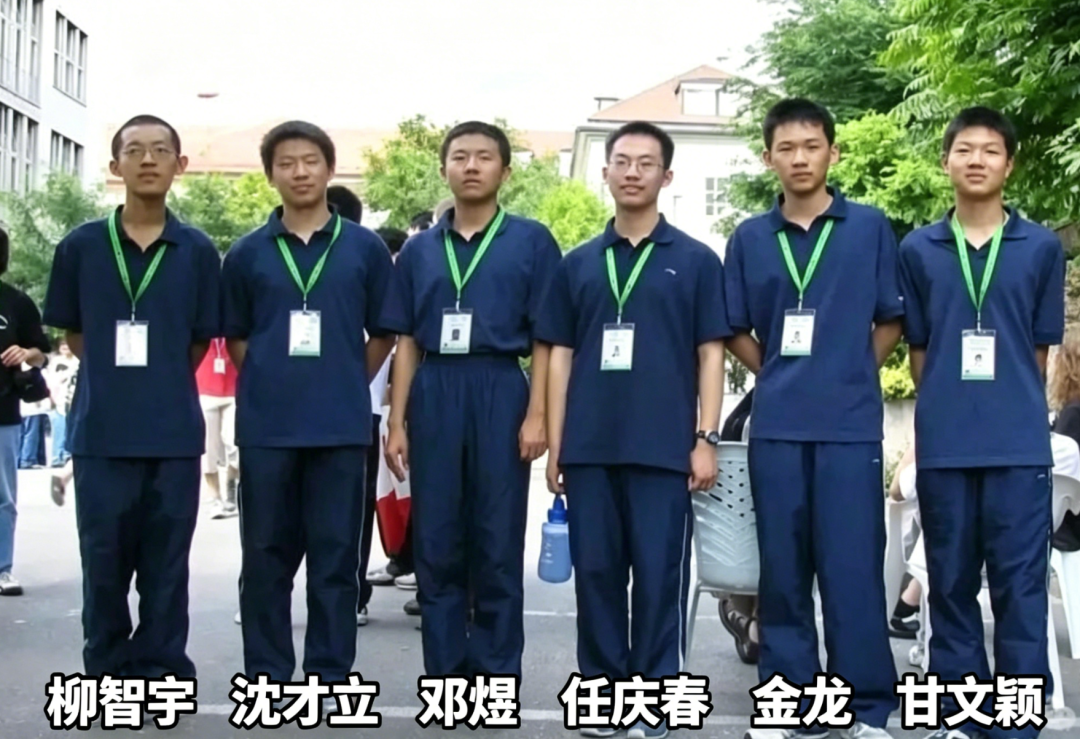
This team of six individuals has the following current statuses:
Liu Zhiyu (Perfect Score): After graduating from Peking University, he declined a full scholarship to MIT and became a monk at Longquan Temple. He returned to secular life in 2022, now engaged in psychological counseling entrepreneurship and is married.
Shen Caili (37 points, 4th place): After graduating from Peking University's School of Mathematics, he went to the United States and now works at Two Sigma, a global top quantitative hedge fund, engaged in quantitative research.
Deng Yu (35 points, tied for 6th place): Transferred from Peking University to MIT, obtained a Ph.D. from Princeton, and is now a professor at the University of Chicago. He won the Fields Medal in 2026 (the first time for Chinese mathematicians alongside Wang Hong).
Ren Qingchun (34 points, 11th place): A two-time IMO gold medalist, he was recommended to Peking University and then went to MIT. He has the least public information, but LinkedIn shows him as a software engineer at Google.
Jin Long (35 points, tied for 6th place): Undergraduate at Peking University, Ph.D. at Berkeley, postdoctoral fellow at Harvard. He returned to China in 2020 and is now an associate professor at the Yau Mathematical Sciences Center at Tsinghua University, researching partial differential equations and quantum chaos.
Gan Wenying (31 points, 13th place): Ph.D. in Combinatorics from ETH Zurich, later left academia and is now a quantitative researcher at Two Sigma's quantitative hedge fund in New York.
The underlying code of this world is mathematics.
The world operates on computation.
1. The Cambrian Explosion of Cambricon
In 2016, brothers Chen Tianshi and Chen Yunji, researchers at the Institute of Computing Technology, Chinese Academy of Sciences, founded Cambricon.

The company had been experiencing losses for a long time, but a decade later, it ushered in the Cambrian Explosion.
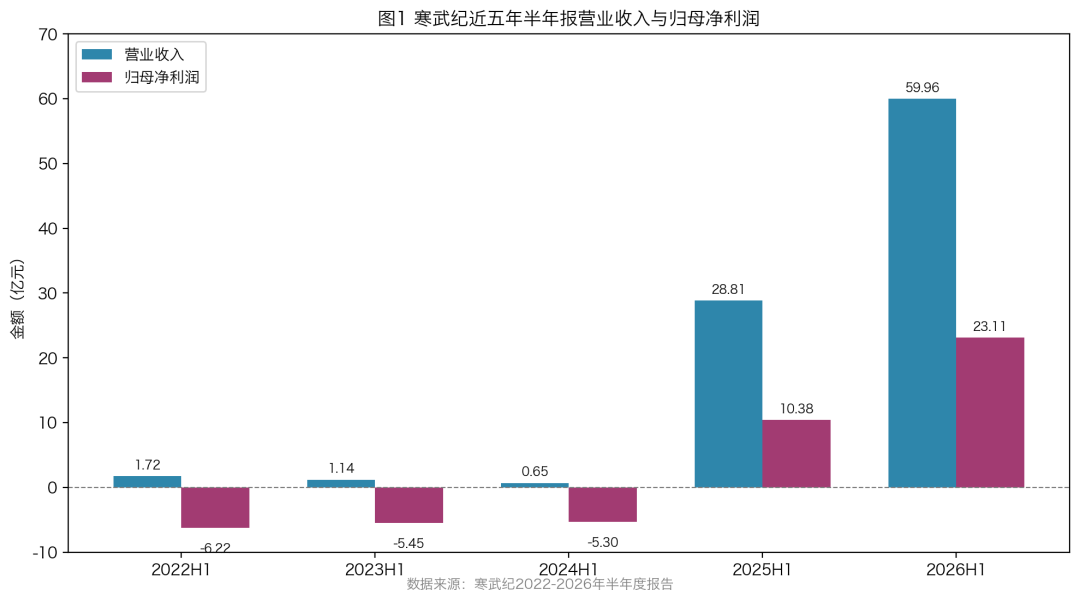
In August 2026, Cambricon released its most impressive semi-annual report since listing on the STAR Market. Revenue reached RMB 5.996 billion, a year-on-year increase of 108%; net profit attributable to shareholders was RMB 2.311 billion, a year-on-year increase of 123%.
Data Source: ifind
For any technology company, this would be a financial report sufficient to excite the market.
But for Cambricon, the significance of this report is even more special.
Because prior to this, Cambricon had long been in a state of "high R&D investment and continuous losses," representing a typical example in the A-share market of being labeled as the "first domestic AI chip stock" while facing question (zhì yí, "doubts") about "when it would become profitable."
The data in the semi-annual report indicates that Cambricon has not only crossed a new threshold in terms of revenue scale but, more importantly, achieved a qualitative leap in profitability.
From losses to profits of RMB 2.311 billion, Cambricon's improvement on the profit side mainly comes from two aspects.
First, revenue scale effects.
In the first half of 2026, the gross margin was 55.3%, slightly lower than the 55.93% in the first half of 2025 and more significantly down from the 62.72% in the first half of 2024.
The decline in gross margin is related to changes in the product mix after large-scale shipments and an increase in the proportion of intelligent computing center projects.
However, the explosive growth in revenue scale caused the total gross profit to surge from approximately RMB 1.611 billion in the first half of 2025 to about RMB 3.313 billion in the first half of 2026, doubling year-on-year. The expansion of total gross profit is the cornerstone of profit improvement.
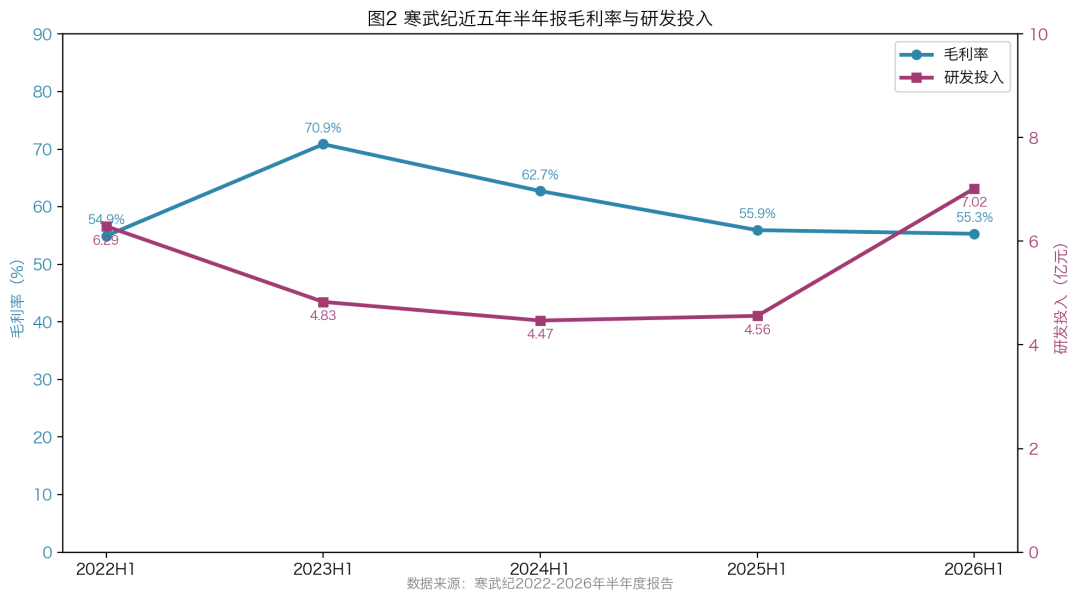
Data Source: ifind
Second, a decline in the R&D expenditure ratio.
Cambricon has long been known for its high R&D investment, with the R&D expenditure ratio exceeding 100% in the semi-annual reports from 2022 to 2024.
It decreased to 15.85% in the first half of 2025 and further to 11.72% in the first half of 2026; the absolute amount of R&D investment increased from RMB 456 million in the first half of 2025 to RMB 702 million in the first half of 2026, a year-on-year increase of +29.63%.
Revenue growth far outpaces R&D growth, with a significant "denominator effect" being the key to profit improvement.
2. Product Structure
1. Cloud Training Chips: A Rigid Demand Driven by AI Large Models
The first main driver of Cambricon's revenue growth comes from the increased shipments of cloud training chips.
In the first half of 2026, the demand for training and inference of domestic large models continued to explode, and the model iterations of leading domestic large model manufacturers led to exponential growth in demand for AI computing power.
In the high-end AI training chip sector, NVIDIA's A100/H100/B200 series has long dominated.
However, since 2022, U.S. export restrictions on advanced chips to China have intensified layer by layer, and the supply of "crippled" chips like the H20 has also been constrained, opening a historic window for domestic AI chips.
Cambricon's SiYuan (MLU) series of cloud training chips, while still lagging behind NVIDIA's flagship products in absolute performance, have become viable in specific scenarios.
More importantly, for domestic internet giants and intelligent computing centers with state-owned backgrounds, chips that are "usable" and "autonomous and controllable" hold more strategic value than chips that are "the most powerful" but "unstable in supply."
2. Intelligent Computing Centers: Centralized Procurement by Local Governments and State-Owned Enterprises
The second main driver comes from the centralized procurement by intelligent computing centers.
In the first half of 2026, intelligent computing centers and state-owned cloud computing platforms led by local governments entered a period of intensive construction. These projects often feature large procurement amounts, long delivery cycles, and strict requirements for supplier qualifications.
As a local AI chip company, Cambricon has a natural advantage in tenders. On the one hand, its products align with the policy orientation of domestic substitution; on the other hand, its full-stack layout across endpoint, edge, and cloud can meet the diverse computing power needs of intelligent computing centers.
From the customer structure disclosed in the financial report, orders from governments and large enterprises have significantly increased, providing important support for the doubling of revenue.
3. Edge and Endpoint: Steady Penetration in AIoT Scenarios
The third main driver comes from the steady growth of AI chips at the edge and endpoint.
As AI large models penetrate endpoint devices, the demand for AI computing power continues to rise in areas such as smartphones, autonomous driving, industrial vision, and security monitoring. Cambricon's product layout (bù jú, "layout") at the edge, while having a lower value per chip compared to cloud training cards, benefits from scattered scenarios, a large customer base, and stable cash flow.
These three main drivers collectively constitute the underlying logic behind Cambricon's 108% revenue growth. However, it is worth noting that the driving forces behind these three main drivers are different. Cloud training chips benefit from the window of opportunity created by external sanctions, intelligent computing center orders benefit from policy-driven centralized construction, and edge and endpoint chips benefit from the long-term penetration of AI applications.
This means that Cambricon's high-performance growth is the result of the superposition of multiple factors, rather than the natural outbreak of a single business.
3. Operational Risks
First, whether the high-performance growth is sustainable. The performance in the first half of 2026 benefited from the superposition of policy windows, sanction spillovers, and the construction of intelligent computing centers. Whether these factors can maintain the same intensity in the second half of 2026 and even in 2027 is uncertain.
Second, the risk of customer concentration. If Cambricon's top few customers contribute a disproportionately high proportion of revenue, any slowdown in procurement by a major customer could significantly impact the company's performance.
Third, balancing R&D investment with profits. The AI chip industry is characterized by rapid technological iteration, requiring Cambricon to maintain high-intensity R&D investment continuously. If R&D is compressed to maintain short-term profits, long-term competitiveness may be impaired; however, if R&D investment is too large, the company may again fall into losses.
Fourth, geopolitical risks. The uncertainty of AI competition between China and the United States could be either a "favorable wind" or an "adverse wind" for Cambricon. If future U.S. export control policies adjust or domestic policy support changes, Cambricon's valuation logic will be affected.
-END-
Disclaimer: This article is an analytical study based on the public company attributes of listed companies and the information disclosed by them in accordance with their legal obligations (including but not limited to interim announcements, periodic reports, and official interaction platforms). Shiyu Xingkong strives for fairness in the content and viewpoints presented in the article but does not guarantee its accuracy, completeness, or timeliness. The information or opinions expressed in this article do not constitute any investment advice, and Shiyu Xingkong shall not be held responsible for any actions taken based on this article. Copyright Notice: The content of this article is original to Shiyu Xingkong and may not be reproduced without authorization.
-
![]()
The 'New Car Death Effect' Hits Series 9 Flagship SUVs
-
![]()
Seres Faces a New Crossroads: AITO’s Shift and the Uncertainty Surrounding Saidou’s Arrival
-
![]()
Buying Huawei’s Intelligent Driving Six-Seater for 100,000 Yuan: Can Fengxing Emulate the Success of Huawei-Powered S Model? | Mingjing Pro
-
![]()
The Tipping Point for AI Computing Power Domestic Substitution in China
-
![]()
Industry Projection: Will Xiaomi Auto Surpass 1 Million Annual Sales by 2028?
-
![]()
Qianwen App Rolls Out Paid Office Membership: A 'Dual-Track' Strategy with Qianwen Office?
-
![]()
Stocking 10 Million Units, Pushing Thickness Limits: Can Apple's First Foldable Break the Market Stalemate?
-
Has the Token Price War Come to an End with DeepSeek's Substantial Price Increase and QianWen's Potential Partial Fees?