ByteDance's AI Ambitions: 12% Tax, No Distillation, Betting on 5 Trillion Parameters
 08/11 2026
 504
504
Doubao channel starts charging commissions.
For the same hotel, same room, and same billing system, the platform takes an 8% cut when booked through Douyin's information feed, but 12% when accessed via Doubao's chat interface.
The 4-percentage-point difference hinges on one variable: traffic originating from AI conversations.
This isn't just another rate adjustment. It's a strategic move by ByteDance in the global AI large model commercialization arena—setting prices first, then scaling volumes.
On the same day, Liu Xing, Doubao's PR head, responded on Weibo: 'No paid promotions, no ad fees—only channel service fees upon successful transactions.'

Translated: 'We're not earning from ads but from user intent.'
12%: The First Explicit Price Tag for AI Access
To grasp the weight of this 12%, we must place it in context.
Software service fees for Douyin's in-app local services ranged from 2.5% to 8%. The accommodation category rose from 4.5% to 8% in 2024. JD Travel still charges 0% commission to attract merchants. When Douyin entered local services, its rates were half of Meituan's.
New platforms typically undercut suppliers initially, then raise prices after gaining market share—a classic playbook.
Doubao breaks this script.
A new channel charging industry-high rates from day one. ByteDance's confidence stems from betting merchants have no 'wait-and-see' option.
In travel, Ctrip dominates ~70% of accommodation bookings with 12-20% commissions. Merchants are highly sensitive to fees but cannot exit platforms.
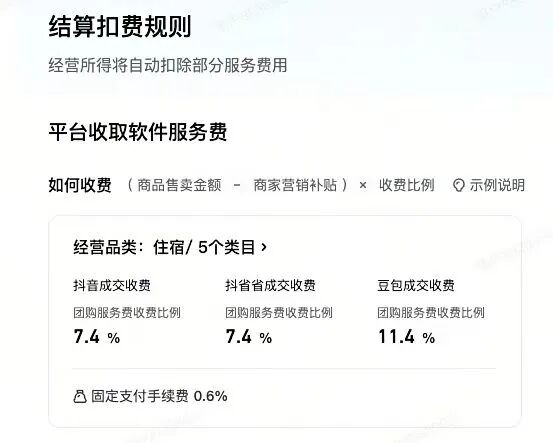
If AI conversations become the primary decision-making gateway, the cost of skipping Doubao far exceeds 12% commissions. This justifies ByteDance's premium pricing during this window.
But the fee structure hides a sharper detail.
Under policies announced on July 27, commissions base on 'user payment + subsidies from non-merchant entities.' This means if ByteDance issues coupons, merchants pay commissions on those subsidies too.
Platform marketing costs partially shift to merchant bills.
This clause matters more than the rate itself. It shows ByteDance prioritizes immediate commercialization over growth subsidies.
QuestMobile data shows Doubao had 382 million MAU by June, surpassing Qianwen (167M) and DeepSeek (130M) combined.
But scale ≠ monetization power.
Per LatePost, Doubao serves 200M+ daily users but generates Doubao's daily e-commerce GMV hovers around RMB 10M, with commissions Since current revenue is negligible, the rate hike targets pricing power, not immediate income. ByteDance's 2026 capex plan exceeds RMB 200B (~60% of 2025 profits). This requires justifiable return paths for internal and external stakeholders. Standalone rates reclassify Doubao from cost center to 'priced asset.' Order volumes may start small, but rates locked into merchant contracts become irreversible. Future growth compounds at this price. Price first, scale later. This sequence reveals ByteDance values pricing windows over current commissions. No Distillation: Zhang Yiming's 'Delayed Gratification' Bet Days before Doubao's commission rollout, Zhang Yiming did something rare—he appeared publicly. At Seed's all-hands meeting, the reclusive founder mandated: ByteDance forbids distilling competitors' models. 'Not chasing rankings with others' outputs.' 'Will sacrifice short-term gains for long-term goals.' What is distillation? Training smaller models using outputs from advanced large models—a cost-effective shortcut to rapid capability gains. Abandoning this path risks short-term backward (lagging) behind competitors. Zhang doesn't care. He argues distillation improves short-term metrics but merely replicates Claude's existing capabilities. Following this path ensures catching up, not surpassing. ByteDance internally prohibits distilling open-source models, even enforcing restrictions via API monitoring. Zhang believes distillation hinders true long-term breakthroughs. 5 Trillion Parameters: A 'Go Big or Go Home' Gamble Exclusive LatePost reporting: ByteDance discusses training a >5 trillion parameter model. How big is that? Alibaba's Qwen 3.8-Max: 2.4T params. Moonshot's K3: 2.8T. Musk's xAI scaled Grok from 500B to 1.5T, targeting 6T next. If realized, this would be China's largest known model. Xiang Liang (Seed Foundation lead) and Shen Ke (LLM pretraining data head) will spearhead development. Seed is reorganizing teams, clarifying roles, and allocating resources. Larger parameters raise capability ceilings but exponentially increase training costs and technical complexity. This isn't incremental improvement—it's a high-stakes gamble. Not ByteDance's first rodeo. Seedance 2.0 (February 2026), the first full-MoE video generation model with 200B params, became the world's top performer post-launch. It now generates $2B annual revenue at 70% margins, exceeding RMB 100M monthly. Seedance proved ByteDance can achieve global leadership in specific AI domains. Language models are different. Seed 2.0 saw limited market impact in H1 2026. Meanwhile, Zhipu's open-source GLM-5 matched Anthropic's Opus series; Moonshot's Kimi K3 (July) neared overseas closed-source leaders in third-party evaluations. Model performance gaps affected revenue. Over 50% of Volcano Engine's token consumption came from Seedance and Seedream (multimodal models), with language models contributing less. Doubao's language model token consumption hit 120 trillion in March, 180 trillion in June—below the 250-300 trillion target. Zhang reassured Seed's team at the all-hands: Training large models is inherently hard. Temporary industry backward (lagging) is acceptable. He urged prioritizing intelligence ceilings, aiming for Seed to join the world's top tier. He endorsed coding as critical but warned against over-indexing: 'Bigger opportunities lie beyond coding.' He praised Seedance's unique market position and technical edge. Rather than following others' paths, he encouraged Seed to develop distinctive models. No distillation, massive parameters, specialized models—all point to one conclusion: ByteDance doesn't want to be China's OpenAI. It wants its own Seed. Three-Pronged Strategy: From C-End to B-End On August 6, ByteDance held its mid-year All Hands meeting. Liang Rubo summarized business strategy principles as 'high priority, thick trunks, optimize long-term.' For AI, this means believing in AGI and insisting on self-research. This echoes Zhang's 'no distillation' stance. But the bigger signal: Douyin and Doubao are now ByteDance's two 'thick trunks.' 'Douyin helps e-commerce and local services. We hope Doubao will become another trunk.' Thick trunks mean: The business is large/important and enables other businesses. To realize this vision, ByteDance executed its largest To B restructuring since 2021: The Feishu product team merged entirely into Doubao. The commercialization sales system transferred to Volcano Engine. Feishu head Xie Xin reports to Doubao's Zhao Qi. All Feishu marketing, sales, and client teams now fall under Volcano Engine's Tan Dai. Doubao (AI brain) + Feishu (workplace) + Volcano Engine (computing) = Three-pronged integration. Why this split? ByteDance realized AI's productivity advances outpaced expectations, making To B critical. In Q2 2026, >90% of Feishu's new clients also purchased Feishu AI products. Enterprises pay for AI, but ByteDance's To B efforts were fragmented—Feishu and Volcano sales teams competed for clients, causing overlap and waste. Now unified: One team sells cloud, large models, and office SaaS with streamlined client onboarding, delivery, and support. Future Feishu will be the sole carrier for Doubao's enterprise models—the output portal for all workplace AI capabilities. Doubao Enterprise Edition has entered beta, natively integrating with Feishu Docs, Meetings, Sheets, and Knowledge Base. ByteDance now possesses three assets rivals covet: Doubao = Superbrain: 382M MAU, 180 trillion daily token calls, locked-in C-end user and data barriers. Feishu = Workplace gateway: Years of enterprise service experience with core organizational structures, workflows, and knowledge bases. Volcano Engine = Computing backbone: Fully supports cloud services, computing power, agent operations, and private deployments. Computing + large models + workplace scenarios + commercialization—a fully closed-loop ecosystem. Alibaba wins through commerce and ecosystem. Tencent wins through social stickiness. ByteDance wins through a flawless ecosystem loop. Global Perspective: Finally, Someone Drops the Act Viewed together, ByteDance's AI strategy becomes chillingly clear: C-End: 382M MAU Doubao acquires users via free/low-cost APIs, forms scale advantages, then monetizes through 12% hotel commissions, Pro memberships (RMB 68/200/500 tiers), and e-commerce commissions. B-End: Feishu + Volcano Engine + Doubao Enterprise Edition deliver unified solutions for enterprises of all sizes, unlocking a RMB 100B+ market for enterprise intelligence. Technical foundation: No distillation, self-developed 5T parameter model, Seedance video model, Seedream image model—betting on 'go big or go home' technical leadership. Organizational alignment: Zhang sets the tone, Liang executes, Zhao oversees products, Tan manages commercialization—shifting from competition to coordinated assaults. This isn't just an AI product story. ByteDance is rewriting entry rules for local services and workplace collaboration using AI. Contrast global AI commercialization paths: OpenAI monetizes via ChatGPT Plus subscriptions and API calls (~$8B annual revenue, still deeply unprofitable). Anthropic's 30M daily users generate $2.5B annualized revenue through high B-end willingness to pay. Google integrates Gemini into Workspace and Cloud via 'Model-as-a-Service.' ByteDance's approach differs. It doesn't want to just sell models. It wants to be the AI-era 'superplatform'—you speak, it books hotels, orders food, buys tickets, writes PPTs, analyzes data, taking a cut from each transaction. Doubao's current per-user daily transaction value is <5 cents. But the 12-18% fee rates represent ByteDance's public bet on how high this number can climb. The price is set. Now it depends on whether users keep paying it. The fatal assumption: AI conversations will become the primary gateway for next-gen consumer decisions. Does this hold? The 2026 China AI Travel Trends Report found 66.2% of users verify AI recommendations on OTA platforms afterward; only 15.2% trust AI platforms enough to buy directly. AI tools excel at content generation but lag in transaction conversion. Building trust is the key commercialization breakthrough. Pricing leads, supply hesitates. If merchants raise prices or hide inventory due to 12-18% fees, users will return to Meituan and Ctrip after price comparisons, degrading the AI entry experience. ByteDance bets on conversion rates. Internally, Doubao's product card conversion exceeds 3%, nearing e-commerce site levels. But user fee tolerance remains unproven until order volumes materialize. Another risk: technology. If the 5T parameter model fails or underperforms, ByteDance faces massive sunk costs. Seed 2.0's precedent looms—heavy investment yet trailing Zhipu and Moonshot in coding capabilities. Zhang Yiming said he could accept short-term setbacks, but how long could the capital market and internal team accept it? With a capital expenditure of 200 billion and an annualized ARR of 4 billion US dollars, these figures represent ByteDance's all-in commitment to AI. But all-in doesn't necessarily mean winning. ─── One Final Addition Doubao imposes a 12% tax, Zhang Yiming says no distillation, ByteDance aims to train models with 5 trillion parameters, and Feishu is merged into Doubao—these four events occurring in just two weeks are no coincidence but a coordinated combination. Taxation on the consumer side establishes pricing power, integration on the business side opens up the monetization chain, the technological foundation bets big on parameter scale, and the founder sets the tone by rejecting shortcuts. ByteDance's AI strategy is finally out in the open. To quote a line from Jiang Wen's 'Let the Bullets Fly': It wants to stand tall and make money at the same time. The global commercialization race for large AI models has shifted from 'who has the strongest technology' to 'who has the deepest scenarios, fastest implementation, and most comprehensive ecosystem.' ByteDance's strengths lie in being the only player in China that simultaneously controls top-tier consumer traffic, business scenarios, and self-sufficient computing power. Its weaknesses are that its technological foundation is still catching up, its commercialization closed loop (closed loop) has yet to be validated, and the outcome of its 5 trillion parameter gamble remains uncertain. But regardless, ByteDance has positioned all its pieces and is one step ahead of everyone else. Baidu is still struggling with how to monetize its technology, Alibaba is still seeking growth for its cloud services, and startups are still figuring out how to keep investors funding them. Meanwhile, ByteDance has already started imposing taxes on every hotel booking. This isn't the final outcome, but ByteDance has already secured its ticket to the finale.

-
![]()
High-End Scientific Instrument Leader Surges 400% on Debut, Lists on STAR Market, Supplies BYD/CATL
-
![]()
Valuation Surges 80x in Two Years, ARR Exceeds $2 Billion: Why Mercor Has Become One of the Most Profitable Platforms in the AI Era?
-
![]()
Can Fuel-Driven Cars Also Embrace NOA? The 2027 Arrizo 8PRO Makes Intelligent Driving More Affordable
-
![]()
Array Waveguide Heats Up, SRG Expands Production, VHG Launches: The Competition for Optical Waveguides Enters a New Phase in 2026
-
![]()
ByteDance's AI Ambitions: 12% Tax, No Distillation, Betting on 5 Trillion Parameters
-
![]()
Can VIVO's Four-Pronged Strategy Ease Competitive 'Pressure'?
-
![]()
Can VIVO's Four-Pronged Approach Ease Competitive 'Anxiety'?
-
![]()
Reversal! Apple's Major iPhone Redesign for 20th Anniversary Not Cancelled: New Glass Design to Debut in 2027