Valuation Surges 80x in Two Years, ARR Exceeds $2 Billion: Why Mercor Has Become One of the Most Profitable Platforms in the AI Era?
 08/11 2026
 540
540
Over the past two years, the hottest topic in the AI industry has revolved around models. OpenAI, Anthropic, xAI, and Google DeepMind continuously push the boundaries of model capabilities; GPUs, computing power, and data centers have become new focal points for capital pursuit.
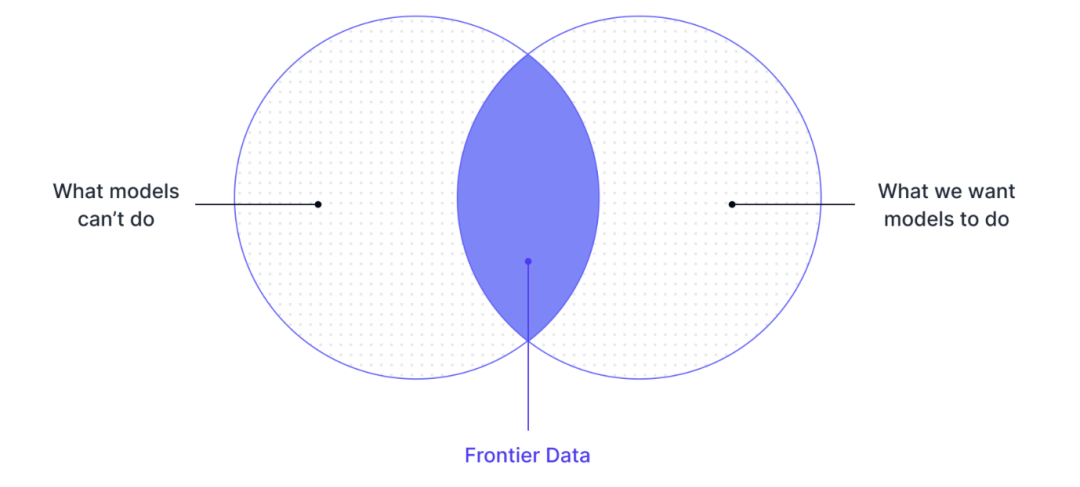
However, many overlook a crucial fact: the next generation of model capabilities will not be determined solely by computing power but by data.
Today, the most valuable data is no longer internet text but high-quality reasoning data (Reasoning Data) created by professionals such as doctors, lawyers, programmers, and researchers.
Whoever can organize these experts will control the most critical production resources for the next stage of AI.
As a result, a company that barely builds models or sells GPUs has grown from a recruitment startup into an AI unicorn with a valuation potentially reaching $20 billion in just two years.
It is Mercor.
01┃ Why Has Mercor's Valuation Surged 80x in Two Years?
Founded in 2023, Mercor was co-established by three young entrepreneurs who received the Thiel Fellowship.
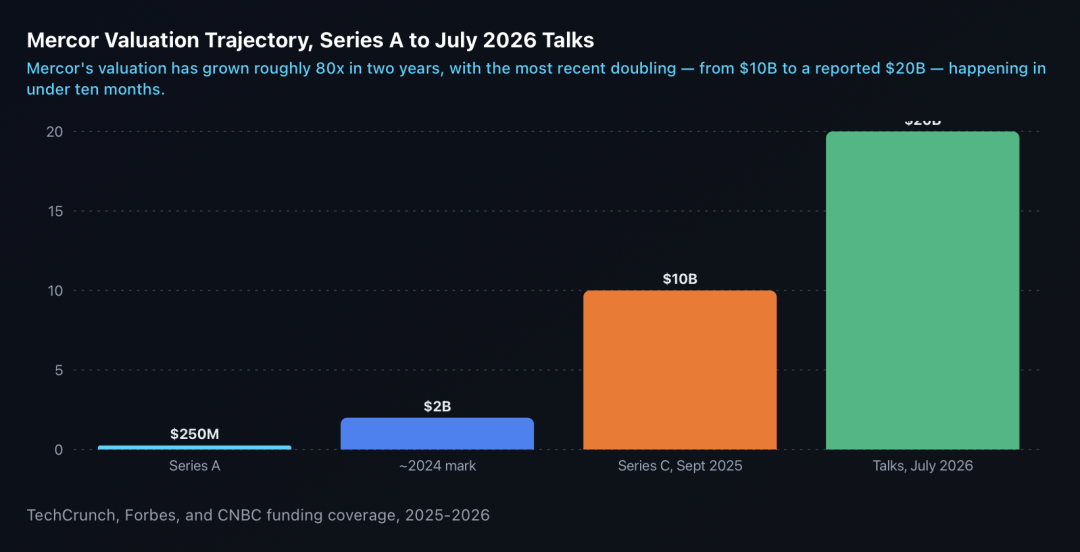
The company is currently in its latest funding round. Market sources indicate it plans to raise approximately $500 million at a target valuation of $20 billion. If completed, this would mean Mercor's valuation would double again in less than a year. Previously, the company secured $350 million in Series C funding in 2025 at a $10 billion valuation; earlier, its valuation was merely around $250 million. In just two years, its valuation has grown nearly 80x.
Even more astonishing is its business growth rate.
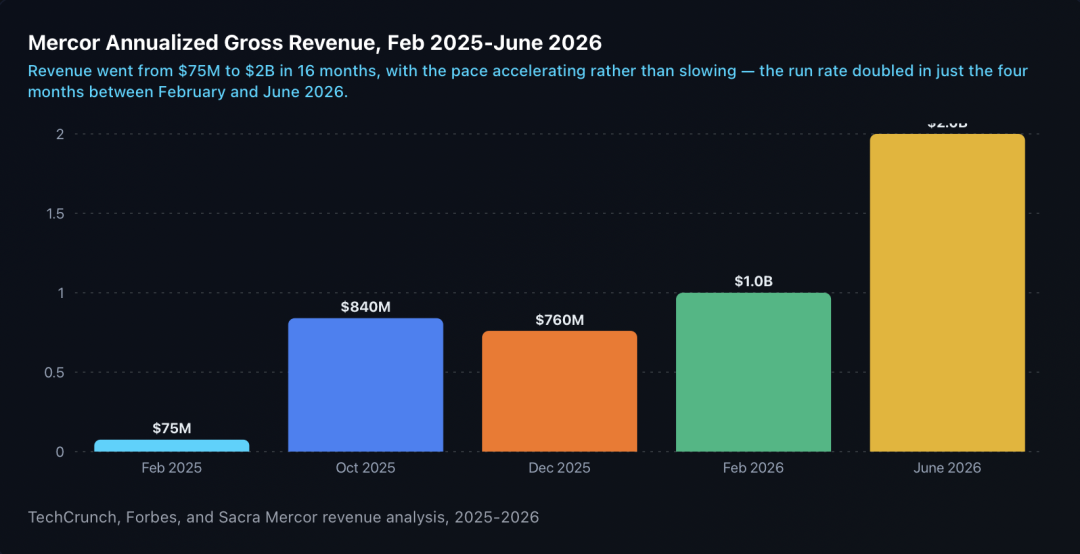
In June 2026, the company disclosed that its annualized revenue had surpassed $2 billion, doubling again compared to four months prior.
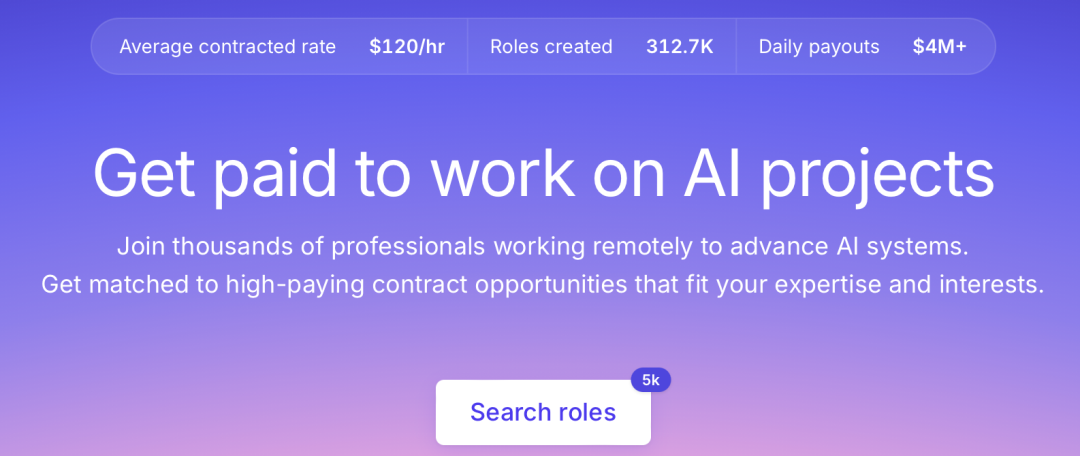
Today, Mercor boasts over 30,000 professional experts, paying out more than $4 million daily in compensation, making it one of the world's largest AI expert data platforms.
Its investor lineup is equally impressive, including top Silicon Valley funds like Benchmark, General Catalyst, Felicis Ventures, and Robinhood Ventures. As the company enters a new funding round, Mercor has become one of the most closely watched AI infrastructure projects in the primary market.
02┃ Mercor Does More Than Just Recruitment
Many initially mistake Mercor for an AI recruitment company.
In fact, recruitment was merely its initial entry point.
What Mercor truly does is build a bilateral marketplace connecting top global professionals with AI labs.
As large models enter the post-training era, relying solely on internet data can no longer continuously improve (continuously improve) model capabilities. Increasingly, models depend on professionals like doctors, lawyers, financial analysts, and software engineers to evaluate, correct, score, and guide reasoning for model outputs.
These tasks are not traditional data labeling but core training data that directly determines model expertise.
Mercor provides precisely such a high-quality expert supply system.
AI companies submit requests, and Mercor rapidly matches global experts using its AI interview and screening system. These experts then continuously participate in model training, evaluation, and reinforcement learning.
In other words, Mercor is not a recruitment platform but is constructing the talent infrastructure for the AI world.
03┃ How Does Mercor Make Money?
Mercor's business model is straightforward yet highly scalable.
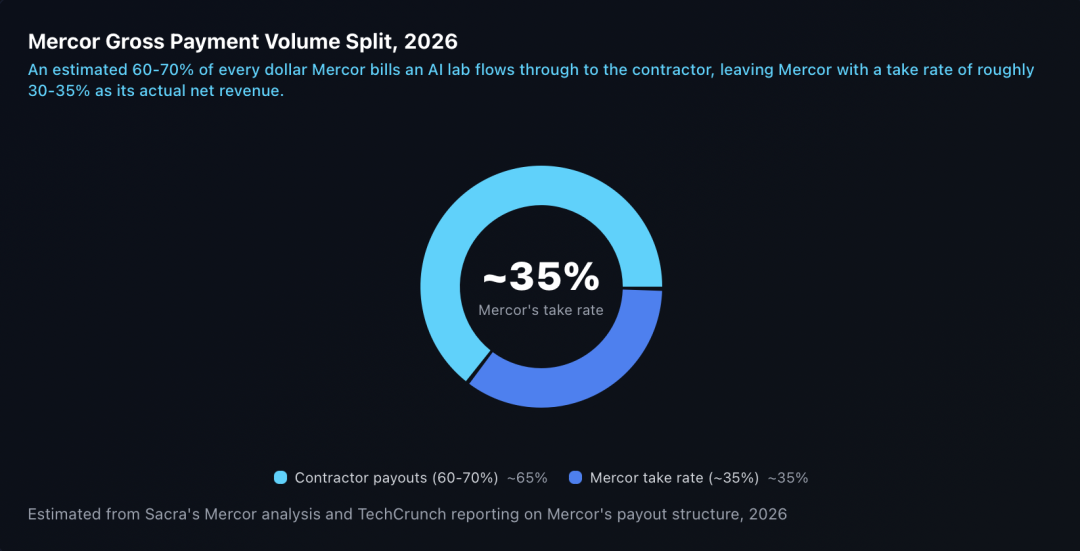
AI labs purchase professional talent services from the platform on an hourly basis, with Mercor collecting a platform service fee from each transaction. Industry estimates suggest its platform commission rate is approximately 30%–35%.
For example, if an AI company hires a medical expert for model training at $150 per hour, Mercor pays the expert around $95, retaining the remainder as platform revenue.
Thus, Mercor's reported $2 billion ARR essentially represents the platform's annualized transaction volume (Gross Payment Volume) rather than traditional SaaS revenue.
At an estimated 30% platform commission, the company's actual annualized revenue has reached approximately $600 million—an astonishing figure for a two-year-old startup. Unlike traditional headhunters requiring extensive manual operations, Mercor leverages AI to automate expert screening, capability assessment, and project matching, significantly reducing delivery costs and enabling rapid platform expansion.
This model resembles bilateral platforms like Uber and Airbnb more than traditional software companies.
04┃ Why Are AI Companies Increasingly Reliant on Mercor?
Traditionally, large models relied on publicly available internet text for pre-training. However, as high-quality internet data becomes depleted, the industry enters the post-training era.
What truly continues to enhance model capabilities is no longer more web pages but expert knowledge.
Doctors can judge medical diagnoses, lawyers can assess legal analysis rigor, senior programmers can evaluate code quality, and researchers can help models understand complex scientific problems. These professional judgments cannot be learned from web text alone.
Consequently, AI labs are Large scale procurement (massively procuring) professional talent.
Mercor stands at the center of this trend. It does not help companies hire employees but assists OpenAI, Anthropic, and others in continuously acquiring the human expertise needed to train next-generation models. As model capabilities penetrate deeper into professional domains, Mercor's expert network will continue expanding, creating increasingly strong network effects for the platform.
05┃ Why Can Mercor Quickly Establish Barriers?
Theoretically, anyone could build an expert database; the real challenge lies in efficiently verifying expert capabilities and continuously matching global supply and demand at scale.
From its inception, Mercor integrated AI into its entire screening process: the platform uses AI to automate expert interviews, resume analysis, skill assessment, and project matching, dramatically shortening traditional recruitment cycles.
Meanwhile, as more AI companies post projects through Mercor, the platform accumulates vast data on expert capabilities, project performance, and training outcomes.
This data continuously optimizes platform matching efficiency, making it increasingly difficult for latecomers to replicate.
For AI companies, speed is paramount. A model firm might need hundreds of professionals with specialized backgrounds within days for training—a task nearly impossible for traditional headhunters.
Mercor has built not just an expert list but an infrastructure capable of consistently, rapidly, and high-quality delivering expert capabilities.
06┃ Why Do Investors Keep Doubling Down?
Mercor's growth rate essentially reflects structural changes in AI industry demand.
In recent years, capital primarily focused on models themselves. Today, more investors recognize that the bottleneck limiting AI capability advancement is no longer models but high-quality expert data.
Mercor occupies this critical node. Unlike single AI applications, it serves nearly all leading AI labs. As OpenAI, Anthropic, Google DeepMind, xAI, and others increase post-training investments, demand for expert data will continue expanding.
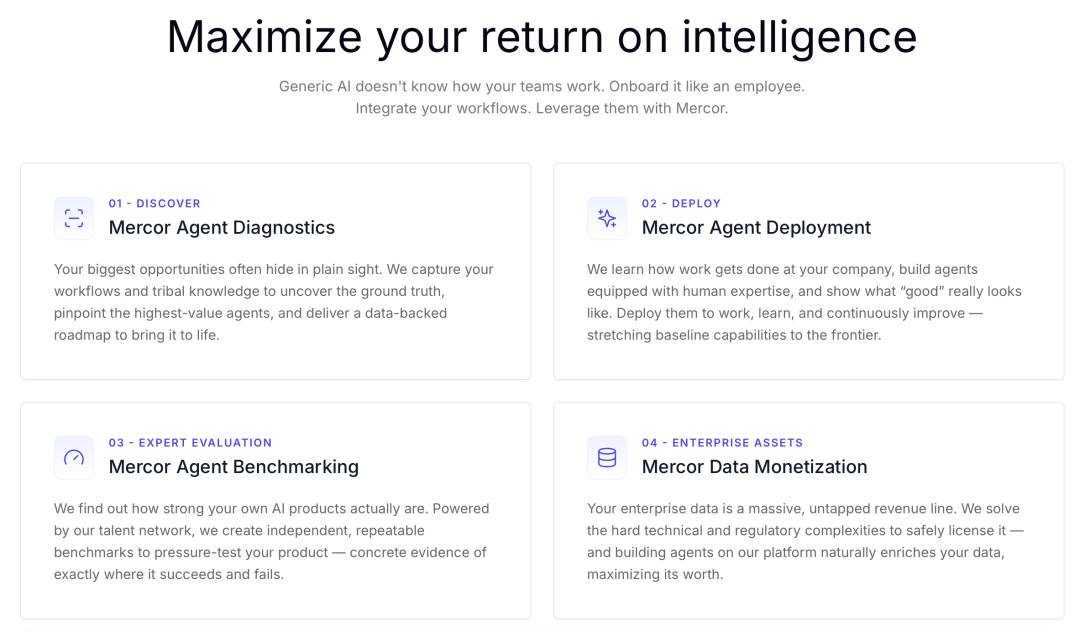
Simultaneously, Mercor has begun evolving from a mere talent platform into a comprehensive AI data production infrastructure. Recently, the company announced its acquisition of AI Agent training firm Deeptune, further enhancing its AI data production capabilities and revealing its long-term strategy to build a complete AI data supply chain.
For investors, this suggests Mercor is not merely a short-term beneficiary of AI hype but has the potential to grow into a new infrastructure platform for the AI era.
07┃ What Truly Makes Mercor Noteworthy
Many see Mercor as merely bringing recruitment into the AI era, but what truly attracts capital is not the recruitment business itself but its position at the AI industry's core.
In the coming years, AI competition will likely shift from model capabilities to high-quality data, professional expertise, and continuous optimization capabilities. Mercor is becoming the most crucial bridge connecting global experts with AI models.
It neither trains models nor produces chips but controls an increasingly vital resource for future AI development: human expertise. As AI penetrates medical, legal, financial, research, and other professional fields, demand for high-quality expert data will only grow.
Conclusion┃ The Next AI Competition Is About Knowledge, Not Just Models
In the coming years, the more critical question may become: Who can continuously access the highest-quality human knowledge?
Mercor's value lies not in developing new models but in building a new infrastructure connecting global professionals with AI.
If GPUs represent AI's computing power and data centers its factories, then companies like Mercor are becoming the knowledge supply chain for the AI world.
This is why more top-tier investment firms are willing to keep betting on this company.
Beta Fund is an early-stage investment institution deeply rooted in Silicon Valley, focusing on the most groundbreaking innovation directions in the AI era, including Agentic AI, AI Native Systems, and AI-driven vertical applications.
Author's Note: Personal views, for reference only
-
![]()
High-End Scientific Instrument Leader Surges 400% on Debut, Lists on STAR Market, Supplies BYD/CATL
-
![]()
Valuation Surges 80x in Two Years, ARR Exceeds $2 Billion: Why Mercor Has Become One of the Most Profitable Platforms in the AI Era?
-
![]()
Can Fuel-Driven Cars Also Embrace NOA? The 2027 Arrizo 8PRO Makes Intelligent Driving More Affordable
-
![]()
Array Waveguide Heats Up, SRG Expands Production, VHG Launches: The Competition for Optical Waveguides Enters a New Phase in 2026
-
![]()
ByteDance's AI Ambitions: 12% Tax, No Distillation, Betting on 5 Trillion Parameters
-
![]()
Can VIVO's Four-Pronged Strategy Ease Competitive 'Pressure'?
-
![]()
Can VIVO's Four-Pronged Approach Ease Competitive 'Anxiety'?
-
![]()
Reversal! Apple's Major iPhone Redesign for 20th Anniversary Not Cancelled: New Glass Design to Debut in 2027