Zuckerberg's Concerns About Superintelligence: Who Holds the Power When the Technology Arrives?
 08/12 2026
 505
505
A Public Proposition on the Attribution of Technological Power
Compiled by Xiaobiga
Edited by Shanzi
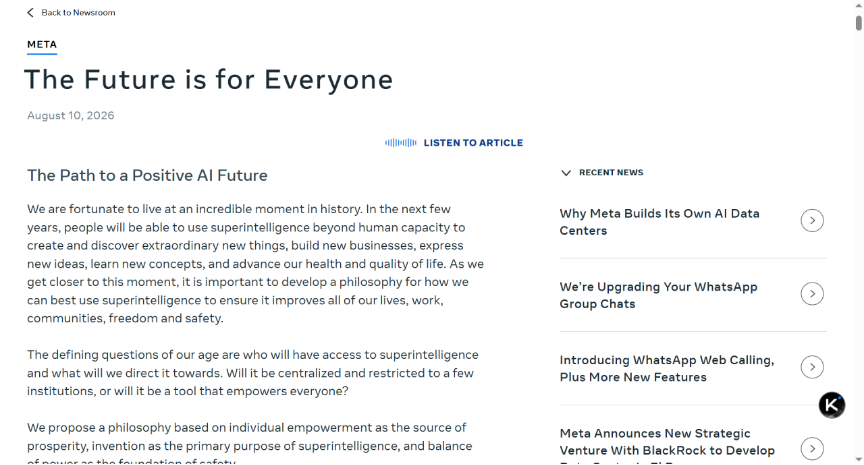
On August 10, Mark Zuckerberg, CEO of Meta, published a nearly 6,500-word article titled 'The Future is for Everyone' on the official website. On the same day, Meta open-sourced the locally runnable model Muse Glimmer and announced the upcoming release of open weights for Muse Spark 1.2.
The core proposition of this letter is focused: superintelligence should not be concentrated in the hands of a few institutions but should be distributed to individuals.
Zuckerberg summarized this into three principles—personal empowerment is the source of prosperity, invention is the primary purpose of superintelligence, and balance of power is the foundation of safety. He predicts that within the next few years, people will have access to superintelligence that surpasses human capabilities; the real question is not 'will the technology arrive' but 'who will hold the power when it does.'

Philosophical Starting Point: Personal Empowerment, Invention, and Balance of Power
Zuckerberg bases his argument on an optimistic historical judgment: every technological transition in humanity has sparked fears of 'being left behind,' but the result has always been more people sharing in prosperity and freedom; AI will follow suit, with future abundance accessible to all. Freedom, open inquiry, free enterprise, and equal opportunity are the values he upholds. He specifically cites the examples of the Wright brothers, Faraday, and early personal computer pioneers to illustrate that breakthrough ideas rarely come from established institutions and that when everyone gains access to stronger tools, they are better equipped to shape the future, not weaker.
This leads to a direct rebuttal of mainstream AI safety narratives. The conventional view holds that the risk lies in creating a 'single benevolent superintelligence' aligned with human values. Zuckerberg argues that this premise is fundamentally flawed: human society is not a single culture, and no technological solution can align with conflicting values simultaneously; a superintelligence designed and controlled by a few institutions will inevitably favor certain groups in its value trade-offs. He thus asserts, 'There is no single benevolent superintelligence.'
His alternative framework is the 'balance of power'—just as Western democratic systems rely on competition and checks to prevent absolute power, the risks of superintelligence should also be mitigated by enabling more entities to possess it and check each other, rather than through capability restrictions. To illustrate the dangers of centralization, he provides three comparisons:
Superintelligent Lawyers: If only one party possesses them, it creates judicial asymmetry in court; if everyone has them, the gaps in ability and resources in litigation are leveled, making justice fairer and more efficient.
Cybersecurity: If only one party holds offensive and defensive capabilities, the world becomes less secure; if defenders universally possess the tools, the entire digital system will be reinforced more quickly.
Business Competition: If only one company possesses it, the market is stifled; if everyone can use it, everyone can create new things that are impossible today, making the economy more vibrant.
Building on this, he clarifies Meta's self-positioning: among the few companies, Meta is primarily targeting 'personal superintelligence'; most other labs focus on building AI for businesses, governments, or institutions. If they lead, the balance of power will shift toward large institutions, whereas Meta has, since its inception, made it its mission to 'put power in the hands of everyone.'
The Form of Personal Superintelligence: Six Scenarios and Employment Restructuring
Following the logic of 'distribution,' the product form naturally emerges: AI will evolve from chatbots answering questions to personal agents that understand users over the long term and act on their behalf.
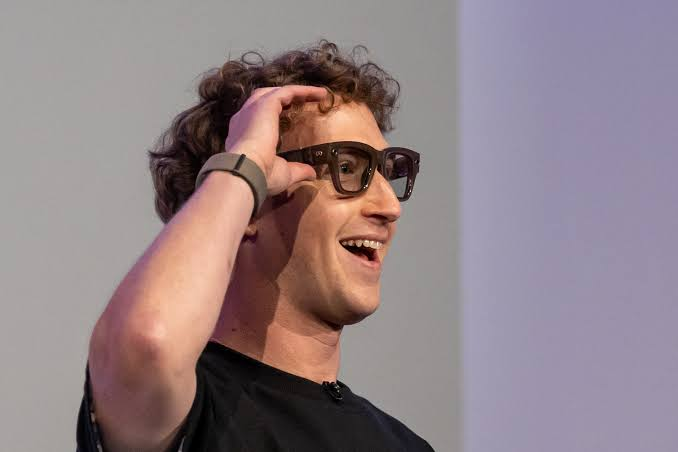
Zuckerberg describes it as understanding your goals and concerns, working 24/7, offering strong privacy options akin to WhatsApp's end-to-end encryption, and conversing with you through any device—including smart glasses. He shares examples from his own use: the agent flags interesting information, assists in prototyping ideas, monitors sleep and training feedback for health maintenance; his 8-year-old daughter loves baking, and the agent generates customized recipes every weekend, helps place orders, and offers baking advice.
The open letter elaborates on the specific connotations of 'personal superintelligence' through six scenarios:
All-Around Assistant: Covers interpersonal, health, career, financial, family, and hobby needs;
Creative Tool: His daughter writes code and generates videos from ideas in the evenings, tasks that would have taken him months or been impossible before; now, they even design robots together; Meta researchers use AI to generate crystal structures for AR glasses, and engineers write new applications in a fraction of the time;
Entrepreneurial Tool: Individuals can implement ideas without needing financing or large teams, steering the economy toward 'entrepreneurialization';
Personalized Tutor: Everyone has a 'Ph.D.-level and infinitely patient' tutor for every subject, and adults can also have personalized learning assistants;
Scientific Progress: Taking Biohub's openly sourced virtual cell and protein models as examples, ordinary people can also participate in scientific discovery; Zuckerberg and his wife Priscilla aim to cure or prevent all diseases within this century, and AI makes this day 'likely to come much sooner';
Accessibility: A free version reaches billions, with additional computing power acquired at the lowest possible price through a 'dynamic auction mechanism.'
On the employment front, his judgment contradicts mainstream concerns: the greatest contribution of superintelligence is 'invention' rather than automation. Human needs are infinite, and the economy will naturally balance automation with personal capability growth; there is no law stating that AI must necessarily grow faster than personal capabilities, and recent statistics even show that personal capabilities can match or surpass automation.
He provides historical parallels: about 90% of people farmed before the Industrial Revolution, and technology freed them to pursue other endeavors; a generation ago, careers in app development, social media creation, electric vehicle technology, or data center operations did not exist, while near-future roles like 'solo product studios,' 'world builders,' and 'personal biologists' will emerge. Business scales may shrink, but the total number of jobs may not decrease, with small businesses remaining the backbone of the economy—only with individuals wielding greater influence.
Risk Governance: From Cybersecurity to Biology and Freedom
Zuckerberg acknowledges that new technologies bring new risks but opposes reducing risks to the simplistic notion that 'technology needs to be centrally controlled.'
In cybersecurity, his logic is: in a free society, individuals also hold double-edged tools, but law enforcement and the military possess stronger weapons and intelligence capabilities; the key is to empower defenders with greater computing power and more intelligence from the same models to enhance overall societal safety. He argues that widely open-sourced systems are safer—more people can discover vulnerabilities and improve the system; the long-term answer is not withholding capabilities but widespread distribution and establishing balance.
Biological risks are discussed separately: the same capabilities can create medicines or synthesize harmful compounds, but historical precedents of such abuse are rare—despite the ability to synthesize harmful substances for decades, it has seldom become a real issue, partly due to a lack of motives like cyberattacks or financial gain; if harmful cases emerge, strategies can be adjusted. He suggests that laboratories should reduce model risks, while governments should restrict the physical production and circulation of dangerous substances and accelerate new drug approval processes.
At the level of freedom, he emphasizes 'preventing government tyranny': superintelligence must primarily empower individuals, with privacy as a foundation—in 'fully private mode,' even Meta or service providers cannot view or authorize access to user information, akin to WhatsApp encryption; governments also need law enforcement tools, but these should be achieved through deep collaboration between laboratories and governments, not by restricting individual capabilities. He also proposes a new approach to 'personal alignment': agents are not instilled with a centralized set of values to prevent transgressions but share the user's own goals and values (except for legal and safety boundaries), and users can opt out if they do not trust them.
As a counterpoint, he cites a centralized alignment failure: a leading model refused to help a user draft a letter to their parents because it deemed standardized tests immoral—this exemplifies the problem of imposing a single institution's value judgments on others.
Infrastructure and Community Covenants
As competition enters the infrastructure phase, energy consumption, water usage, and environmental controversies surrounding data centers rise. Zuckerberg proposes a 'community covenant': every project must significantly benefit the local area—through high-paying local jobs, investments in schools and public services, no electricity price hikes, proper environmental treatment, and tax revenue funneled back into public services like teachers, police, and firefighters.
Supporting measures include establishing a 'Future Belongs to Everyone Fund' to directly support every community hosting a data center. He cites Richland Parish, Louisiana, as an example: due to tax revenue growth from Meta's investment, local teachers received $50,000 bonuses this year, and teachers from other states are moving in; he believes it will become one of the best school districts in the country. To alleviate shortages of skilled workers, Meta founded the 'American Workforce Academy,' offering free training for carpenters, electricians, construction workers, etc., and guarantees high-paying jobs at data center locations.
In energy, Meta states it will build its own power generation facilities, ensuring no displacement of local energy and sometimes even feeding surplus low-cost electricity back to the community; data centers are designed to be 'among the most water-efficient globally,' with a commitment to achieving 'net positive water' by 2030—restoring more water in operating watersheds than is withdrawn, with a 200% restoration target in high-water-stress areas. Regarding government-business collaboration, he suggests that frontier labs should not wait until model training is complete before submitting to government review but should provide 'intermediate training checkpoints' and technical personnel during training to allow governments to reinforce critical systems and identify safety hazards in advance.
Defending 'Distillation' Practices and Warning Against Chinese AI Overtaking
Open source forms the second pillar of the entire letter and is the most visible divergence from closed-source approaches.
Zuckerberg clarifies that Meta strongly supports open-source AI and will 'soon resume releasing some open-source models,' with Muse Glimmer (locally runnable) and the upcoming open weights for Muse Spark 1.2, revealed on the same day as the article, serving as signals. His logic is: the more people access models, the more entities can discover vulnerabilities and improve systems; if superintelligence remains closed (closed) to a few institutions, society will lack checks and balances. He cites a recent case where HuggingFace repaired a security incident using widely available open-source models.
He actively defends 'distillation,' opposing its simplification as intellectual property infringement and advocating that the principle of 'learning from anything observable' must be preserved, lest it weaken U.S. competitiveness. He frames this as a struggle for leadership in the open-source ecosystem: if the U.S. self-limits due to training data restrictions, open-source models from China and other countries may overtake it.
At the infrastructure level, he points out that while the U.S. leads in chip design, it lags in energy and physical construction speed—for example, China 'brings online more than 1GW of nuclear capacity every other week'; thus, the U.S. must accelerate both energy and data center construction while maintaining export controls on chips to slow down competitors. His judgment is blunt: AI may be the most fiercely competitive industry in history, with innovations absorbed within months; maintaining a two-month lead is highly valuable, and any policy delaying model releases by a month could significantly jeopardize leadership.
Governance and 'ultimate control' are placed in the final ring.
Zuckerberg acknowledges that having a CEO personally decide on superintelligence deployment is not optimal, so he establishes a new mechanism: an independent board responsible for approving safety standards for model releases and reviewing each release, while advocating that other labs follow suit to form industry-wide governance. Regarding existential risks, he argues that a healthy balance is not having a single centralized superintelligence but many individuals and enterprises possessing intelligences with diverse goals that check each other; the most dangerous path is a lab training a powerful model and keeping it for itself, forming an unchecked single intelligence.
The most hardcore technical judgment lies in recursive self-improvement: once AI can autonomously optimize itself, systems focused on efficiency gains could theoretically increase 'intelligence output per gigawatt' by 100 times or more; a self-improving AI occupying only a small fraction of global computing power could acquire effective intelligence surpassing the rest combined.
His bottom line is: the vast majority of intelligence must be human-directed and serve human goals; relevant entities must jointly build a sufficiently large computing power base—allocating some computing power for self-optimization to remain competitive while directing a significant majority toward personal goals. In policy terms, he summarizes this as four points: Meta will focus on delivering personal superintelligence to billions and small businesses; open source is a positive force preventing centralization; independent governance is indispensable; government policies are necessary but must collaborate closely with industry and not slow U.S. competitiveness.
Conclusion: A Public Proposition on the Attribution of Technological Power
Viewing this open letter within the context of Meta's development trajectory, its core extends beyond mere technological pathways; rather, it represents a systematic statement on 'the attribution of power in the era of superintelligence.' Personal superintelligence, open models, smart glasses, and substantial investments in computing power are all woven into a single narrative: the focus of competition is shifting from 'how powerful the model is' to 'who secures the most enduring and intimate relationship between humans and AI.' For Meta, this continues its product philosophy of 'empowering individuals' that has been present since the social networking era, and it also represents an opportunity to break free from reliance on third-party operating systems and reclaim control over entry points.
Zuckerberg writes at the end of the letter that developing superintelligence will be the most profound technological advancement we witness in our lifetimes.
Thus, this letter can be interpreted as a proposition: the value of superintelligence lies not in being controlled by a few, but in being widely distributed; its risks stem not only from its capabilities but also from the concentration of those capabilities. Regardless of whether Meta ultimately achieves this vision, it has woven 'open-source, inclusivity, infrastructure, and governance' into a public discourse on how technological power should be distributed—and the validity of this discourse ultimately depends on the real-world evolution of model capabilities, computing power supply, and platform control.
Original source: Meta official website (meta.com/thefutureisforeveryone/).
-
![]()
A Week with QianWen Office: The Highs and Lows
-
![]()
It's Time to Invest in China's Auto Industry
-
![]()
An AI Position with an Annual Salary of 1.7 Million Yuan Suddenly Becomes Highly Sought-After
-
![]()
Chevrolet and Skoda Exit China Before Mazda and Peugeot-Citroen
-
![]()
Zuckerberg's Concerns About Superintelligence: Who Holds the Power When the Technology Arrives?
-
![]()
Auto Scene Competition in Full Swing
-
![]()
Just Hit with a $1.4 Trillion Lawsuit, Meta Open-Sources Its 30B "Pocket Rocket" Overnight: Zuckerberg Calls Out DeepSeek, Qwen, Kimi
-
![]()
Samsung Z Fold 8 Ultra Review: A $2,100 Foldable Flagship—What Justifies the Price?