It's Time to Invest in China's Auto Industry
 08/12 2026
 505
505
Amid the wave of global capital accelerating its allocation to Chinese assets, the automotive manufacturing sector is transforming from an 'optional track' to a 'must-have allocation.'
In 2026, uncertainty will remain the dominant theme in the global economy. Amid the combined disruptions of major power rivalries, geopolitical conflicts, policy divergences, high debt levels, and technological transformations, a growing number of global investors are turning their attention to China. At the Shenzhen Stock Exchange's 2026 Global Investors Conference held not long ago, Liu Haoling, Vice Chairman of the China Securities Regulatory Commission, shared that foreign capital has steadily flowed into China's stock market through various channels this year. To date, various types of foreign investors hold over RMB 4 trillion in market value of tradable A-shares, making them significant participants in China's capital market.
Amid this wave of global capital accelerating its allocation to Chinese assets, the automotive manufacturing sector is transforming from an 'optional track' to a 'must-have allocation.' En Xuehai, Chairman of China Asset Management Solutions at J.P. Morgan Asset Management, stated that the comprehensive optimization of the industrial structure and the vigorous rise of emerging sectors are fundamentally reshaping global investors' valuation perceptions and investment allocation logic regarding Chinese assets. Today, a wealth of high-quality new investment opportunities has emerged in emerging fields such as artificial intelligence, cutting-edge technologies, and new energy vehicles, propelling China's transformation from a traditional manufacturing powerhouse into a core benchmark for global emerging industry development.
Global Capital Floods into China
Several recent data points indicate a significant increase in foreign capital's willingness to allocate to Chinese assets. Wind data shows that in the first quarter, QFIIs were among the top ten shareholders in 1,522 A-share companies, with a combined market value of holdings exceeding RMB 200 billion, a notable increase from the end of 2025. Since the beginning of the year, over 500 foreign institutions have conducted more than 3,200 research visits to A-share listed companies, with 10 institutions exceeding 50 visits each. UBS data reveals that foreign institutions' allocation to Chinese stocks remained stable for the third consecutive quarter in the first quarter, with Asian-mandated funds further increasing their overweight positions and global-mandated funds also slightly increasing their holdings of Chinese stocks.
Fang Dongming, Head of China at UBS Global Financial Markets, stated that despite uncertainties such as geopolitical factors, China's stock and bond markets, as well as the RMB assets, have demonstrated resilience, becoming important 'safe havens' for global assets. As En Xuehai put it, 'China has seen a surge of emerging technologies, with many new stories and possibilities. J.P. Morgan is very bullish on China and will remain anchored here for the long term to explore more market opportunities.' The automotive sector is one of the hot investment tracks where capital is heavily focused.
A previous annual report by Invesco Asset Management pointed out that over the next five years, the proportion of sovereign wealth funds considering China a high or medium priority for allocation will jump from 44% in 2024 to 59%. This survey covered 83 sovereign wealth funds and 58 central banks worldwide, managing approximately USD 27 trillion in assets collectively. Invesco noted that the renewed interest from sovereign funds in China reflects a more cautious and focused strategy, indicating 'a more thoughtful, industry-specific investment approach targeting sectors poised to achieve global leadership with the support of China's market momentum and strategic policies.' Highly favored areas include semiconductors, cloud computing, artificial intelligence, electric vehicles, and renewable energy infrastructure. Invesco cited the view of a Middle Eastern sovereign wealth fund, stating that China will dominate the solar, wind, electric vehicle, and battery markets in the coming decades.
The report highlighted that in early 2025, progress made by AI startup DeepSeek ignited investment enthusiasm in tech stocks, with this optimism subsequently spreading to other sectors such as robotics, biotechnology, and electric vehicles. In Invesco's survey, approximately 78% of respondents expected China's technology and innovation sectors to become globally competitive. In fact, in April this year, KKR's Global Macro and Asset Allocation team visited China, including stops in Beijing and Hong Kong, to engage with companies across various industries such as automotive, robotics, and consumer services.
Notably, Gulf capital has become more enthusiastic and proactive toward China's capital market. Sovereign wealth funds from the UAE, Saudi Arabia, Qatar, and other countries are no longer satisfied with passively allocating to Chinese assets through international indices. Instead, they are directly participating in equity financings, private placements, and long-term shareholdings of leading Chinese companies as cornerstone investors, strategic shareholders, and industrial partners. Media reports, based on CSRC data, reveal that as of the end of May 2026, the number of Qualified Foreign Institutional Investors had reached 981, with 50 new additions in the first five months of 2026—a record high for the same period. Among them, eight are from the Middle East. Earlier this year, foreign media reported that the Saudi Arabian Public Investment Fund (PIF) had completed the registration of its Shanghai office, which officially commenced operations this year. To date, PIF's investments in China have exceeded USD 22 billion, focusing on areas such as sustainable development, technology, automotive, and healthcare, encompassing both primary market equity investments and secondary market asset allocations. Industry insiders believe that for China's capital market, Gulf capital is becoming another significant source of long-term incremental capital following northbound funds. For Gulf countries, China represents a core target market for technology acquisition, industrial upgrading, and asset diversification in their 'post-oil era' transformation.
China's Entire Automotive Industry Chain Attracts Favor
As global capital redraws its investment map, China's automotive industry is entering the core circle, with sovereign wealth funds, international asset management giants, and industrial capital competing to invest. It should be emphasized that this investment boom is not mere speculation but a long-term allocation behavior based on the restructuring of industrial fundamentals. Investment covers the entire automotive industry chain, including new energy vehicles, intelligent driving, and core components, painting a new picture of global capital layout (Chinese term meaning 'strategic deployment') in China's automotive sector.
In April, CATL announced a share placement to raise funds. The announcement revealed that CATL plans to offer 62.385 million new H-shares at a placement price of HKD 628.20 per share, aiming to raise approximately HKD 39.19 billion. The funds will be used for global new energy project construction and zero-carbon business layout (strategic deployment), R&D investment, supplementary daily operating funds, and other general corporate purposes. Media sources cited insiders as saying that over 150 institutions participated in the subscription for CATL's H-share placement, including Norges Bank Investment Management (NBIM), Hillhouse Investment, hedge funds, sovereign wealth funds, and existing shareholders.
If CATL's ability to attract global capital is expected, then Zero One Motors, still in the early stages of commercialization, quickly gaining investor favor directly proves the unique charm and value proposition of China's automotive industry chain. In March, the new energy intelligent heavy-truck company Zero One Motors completed a new round of RMB 1.2 billion in financing, co-led by Puquan Capital, Momenta, and NIO Capital, with participation from Anhui Lingtong Group, Fangguang Investment, Temasek-backed InnoVen Capital, Joy Capital, Shenneng Chengyi, and Blue Lake Capital, as well as follow-on investments from existing shareholder Huoshui Capital. On May 26, Zero One Motors announced the completion of a USD 200 million Series B2 financing, with investors including Zijin Mining, Yankuang Capital under Shandong Energy Group, Sanhua Holding Group, Temasek, and InnoVen Capital, among over ten industrial and institutional capital sources.
It is worth mentioning that DeepWay, another player in the new energy heavy-truck sector, announced in April the completion of a Pre-IPO round exceeding USD 310 million, led by UAE-based Leishi Capital, with follow-on investments from foreign investors such as Australia's NGSSuper and Singapore's ABC Impact. This marks the first time Middle Eastern capital has invested in the domestic heavy-truck autonomous driving sector.
Beyond the new energy vehicle sector, intelligent connected vehicle technology is also a focal point for global capital increasing its layout (strategic deployment) in China's automotive industry. On June 15 this year, Haoen Automotive Electronics, a provider of intelligent driving perception systems, officially listed approximately 9.4127 million A-shares issued to specific investors on the Shenzhen Stock Exchange. The private placement attracted 17 investors to participate in the subscription, with 13 ultimately allocated shares, including international investment banks, public funds, securities firm asset management, industrial capital, and renowned individual investors. UBS, Caitong Fund Management Co., Ltd., Nord Fund Management Co., Ltd., Hua'an Securities Asset Management Co., Ltd., and Shenzhen Zhongke Bluecom Technology Co., Ltd. were among the subscribers.
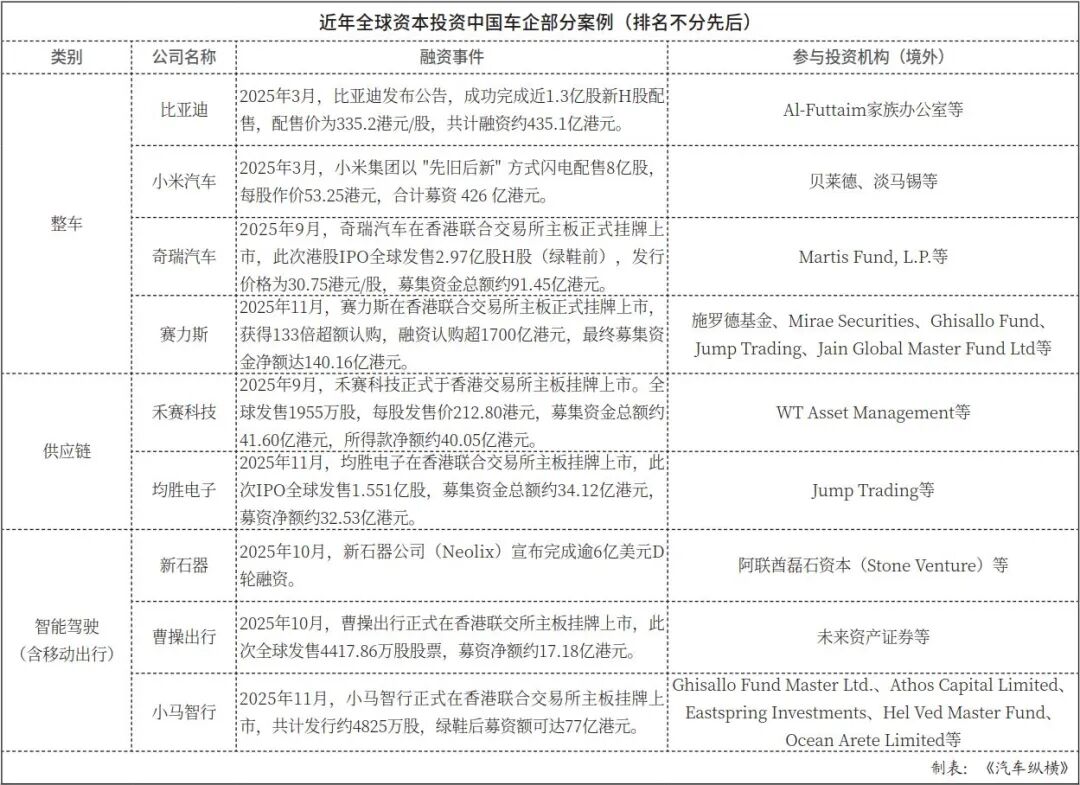
In addition to the aforementioned cases, foreign capital has frequently appeared in the financing lists of companies across China's automotive industry chain in recent years, such as multiple automakers' Hong Kong IPOs and traditional automakers' placement of new shares last year (see table for details).
Multiple Advantages Create a Capital 'Gravitational Field'
The primary reason global capital views China's automotive industry as a key allocation area lies in the superposition (superposition) of multiple advantageous factors. China's vast automotive market continues to release its advantages, providing rich commercialization scenarios and massive data support for technological innovation. Meanwhile, China has built the world's most complete automotive industry ecosystem, enabling the entire process from technology verification to large-scale production to be completed at lower costs and faster speeds. Coupled with Chinese companies' innovation speed and cost control capabilities, which are highly valued by global capital for their returns, China's automotive industry is transitioning from a 'follower' to a 'leader' while providing clear value anchors for long-term investments worldwide.
China is the world's largest single automotive market and manufacturing base. According to data released by the China Association of Automobile Manufacturers, in 2025, China's automobile production and sales reached 34.531 million and 34.40 million units, respectively, maintaining the top global position for the 17th consecutive year. Among them, new energy vehicle sales reached 16.49 million units, securing the top global spot for the 11th consecutive year. From January to May this year, cumulative sales of new energy passenger vehicles in China reached 1.577 million units, up 14.8% year-on-year, maintaining a high growth trajectory. For investors, a vast and stable consumer market means predictable demand across every link, from complete vehicles to supply chains. The market's enormous capacity provides Chinese companies with an unparalleled testing ground for technological iteration, cost allocation, and new model validation—effects that no other market can replicate. This market-driven industrial evolution speed represents the safety margin most valued by long-term capital.
If market size determines capital's 'willingness to enter,' then the completeness and resilience of the industrial chain determine whether capital 'dares to go all-in.' China boasts nearly the world's most complete new energy vehicle supply chain, ranging from lithium ore processing to battery manufacturing and vehicle integration. This cluster effect enables Chinese companies to complete the entire process from technology verification to large-scale production at lower coordination costs and faster response speeds, demonstrating high stability and self-repair capabilities—a compelling 'safety declaration' for long-term capital.
More importantly, China's automotive industry has transformed from a mere manufacturing base into a cradle of cutting-edge technologies. In May this year, the 'Ten-Year Development Report on Intellectual Property in the Automotive Industry' pointed out that China has consistently led the world in automotive patent disclosures over the past decade, far surpassing the United States, Japan, and Europe. Specifically, patent disclosures in the new energy vehicle sector grew from over 50,000 in 2016 to over 110,000 in 2025, with an average annual growth rate of 17.1%. Intelligent connected vehicle patents increased from 44,000 to 93,000, with an average annual growth rate of 11.6%. Chinese automotive companies' overseas patent layout (strategic deployment) now covers over 50 countries and regions.
In recent years, the continuous optimization of the Qualified Foreign Institutional Investor (QFII) system has significantly enhanced the ease of foreign capital's entry into China's capital market, with investment scopes expanding from early-stage stocks to a richer array of asset classes, including bonds, funds, futures, and derivatives. Luo Ronghua, Dean of the School of Finance and the China Institute of Finance at Southwestern University of Finance and Economics, stated in a media interview that the record-high number of QFIIs in the first five months of 2026 results from the combined effects of system optimization, improved risk management tools, asset attractiveness, and global capital allocation adjustments.
As Luo Ronghua put it, 'For foreign institutions themselves, the Chinese market is no longer a subsidiary allocation within emerging market portfolios but a major asset class requiring independent research, pricing, and risk control. The ability to understand China's macroeconomic cycles, industrial policies, corporate behaviors, and local investor structures will directly impact their global portfolio management capabilities.' The clarion call for global capital to increase its holdings in China's automotive industry has sounded. However, amid this enthusiasm, investors must promptly adjust their cognitive frameworks, delve deeply into the underlying logic of China's automotive industry chain development, and make informed predictions to seize era-defining opportunities while achieving higher and more stable long-term returns.

Image: From the Internet
Article: Auto Review
Layout: Auto Review
-
![]()
July Sees Record 65.1% Penetration Rate for New Energy Passenger Vehicles, Fueled by Robust Export Growth
-
![]()
After Three Months of Duan Jianjun Taking Over, Yu Kexin 'Goes Missing' as Top Sales Executive—Is Volvo's Core Management Facing Another Shake-Up?
-
![]()
Lexus Wants to Repeat Tesla's Playbook
-
![]()
Cars Priced at 50,000 Yuan Struggle in Sales, While Those Over 400,000 Yuan See High Demand
-
![]()
Analysis of BBA Reputation Index in July 2026: Service Issues Become a Common Problem
-
![]()
CATL Takes a Step Back, Li Auto Dives Deeper
-
![]()
Tencent's Chess Game in WorkBuddy
-
![]()
R&D Cycle Cut in Half Following Trends: Joint Venture Automakers Now Producing Quick-Turnaround Vehicles