An AI Position with an Annual Salary of 1.7 Million Yuan Suddenly Becomes Highly Sought-After
 08/12 2026
 519
519
Cover image | Produced by Pencil News
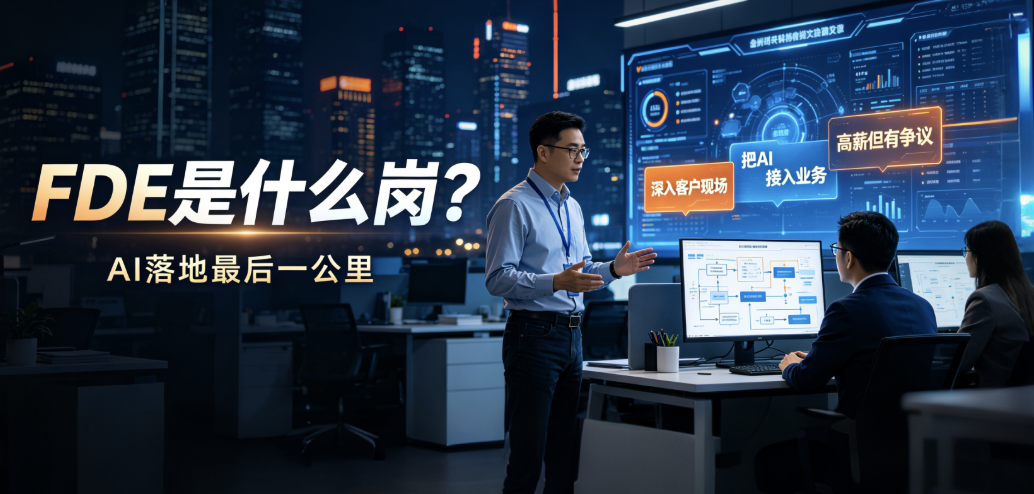
Recently, an AI position called FDE has suddenly become popular.
On recruitment platforms, ByteDance's "Doubao AI Large Model FDE" offers a maximum monthly salary of 70,000 yuan with 15 salaries a year; Ant Group's B-end FDE offers a maximum monthly salary of 60,000 yuan; and Zhipu AI's FDE leader offers a maximum monthly salary of 80,000 yuan.
In Silicon Valley, the median annual salary for FDE-related positions exceeds $250,000 (nearly 1.7 million yuan), with companies like OpenAI, Anthropic, and Salesforce heavily investing in this area.
FDE, which stands for Forward Deployed Engineer, refers to professionals who work on-site with clients to integrate AI technologies into enterprise business processes. They not only write code and build systems but also communicate with executives and employees to translate vague corporate demands like "we want to use AI" into actionable workflows.
However, this position is not without controversy. Some hail it as the most valuable new profession in the AI era, while others dismiss it as merely "high-end outsourcing."
- 01 - Newly Established with a Valuation of 94.5 Billion
The FDE role is not entirely new.
As early as around 2010, U.S. data company Palantir established this position. After securing contracts with military and intelligence agencies, Palantir dispatched engineers directly to client sites—even to frontlines in Iraq and Afghanistan. When soldiers reported "this road looks suspicious," engineers immediately transformed such insights into annotation tools on maps, with effective features later integrated back into the platform. To this day, roughly half of Palantir's employees serve in FDE roles.
So why has FDE suddenly become popular in 2026?
Zhan Bingqiang, founder of AIGCLINK, believes that "hype plays a significant role." He told Pencil News that FDEs have existed for years but were previously known by different names, such as "high-end outsourcing." There's even an industry joke: FDEs call themselves "high-end outsourcers," while OPCs (on-site project consultants) refer to themselves as "freelancers."
Yet behind the hype lies genuine demand.
The most critical factor is the AI industry's transition from "selling models" to "delivering results."
Over the past two years, enterprises have enthusiastically purchased AI models and agents, but many projects stalled at the demonstration stage, encountering obstacles when deployed in production—legacy systems couldn't connect, data was scattered across WeChat and Excel, executives couldn't articulate specific needs, and compliance and permission issues arose. While large models are standardized products, enterprises vary widely in their data, processes, and systems. Someone must bridge the "last mile" from demo to practical deployment.
A report by Ding Jiao mentioned an FDE named Lawted who visited a Shenzhen freight forwarding company and found dozens of employees repeatedly performing the same task: opening shipping PDFs sent via WeChat and email, extracting port and vessel schedule information, confirming details, and manually entering them into systems. Lawted automated the entire process using AI tools.
This exemplifies the value of FDEs. As Zhan Bingqiang puts it: "In the past, there was no clear identity for those implementing AI in enterprises. Now, FDEs provide a distinct role for professionals driving AI transformation in businesses."
Overseas giants have further fueled FDE's popularity.
In May 2026, OpenAI announced the establishment of The Deployment Company, valued at $14 billion (approximately 94.5 billion yuan), with initial funding exceeding $4 billion. It also acquired UK consulting firm Tomoro (with about 150 experienced FDEs) as the foundation of its deployment team.
Around the same time, Anthropic partnered with Blackstone and Goldman Sachs to launch a $1.5 billion joint venture for enterprise AI services, focusing on deployment in highly regulated sectors like finance and healthcare. Salesforce publicly recruited 1,000 FDEs for its Agentforce product line. AWS, the world's largest cloud computing company, planned to invest $1 billion to build a multi-thousand-strong FDE team.
Compared to industries like finance and internet, manufacturing—with thin profit margins and difficult transformations—represents the "main battlefield" where AI implementation offers the greatest efficiency gains and FDE value. Frontline FDEs in industrial manufacturing, construction engineering, and cross-border e-commerce have demonstrated that when enterprises witness tangible efficiency improvements, their attitudes shift from wait and see (wait-and-see) to actively seeking more AI transformations.
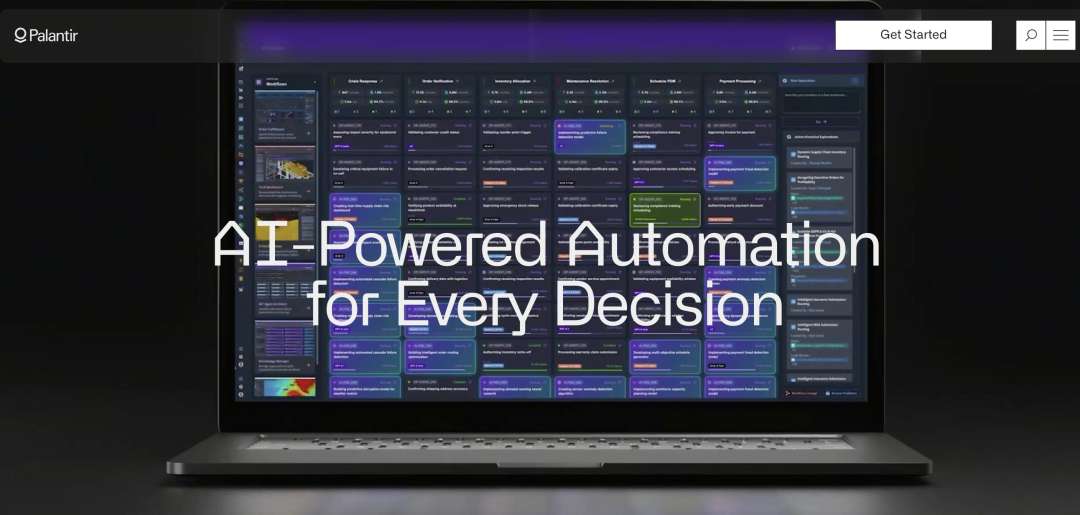
Palantir AIP product interface Source: gateex.com
Domestic policy support has also played a role. Beijing and other regions have incorporated concepts like OPC, FDE, and Token into relevant government initiatives, propelling the already-trending topic into mainstream discourse. Li Yachong, founder of Putao Teng Technology, observed: "Because there's genuine demand for AI implementation, the specific job title doesn't matter—the underlying logic is that enterprises will increase AI adoption. The name doesn't affect this demand itself."
The combination of two forces—enterprises' real pain points in AI deployment and capital and policy support—has transformed FDE from a niche engineering role into a widely discussed profession.
- 02 - New Opportunities for IT Outsourcing Companies
Zhan Bingqiang draws an analogy: If the previous information age was the agricultural era, then AI represents the industrial era. Today's FDEs are like "farmers operating harvesters."
In the past, writing software required ten people working for months; now, a small team armed with Claude, Codex, and AI agents might accomplish the same task.
"On-site development used to mean writing code manually; now, AI writes code or helps clients use AI," says Li Yachong. The essence remains unchanged, but the tools have evolved.
Indeed, when harvesters were still novel, operators who could use them were exceptionally valuable.
"But this window of opportunity is short—likely lasting only until the first half of next year before competition narrows," warns Zhan Bingqiang.
This creates an opening for traditional IT service providers. "FDE is the easiest direction for industry professionals to transition into," says Zhan.
Traditional IT outsourcers already interact with clients, understand project delivery, and are familiar with legacy enterprise systems. By acquiring AI skills and transitioning to FDE roles, they gain a more practical advantage than pure model researchers learning about factories, finance, or ERP systems from scratch.
Anthropic is taking this path to the extreme.

Claude by Anthropic Source: winbuzzer.com
In June, it announced a partnership with veteran IT service provider (IT service provider) DXC. DXC plans to train tens of thousands of Claude-certified FDEs and deploy them in banks, airlines, insurance companies, manufacturing firms, and government agencies.
DXC itself employs 115,000 people who have long managed critical systems for these clients. Before collaborating with Anthropic, DXC had already integrated Claude into developing its AI-native OASIS operations platform, with over 95% of the code generated by Claude.
The fact that 95% of code can now be generated by AI hasn't eliminated forward-thinking IT service companies. Instead, they're scaling up FDE training because clients never just buy code—they buy solutions.
Zhan Bingqiang highlights this as the most noteworthy shift in FDE's business model.
Traditional outsourcing favored "selling manpower"—charging for ten people over six months. Future FDEs may adopt two distinct pricing models.
The first involves deploying an "AI employee" for enterprises.
FDEs set up the AI employee, train the client's staff to use it, and provide ongoing support—"helping them mount the horse and escorting them a mile."
The second, more radical approach: selling results directly.
"You don't need to care about the intermediate process," explains Zhan Bingqiang.
For example, if a task previously cost 30,000 yuan, an FDE with their AI employee could complete it for 10,000 yuan. The client only pays for the final outcome, regardless of whether three people or one person plus ten agents did the work.
Next, some companies might sell "completed tasks" outright.
This is why Zhan believes small and medium-sized IT firms must transformation (transform) rapidly. "In the future, every boss must become an FDE themselves."
If software or AI company leaders don't understand AI's current business capabilities and continue operating under old human-resource or project-based logic, Zhan argues such firms will lose competitiveness.
Taking it a step further, enterprises should become AI-native companies; at minimum, managers must possess the ability to reorganize delivery using AI.
- 03 - Business Acumen Matters More Than Technical Skills
"I have a fairly certain conclusion," he says. "FDEs will become a definitive role in AI companies. Just as the internet era created product managers, operations, and technical roles, FDEs will emerge as a standard position in future AI-native firms."
His reasoning: Regardless of how intelligent agents evolve, customizing AI transformations for specific enterprise scenarios will always require professionals working on the ground to handle "dirty work." AI-native companies can focus on models and data, but frontline client engagement and last-mile delivery must fall to FDEs.
However, he believes Vibe Coding (AI-assisted programming) won't ultimately serve as a true barrier—"eventually, everyone might master it."
The real differentiators are industry expertise and business acumen.
Zhan Bingqiang outlines the competencies of a qualified FDE: first, industry know-how; second, Vibe Coding ability; third, client-facing delivery and implementation skills; and fourth, business acumen.
"Ultimately," says Zhan, "FDEs compete on two abilities: professionalism (depth of industry know-how) and business acumen."
Recent hiring trends at OpenAI reflect this shift.
The company is now recruiting not just general FDEs but specialists in healthcare, life sciences, government, and other fields.
Healthcare FDEs must understand hospitals, insurance, electronic medical records, and regulatory environments; life science teams work directly with pharmaceutical companies, biotech firms, and CROs on drug discovery and R&D processes; government roles even require security clearances.
FDEs are increasingly resembling "industry experts + engineers" rather than purely technical roles.
This means not everyone flocking to FDE roles today will secure million-yuan salaries.
China's recruitment market is already stratified. A survey by China Economic Net found that ordinary FDEs earn about 20,000–30,000 yuan monthly, while senior roles often exceed 400,000 yuan annually. The highest-paying positions at ByteDance, Ant Group, and Zhipu AI are concentrated among top-tier talent.
The rise of FDEs reflects a broader shift in the AI industry.
How far this role evolves depends on the depth of AI adoption. If AI permeates every industry and enterprise as fundamentally as electricity, demand for FDEs will only grow—much like how the electrical age needed electricians and the information age needed programmers.
The FDEs who endure will be those who master both technology and business while building strong client relationships.
This article is for informational purposes only and does not constitute investment advice.
-
![]()
July Sees Record 65.1% Penetration Rate for New Energy Passenger Vehicles, Fueled by Robust Export Growth
-
![]()
After Three Months of Duan Jianjun Taking Over, Yu Kexin 'Goes Missing' as Top Sales Executive—Is Volvo's Core Management Facing Another Shake-Up?
-
![]()
Lexus Wants to Repeat Tesla's Playbook
-
![]()
Cars Priced at 50,000 Yuan Struggle in Sales, While Those Over 400,000 Yuan See High Demand
-
![]()
Analysis of BBA Reputation Index in July 2026: Service Issues Become a Common Problem
-
![]()
CATL Takes a Step Back, Li Auto Dives Deeper
-
![]()
Tencent's Chess Game in WorkBuddy
-
![]()
R&D Cycle Cut in Half Following Trends: Joint Venture Automakers Now Producing Quick-Turnaround Vehicles