Lenovo Group is Making Big Moves: Server Business Takes Off, AI Server Backlog Orders Reach 360 Billion Yuan!
 08/14 2026
 322
322
Author|Luo Qian
Editor|Key Points Team
On August 13, Lenovo Group announced its Q1 FY2026/27 results, making the market realize that its predictions for the company's infrastructure business were once again lagging behind reality.
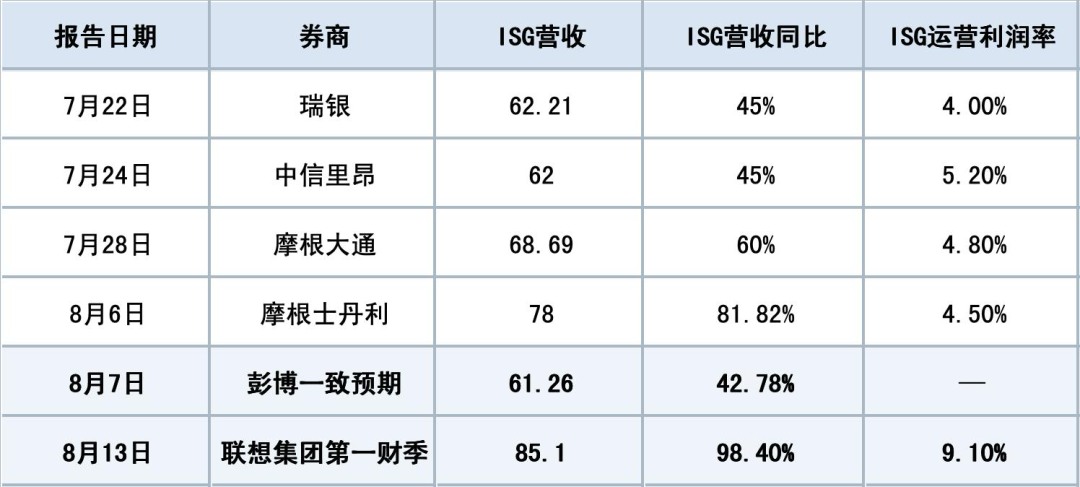
A week earlier, Morgan Stanley analyst Howard Kao's team had just raised their profit margin forecast for Lenovo's infrastructure business from 4.5% to 5.2%, writing in their report that "the Street (i.e., market analysts' general expectations) is still underestimating Lenovo's execution"—a rather aggressive phrasing in analyst circles.
Lenovo Group delivered a real figure of 9.1%.
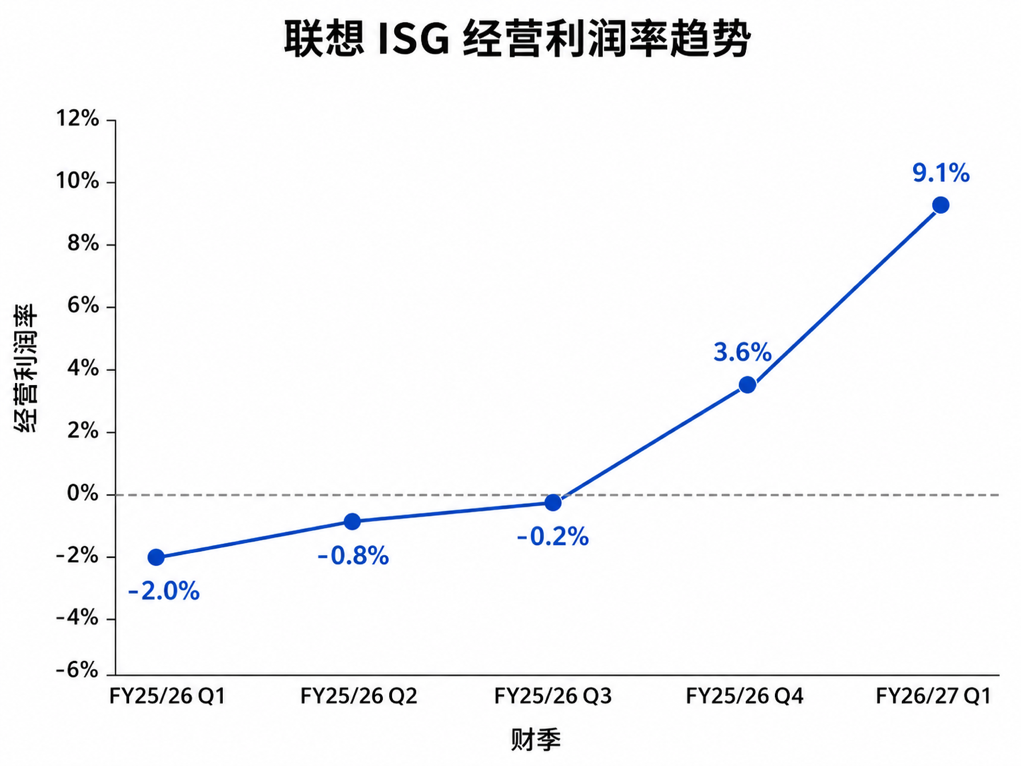
This was the result after Lenovo's Infrastructure Solutions Group (ISG)—primarily focused on server business—improved its profit margin for the fifth consecutive quarter and then suddenly bent the trajectory sharply upwards. Just three months ago, this business's profit margin was only 3.6%, having just climbed out of four consecutive quarters of losses.
For the general public, Lenovo is still the company that rose to prominence in the 1990s through a "trade-technology-manufacturing" approach and became famous in 2005 for its "snake swallowing an elephant" acquisition of IBM's PC business—a massive, low-margin, and lackluster-growth PC manufacturer.
But over the past year or so, a series of numbers have been gradually rewriting this narrative.
Lenovo Group disclosed its Q1 FY2026/27 results: As of June 30, 2026, Lenovo Group achieved revenue of 183.4 billion yuan (approximately $26.9 billion), up 43% year-on-year; adjusted net profit surpassed $1 billion for the first time, soaring 176% year-on-year; adjusted net profit margin surged to 4%, nearly doubling year-on-year.
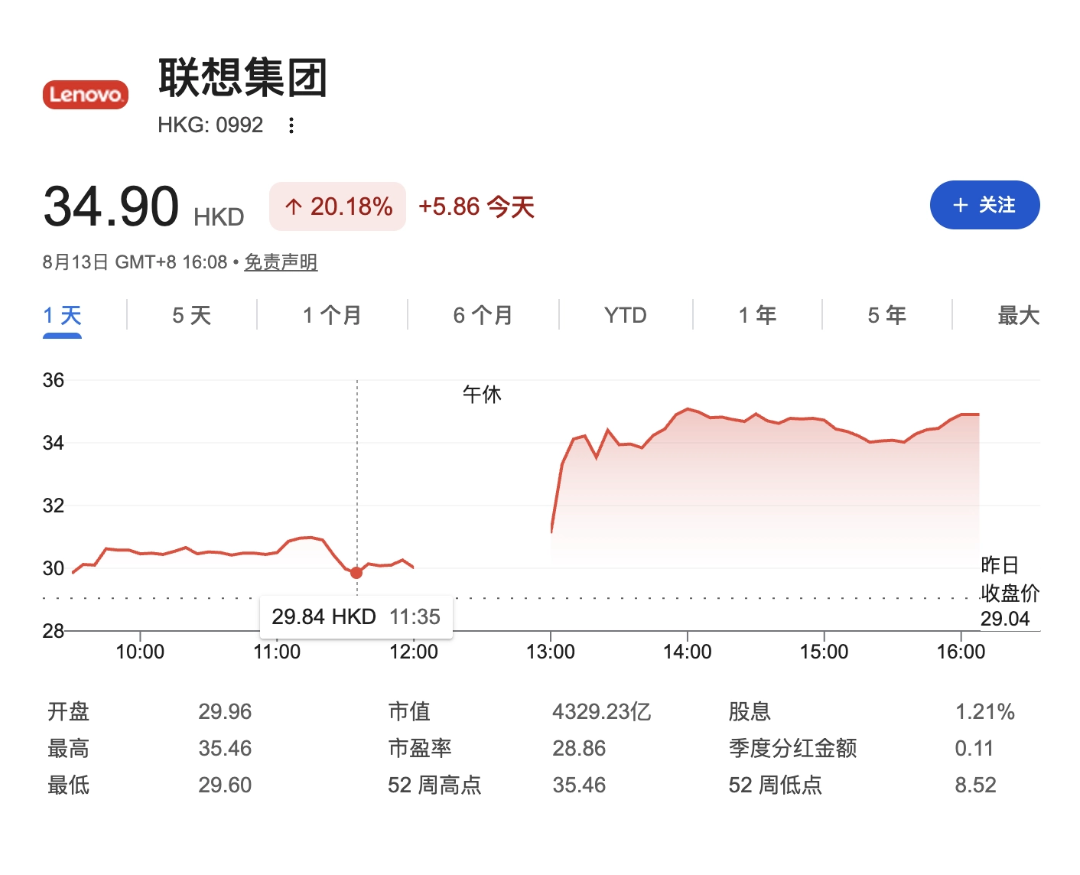
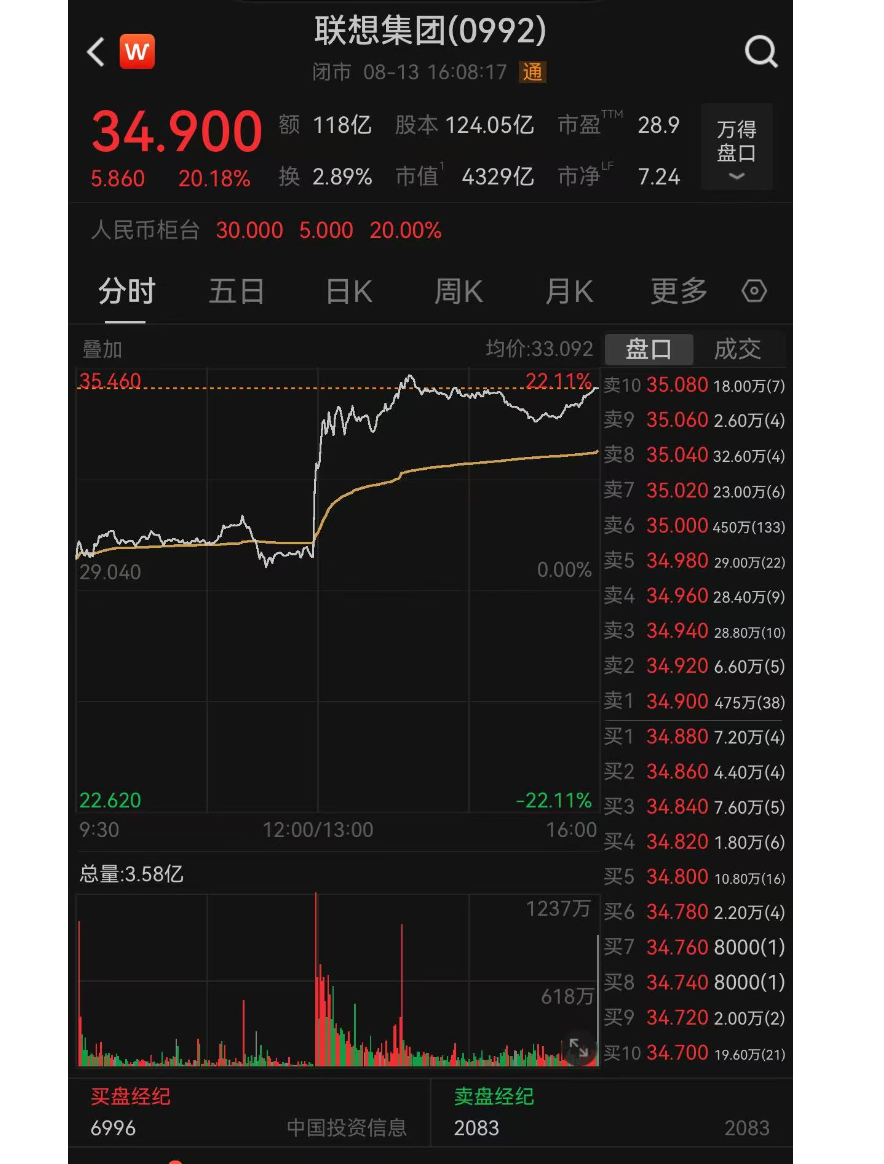
Driven by the strong performance that exceeded expectations across the board, as of the market close on August 13, 2026, Lenovo Group's stock price stood at HK$34.9, up 20.18%, leading the Hang Seng Tech Index and hitting a new all-time high; Lenovo Group's stock price has risen nearly 300% year-to-date, with the company's market capitalization surging from around HK$100 billion to firmly exceed HK$400 billion.
This time, the real driver of the revaluation was no longer just PCs, but a business segment that had rarely been seriously studied by the market before.
A Financial Report Far Exceeding Analysts' Collective Expectations
What truly made investors and analysts restless was ISG's performance.
As of the end of June 2026, Lenovo's ISG business revenue reached 57.9 billion yuan, up 98% year-on-year, nearly doubling; operating profit margin was 9.1%, surging 5.5 percentage points quarter-on-quarter and 11.1 percentage points year-on-year. A more striking figure was Lenovo Group's AI server order backlog—soaring from $21 billion (140 billion yuan) in the previous quarter to over $54 billion (360 billion yuan), a 2.6-fold increase quarter-on-quarter.
This trajectory is steeper than any sell-side model had calculated.
ISG's profit margin trajectory over the past five quarters has been: from -2.0% in FY2025/26 to -0.8%, to -0.2%, to a first-time positive 3.6%, and then to the just-announced 9.1%—a textbook-style turnaround curve, except its reversal speed exceeded the expectations of nearly all observers.
In the month leading up to this financial report's release, UBS, JPMorgan, CLSA, and Morgan Stanley successively raised their ratings or target prices for Lenovo Group, reclassifying the company from "neutral" or "hold" to "overweight" or "outperform." Mainland brokerages Tianfeng Securities and Zhongtai Securities also initiated coverage on Lenovo Group. CLSA set a target price of HK$36, calling Lenovo Group the "top pick in China's tech sector." But even these bullish analysts had previously forecast ISG's profit margin to generally fall between 4.0% and 5.2%.
Yang Yuanqing, Lenovo Group's Chairman and CEO, stated at the earnings call, in a way that somewhat confirmed this trajectory was no accident. "After becoming a market leader in personal computers and smart devices, AI and infrastructure businesses are also growing into global market leaders." If this statement had been made two years ago, it would likely have been seen as a vision; but after this financial report, it reads more like a belated strategic announcement.
A Chess Game Laid Out Twelve Years Ago
To understand how this financial report came about, we must go back to a trading day in January 2014.
On that day, Lenovo announced the acquisition of IBM's x86 server hardware business for $2.3 billion—including the entire product line such as System x and BladeCenter. This was another "snake swallowing an elephant" acquisition by Lenovo, following its $1.25 billion purchase of IBM's global PC business in 2005. At the time, Lenovo's annual revenue was around $30 billion, and the new revenue from this deal was only about $5 billion, widely seen as another routine move by Lenovo to find a second growth engine after PC market saturation.
No one could have foreseen that eleven years later, this deal would become the technological cornerstone for Lenovo to establish itself in the global AI infrastructure competition.
Over the next six years, Lenovo combined IBM's enterprise-grade architectural capabilities with its own extreme manufacturing cost control honed in the PC era, entering the fierce competition for the global TOP500 supercomputer rankings. From 2018 onwards, Lenovo consecutively ranked first globally in the number of TOP500 supercomputer suppliers—173 units in 2019, 180 in 2020, and still topping the list with 162 units in 2024.
This patiently accumulated achievement ultimately manifested in the more mainstream traditional server market.
According to Lenovo Group's Q1 FY2026/27 results, in the global x86 server market, Lenovo's traditional server revenue scale has climbed to second place worldwide, with a year-on-year growth rate of nearly 37%, the fastest among leading vendors; ISG's overall scale has more than tripled compared to a decade ago, with a compound annual growth rate of 47% over the past two years.
In other words, Lenovo's progress in the server track (track) is not just a short-term dividend from the AI wave, but a market share curve that has been running for over a decade, simply pushed onto a steeper slope in this cycle.
At the same time, Lenovo also began refining a technology that would later become extremely important: a liquid cooling system named "Neptune."
The research and development of the "Neptune" liquid cooling system can be traced back nearly two decades, with its technical lineage inherited from IBM mainframes, initially designed to address cooling and energy efficiency issues in high-density computing clusters. Long before the rise of large models, its PUE could already be reduced to below 1.1, with thermal removal efficiency reaching up to 98%. After long-term iterations, Neptune has now evolved to its seventh generation, expanding from a single cooling technology to a system-level liquid cooling solution covering design, deployment, and operation.
According to ISG head Ashley, compared to some industry solutions still using 30–40°C inlet water, Lenovo already supports 45°C high-temperature inlet water and has formed a complete technical system covering outlet water temperature control, chip-level cooling, rack-level deployment, and energy reuse, applicable to Lenovo's entire server product line. Currently, Lenovo's factories mass-produce liquid-cooled racks with power coverage from 65 kW to 210 kW, expected to rise to 500 kW per rack in the coming years. Lenovo has already achieved large-scale deployment of liquid cooling technology, leading the industry globally in the number and scale of liquid-cooled data center transformations.
Around 2021, Lenovo underwent an organizational restructuring: splitting the company into three business groups—Intelligent Devices Group (IDG), Infrastructure Solutions Group (ISG), and Solutions and Services Group (SSG).
This was the first time Lenovo Group elevated its server business to a strategic level on par with PCs at the organizational level.
The real turning point came after the outbreak of generative AI. In January 2025, Lenovo announced the acquisition of Israeli high-end storage company Infinidat, filling its last significant gap in enterprise-grade storage; at the Consumer Electronics Show in Las Vegas in January 2026, Lenovo held its largest-ever product launch at the Sphere venue, jointly introducing a gigawatt-scale "Lenovo AI Cloud Super Factory" cooperation plan with NVIDIA.
Supporting this strategy is an already-unfolded product roadmap. In AI servers, the GB300 NVL72 training platform has begun full-scale shipments; at NVIDIA's GTC conference in March this year, Lenovo secured the global launch partner status for the next-generation Vera Rubin NVL72 platform. Around training and inference, Lenovo simultaneously rolled out training servers like ThinkSystem SR780a V3 and SD650 V3, as well as inference server matrices including SR675i, SR650i, and SE455i, plus the ThinkEdge SE100 for edge computing scenarios—this full-scenario product line covering from data center cores to network edges drove Lenovo Group's AI server backlog orders to surge more than 2.5 times in Q1.
A Neocloud Closed Loop Being Validated by Financial Results
"The market is shifting from worrying about excessive capital expenditures to believing in demand and profit realization," said Li Qi, analyst at Tianfeng Securities' overseas tech team.
In mid-August, two representative Neocloud companies announced their Q2 results: CoreWeave revenue reached $2.6 billion, up 112% year-on-year, exceeding market expectations of $2.5 billion; Nebius revenue hit $580 million, soaring 454% year-on-year, also surpassing expectations of $560 million. Both stocks surged after the earnings release, with Nebius jumping 34% in a single day and CoreWeave rising 19%, directly boosting the entire AI hardware supply chain—SK Hynix ADRs, SanDisk, Micron, NVIDIA, and Intel rose 9.0%, 5.8%, 4.9%, 3.0%, and 3.3% respectively that day.
Three signals released by Neocloud companies confirmed the market's judgment of "insatiable computing demand": First, order backlogs are high and still accelerating. CoreWeave's order backlog reached $104 billion at the end of Q2; Nebius's new customer contract value in Q2 grew over 9 times year-on-year, with 2027 capacity almost fully sold out under current conditions, and the company's cumulative contract commitments now reaching $40 billion.
Second, pricing power is shifting from buyers to sellers. CoreWeave raised prices for its entire product line by about 25% in July, with new Q2 contracts expecting profit margins 5–10 percentage points higher than previous quarters, largely benefiting from the cost-effectiveness of NVIDIA's next-generation Vera Rubin platform.
Third, the payback period for capital expenditures is shortening. Nebius disclosed that the payback period for capital expenditures and operating costs corresponding to Q2 contracts was about 1 year and 10 months, significantly shorter than the previously expected 2–3 years; about 70% of new contracts already include customer prepayments, covering 50–60% of capital expenditures.
By 2030, Neocloud vendors are expected to capture about 20% of the $267 billion global AI cloud market, and Lenovo Group's presence in this group is rapidly rising.
It is understood that Lenovo Group's order backlog for AI cloud customers grew 157% quarter-on-quarter, including Nscale, which has deployed over 7,000 GPUs, and IREN, which has deployed thousands of Lenovo servers. Lenovo summarizes its approach as the "ODM+ model"—providing customized system design and rack-level integration for Neocloud customers, helping them shorten capacity ramp-up cycles and compress the time to first Token generation.
A Non-Zero-Sum Game Benchmark
If we zoom out to the global AI infrastructure competition landscape, a more direct comparison emerges: Dell Technologies.
Recently, Morgan Stanley, while comb, sort out, organize, arrange, streamline (combing through) the global AI infrastructure supply chain, directly placed Lenovo Group in a list titled "Compute Manufacturing Ecosystem," alongside Dell and other companies, as one of the key targets for AI infrastructure investment themes in the Asia-Pacific region.
This classification itself, to some extent, more bluntly illustrates the capital market's shifting perception of Lenovo Group's identity than any financial report.
Headquartered in Texas, USA, Dell has long been one of the largest players in global AI servers, thanks to the full-stack storage and virtualization capabilities acquired through its $67 billion purchase of EMC in 2016. According to Dell's latest financial report disclosed in early June, Dell's ISG revenue reached $29 billion, up 181% year-on-year; operating profit margin was 10.5%; AI server order backlog reached $51.3 billion.
In absolute terms, Dell still leads—its ISG revenue is about 3.4 times that of Lenovo, and AI-optimized server revenue soared 757% year-on-year. But in terms of trajectory: Lenovo's latest quarterly backlog orders (about $54 billion) have caught up with or even slightly surpassed Dell's backlog ($51.3 billion), although the two companies' statistical caliber (methods) may not be entirely consistent. And in terms of profit margins, the gap between the two companies has narrowed to within 1.4 percentage points from a wide margin six months ago.
Dell relies on the full-stack storage capabilities brought by EMC, plus its ability to be the first to mass-produce on the latest architectures for major North American clients and NVIDIA; Lenovo relies on a more decentralized global manufacturing network and its cloud computing customer coverage in China and emerging markets. To some extent, this is not a zero-sum game—the AI infrastructure pie itself is still rapidly expanding, and the two companies are more likely eating larger shares of the same growing market.
Conclusion
It is worth noting that Lenovo has never abandoned PCs. In fact, in the same quarter when ISG business surged, Lenovo's PC business still expanded its market share against the trend, reaching a 24.2% market share, widening its lead over the second-place competitor for the tenth consecutive quarter.
Against the backdrop of rising storage costs and overall market pressure, Lenovo Group has leveraged its supply chain advantage of 'global resources/local delivery' to achieve a favorable outcome, showcasing its dominance in the PC market: As of the end of June 2026, Lenovo Group's IDG (Intelligent Devices Group) still achieved revenue of RMB 116.4 billion against the trend, representing a year-on-year increase of 27%; its operating profit margin reached 7.1%, further improving by 0.1 percentage points sequentially and exceeding market expectations by 0.2 percentage points.
Looking back, Lenovo Group's true strategy has never been as simple as 'betting on AI': Lenovo used the supply chain influence and cash flow accumulated from two decades of PC business as its foundation, paved the way with a decade of technological precipitate in server business, and ultimately, during the window period of concentrated AI computing power demand Outbreak (outbreak), transformed ISG from a marginal business that had sustained losses for four consecutive quarters into a core growth engine with a single-quarter operating profit margin of 9.1% and a surge in AI server backlog orders exceeding 2.5 times.
Major ratings agencies and target prices are still catching up, but it is the data delivered by Lenovo Group itself that has truly outperformed analysts' models. The game is still ongoing, and with this move, Lenovo Group has stayed ahead of everyone else.
-
Will WeChat Agent Replicate the Bidding Ranking Model, Bypassing Search?
-
![]()
Did Zhong Shanshan Make a Mistake?
-
![]()
Flash Charging and 'Celestial Eye': Standard Features in Qin MAX, Positioned to Challenge B-Class Sedans
-
![]()
Wey's Quandary: Can't Afford to Lose Blue Mountain, Yet V Series Struggles to Gain Ground
-
![]()
Google AI Sees Personnel Turmoil: Full-Stack as a Moat, but Also a Source of Conflict
-
![]()
Lenovo Group is Making Big Moves: Server Business Takes Off, AI Server Backlog Orders Reach 360 Billion Yuan!
-
![]()
WPS: A Future Plugin in the Making?
-
![]()
Zhang Xue Motorcycle Secures Sole Investment from Sequoia China, Valuation Soars to 6 Billion Yuan Post-Investment