Three Waves of Technological Advancement in Sync: Who Will Seize the Next AI 'Opportunity Window'?
 08/17 2026
 366
366
These three waves of technological advancement are simultaneously crashing against the same reef.
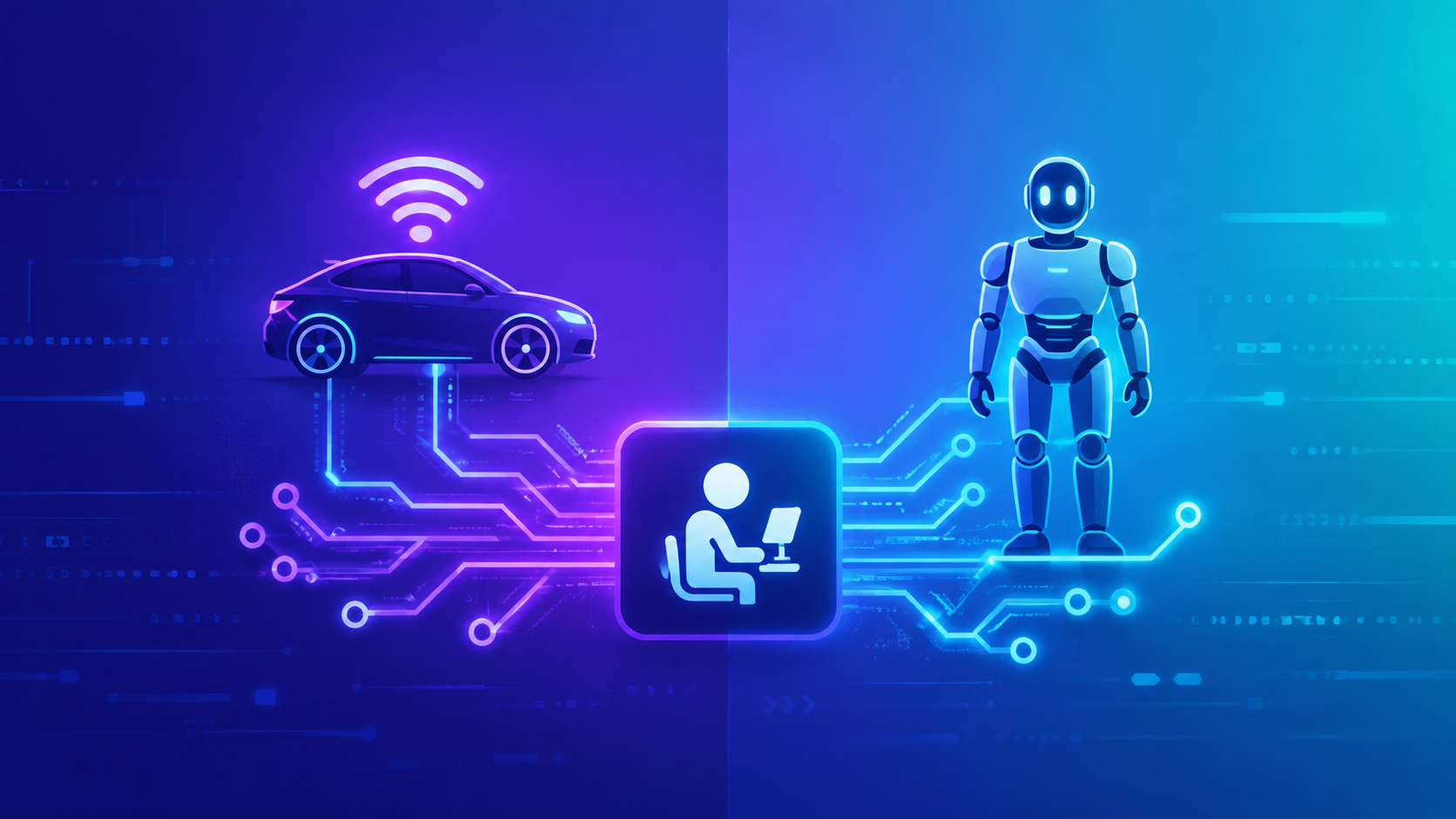
Robots are moving from laboratories to production lines, beginning to develop human-like intelligence. Intelligent driving assistance is no longer limited to high-end vehicle models but is rapidly extending to 100,000-yuan-class family cars, achieving large-scale adoption. Edge AI is driving the lightweight deployment of large models, with continuous evolution in smartphones, smart glasses, and camera terminals, accelerating the formation of intelligent agents with collaborative capabilities.
These three waves, though differing in direction and pace, are converging at the same point in 2026. While many market observers view this convergence as a short-term trend, it is underpinned by deeper industrial logic: Once intelligent machines with autonomous decision-making capabilities become universal infrastructure for various intelligent scenarios, those who seize the core entry points for scenario intelligence will capture the next wave of AI growth dividends.
Embodied AI is undoubtedly the hottest keyword in 2026.
The 15th Five-Year Plan lists it as a new economic growth point. In 2025, it was mentioned for the first time in the Government Work Report. In 2026, the Ministry of Industry and Information Technology (MIIT) and the State-owned Assets Supervision and Administration Commission (SASAC) jointly launched a special initiative for real-world training of humanoid robots and embodied AI, aiming to complete application validation and routine deployment in representative scenarios by the end of 2026. With policy support, the industry has undergone a historic leap in scale.
In terms of technological evolution, embodied AI is transitioning from 'seeing and moving' to 'being capable and useful.' The industry has now established a complete full-stack technology system covering five core areas: environmental perception, cognitive decision-making, motion execution, hardware platforms, and simulation data support. This system forms a closed physical interaction loop of 'perception-understanding-planning-execution-feedback,' serving as the foundational infrastructure for humanoid robots and industrial general-purpose intelligent agents to operate autonomously.
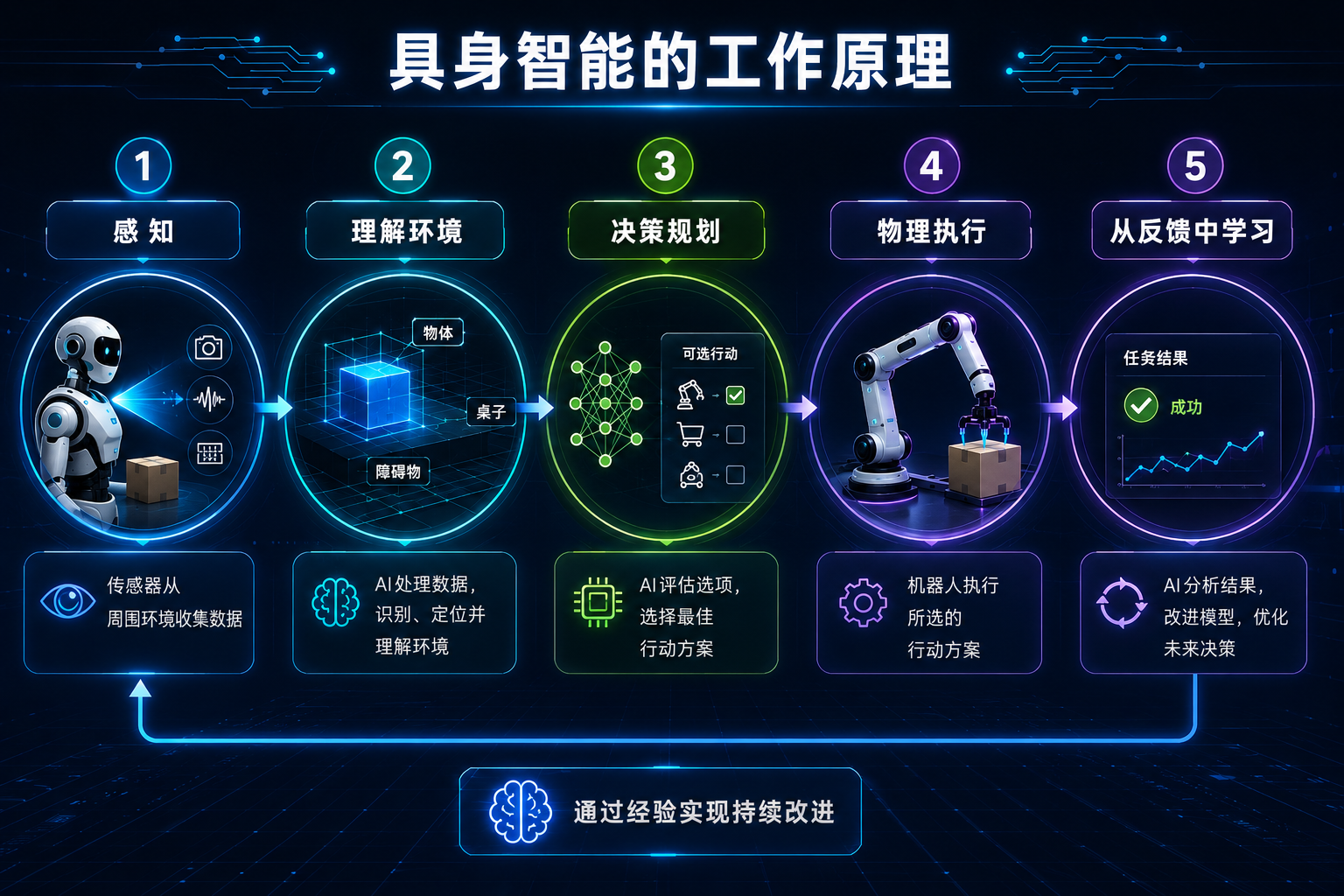
At the perception level, the industry has shifted from passive image capture to active multi-modal perception. Devices now integrate RGB-D depth cameras, LiDAR, and 4D millimeter-wave radars for collaborative operation. Leveraging NeRF (Neural Radiance Fields) and 3D Gaussian Splatting technologies, real-time 3D reconstruction of indoor and industrial scenes is achieved. Pure vision solutions, inspired by autonomous driving perception logic, rely on multi-camera systems for radar-free environmental modeling, combined with instance segmentation algorithms for object localization and material identification.
To meet precision operation demands, six-axis force sensors and distributed flexible tactile arrays have become standard, capable of capturing grip friction and subtle object deformations. A multi-source temporal fusion framework aligns visual, tactile, inertial, and audio data, mitigating recognition failures caused by low light, reflections, or occlusions, providing millimeter-level perception benchmarks for hand-eye coordination.
Cognitive decision-making large models represent the core dividing line between traditional automation equipment and embodied AI. In 2026, the industry predominantly adopts a dual-engine architecture combining VLA (Vision-Language-Action) models with physical world models, forming a dual-system that synergizes high-level semantic planning with real-time action generation.
The VLA end-to-end model directly maps images, natural language instructions, and continuous action sequences, eliminating traditional hierarchical decomposition processes. After model distillation and lightweight modification, it enables offline local inference on robot endpoints, free from cloud network latency constraints. The physical world model incorporates complete dynamics rules for gravity, friction, deformation, and collision, allowing virtual simulation of action outcomes before execution to predict risks such as grip failures, collisions, or material spills, addressing logical discontinuities in multi-step long-duration tasks.
Building on this, the industry has developed intelligent agent planning frameworks that decompose complex processes using chains of thought, accumulate operational experience through short-term interaction memory and long-term scenario knowledge bases, and enable cross-scenario capability reuse via MCP protocols and skill plugin systems. Rapid adaptation to new materials and production lines is achieved with minimal samples through drag-and-drop teaching and offline reinforcement learning.
The motion control system employs a hierarchical hybrid architecture, with large models handling high-level task planning and bottom-level servo closed-loop systems ensuring millisecond-level stable execution. The upper layer coordinates whole-body movements, including upper limb grasping, lower limb walking, and body turning, generating smooth trajectories through diffusion strategies. Built-in dynamic obstacle avoidance and load balancing logic accommodate complex tasks such as pushing carts, packing, and stair climbing.
The bottom layer focuses on impedance control, torque closed-loop control, and model predictive control, with control frequencies reaching up to kilohertz. Paired with dedicated bipedal gait balance algorithms to compensate for center-of-gravity shifts, the control system eliminates action jitter and positioning errors caused by large model outputs. The virtual-real iterative closed loop has become a standardized data production pipeline, where real interaction data collected in physical environments is fed back to simulation platforms for batch training. Optimized action strategies are then deployed to physical devices for further iteration, significantly reducing equipment wear and time costs associated with real-machine trial-and-error.
Hardware platforms and edge computing power form the physical foundation for embodied AI deployment. The hardware side features lightweight integrated servo joints, high-precision harmonic drives and reducers, and high-power frameless torque motors as core execution units, paired with multi-degree-of-freedom bionic dexterous hands and adaptive flexible grippers. The new generation of electric bipedal chassis is gradually replacing outdated hydraulic solutions, achieving comprehensive optimizations in weight reduction, noise reduction, and maintenance costs.
On the computing side, robot-specific NPUs, automotive-grade AI chips, and in-memory computing modules have become mainstream choices, paired with real-time operating systems to achieve millisecond-level synchronization of perception, inference, and control modules. This addresses pain points such as network disconnections, data privacy leaks, and high latency associated with cloud-based inference. Supported by low-latency distributed communication buses and high-density lithium battery modules, continuous long-duration operation is enabled.
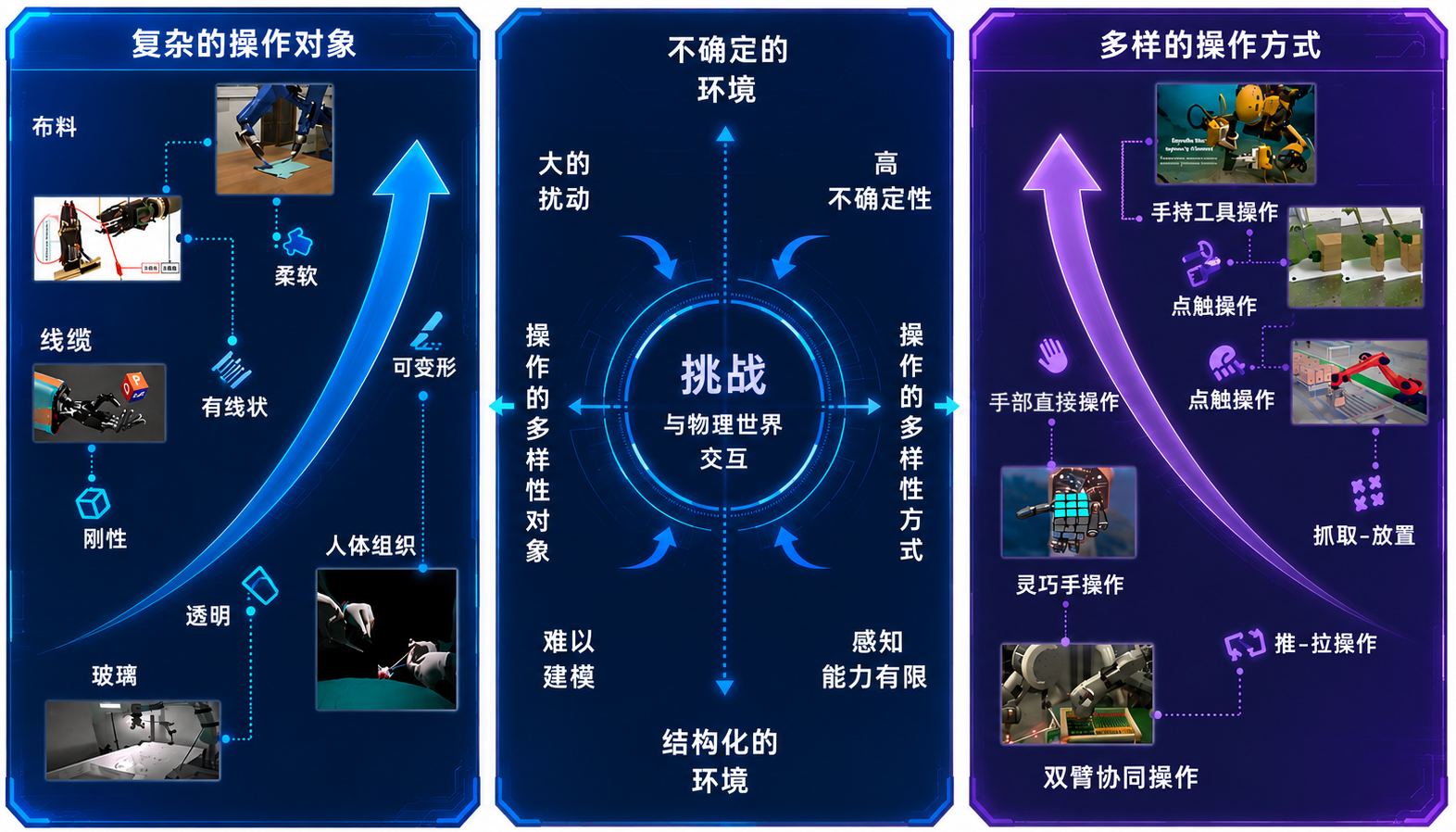
This year, significant milestones in mass production are emerging rapidly. Zhiyuan Robotics rolled off its 15,000th embodied robot in June 2026, less than three months after breaking the 10,000-unit production milestone. Gaogong Robot Industry Research Institute estimates that domestic humanoid robot shipments could reach 62,500 units in 2026, with industry experts projecting annual production to reach 100,000–200,000 units. More critically, price breakthroughs have occurred—Unitree Technology's Unitree R1 starts at just 29,900 yuan, while Songyan Dynamics' Bumi is available for pre-sale at under 10,000 yuan. When a humanoid robot's price approaches that of an electric bicycle, the door to commercialization truly opens.
Once product prices cross the psychological 'acceptance threshold' of the masses, market expansion could be exponential. Roland Berger predicts that under a baseline scenario, the global humanoid robot market could reach $300 billion by 2035; under an optimistic scenario, this figure could soar to $750 billion. If technological iteration, supply chain maturation, and application expansion continue at their current trajectory, the market could exceed $4 trillion by 2050, approaching the scale of today's automotive industry.
Currently, the entire industry remains in the stages of laboratory verification and small-scale pilot deployments, with 3–5 years of sustained effort needed before general-purpose humanoid robots achieve large-scale adoption and full industry commercialization. Short-term industry growth will concentrate on structured terminal scenarios such as industrial warehousing material handling, simple sorting in the 3C industry, and fixed production lines in new energy sectors—these are the core tracks where embodied AI will first unlock terminal AI growth dividends. Non-structured scenarios like household services, multi-process flexible manufacturing, outdoor complex operations, and medical precision procedures still lack the operational stability required for commercial use.
L3 Mass Production Begins: L4 Enters the 'Final Battle'
As the most commercially mature and fastest-penetrating track within the AI wave, autonomous driving, with vehicles as mobile intelligent terminals, has officially entered a critical industry inflection point characterized by 'end-to-end large models + mapless urban NOA + L3 compliant mass production.' Technological architectures, hardware supply chains, and data closed-loop systems have undergone comprehensive iteration.
MIIT data shows that since this year, the penetration rate of L2 combined driving assistance in passenger vehicles in China has reached 70.5%, while the penetration rate of Navigate on Autopilot (NOA) functions has reached 34.2%. The first batch of L3 conditionally automated vehicle models has begun operating in specific regions.
In terms of technological paradigms, autonomous driving is accelerating its shift from 'end-to-end' to 'physical AI.' In the first half of 2026, leading players dense [jǐn mí] (intensively) released physical AI solutions based on world models, VLA, and reinforcement learning. NVIDIA has built a complete ecosystem for autonomous driving, industrial simulation, and embodied AI through its Omniverse platform, Cosmos world model series, and physical AI technology stack. NIO and XPENG have adopted architectural strategies that fuse VLA with world models, aiming to combine VLA's human-like logical reasoning capabilities with world models' physical environment prediction capabilities to advance toward L4 autonomy. Huawei's ADN remains committed to world model implementation, while Momenta has introduced R7, a physical AI model based on world models and reinforcement learning.
The industry has long relied on a hierarchical modular architecture for perception, prediction, planning, and control, which suffered from lengthy linkages and severe information loss. In 2026, end-to-end VLA architectures have become standard in high-level intelligent driving systems. This architecture directly outputs continuous control signals for steering, acceleration, deceleration, and braking based on raw data from onboard multi-sensors and natural language instructions, eliminating multi-layer artificial rule decomposition and aligning decision-making logic more closely with human driving anticipation.
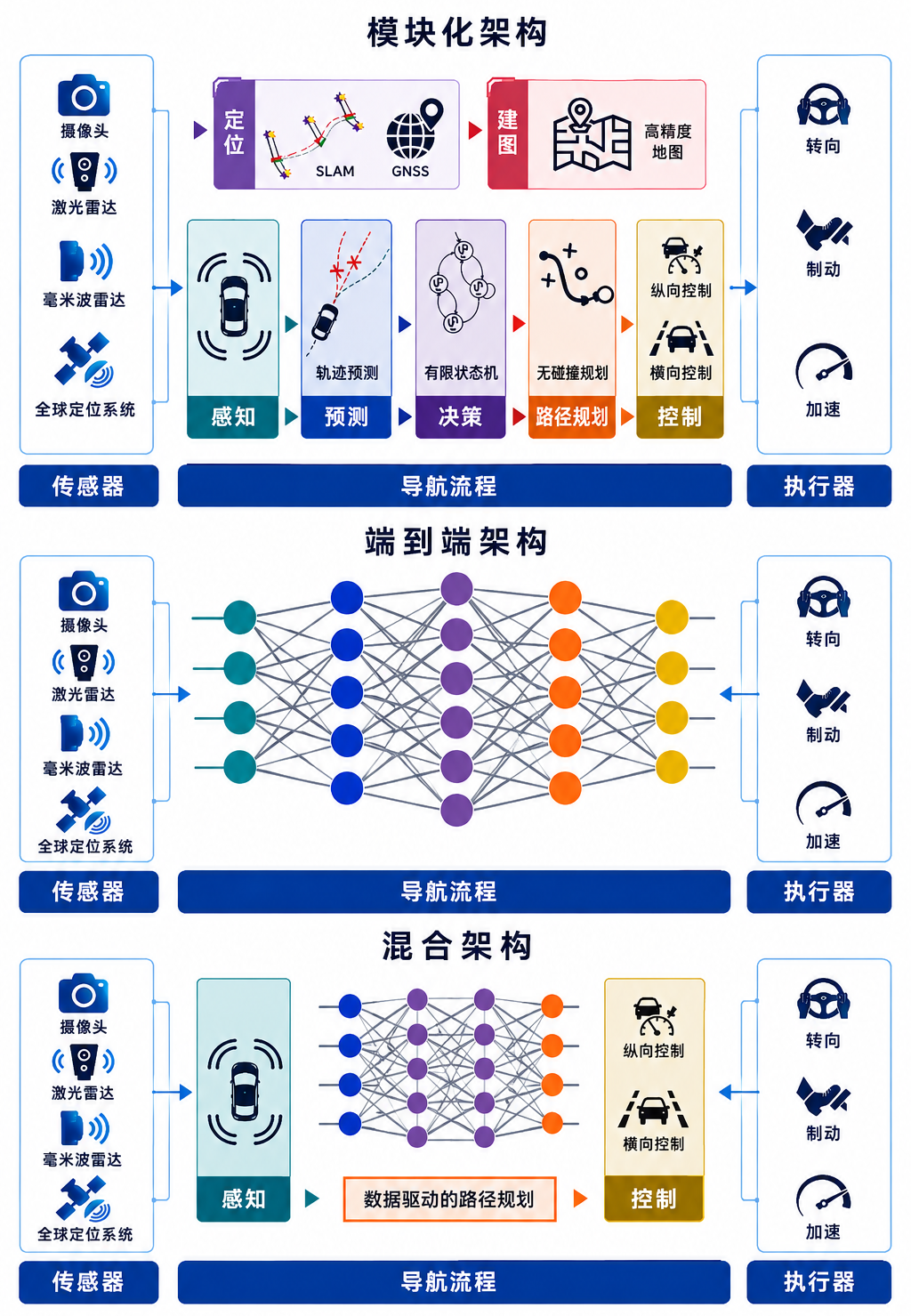
Tesla's FSD V12, XPENG's XNGP 4.0, Huawei's ADS 5.0, and BYD's Divine Eyes have all achieved native end-to-end deployment, enabling models to autonomously interpret latent road risks, identify rolling balls by the roadside to anticipate child dashes, and maintain safe distances when overtaking large vehicles—achieving human-like adversarial driving.
Supporting world models have become a core algorithmic increment, with NIO's NWM 2.0, XPENG's Physical World Foundation Model, and intelligent driving cloud simulation engines achieving simultaneous mass production deployment. World models incorporate complete traffic dynamics and object motion rules, enabling virtual simulation of various emergency scenarios. They generate large volumes of simulation training samples for long-tail cases such as road construction, irregular obstacles, and 'ghost pedestrians,' significantly reducing real-road data collection costs.
The industry has formed a hierarchical system of 'cloud-based large model training distillation + vehicle-end lightweight model inference.' Using LoRA fine-tuning and 4/8-bit quantization compression techniques, 7B-scale VLA models are deployed to vehicle domain controllers, enabling local offline real-time decision-making free from cloud network latency constraints.
Meanwhile, mapless solutions have fully matured. Automakers no longer rely on pre-stored road topology maps but instead complete dynamic real-time mapping using vehicle-mounted multi-view vision and 4D millimeter-wave radars, achieving 'all-road capability' for urban NOA. Leading domestic brands' mapless navigation now covers all prefecture-level cities in China, closing the loop across all scenarios from parking space to parking space (D2D). It automatically handles complex urban driving conditions such as multi-level garage parking, gate passage, roundabout entry, and unprotected left turns. Commute-specific NOA can rapidly activate fixed commuting routes with minimal real-road data, significantly shortening functional deployment cycles.
The competition between pure vision and multi-sensor fusion approaches in perception systems has intensified. Hardware mass production has driven significant price reductions, enabling high-level intelligent driving to rapidly extend to 100,000-yuan-class family models. Pure vision solutions rely on 8-megapixel HDR front-view cameras and multi-view surround vision, using algorithms to compensate for sensor limitations and targeting low-cost entry models. High-end models generally adopt multi-modal fusion solutions combining 'LiDAR + 4D millimeter-wave radar + high-definition vision.' Solid-state MEMS LiDAR costs have dropped from 100,000 yuan per unit in earlier years to the 1,500–2,000 yuan range. 4D millimeter-wave radars, replacing traditional 2D radars, can precisely identify obstacle height, speed, and lateral motion trends, resolving perception failures in rain, backlighting, and nighttime conditions.
Sensors now achieve millisecond-level temporal synchronization calibration, with industry standards requiring multi-device data synchronization errors below 2ms to avoid object position determination deviation [piān chā] (deviations) during high-speed travel. Iterative advancements in flexible light-blocking and waterproof coating processes have significantly improved imaging stability in heavy rain, dense fog, and strong backlighting environments, with perception robustness improving by over 60% compared to two years ago.
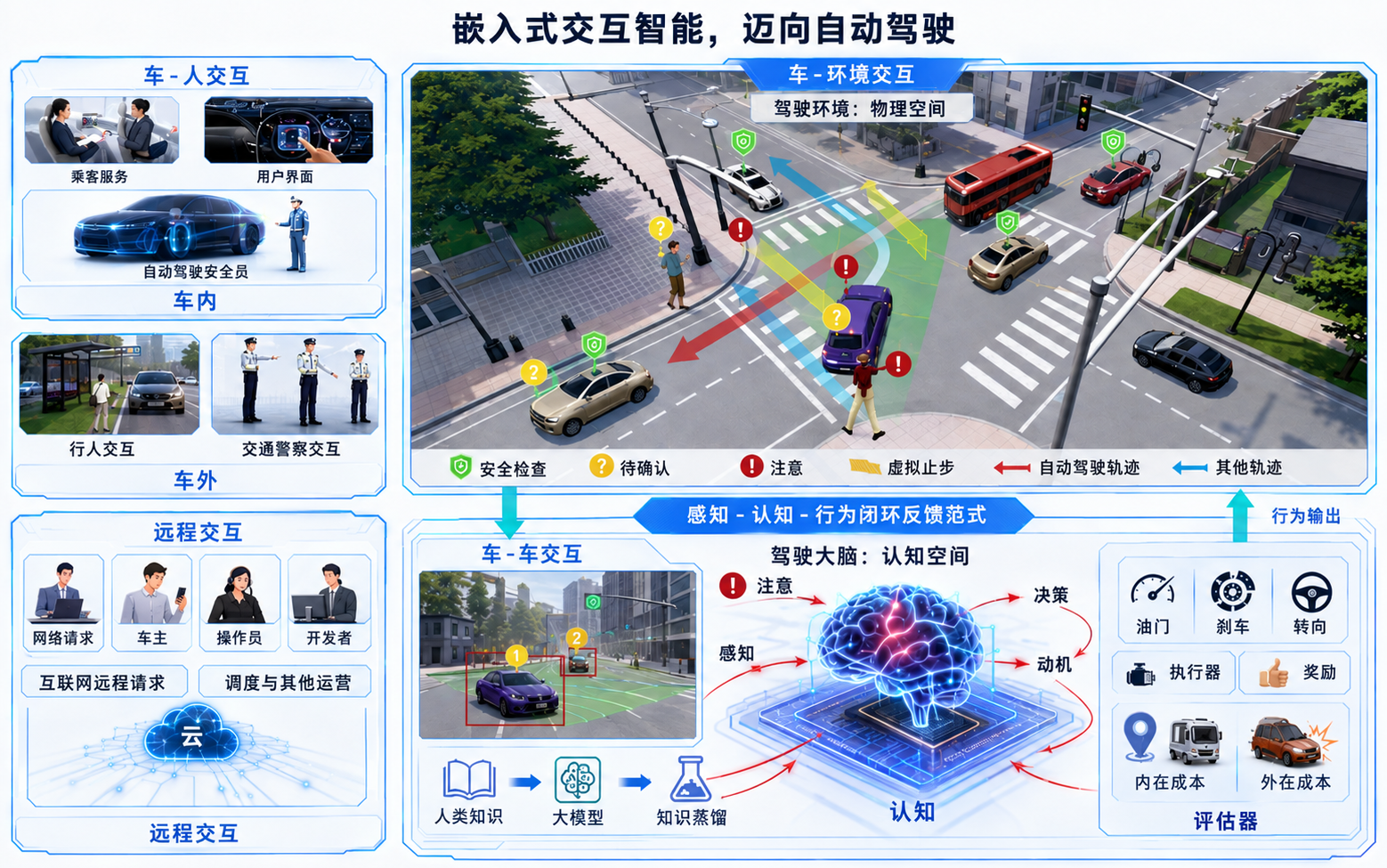
The industry no longer solely pursues TOPS (Tera Operations Per Second) values; memory bandwidth and power efficiency have become core evaluation metrics. Domestic chips have achieved an energy efficiency ratio of 5 TOPS/W, balancing computing power output with vehicle power supply constraints. Vehicles are equipped with unified real-time operating systems that streamline data flows across perception, model inference, and chassis control, maintaining end-side inference latency below 100ms to meet safety response requirements for emergency braking in highway and urban driving. A complete OTA (Over-the-Air) iteration pipeline has been established, with weekly model updates pushed to users, relying on massive volumes of user-collected road data to continuously optimize algorithm performance.
Leading automakers have built computing centers with petascale-level computing power. Tesla's cloud training computing power has surpassed 88.5 EFLOPS, while domestic players like XPENG, NIO, and Huawei have all established dedicated computing clusters exceeding 10 EFLOPS to support processing, automatic annotation, and model training for tens of billions of kilometers of road-collected data annually. The industry has formed a complete data flywheel of 'real-road driving → automatic transmission of hazardous scenarios → cloud simulation reproduction → model distillation and deployment to vehicles.' Automatic annotation tools have reduced manual annotation labor costs by 70%, while generative simulation engines can infinitely generate samples for rare long-tail scenarios such as construction zones, extreme weather, and irregular obstacles, addressing gaps in real-road data distribution.
Simultaneously, L3 autonomous driving has achieved policy breakthroughs. Two domestic models have obtained MIIT's L3 conditionally automated driving access permits, clarifying that the system takes over vehicle control under clear highway conditions, with automakers assuming primary accident liability. Mandatory safety standards, including a 10-second driver takeover window and dual-dimension driver monitoring (eye tracking + head posture recognition), have been implemented, officially ushering in the era of compliant mass production for high-level autonomous driving.
By 2026, autonomous driving has completed a generational leap from traditional driving assistance to AI-native high-level intelligent driving. End-to-end VLA large models, mapless all-domain NOA, domestic high-computing-power chips, multi-modal perception hardware, and cloud simulation data flywheels form a complete and mature technological system. As mobile intelligent terminals, vehicles have pioneered large-scale AI implementation, making autonomous driving the first track to deliver terminal AI dividends.
However, the industry still faces multiple constraints that are difficult to eradicate in the short term. At the algorithmic level, there is insufficient generalization for long-tail scenarios and a lack of explainability in end-to-end models. At the hardware level, there are prominent contradictions in the trade-off triangle of computing power, power consumption, and cost, along with a shortage of high-end chip supply. At the mass production and deployment level, there are issues such as ambiguous regulatory responsibilities, incomplete supporting infrastructure, significant pressure on vehicle profitability, and lengthy safety verification cycles.
In the short term, industry growth is concentrated in controllable scenarios such as highway NOA (Navigate on Autopilot) and urban closed-road piloting. The large-scale popularization (popularization) of L3 autonomy across all domains and the commercial deployment of full-scenario L4 autonomy still require continuous technological breakthroughs, regulatory improvements, and supply chain cost reductions. In the long run, the world models, edge-side lightweight inference, multimodal fusion, and data closed-loop engineering capabilities accumulated by automakers and autonomous driving companies like Pony.ai and Mushroom Auto will continue to migrate toward embodied intelligence and edge-side consumer AI terminals, becoming core technological assets shared across the three-tier AI terminal wave.
The Dawn of Edge AI: From 'Feature Stacking' to 'Personal Intelligent Agents'
Compared to the previous two sectors, edge AI is closest to ordinary people's lives, and its Outbreak (breakout) is the most visible.
The industry generally defines 2026 as the 'Dawn of Edge AI.' Frost & Sullivan predicts that the global edge AI market size will surge from RMB 321.9 billion in 2025 to RMB 1.2 trillion in 2029, with a compound annual growth rate (CAGR) of 40%. IDC expects that by 2028, China's personal AI terminal shipments will reach 147 million units, with a penetration rate exceeding 53%. More aggressive estimates come from Gartner, which projects that global GenAI smartphone shipments could exceed 559 million units by 2026, doubling in three years.
AI smartphones and AI PCs are the two core carriers of consumer-side edge AI and the first hardware categories to release the benefits of terminal AI to consumers. By 2026, the industry will complete a generational leap from 'add-on AI tools' to system-native edge-side large models.
First, chip NPUs and memory hardware undergo comprehensive upgrades to support native offline large model operations. Flagship smartphone SoCs universally integrate dedicated NPUs with hundreds of TOPS of computing power. MediaTek Dimensity 9600, Qualcomm Snapdragon 8 Gen4, Kirin 9020, and Apple A20 all adopt dual-NPU heterogeneous architectures, natively supporting INT4/FP8 low-precision quantization instructions, reducing power consumption for equivalent inference tasks by over 20% compared to previous generations.
Compute-in-memory (CIM) compact storage units begin to be introduced in mid-range models, alleviating memory bandwidth bottlenecks. Long-conversation KV Cache occupancy can be reduced by 40%, significantly improving multi-round conversation stuttering and crash issues. Thermal management solutions are simultaneously optimized, with ultra-thin VC liquid cooling and graphene composite thermal dissipation covering mainstream flagships, ensuring that prolonged AI photo editing and video generation do not trigger forced chip frequency reductions.
Second, lightweight model technologies mature, enabling full-scenario local multimodal inference. INT4 mixed quantization, model distillation, and LoRA lightweight fine-tuning become standardized deployment solutions for smartphones. A 3B-parameter model occupies only 2GB of memory, while a 7B quantized model is controlled within 3.5GB. Offline Q&A, document summarization, and voice translation delays are stably controlled within 800ms, with basic task accuracy loss kept below 5%. Major vendors launch self-developed edge-side foundations: Huawei's Pangu Mobile Foundation, Alibaba's Tongyi Qianwen Lightweight Edition, vivo's Blue Heart 3B, and Apple's Apple Intelligence 3 billion-parameter edge model come pre-installed across the board.
Third, system-level AI Agents and edge-cloud collaborative architectures take shape. Vendors completely abandon fragmented AI applications, embedding intelligent agents into the operating system's core. Leveraging the MCP (Multi-Context Protocol) context protocol, they integrate data across albums, contacts, keyboards, office apps, and cameras, enabling autonomous completion of multi-step continuous tasks such as automatically organizing meeting recordings, batch-generating image copy, and cross-APP information aggregation.
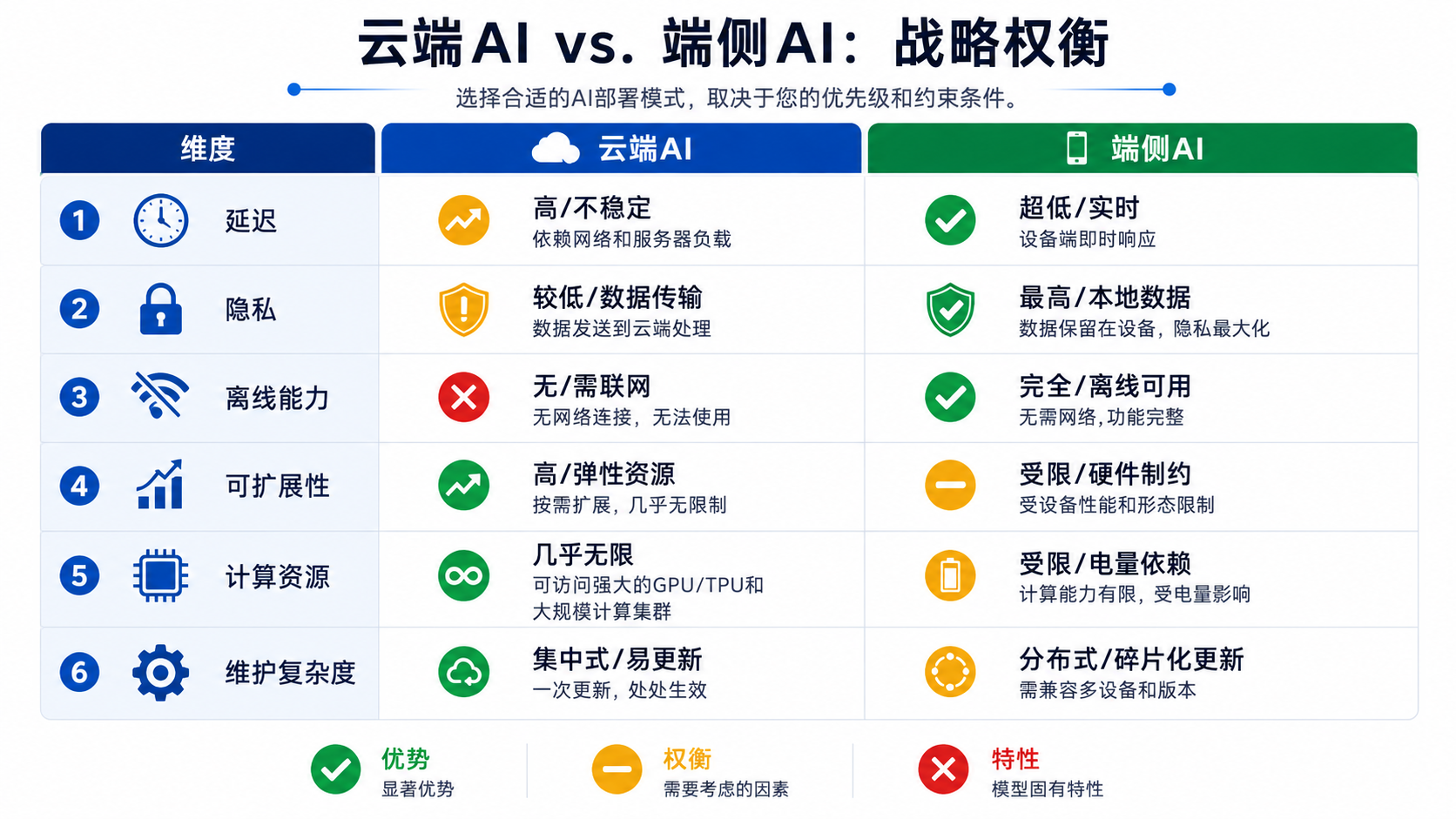
Edge-cloud dynamic scheduling becomes a universal paradigm: Simple text and image lightweight tasks are executed locally, while complex mathematical reasoning and ultra-long multimodal generation are automatically offloaded to the cloud. Federated learning mechanisms become widespread, uploading only model gradients rather than raw user data to balance iteration efficiency and privacy compliance. Cross-device interconnection systems are implemented, allowing smartphone edge model capabilities to flow to tablets, AI glasses, and PCs, forming a distributed consumer terminal intelligence network with a single lightweight foundation reused across hardware.
In the AI PC sector, a three-tier product matrix is taking shape. Lightweight office laptops integrate low-power NPUs for basic document and meeting AI tasks. Mid-range creative laptops pair discrete GPUs with integrated NPUs to support local image and short-video generation. High-end workstations adopt NVIDIA RTX Spark or multi-memory Apple architectures for local large model fine-tuning, industrial simulation, and film rendering. The government and enterprise commercial market is rapidly growing, with local offline AI solutions meeting data confidentiality requirements, replacing traditional cloud subscription services, and significantly reducing long-term usage costs.
Intel Core Ultra and AMD Ryzen AI integrate dedicated NPUs with single-chip peak computing power ranging from 40–130 TOPS, natively supporting local 7B model inference. NVIDIA introduces the RTX Spark Arm architecture PC chip, featuring an independent AI supercomputing unit fully compatible with the CUDA ecosystem, dramatically lowering the computational threshold for multimodal generation and local fine-tuning. Apple's M4 series unified memory architecture continues to iterate, with 32GB and 64GB ultra-large memory models becoming mainstream for productivity. Unified memory eliminates data transmission barriers between CPU, GPU, and NPU, enabling local large model throughput speeds that outperform X86 models.
Lightweight inference frameworks OpenVINO, Ollama, and TensorRT-LLM complete cross-platform adaptation, allowing ordinary users to deploy 7B–34B quantized models with one click. Professional developers support local LoRA fine-tuning and private knowledge base integration, while enterprise users can deploy industry-specific vertical models offline for handling confidential documents.
The core value of AI PCs is concentrated in local high-intensity productivity scenarios, such as long-form contract analysis, local AI editing of massive media assets, offline code development, internal enterprise data processing, and 3D-assisted modeling—all completed using local computing power to prevent internal data leaks. Edge-cloud collaboration is clearly divided: The PC handles private data processing, real-time interaction, and offline creation locally, while the cloud undertakes high-load tasks like ultra-large model fine-tuning, trillion-parameter knowledge base retrieval, and high-definition long-video generation. Model incremental update packages are automatically synchronized during network idle periods.
Multi-agent collaborative toolchains are deployed, enabling AI PCs to autonomously schedule local files, external cameras, and peripheral hardware to complete continuous workflows, achieving natural language-driven whole-machine operation and Completely get rid of it (completely breaking free from) traditional mouse-click interaction logic.
While AI smartphones and AI PCs are surging in momentum, both device categories face underlying constraints that cannot be eradicated in the short term. AI smartphones are constrained by physical ceilings in memory, power consumption, and thermal management, as well as chip fragmentation ecosystems, limiting them to lightweight basic AI tasks. AI PCs are hindered by X86/ARM software fragmentation, high hardware costs, and user adoption barriers, with local high-intensity productivity AI only available on high-end models.
In the short term, the benefits of terminal AI will be concentrated in high-end flagship smartphones and professional creative AI PCs. As compute-in-memory chips become widespread, industry-wide standards are established, and model lightweighting technologies continue to iterate, mid-range models will fully acquire complete offline multimodal AI capabilities, triggering a full-scale, domain-wide Outbreak (breakout) of AI benefits in the consumer terminal market.
The convergence of technological waves is no coincidence but an inevitability.
This will be an industrial transformation more enduring and far-reaching than cloud-based large models. The benefits of terminal AI will extend across the entire industrial chain (supply chain), including chip vendors, hardware manufacturers, algorithm model firms, and scenario solution providers. For industry participants, the real question is no longer 'whether to integrate edge AI' but 'how to establish their own barriers in the terminal space.'
The wave has arrived, and the terminal is the shore. The script for the next round of AI growth is unfolding on every smart device.
-
![]()
Lei Jun’s Xiaomi SU7 Shatters Records, Netizens Applaud Its Remarkable Achievement!
-
![]()
Porsche Won't Give Up on Manual Transmissions! Will Persist as Long as Regulations Allow and Market Demand Exists
-
![]()
This Summer, Car Rentals Are Surprisingly Affordable
-
![]()
MiniMax H3 Closes In, Leaving Seedance with Limited Safe Space
-
![]()
Blockbuster! Li Shufu Steps Down as Chairman, An Conghui Takes Over, Geely Ushers in 'Coming-of-Age' Moment
-
![]()
AI Smartphones: Don't Expect Price Drops Anytime Soon
-
![]()
Kingdee International's AI Aspirations Stumble at Market Cap Barrier: Can Xu Shaochun's Ambitious Vision Sustain Investor Confidence?
-
![]()
Phase I Project Covering 7 Million Square Meters Reaches Stable Mass Production! Shuangxin Materials Speeds Up Its PVA Optical Film Production Capacity Deployment