Lei Jun’s Xiaomi SU7 Shatters Records, Netizens Applaud Its Remarkable Achievement!
 08/18 2026
 343
343
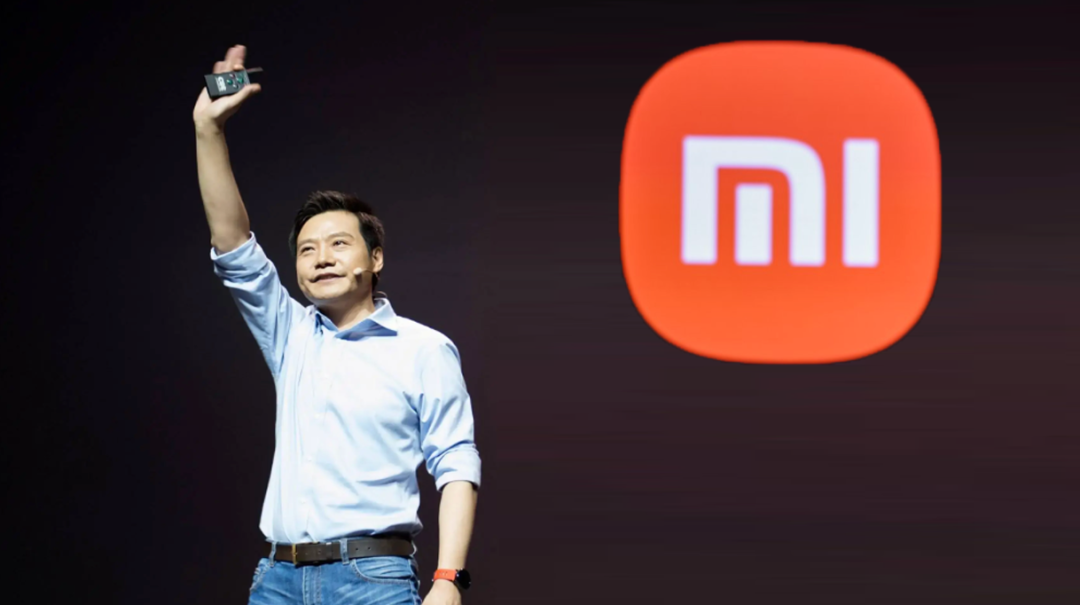
Image Source: Xiaohongshu
On August 17, Lei Jun unveiled a significant automotive industry report: The Xiaomi SU7 officially launched on March 28, 2024, and within just 28.5 months, the series has achieved over 500,000 cumulative deliveries, setting multiple new industry benchmarks. Lei Jun also expressed his gratitude to all SU7 owners for their unwavering support.
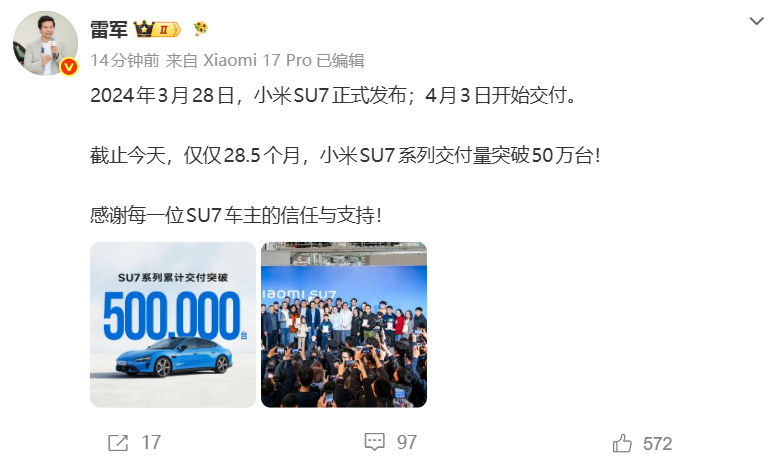
Image Source: Weibo
Following the report’s viral spread online, public opinion in the comment section became polarized, sparking intense debate. Numerous genuine owners shared their driving experiences, with an overwhelming surge of positive feedback:
“I’ve been driving it for nearly a year. The chassis feels robust, the 800V fast charging eliminates range anxiety, and it offers exceptional value for money.” “The HyperOS infotainment system operates smoothly, the high-speed intelligent driving significantly reduces fatigue, and it’s perfect for daily commutes and short family trips. Buying this car was a great decision.”
Meanwhile, controversies and criticisms have persisted, with many netizens raising specific concerns:
“Lei Jun excels at marketing hype; the promotional language is exaggerated and lacks realism.” “Since its release, the SU7 has faced ongoing controversy over alleged exterior design plagiarism, with its originality being heavily questioned.”
Automotive sales figures don’t lie. The impressive milestone of 500,000 deliveries directly dispels doubts that the Xiaomi SU7 is merely a “short-lived internet sensation,” firmly establishing itself in the mainstream 200,000-yuan sedan market and setting four major industry records.
Netizens claim that the Xiaomi SU7 is also the only sedan in the 100,000+ price range to surpass 100,000 cumulative sales within six months. 
Image Source: Weibo
Breaking Category Bias: It shatters the industry stereotype that “pure electric coupes are stylish but niche and cannot achieve high volume,” setting the fastest record for 500,000 deliveries of a domestic pure electric coupe.
Domestic High-End Benchmark: It becomes the only model among domestic new forces to surpass 500,000 deliveries of a single model priced above 200,000 yuan, joining the ranks of phenomenal products.
Surpassing Global Benchmark: Tesla’s Model 3 took 36 months to reach 500,000 deliveries, while the Xiaomi SU7 achieved it in just 28.5 months, 7.5 months faster. Even accounting for statistical differences, its growth advantage remains top-tier in the industry.
Dominating Niche Segment: It tops the sales charts for sedans priced above 200,000 yuan for four consecutive months, successfully breaking the long-term foreign monopoly on the high-end sports sedan segment.
The 500,000 deliveries mark is not only a milestone for Xiaomi Auto but also a powerful testament to Chinese new energy brands achieving breakthroughs and setting new industry benchmarks in the high-end sedan segment.
Single Model Takes on BBA’s “56E,” Sales Data Shatters Automotive Market Perceptions
Long before the 500,000 delivery record, the Xiaomi SU7 had already achieved legendary monthly sales. In July 2026, the SU7 sold 21,044 units, securing its fourth consecutive month as the best-selling sedan in the 200,000-yuan segment, achieving a dominant lead in its niche.
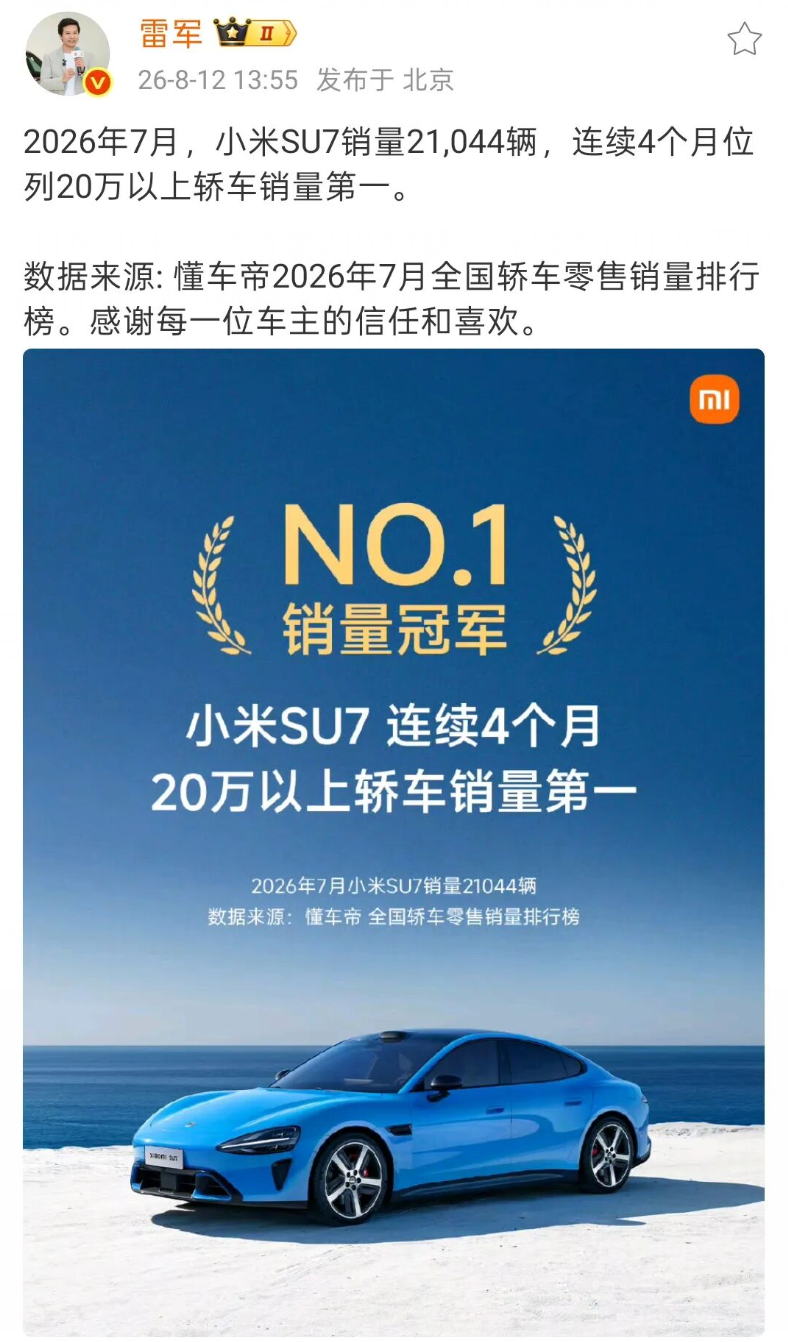
Image Source: Weibo
As the only domestic mid-to-large pure electric sedan capable of competing with the Tesla Model 3, after the SU7's explosive popularity, numerous competitors launched models with highly similar exteriors and pricing, leading netizens to joke that “everyone is following Xiaomi's lead.” This surreal automotive scene was born: while some netizens questioned the SU7's alleged copying, the entire industry was imitating its design. The exterior can be replicated, but core technology and experience cannot be copied, and the SU7's leading position remains unshaken.
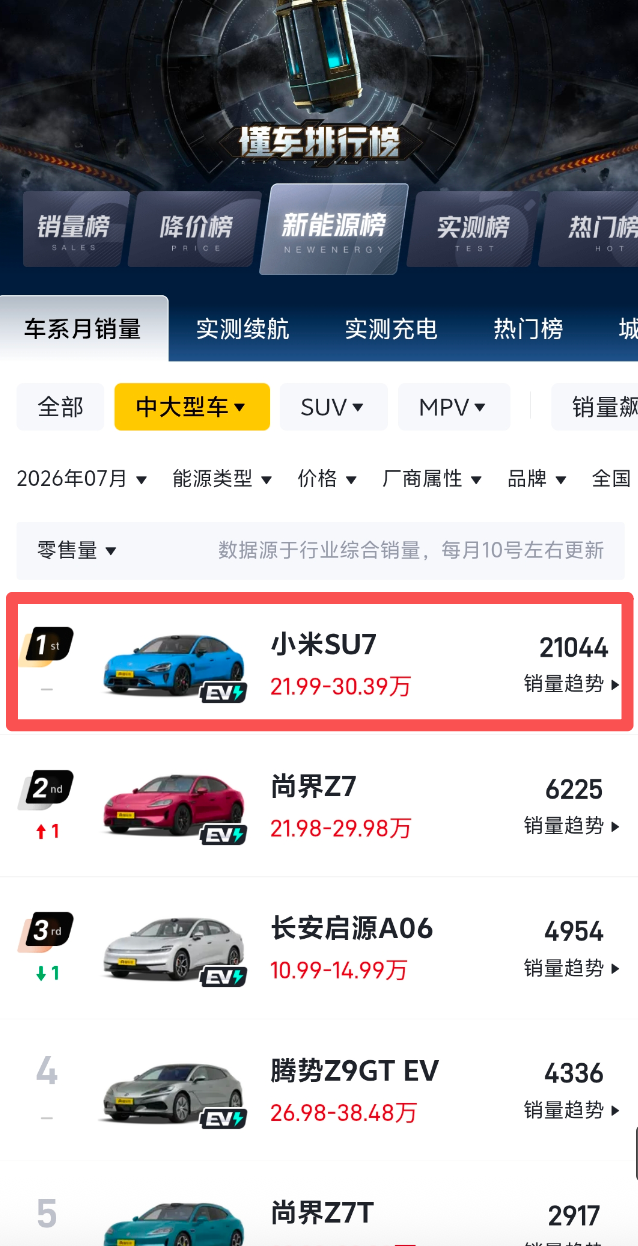
Image Source: DCD Auto
July’s sales data for mid-to-large sedans across all categories completely overturned traditional norms: Xiaomi SU7 led with 21,044 units, while the Mercedes-Benz E-Class sold 9,200 units, Audi A6L 6,992 units, and BMW 5 Series 5,874 units. The combined sales of BBA’s three classic luxury sedans totaled just 22,066 units, roughly equal to the SU7's single-model sales.
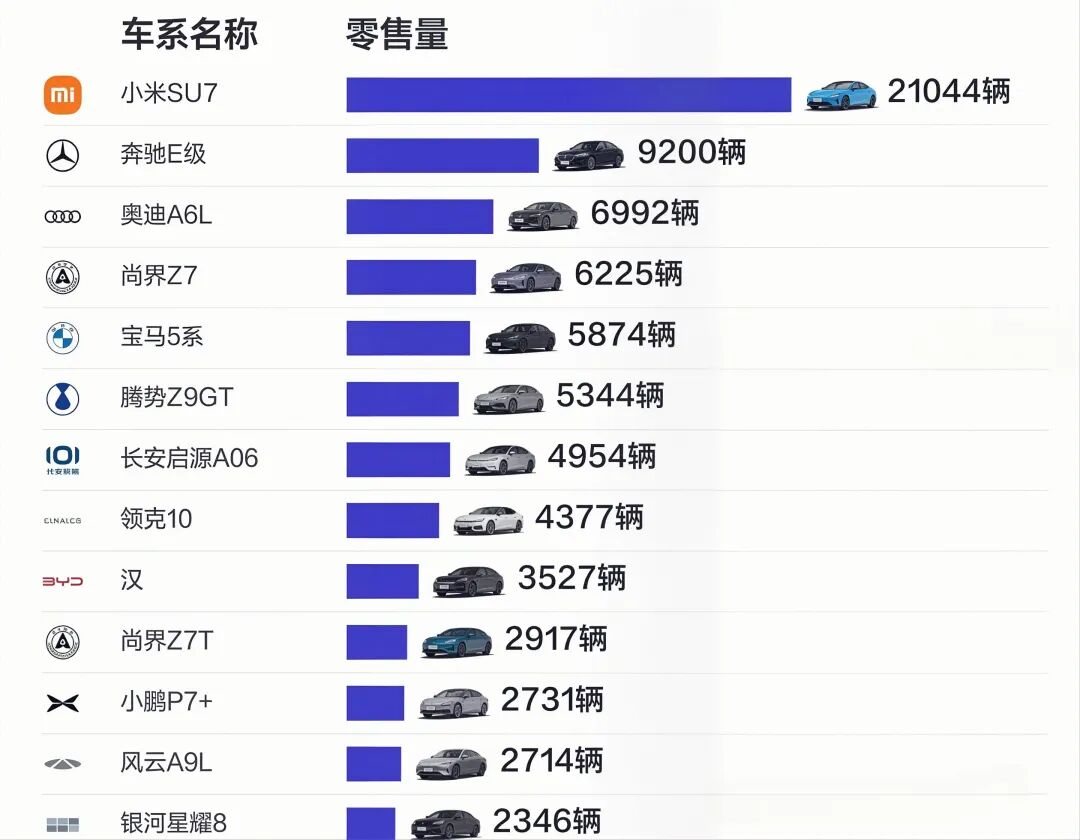 Image Source: Yiche Rankings
The BBA’s “56E,” which once monopolized the mid-to-high-end sedan market, is now easily matched by a domestic pure electric coupe, marking a historic reversal in the automotive market. The similarly styled Shangjie Z7 sold 6,225 units, outperforming the BMW 5 Series, leading many netizens to say: “Without similar models diverting orders, the SU7 could easily surpass 25,000 monthly sales.”
The current automotive market sentiment is deeply divided: Online skepticism and criticism persist, with many believing the SU7 relies on Xiaomi fans and hype for sales, but in reality, the SU7 is ubiquitous on the roads, with penetration rates continuously rising. This consistent performance of over 20,000 monthly sales during non-promotional periods, achieved without price cuts or hype, relies solely on product strength, completely outpacing established joint venture models like the Camry and rewriting the years-long joint venture monopoly.
Automotive Market: A Tale of Two Extremes – Domestic Rise, Joint Venture Fuel Vehicles Decline
The SU7's sustained success vividly demonstrates the current automotive market's polarization: New energy blockbusters continue to dominate, while traditional joint venture fuel vehicles collectively falter and accelerate toward marginalization. Today, from first-tier cities to smaller counties, the SU7's visibility is unmatched, successfully transitioning from a viral new model to a national bestseller for home use.
Traditional joint venture brands show clear signs of decline: Honda's sales have halved with consecutive losses, Chevrolet has nearly exited the Chinese market, and mainstream fuel vehicle sales from Volkswagen, BBA, and Toyota have all declined. Fuel vehicle market share has plummeted from a peak of 94.3% to less than 40%, marking the end of the golden era for joint venture fuel vehicles.
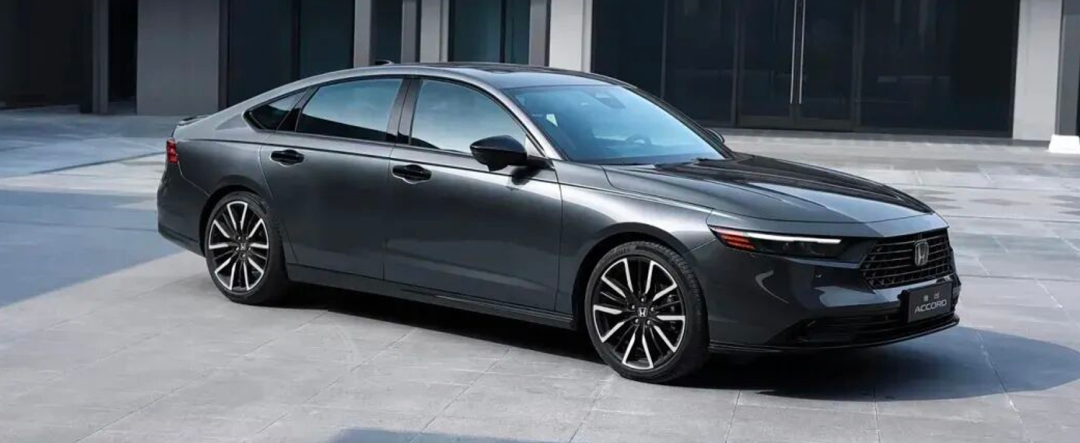 Image Source: 36Kr
One netizen accurately summarized: “Consumers are no longer paying for inflated brand premiums.” The Xiaomi SU7's popularity is the best microcosm of domestic new energy vehicles overtaking and surpassing foreign brands.
Breaking the “Short-Lived Internet Sensation” Curse – Hardcore Strength Supports Long-Term Success
During Xiaomi's early foray into automotive manufacturing, doubts flooded the internet, with many believing the SU7 was just a viral model for Xiaomi fans that would fade once hype died down. However, the frequent short-lived blockbuster phenomena in the new energy industry did not repeat with the SU7. Monthly sales championships, surpassing 100,000 units in six months, and consistently maintaining over 20,000 monthly sales during non-promotional periods—these hardcore data points have shattered the myth that viral models are fleeting.
The SU7 is not without flaws: while its sleek design offers high aesthetics, rear headroom is limited, providing a subpar experience for taller passengers—this is the only widely acknowledged drawback among car enthusiasts. Meanwhile, controversies over its exterior originality and Lei Jun's marketing style persist, but most owners agree that the vehicle's core strengths in range, intelligent driving, and driving experience are more than sufficient, with minor flaws not affecting daily home use or commuting.
In contrast, traditional joint venture fuel vehicles, with their slow iteration, outdated smart configurations, severe cost-cutting, and excessive premiums, cannot keep up with young users' demands and are inevitably being phased out by the market.
Rejecting Low-Price Competition – Delivering 300,000-Yuan Experience at 200,000-Yuan Pricing
The current automotive market suffers from severe cutthroat competition, with most automakers trapped in mindless price wars, selling at a loss and devaluing their brands. Xiaomi refuses to engage in price wars, instead focusing on value competition and forging a differentiated breakthrough path.
Priced affordably at 200,000 yuan, the SU7 comes standard with 800V high-voltage fast charging, LiDAR, advanced intelligent driving, and the HyperOS full-ecosystem cockpit, delivering across-the-board upgrades in three-electric performance, smart interaction, and driving experience, outclassing joint venture fuel vehicles in the same price range. In contrast, joint venture models priced at 200,000-300,000 yuan universally cut corners, failing to equip even basic smart configurations and driver assistance systems across all trims, highlighting a vast product strength gap.
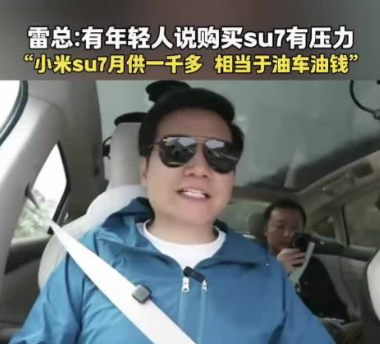
Image Source: Douyin
Netizens joke: “On one side, you have stacked configurations and service to enhance experience; on the other, cost-cutting to protect profits and rely on legacy strengths. The gap between old and new automotive markets is stark. Even if you don’t approve of Lei Jun's marketing, you can’t deny the SU7's configuration sincerity.”
Beyond hardware advantages, Xiaomi's service details continue to win fans. All national stores are equipped with AED defibrillators, prioritizing user safety and breaking the traditional 4S store model that prioritizes profits over service, shattering the outdated stereotype that “joint venture vehicles offer more reliable service.”
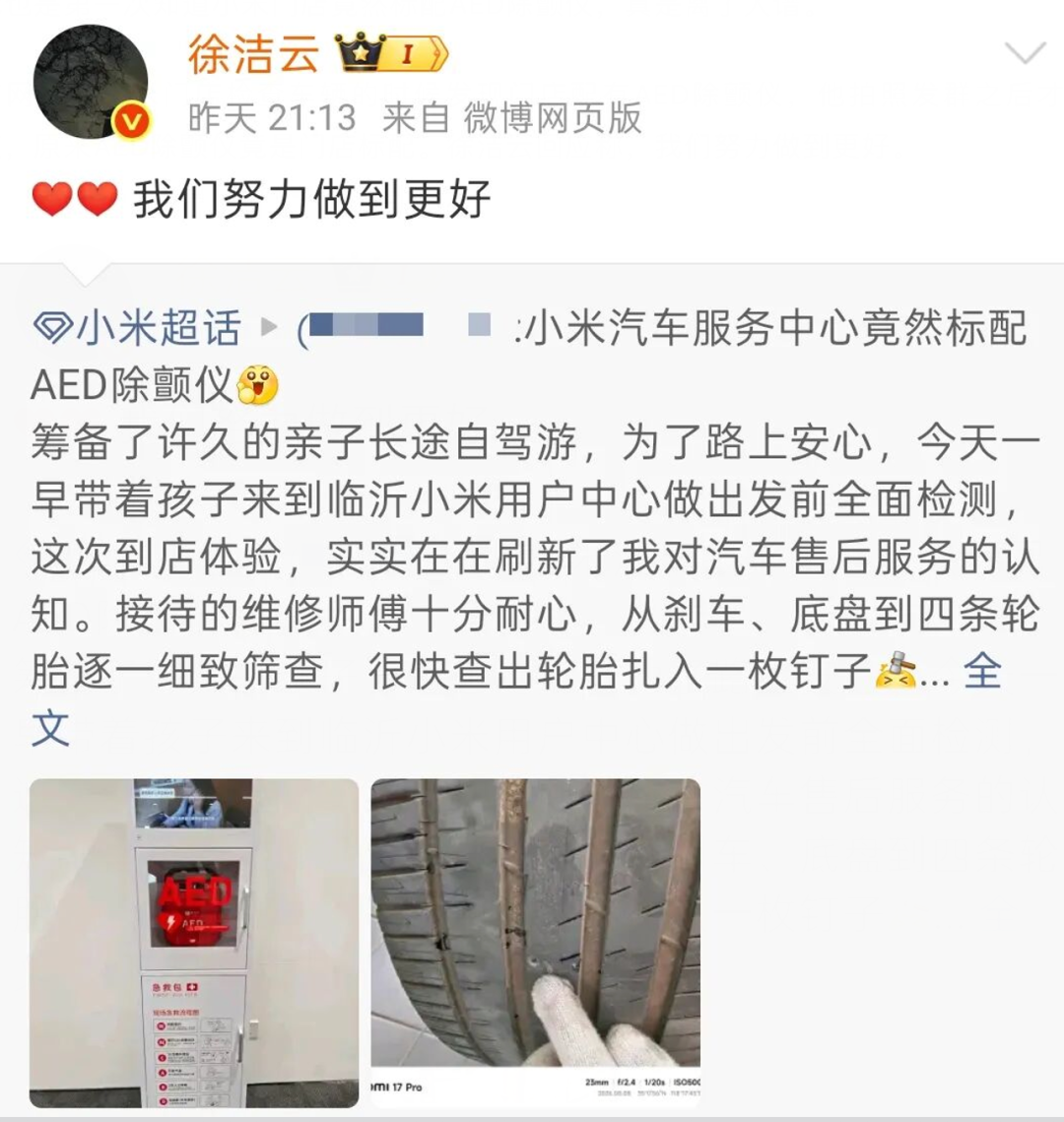
Image Source: Weibo
Exclusive Ecosystem Moat – The Core Advantage Competitors Cannot Replicate
Online debates persist over the SU7's long-term dominance: supporters credit its self-developed technology and ecosystem, while skeptics attribute it to marketing and Xiaomi fan bias. However, the SU7 undeniably possesses two irreplaceable core strengths: Lei Jun's long-term strategic layout and Xiaomi's unique human-vehicle-home ecosystem moat.
From the outset of automotive manufacturing, Lei Jun rejected short-term hype and quick profits, instead heavily investing tens of billions in core R&D areas like three-electric systems, pure electric platforms, and integrated casting, shedding the “assembly plant” label associated with cross-industry automakers. Most joint venture automakers' electrification efforts remain stuck at “oil-to-electric” conversions, with stagnant core technology.
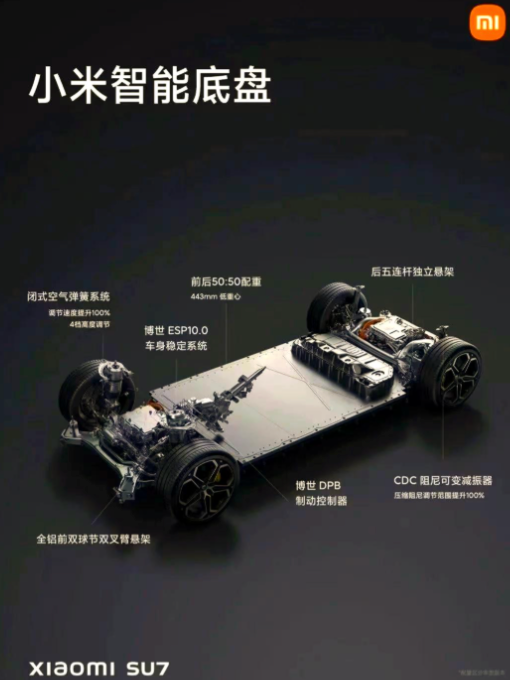
Image Source: Xiaomi Official
Leveraging its massive user base of hundreds of millions of smartphone and IoT users, Xiaomi Auto is not just a transportation tool but an entry point to a smart lifestyle ecosystem, with seamless device interconnection fostering strong user loyalty—a closed loop that foreign competitors cannot replicate. Meanwhile, Xiaomi repurposes its mature offline retail network to penetrate lower-tier markets at low cost, insists on OTA updates, listens to user feedback, and operates with a model far superior to the rigid, outdated traditional joint venture brands.
A Complete Paradigm Shift – Domestic New Energy Leads the Automotive Market
This round of automotive market reshuffling represents a comprehensive overhaul of old and new automotive manufacturing philosophies and business models. Joint venture brands, clinging to fuel vehicle legacy and lagging in intelligent transformation, cannot keep up with modern consumer demands, making their decline inevitable.
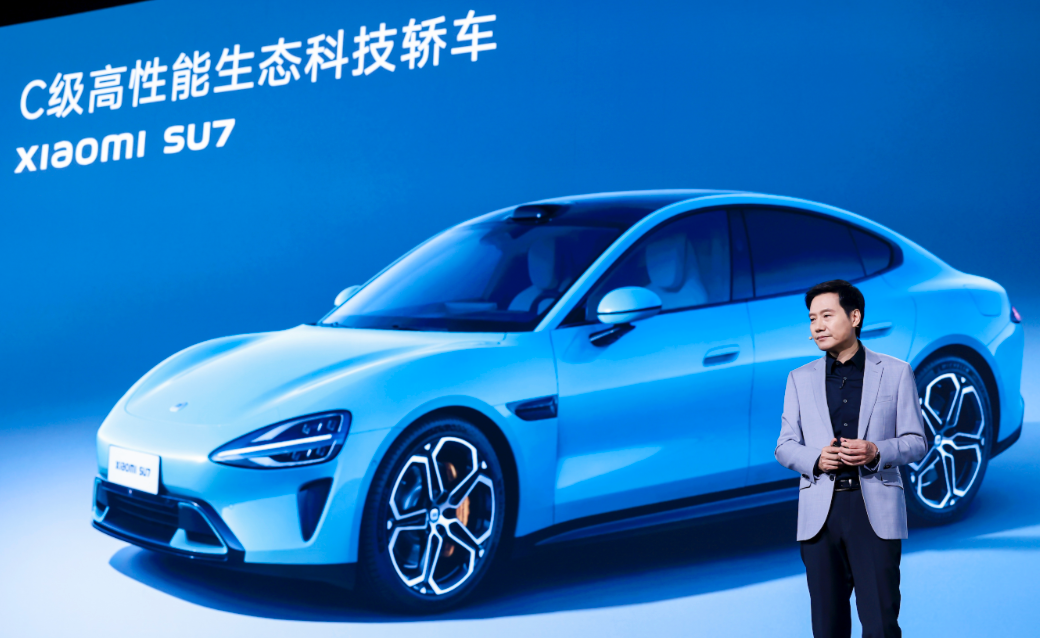
Image Source: Weibo
Even as the SU7 faces ongoing controversies over marketing and exterior design, the hardcore data of 500,000 deliveries in 28.5 months, four consecutive monthly championships, and single-model sales rivaling three BBA luxury sedans speak for themselves. Through self-developed technology, superior experience, ecosystem moats, and long-termism, the Xiaomi SU7 has breached the foreign-dominated high-end sedan segment, witnessing a comprehensive comeback for domestic new energy vehicles. The era of smart vehicles led by Chinese automakers has arrived.
Interactive Topic: What are your thoughts on the Xiaomi SU7 setting a new record of 500,000 deliveries? Do you think Lei Jun's promotional style is too flamboyant? Will controversies over its exterior design affect its long-term reputation? Can the SU7's rear headroom limitation prevent it from continuously capturing BBA market share? Share your opinions in the comments.
Disclaimer: This article is solely for financial commentary by major industry players and does not constitute investment advice. All corporate data and regulatory events mentioned are from publicly available information and are for reference only, with official announcements prevailing. Images sourced from the internet; please contact us for copyright removal if needed.
-
![]()
How Can the Charging Industry Overcome the Challenge of Inefficient Competition in the Era of Vehicle-Energy Integration?
-
![]()
The First Person in the World to Be 'Fired by AI' Has Appeared, but This AI Boss Made Me Laugh
-
![]()
What’s the Cost of Remaking ‘Cow Comes’ Using MiniMax Design?
-
![]()
AI Office Enters the Paid Era: Alibaba, Tencent, and ByteDance Engage in a 'Three-Way Showdown'
-
![]()
Can Pallas-1 Propel Galactic Energy to Secure the Third IPO Slot?
-
![]()
Lei Jun’s Xiaomi SU7 Shatters Records, Netizens Applaud Its Remarkable Achievement!
-
![]()
Porsche Won't Give Up on Manual Transmissions! Will Persist as Long as Regulations Allow and Market Demand Exists
-
![]()
This Summer, Car Rentals Are Surprisingly Affordable