AI Smartphones: Don't Expect Price Drops Anytime Soon
 08/18 2026
 398
398
In August 2026, Google and Honor almost simultaneously revealed their latest AI smartphones.
Google's Pixel 11, powered by Tensor G6, was officially described as "not just building a faster chip, but an engine built for a purpose": TPU performance increased by 50%, on-device AI tasks ran up to 3.5x faster, and energy consumption dropped to roughly one-third of the original. Honor's Robot Phone introduced a gimbal camera in hardware and collaborated with Alibaba's QianWen large model to create a terminal large model solution in software. YOYO could now execute over 100 complex tasks consecutively and launched Agentic OS.
As new smartphone releases surged in August and September, how would mobile devices step into the AI era?
Let's rewind the story of mobile computing power nine years ago. In 2017, Huawei's Kirin 970 and Apple's A11 both launched the first Neural Processing Units (NPUs) for smartphones in the same month. Back then, mobile chip manufacturers grappled with the question: What should all this computing power be used for? Computational photography, Face ID, or voice assistants? However, without killer applications, TOPS (Tera Operations Per Second) for mobile chips never became the biggest selling point.
In 2023, generative AI made computing power a buzzword in the tech industry. By 2025, intelligent agents rapidly evolved, and physical AI became a key industry direction, with smartphones serving as a crucial carrier. AI's demand for computing power brought mobile performance back to center stage. Real-world tests showed that computing power significantly impacted user AI experience. Some users ran Gemma 4 on a vivo Y500 Pro, waiting 2.8 minutes for a 500-word response, with image recognition freezing for 5 minutes and the app crashing. This led many users to disable most on-device AI features shortly after purchasing AI smartphones. It's foreseeable that as smartphones enter the AI era, mobile chips will reignite the performance race.
To meet AI demands, NPUs in smartphones are evolving from general-purpose inference accelerators into processors tailored for Transformer/MoE architectures. This trend aligns with the emergence of AI inference cards, shifting design logic from "general-purpose performance" to "model-aware," enabling chips to understand models and vice versa.
Apple integrated AI accelerators into the GPU of the A19 Pro, allowing LLM/Diffusion inference to simultaneously utilize three parallel engines: GPU compute units + NA matrix units + NE 16-core. The iPhone 17 Pro maintained a 30+ tok/s inference speed when continuously running large models (e.g., Apple Intelligence's on-device 3B LLM).
Google's Tensor chips, from foundational architecture to hardware-software synergy, were deeply customized for on-device AI and high-performance, low-power inference. The TPU optimized matrix multiplication and accumulation (GEMM) for neural networks, enabling direct data flow between compute units, reducing RAM access frequency, and improving energy efficiency. It natively supported low-precision formats like INT8/FP16/BF16, significantly cutting memory bandwidth and power consumption with minimal accuracy loss. For Transformer attention mechanisms, it added high-speed SRAM caching and high-bandwidth memory scheduling, reducing first-token latency and continuous output power for on-device generative AI.
Qualcomm integrated scalar, vector, and tensor accelerators into a single NPU, reducing data transfer delays between units. It broke down neural network layers into micro-slices and deeply fused them (supporting up to 10+ layers simultaneously), minimizing external DRAM access and enabling intermediate data computation on-chip, drastically lowering power consumption. The NPU featured large on-chip shared high-speed caches, providing high bandwidth for Large Language Models (LLMs) and Vision Transformers (ViTs), reducing power consumption from memory access.
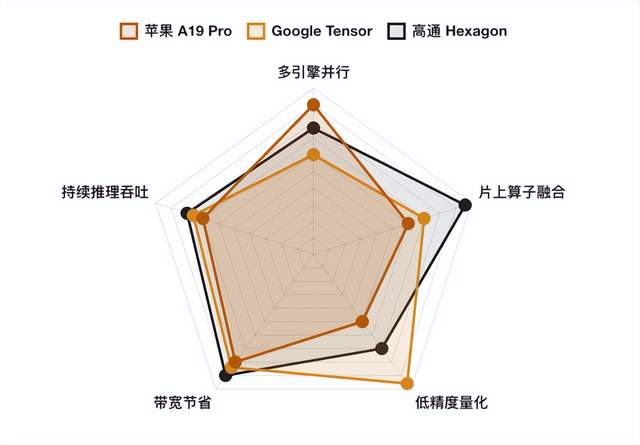
As chip design began revolving around models, relationships between chip and model manufacturers transformed. Some chip companies forged ecosystem-level partnerships with large model vendors. MediaTek deployed StepFun's ACE-Step music model on the Dimensity 9500 platform via on-device visualization, significantly boosting model and algorithm porting efficiency. Naturally, companies like Google, with its proprietary Gemini large model, gained a first-mover advantage in mobile AI.
Hardware-software integration became paramount in the AI era. A 7B model (FP16, 14GB) required reading all weights to generate each token, limiting theoretical throughput to ~5 tok/s at 67–85GB/s bandwidth (pure bandwidth calculation, independent of third-party compute estimates). Under unchanged bandwidth and chip design, compressing weights from 2 bytes to 0.5 bytes and shrinking the model to ~3.5GB quadrupled theoretical speed (67GB/s ÷ 3.5GB ≈ 19 tok/s). Achieving this required native chip support for INT4/INT2/FP8 computations, as only chips with corresponding units could deliver such speed. Quantization had limits—below INT4, accuracy loss became noticeable. However, smartphones often lacked not compute power but memory bandwidth.
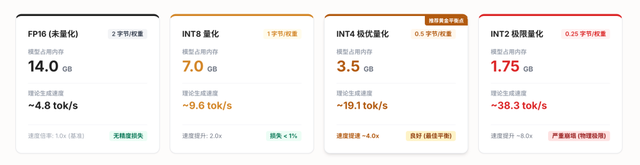
Computing power is just one aspect of the AI smartphone experience. Even with ample transistors, throughput to users remains constrained by channel limitations.
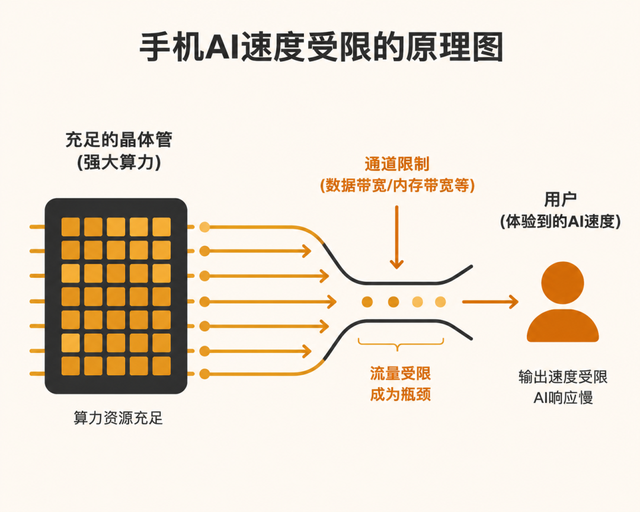
Why do we say mobile chip computing power is sufficient? Someone attached two CPU coolers to a Snapdragon 8 Elite smartphone and ran *The Witcher 3* at 1080p ultra settings, achieving 20–30 FPS with GPU utilization at 99%. This demonstrated that raw mobile chip computing power already rivaled PCs. However, in AI inference scenarios, computing power alone wasn't the sole focus for AI experience. Large models generated text via "autoregressive decoding," requiring a full model weight read for each token. This meant generation speed heavily depended on memory bandwidth, not just processor compute units.
To boost memory, MediaTek's Dimensity 9500 introduced a compute-in-memory NPU. Both Google and Qualcomm, as mentioned earlier, optimized memory access speeds.
JEDEC released the LPDDR6 standard in July 2025. LPDDR5X speeds rose from 8.5Gbps to 10.7Gbps, with bandwidth increasing from 51GB/s to 85GB/s. Compared to LPDDR5X, LPDDR6 offered significant improvements in performance and energy efficiency. Its data throughput increased by 33%, with single-pin transmission rates reaching 14.4Gbps, while memory power consumption dropped over 20% from the previous generation. SK Hynix announced LPDDR6 products using sixth-generation 10nm-class (1c) process technology, with single-chip capacities up to 16GB.
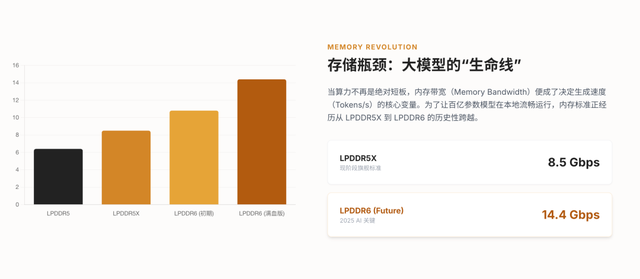
Much like HBM's significance in the AI era, on-device AI performance is unlikely to see qualitative breakthroughs until LPDDR6 mass production and compute-in-memory maturity. Though LPDDR6 is imminent, large-scale commercialization will take time. Current memory prices are already exorbitant, and the new standard will further inflate costs, directly impacting retail prices and hindering shipments. For mobile memory bandwidth to jump from 85GB/s to levels capable of smoothly running large models, not only technological breakthroughs but also a cooling-off of the memory market are needed.
03 Industry Chain Ripple Effects: Memory Price Hikes, Capacity Crunch, Model Licensing Fees
For consumers, the cost of smartphones entering the AI era is already apparent.
Memory was the first sector impacted. Manufacturers shifted production to HBM and DDR5, slashing DDR4 output. LPDDR5's share in smartphones was projected to rise to 73% by 2026. Mobile devices were forced to upgrade: 12GB became the "minimum" for AI smartphones, 16GB LPDDR5X the flagship standard, and some models reached 24GB. TrendForce's latest smartphone industry research showed soaring component costs, led by memory, expected to significantly raise production costs for Apple's next-gen iPhone 18 series. The Bill of Materials (BOM) cost for the 256GB version was projected to rise ~38% year-over-year. Memory costs, which accounted for ~10% in 2025, were expected to exceed 40% by H1 2027.
Advanced process nodes faced capacity constraints, raising mobile processor costs. TSMC increased its 2026 capital expenditures to a record $60–64 billion, notifying customers of price hikes for 7nm and below processes. AI accelerators occupied most N3 capacity, squeezing advanced node availability for smartphone chip clients like Qualcomm and MediaTek. CoWoS advanced packaging also prioritized AI chips, indirectly driving up overall foundry costs.
Model manufacturers entered the spotlight. Both consumers and smartphone makers needed model vendors to create more on-device-friendly "small models," adding a middleman between them. As integrators, smartphone makers could decide which models to use, which features to run on-device vs. cloud, and how to allocate memory and cooling budgets. Consequently, some smartphone makers began developing in-house models, driven by bargaining power considerations.
Currently, AI smartphone adoption is primarily driven by flagship models including AI capabilities as a standard feature—a "passive popularization " (passive adoption) dynamic. AI's appeal to users remains limited, with a gap between early adopters and the mainstream market. While mobile processor vendors tout on-device AI for local privacy protection, the industry consensus remains hybrid on-device-cloud AI for now. No mainstream manufacturer, whether for AIPC or AI smartphones, pursues a pure on-device approach. The privacy and low-latency benefits of on-device AI have yet to translate into clear consumer willingness to pay extra. For mobile AI, the industry faces a fundamental question: Will consumers actively upgrade phones for AI features?
From a user experience standpoint, the most noticeable improvements remain in "nice-to-have" scenarios like photo editing, translation, and summarization. Groundbreaking designs are still missing. AI smartphones lack an "iPhone moment," "ChatGPT moment," or "DeepSeek moment." While vendors' roadmaps prioritize "intelligent agents" as the next focus, the threshold for integrating agents with smartphones hasn't been crossed. Crossing it could make AI a true driver for device upgrades; failing to do so would relegate on-device AI to a marketing label for high-end models.
Until LPDDR6 mass production and memory market cooling occur, AI smartphones won't see price drops.
-
![]()
AI Office Enters the Paid Era: Alibaba, Tencent, and ByteDance Engage in a 'Three-Way Showdown'
-
![]()
Can Pallas-1 Propel Galactic Energy to Secure the Third IPO Slot?
-
![]()
Lei Jun’s Xiaomi SU7 Shatters Records, Netizens Applaud Its Remarkable Achievement!
-
![]()
Porsche Won't Give Up on Manual Transmissions! Will Persist as Long as Regulations Allow and Market Demand Exists
-
![]()
This Summer, Car Rentals Are Surprisingly Affordable
-
![]()
MiniMax H3 Closes In, Leaving Seedance with Limited Safe Space
-
![]()
Blockbuster! Li Shufu Steps Down as Chairman, An Conghui Takes Over, Geely Ushers in 'Coming-of-Age' Moment
-
![]()
AI Smartphones: Don't Expect Price Drops Anytime Soon