Blockbuster Move: Jensen Huang's Strategic Investment Tied to Elon Musk's Ventures
 08/21 2026
 534
534
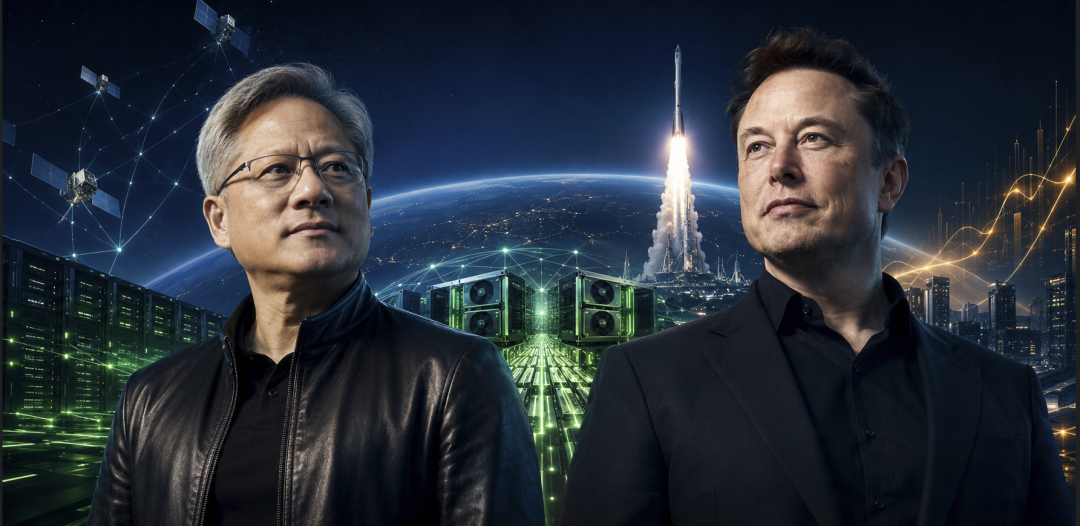
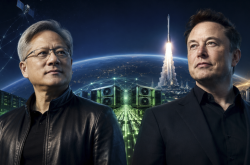
The buzz today surrounds the news that Jensen Huang is linked to an investment in Elon Musk's endeavors.
First, let's clear up a common misconception. Strictly speaking, it's not Jensen Huang personally investing in Elon Musk. Rather, NVIDIA has acquired a significant stake in SpaceX through its investment in xAI.
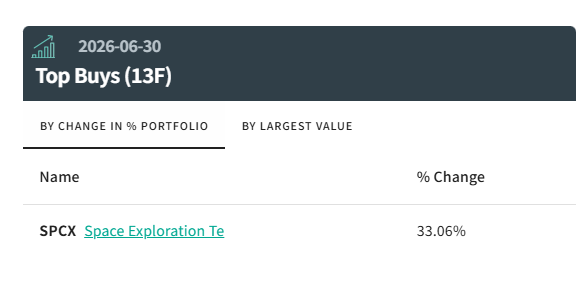
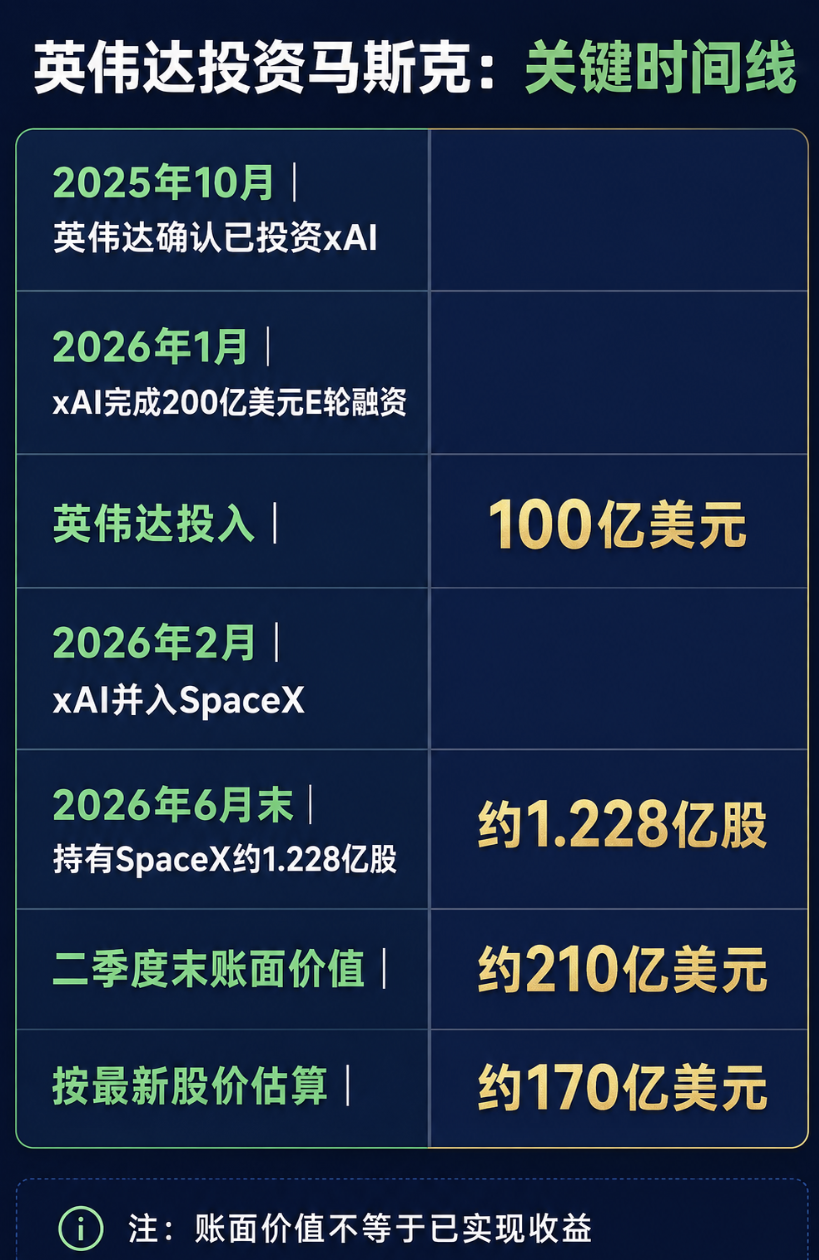
According to NVIDIA's latest filing with the U.S. Securities and Exchange Commission, as of the end of June 2026, the company held approximately 122.8 million shares of SpaceX, with a book value nearing $21 billion at that time. Based on the current stock price, this investment is now valued at around $17 billion.
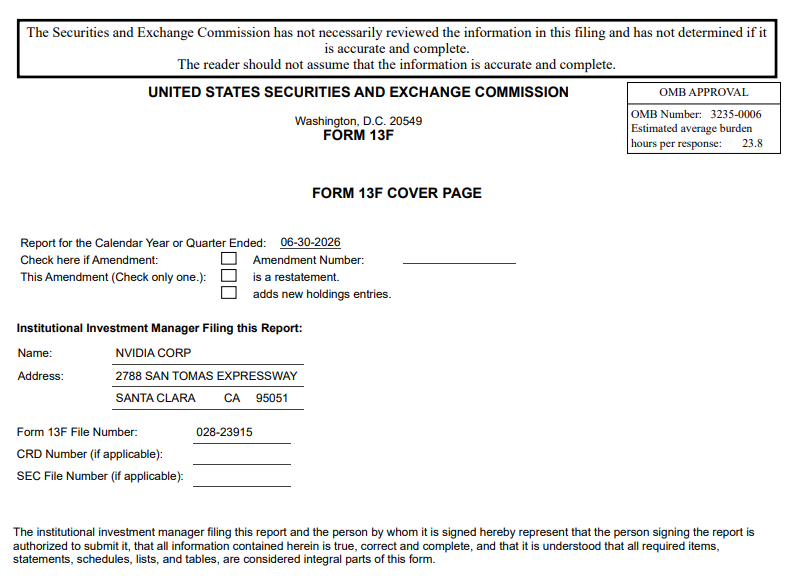
This stake primarily originates from NVIDIA's $10 billion investment in xAI made in January of this year.
A month subsequent to this investment, xAI merged with SpaceX. A straightforward calculation reveals that the book value at the end of the second quarter had surged by approximately $11 billion compared to the initial investment cost. Even considering the latest stock price, the unrealized gain still stands at around $7 billion.
This investment is indeed remarkable, but focusing solely on the paper profit would be an oversimplification of Jensen Huang's strategic move.

The $10 billion investment secures more than just shares
This development has captured attention primarily because two titans of the global tech industry are now intertwined at the capital level.
Jensen Huang commands the world's most coveted AI computing power platform, while Elon Musk has seamlessly integrated large-scale models, social platforms, autonomous driving, humanoid robots, rockets, and satellite networks into a cohesive business ecosystem.
Previously, they operated as supplier and customer; now, they've added a shareholder dimension to their relationship.
Moreover, the return on this investment materialized swiftly. xAI secured a $20 billion Series E funding round in January 2026, with NVIDIA as a strategic investor. By February, xAI had merged with SpaceX.
By the end of June, the book value of NVIDIA's SpaceX shares had nearly doubled from the initial investment.
However, unrealized gains don't equate to cash in hand. Following SpaceX's public listing, its stock price experienced fluctuations, causing the estimated market value of NVIDIA's holdings to decline from about $21 billion to around $17 billion. Describing the $21 billion as "earned $11 billion" is inaccurate. A more precise statement would be that NVIDIA achieved approximately $11 billion in unrealized gains by the end of the second quarter.
What truly warrants examination is why Jensen Huang was willing to commit $10 billion to Elon Musk's ventures.
The astute Jensen Huang isn't betting on an individual but securing a lucrative computing power resource.
The primary motive is to secure a major future GPU buyer. The Colossus supercomputing cluster, constructed by xAI, is already a significant consumer of NVIDIA GPUs and high-speed networks.
In 2024, NVIDIA revealed that the cluster was expanding from 100,000 Hopper GPUs to 200,000. Now, as part of the SpaceX ecosystem, xAI's computing power demands will extend beyond Grok to encompass satellite communications, robotics, autonomous driving, engineering simulations, and orbital calculations.
This implies that NVIDIA's investment yields capital returns and the potential for years of chip, network, and software orders.
For ordinary investors, returns stem from stock price appreciation. For NVIDIA, returns can also arise from customer expansion, allowing for simultaneous capital and operational gains.
The secondary motive is to establish an early foothold in space computing. Ground data centers face increasing constraints due to power, land, and cooling limitations. Musk's rocket launch capabilities, satellite networks, and AI businesses offer a unique industrial synergy that could materialize orbital computing. SpaceX is also forging collaborations on satellite AI computing payloads.
While this direction presents technical and cost challenges in the short term, once scaled, NVIDIA could transition from a ground AI factory core supplier to the underlying platform for space AI infrastructure.
The tertiary motive is to transform NVIDIA from a mere chip seller to an organizer of the computing power ecosystem.
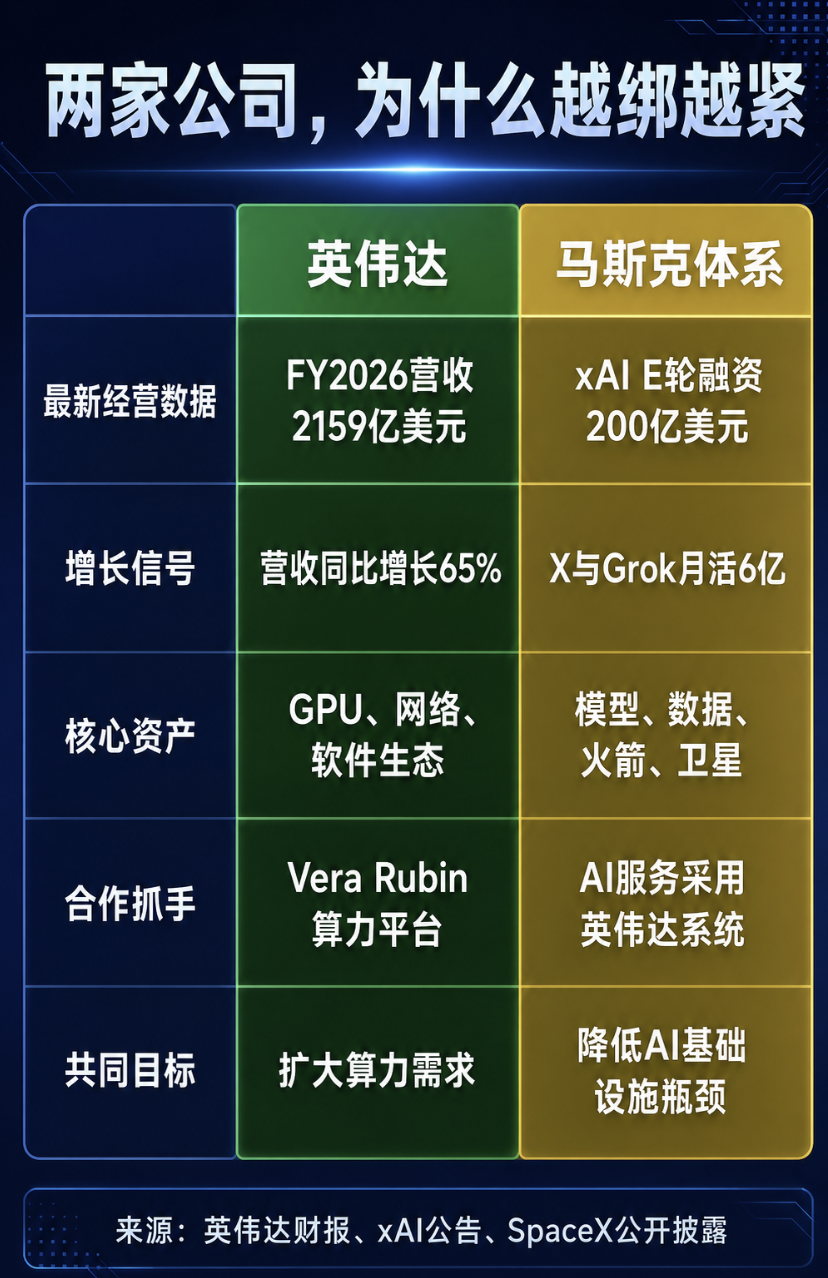
NVIDIA's fiscal year 2026 revenue soared to $215.9 billion, marking a 65% year-over-year increase, with fourth-quarter data center revenue reaching $62.3 billion. In the first quarter of fiscal year 2027, revenue further surged to $81.6 billion, with data center revenue at $75.2 billion.
This robust cash-generating capability enables NVIDIA to pursue a strategy that competitors find challenging to replicate: investing profits in customers, aiding in computing power expansion through investment, and subsequently having customers procure more NVIDIA systems.
This strategy is astute. Chips serve as the entry point; capital acts as the amplifier, while CUDA, networks, complete machines, and financing capabilities collectively form the competitive moat.
Musk also stands to gain significantly from Jensen Huang—and urgently so
This relationship is mutually beneficial. Musk possesses data, users, and application scenarios, but computing power remains the most formidable barrier in the AI race. xAI disclosed that the combined monthly active users of X and Grok applications have surged to 600 million. Increased user base translates to higher computing power consumption for model training, inference, and video generation.
NVIDIA can supply not only GPUs but also Spectrum X networks, the Vera Rubin platform, software toolchains, and comprehensive cluster deployment experience. Musk recently publicly stated that SpaceX's future AI services will be based on NVIDIA systems and expressed optimism about the Vera Rubin architecture.
On one side lies the most voracious demand for computing power; on the other, the strongest delivery capability. The collaboration between the two companies transcends mere celebrity endorsement; it represents a profound integration of supply and demand.
The global AI industry is entering a phase where capital and orders mutually reinforce each other. In my view, this deal will have three significant impacts.
The unit of AI competition is evolving. Previously, it revolved around model parameters; now, it's about organizing chips, power, networks, financing, and applications cohesively. While single-point technologies remain crucial, systemic capability increasingly determines industrial pace.
The "Head Effect" may continue to intensify. NVIDIA supports major clients with capital, and these clients reciprocate with orders, subsequently training stronger models through larger clusters. This cycle will raise the barrier for latecomers in cutting-edge AI and compel AMD, cloud vendors' self-developed chips, and other infrastructure suppliers to accelerate alliances.
AI will integrate more rapidly with aerospace, automotive, and robotics. The greatest value of Musk's ecosystem lies not in the individual size of each company but in the seamless flow of data across scenarios and the reuse of computing power across businesses.
Satellites provide connectivity; cars and robots generate real-world data; large models handle understanding and decision-making; GPUs undertake training and inference. Industrial boundaries are being redrawn.
However, this model is not without risks. Suppliers investing in clients, who then massively procure supplier products, can easily raise market concerns about circular financing and genuine end-user demand.
SpaceX's stock price fluctuations also underscore that even excellent assets do not solely appreciate. If AI commercialization speed cannot keep pace with capital expenditures, today's synergistic advantages could become tomorrow's asset burdens.
Final Verdict
The most striking aspect of Jensen Huang's investment this time is not the paper profit accrued in half a year but that he secured three critical elements with $10 billion: long-term orders from a super customer, entry into Musk's technological landscape, and a priority position in the next generation of AI infrastructure.
Musk gains capital and computing power; Huang gains demand and scenarios. The two are not merely forming an alliance but are jointly constructing a highway from GPUs to large models, robots, cars, and space computing.
If this road is successfully built, NVIDIA's earnings will transcend mere equity returns, and SpaceX's gains will extend beyond cheaper capital. The competitive rules of the global AI industry will be rewritten.
While capital markets focus on calculating paper profits, the true industrial victors are calculating entry points for the next decade.
What's your perspective on Huang's investment in Musk's ventures?
-
![]()
Blockbuster Move: Jensen Huang's Strategic Investment Tied to Elon Musk's Ventures
-
![]()
When Even Boxy SUVs Embrace Smart Driving, What Future Awaits Off-Road Vehicles?
-
![]()
Three Major Factions Lock Horns in Fierce Contest, Chengdu Auto Show Sizzles with Anticipation
-
![]()
Alibaba's AI Ledger, Calculated So Clearly for the First Time | Earnings Report Insight
-
![]()
HONOR Robot Phone: Telling the Lightest AI Story with the Heaviest Hardware
-
![]()
Yu Chengdong's Harmony Intelligent Travel Achieves 'First in New Force Deliveries', Netizens: Unbeatable Win
-
![]()
Six Entities Invest 8.2 Billion to Launch Shenlong Technology
-
![]()
Give BMW X3 a Chance?