Alibaba’s New Fiscal Quarter: 45% Revenue Surge in Alibaba Cloud, Enhanced Profitability in AI Cloud, but Widening Losses in the Application Layer
 08/23 2026
 537
537
Alibaba’s Two AI Pillars Show Divergent Performance: Cloud and Computing Services Soar with High Growth, Wu Yongming Predicts ROI Within Three Years, While AI Lab and Qwen Application Businesses Face RMB 13.9 Billion Loss but Remain Competitive
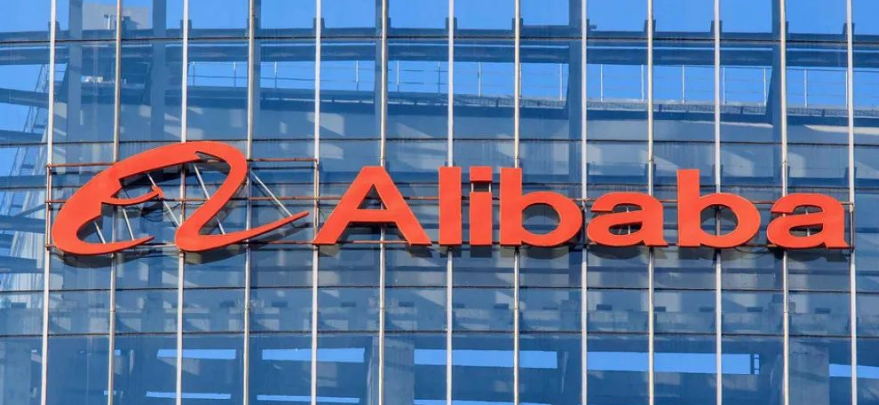
According to the Yangtze Evening Post, Alibaba Group released its financial report for the first quarter of fiscal year 2027 on August 20, revealing a significant acceleration in AI commercialization this quarter, with a 45% increase in external commercial revenue for Alibaba Cloud.
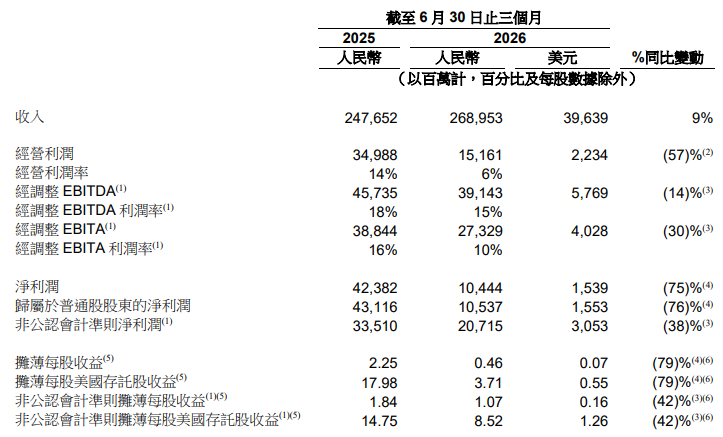
This quarter, Alibaba’s strategic investments in AI have continued to pay off, resulting in leading full-stack AI capabilities and tangible business growth. From computing power and chips to models and AI applications, the AI + cloud sector has seen comprehensive acceleration.
On one hand, the performance of AI cloud and computing services businesses has been remarkable.
Alibaba Cloud’s external commercial revenue experienced robust growth of 45%. Alongside this revenue growth, the EBITA profit of the AI cloud and computing services division also surged by 133% year-on-year, with the adjusted EBITA margin climbing to 12%. Additionally, the structural quality of Alibaba Cloud’s accelerated growth continues to improve, with quarterly revenue from AI-related products reaching RMB 12.376 billion, marking the twelfth consecutive quarter of triple-digit year-on-year growth. AI has unequivocally become the driving force behind cloud growth.
At the chip level, Alibaba has achieved large-scale commercialization of its self-developed computing power. T-Head has established a full-stack self-developed system encompassing GPUs, CPUs, and network chips, including the latest-generation AI processor Zhenwu M890. Through Alibaba Cloud, Zhenwu chips have been widely adopted by over 650 external clients across more than 20 industries, including autonomous driving, internet, and finance.
Moreover, Alibaba Cloud has shortened the delivery cycle for large-scale AI data centers to 100 days. This year, the production capacity efficiency of its self-developed modular data centers will more than double to meet the surging demand for AI computing power.
Wu Yongming, CEO of Alibaba Group, stated that the company delivered strong performance this quarter, with full-stack AI capabilities driving sustained improvements in commercial returns. External commercial revenue for Alibaba Cloud accelerated to 45% growth, while revenue from AI-related products has maintained triple-digit year-on-year growth for the twelfth consecutive quarter.
Wu also highlighted that Alibaba’s recently released cutting-edge language, programming, video, voice, image, and music models all rank among the top performers. The company launched Qwen Office, an AI productivity platform designed to enhance enterprise production efficiency and capabilities. Leveraging its full-stack AI strategy, Alibaba is well-positioned to capitalize on significant growth opportunities in the AI and AI computing power markets.
On the other hand, the adjusted EBITA loss for the AI Lab and application business amounted to RMB 13.861 billion, compared to a loss of RMB 3.224 billion in the same period last year. This widening loss is primarily attributed to increased investment in AI capabilities and inference costs associated with the Qwen app.
The financial report indicates that the Qwen APP has been integrated into business scenarios such as Taobao, Tmall, and Taobao Deals. To date, 250 million users have experienced AI-driven shopping scenarios through intelligent agent functions. In the enterprise market, Alibaba launched Qwen Office, aiming to penetrate enterprise productivity scenarios through AI models and intelligent agent capabilities.
However, as the scale of applications expands, cost issues have surfaced. This quarter, revenue from the AI Lab and application business reached RMB 3.338 billion, up 16% year-on-year, but the adjusted EBITA loss stood at RMB 13.861 billion, compared to a loss of RMB 3.224 billion in the same period last year. The financial report attributed the widening loss to increased investment in AI capabilities and inference costs related to the Qwen APP.
Currently, there is no immediate solution to this challenge. Infrastructure commercialization is progressing rapidly because enterprise clients already have clear demands, while the application layer requires re-establishing user habits and payment models.
During the internet era, Alibaba generated cash from its mature e-commerce business to invest in new ventures like cloud computing. In the AI era, this cycle is lengthening, as infrastructure needs to be built in advance, models require training, and applications must await scale effects.
According to Dolphin Research, Alibaba’s main future prospects and growth potential still lie in its AI and cloud businesses. Specifically, this depends on 2+1 factors: the two most critical are the acceleration in Alibaba Cloud’s growth rate and the industry ranking of the Qwen flagship model, while a relatively secondary factor is the cost advantage that T-Head’s self-developed chips can bring to Alibaba.
First, regarding the future momentum of cloud revenue growth, since current demand clearly outstrips supply, the pace of revenue release primarily depends on the speed of computing power deployment. Combined with Alibaba’s nearly doubled Capex (capital expenditures) quarter-on-quarter this quarter and recent reports of relaxed imports of chips like H200, it is foreseeable that Alibaba Cloud’s computing power deployment will significantly accelerate in the coming quarters, driving further revenue growth.
Another notable development is that the self-developed Qwen large model has regained a near-top-tier ranking domestically. Previously, due to the departure of some R&D members, the Qwen model’s performance ranking had fallen significantly behind unicorn companies like Zhipu, Kimi, and DeepSeek.
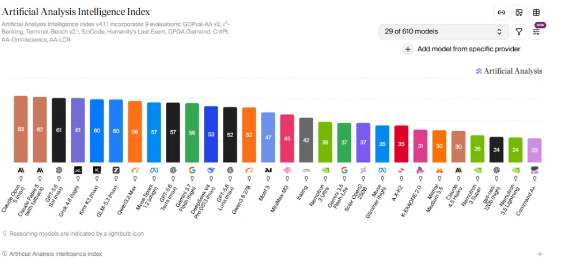
Source: Dolphin Research
After the release of Qwen 3.8, its performance ranking has re-approached domestic SOTA levels such as Kimi K3 and GLM 5.3 (though it has not yet surpassed them). Logically, Alibaba Cloud can sell any open-source model, but the capability level of its exclusive self-developed models remains a key differentiator when competing for clients.
Additionally, self-developed models can better optimize hardware matching, offering relatively higher profit margins. In the long run, cost and efficiency differences are also core competitive barriers in the cloud industry.
According to the latest domestic AI rankings released by Maomu in August 2026, DeepSeek reclaimed the top spot in the AI traffic rankings (domestic) last month, with 355 million monthly visits, achieving a significant lead. Previously, Doubao, which had consistently dominated C-end user traffic, fell to second place with 87.1439 million monthly visits.
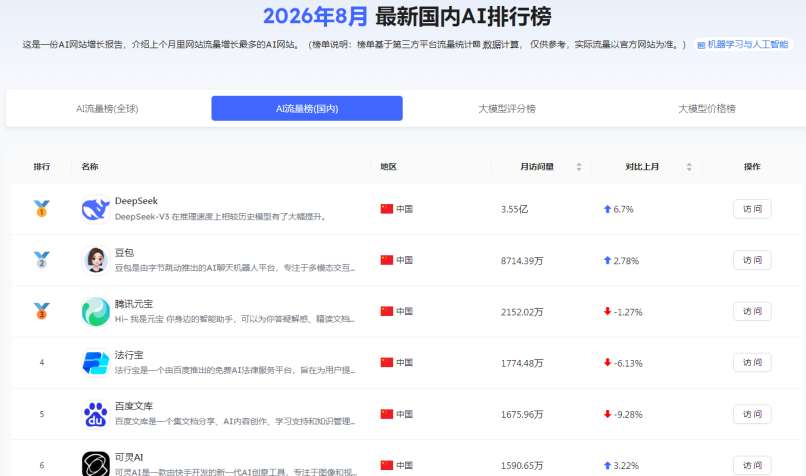
Alibaba’s Wan.Video ranked 35th with 1.4388 million monthly visits, Tongyi Wanxiang ranked 44th with 747,100 monthly visits, and Tongyi Qianwen ranked 57th with 520,200 monthly visits. Alibaba’s entire product lineup still lags significantly behind other domestic large models in terms of C-end user traffic.
-
![]()
Raking in Big Profits Overseas! Chery’s Overseas Revenue Makes Up 70% in H1, with Gross Margin Climbing to 16.1%
-
![]()
Alibaba’s New Fiscal Quarter: 45% Revenue Surge in Alibaba Cloud, Enhanced Profitability in AI Cloud, but Widening Losses in the Application Layer
-
![]()
The AI Version of 'PayPal Mafia' Has Arrived: 20 AI Startups Raise Over $4.6 Billion in Funding
-
![]()
Wang Jian's Vision: Paving a Pathway for Alibaba Through AI
-
![]()
Hyundai Motor Workers Strike Today, Fearing Job Losses to Robots
-
![]()
Embracing 'Light': O-film Unveils Its 'Illuminating the Future' Strategy
-
![]()
SenseTime’s SenseNova U1.5 Lite Goes Open Source: Ushering in a New Era of Predictable AI Image Generation
-
![]()
Collaboration Initiated! Tesla Officially Welcomes Doubao Onboard