iPhone Air Suffers Catastrophic Setback in China! Price Slashed by 2900 Yuan, Production Slashed by 80%: Is This Apple's "Strategic Retreat"?
 01/26 2026
 536
536
A clearance sale is in full swing.
On January 25th, the Chinese version of the iPhone Air embarked on a large-scale promotional price drop across multiple platforms, including the Apple Store on Tmall, JD.com's flagship Apple store, Pinduoduo's 10 billion subsidy initiative, and numerous other authorized Apple dealers both online and offline.
This is undeniably an official Apple "large-scale" price reduction campaign, mobilizing both online and offline channels, including its own Apple Store on Tmall, and it is set to last at least until February 11th.
In terms of the magnitude of the price reduction, the iPhone Air, launched in late October with a starting price of 7999 yuan, is now available for as low as 5499 yuan after a direct reduction of 2000 yuan and an additional 500 yuan national subsidy. On platforms like JD.com's self-operated store, with an extra 400 yuan trade-in subsidy, the iPhone Air can be purchased for as low as 5099 yuan, marking a significant price drop of 2900 yuan from its initial price.
It's noteworthy that Pinduoduo's participation in the 10 billion subsidy program suggests that the iPhone Air may maintain a price point around 5000 yuan or even be pushed lower in third-party channels.
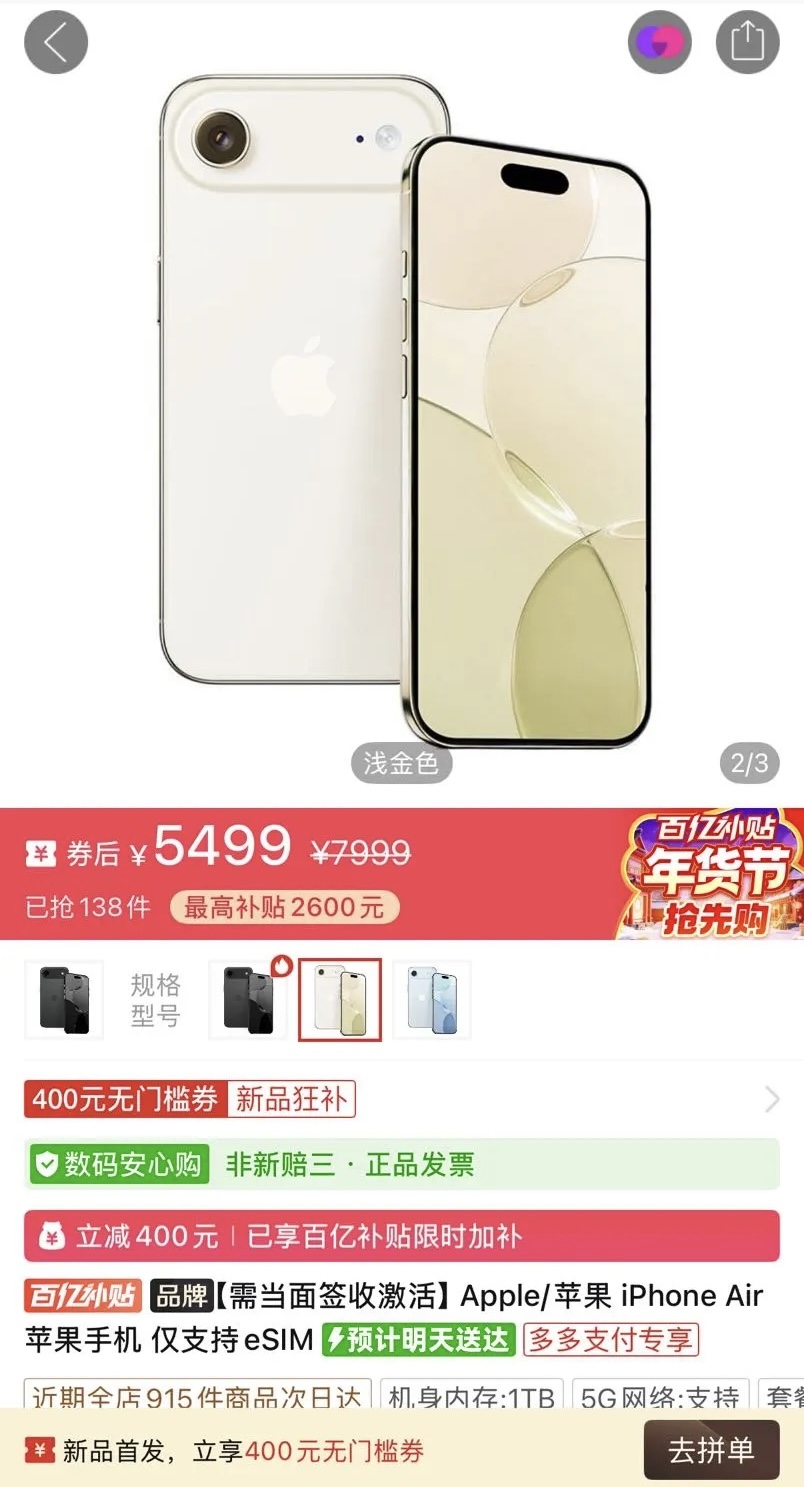
Image Source: Internet
Xiaolei recalls that during last year's 618 shopping festival, the 128GB version of the iPhone 16 Pro also made waves by dropping significantly from its initial price of 7999 yuan to 5499 yuan (after national subsidy), and even reaching as low as 4999 yuan on some platforms, becoming the "best-seller" of the season.
Can the iPhone Air replicate the successful "price-for-volume" strategy of the 128GB version of the iPhone 16 Pro during this year's Spring Festival shopping festival?
The Domestic iPhone Air Sees Drastic Price Drop: Apple Doesn't Anticipate Strong Sales
The domestic iPhone Air has implemented such a substantial price reduction just three months after its launch, marking the fastest and most drastic price drop for a new iPhone in history, which is somewhat "unexpected."
Typically, new iPhones see their first wave of large-scale price reductions during Double 11, with relatively small decreases; the second wave occurs during the Spring Festival of the following year, with larger decreases; and the third wave takes place during 618 of the following year, representing the largest decreases and the final battle; after which, the next generation of iPhones is introduced, and the cycle repeats.
Therefore, following "normal" logic, the domestic iPhone Air would not see such a substantial price reduction until this year's 618, akin to the successful "price-for-volume" strategy of the 128GB version of the iPhone 16 Pro during last year's 618.
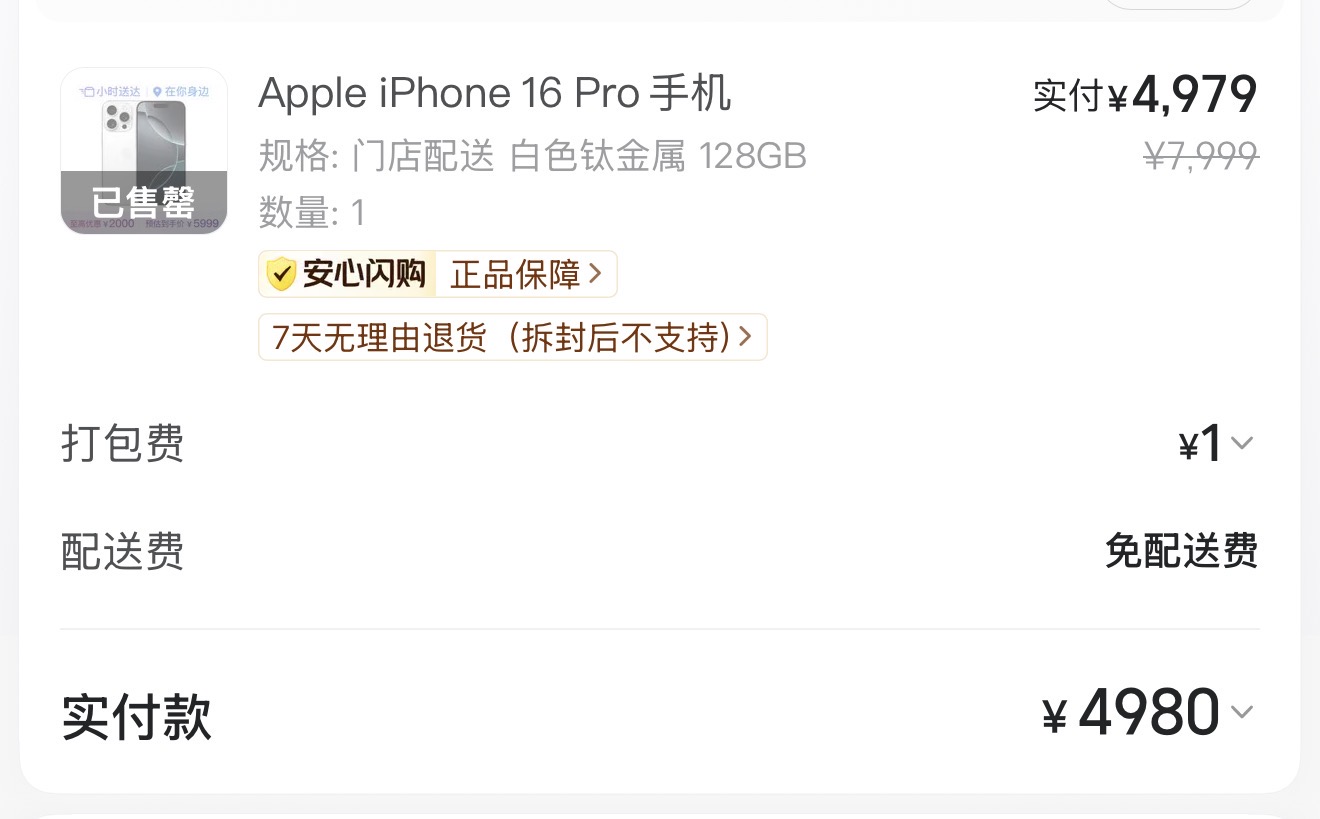
Screenshot from Leikeji
However, the domestic iPhone Air has chosen to initiate a price reduction frenzy close to or even comparable to this year's 618 "lowest price" ahead of schedule. What is Apple's intention?
It must be pointed out that even with such an early and substantial price reduction this year, it is unlikely that the domestic iPhone Air will replicate the "best-seller" performance achieved by the 128GB version of the iPhone 16 Pro during last year's significant price reduction promotion, a fact that even Apple itself is well aware of.
At the Apple Store on Tmall participating in this year's Spring Festival promotion, only 13,000 units of the iPhone Air are available; in contrast, a total of 200,000 units of the iPhone 17 Pro series are offered. The iPhone 17, which has been in relatively short supply since its launch, is not participating.
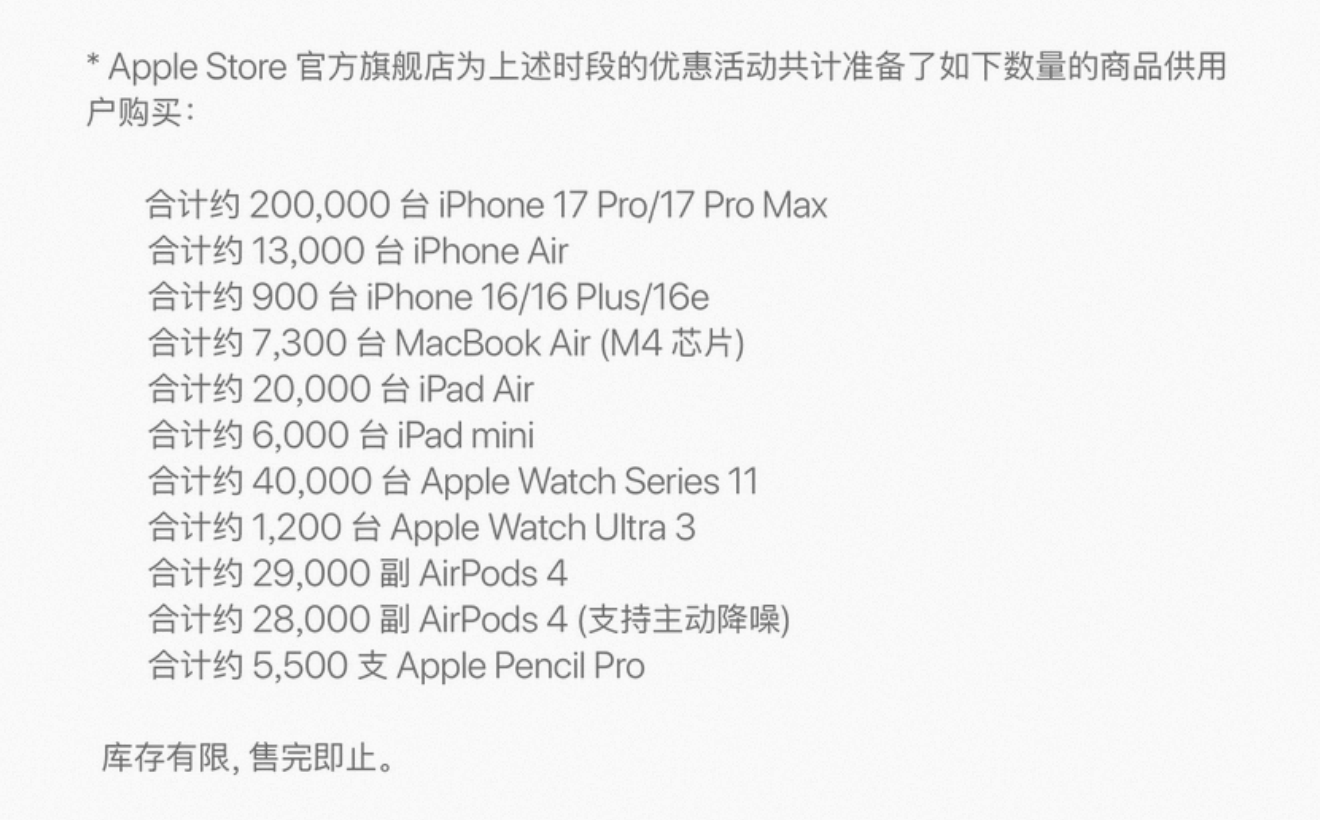
Image Source: Apple Store on Tmall
Is Apple unwilling to allocate more iPhone Air units for the Spring Festival promotion? Obviously not. As early as last October, multiple sources indicated that due to the "weak" performance in the global launch market, Apple was planning to significantly cut production capacity for the iPhone Air. Analyst Ming-Chi Kuo from TF International Securities even provided specific data, stating that production would be "reduced by over 80%" by the first quarter of this year.
Under such rapid adjustments, the domestic iPhone Air has seen Apple initiate a substantial price reduction just three months after its launch, indicating that the previously produced iPhone Air units have not been well absorbed in terms of production capacity, necessitating a "special" promotional campaign at the beginning of this year.
Through the classic combination of "substantial production cuts + substantial price reductions," the domestic iPhone Air has initiated an "unprecedented" clearance sale just three months after its launch. To some extent, this also signifies Apple's declaration that this model has entered the latter half of its lifecycle.
What Is Apple's Intention Behind the Clearance Sale of the Domestic iPhone Air?
Since Apple does not expect the domestic iPhone Air to significantly boost sales through substantial price reductions, its main intention seems to be clearing inventory as early as possible this year while initiating a "clearance sale," thereby ending the "waste" of iPhone production line and sales resources on this "hot potato" model.
This encompasses two major aspects:
1. Further aligning the production capacity and sales resources of other new iPhone models.
The latest activation data released by @Digital Chat Station shows that since its launch, the domestic iPhone Air has seen fewer than 200,000 activations, while the iPhone 17 has exceeded 4.8 million activations, the iPhone 17 Pro has surpassed 4.9 million activations, and the iPhone 17 Pro Max has exceeded 8.26 million activations.
In terms of proportions, among the currently accumulated 18.16 million activated domestic new iPhone devices, the iPhone Air accounts for only about 1%, the iPhone 17 accounts for approximately 26%, the iPhone 17 Pro accounts for around 27%, and the iPhone 17 Pro Max accounts for about 46%.
Based on the "actual performance" of activation volumes, the iPhone Air, currently accounting for only 1%, is almost negligible in the new iPhone lineup. In stark contrast, the highest-priced iPhone 17 Pro series (especially the Max model) has been in high demand, while the entry-level iPhone 17 has been in short supply.
As a "transitional product" showcasing concepts or preparing for new form-factor iPhones, Apple has already allocated resources and importance far exceeding its actual market performance to the iPhone Air. Entering 2026, it is logical for Apple to fully shift its focus away from the iPhone Air, further allocating resources, boosting production capacity, and matching sales channel resources for the iPhone 17 Pro series and the iPhone 17.
Image Source: Apple
2. Making way for the pre-production capacity of the next-generation iPhone in advance.
According to multiple rumors, Apple will introduce its first foldable iPhone this year. As a brand-new form-factor product, Apple's foldable new machine (the so-called "iPhone Fold") will undergo an earlier and longer supply chain debugging and preparation process than regular iterative models.
Supply chain news from late November last year indicated that Apple's foldable new machine has entered the Engineering Verification Test (EVT) and pre-production phase, with only minor design adjustments remaining. Since December last year, renderings, model images, and more detailed information about Apple's foldable new machine have been flooding in, with the next-generation iPhone lineup led by the "iPhone Fold" already entering a tight pre-production capacity preparation stage.
In summary, whether for other new iPhone models or the next-generation iPhone, it is timely for Apple to significantly reduce production line resources for the iPhone Air and initiate a comprehensive clearance of its production capacity.
The Domestic iPhone Air's Catastrophic Defeat: Promoted by Multiple Factors
As a once highly anticipated domestic eSIM pioneer, the iPhone Air can be described as "falling before even taking off." The failure of the iPhone Air's debut in the Chinese market has directly dragged down the initial performance of domestic eSIM.
To date, the domestic models supporting eSIM include the Apple iPhone Air, OPPO Find X9 Pro Satellite Communication Edition, Huawei Mate 80 RS Porsche Design, and the recently launched Honor Magic8 Pro Air. Among these, only the iPhone Air "exclusively supports eSIM," making its situation even more poignant.
Focusing on Apple models, starting with the iPhone 14 series in 2022, eSIM has been exclusively supported in the U.S. market. In recent years, as more users have switched to the iPhone 14 and its subsequent series, eSIM has achieved mainstream adoption among U.S. iPhone users. Given that iPhones almost dominate half of the U.S. mobile phone market, this highlights their powerful market promotion effect.
However, Apple's "thinnest and lightest" iPhone Air launched last year also encountered a "Waterloo" in the U.S. market and overseas markets outside China.
Data shows that 10 weeks after its U.S. market launch, the secondhand resale value of the iPhone Air dropped by over 40% compared to its new machine price. In contrast, the iPhone 17 Pro Max of the same storage version saw a decrease of less than 27%, the iPhone 17 Pro less than 32%, and the iPhone 17 less than 33%. Clearly, the global market performance, especially the U.S. market debut, indicates significant "issues" with the iPhone Air in terms of both product and pricing.
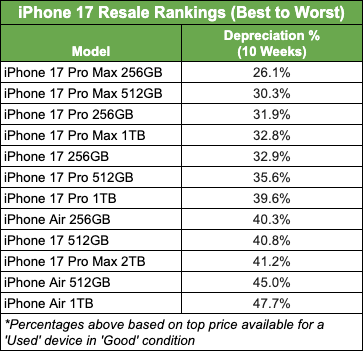
Image Source: SellCell
Turning to the Chinese market, the domestic iPhone Air, wearing the halo of the "eSIM technology pioneer," has suffered an even more disastrous defeat.
Tech enthusiasts are not interested in domestic eSIM; ordinary consumers find switching to eSIM troublesome. Users who can accept other aspects of the iPhone Air's experience may not accept domestic eSIM; those who can accept domestic eSIM on the iPhone Air may not accept the sacrifices made for "ultimate thinness and lightness" in terms of basic experience.
Fundamentally, the iPhone Air's catastrophic defeat in the Chinese market is the result of product-level resource misallocation and various limitations during the initial stages of eSIM implementation. The iPhone Air's failure in the Chinese market will also profoundly impact the subsequent promotion of domestic eSIM.
The Full Rollout of Domestic eSIM Requires Concurrent Efforts from Domestic Manufacturers
The one who ties the bell must untie it. Even if the iPhone Air's hardware experience did not suffer from so many compromises, and even if the domestic eSIM switching experience on the iPhone Air could have been more user-friendly, the domestic iPhone Air would not have achieved its current market performance.
For Apple, the fortunate aspect amidst this misfortune is that the strong market performance of the iPhone 17 Pro series and the iPhone 17 in this generation of new iPhones is sufficient to offset all the negative effects brought by the iPhone Air. Although this major lesson has not dealt a crippling blow to Apple, it should at least be etched in its memory.
Image Source: Apple
For the foldable iPhone that may be launched this year and the potential next-generation iPhone Air, it is hoped that Apple can learn valuable lessons from this experience.
Regarding the promotion of domestic eSIM mobile phones, reliance cannot be solely placed on Apple, or even on the iPhone Air as the "village's hope." Instead, more manufacturers, especially domestic ones, should take the lead and jointly promote the gradual implementation and application of eSIM among domestic mobile phone users alongside Apple and others.
In this process, as long as the momentum from mobile phone manufacturers (especially domestic ones) grows stronger, such as when major domestic mobile phone brands all launch new machines (even flagship models) that "exclusively support eSIM," operators will also keep pace with the times and accelerate their efforts to provide eSIM switching users with a more convenient and optimized overall experience.
Finally, theoretically speaking, besides this inventory clearance campaign before the Spring Festival, there will likely be another one during the mid-year 618 shopping festival for the domestic iPhone Air. Whether the price will reach a new low at that time remains unknown; however, with this inventory clearance campaign initiated now, the inventory clearance pressure for the domestic iPhone Air will be significantly reduced by then.
Apple iPhone iPhone Air
Source: Leikeji
The pictures in this article are from: 123RF Royalty-free Image Library
-
![]()
Hardware is the skeleton, AI is the soul, and data integrates the two
-
![]()
China’s AI Industry: A Unified Pivot Towards Monetization?
-
![]()
New Progress! Infineon Completes Acquisition of ams OSRAM's Non-Optical Sensor Business
-
![]()
35 Million Bet on an Optical Future! Tengjing Technology Makes a Move in AR
-
![]()
Why World Models Get Stuck on Construction Roads in Autonomous Driving Applications
-
Alibaba Initiates Cultural Transformation: Is Jack Ma Making a Strategic Comeback?
-
Tianfeng Heads to Hong Kong for IPO with RMB 3.8 Billion in Funds: Xingyu's Cross-Border Foray into Embodied AI Faces Uncertain Future
-
![]()
Mengshi Auto’s High-End Aspirations Dashed: Huawei Partnership Fails to Revive Sales, New Model’s Entry Price Dips Below 300,000 Yuan