Huawei, Xiaomi, OPPO, Vivo, and Honor Kick Off Spring Festival Marketing: "AI-Infused New Year Vibes" as Standard, What Fresh Innovations Are in Store This Year?
 02/02 2026
 640
640
Competing on New Year Vibes, Not Specs.

As the annual Spring Festival draws near, a palpable sense of "New Year" permeates both the physical and digital realms, signaling that the festive season is imminent.
Smartphone makers seem to have orchestrated a synchronized move, rolling out a plethora of limited-time New Year enhancements: bespoke watermarks, themes, fireworks displays, festive surprises, and more. These features may not boast "cutting-edge" specs, but they excel in one crucial area—ease of use, enabling users to effortlessly capture, share, and craft content.
Some readers might grumble: This is the same old song and dance every year, devoid of innovation. However, from a manufacturer's vantage point, it's not merely about "riding the wave."
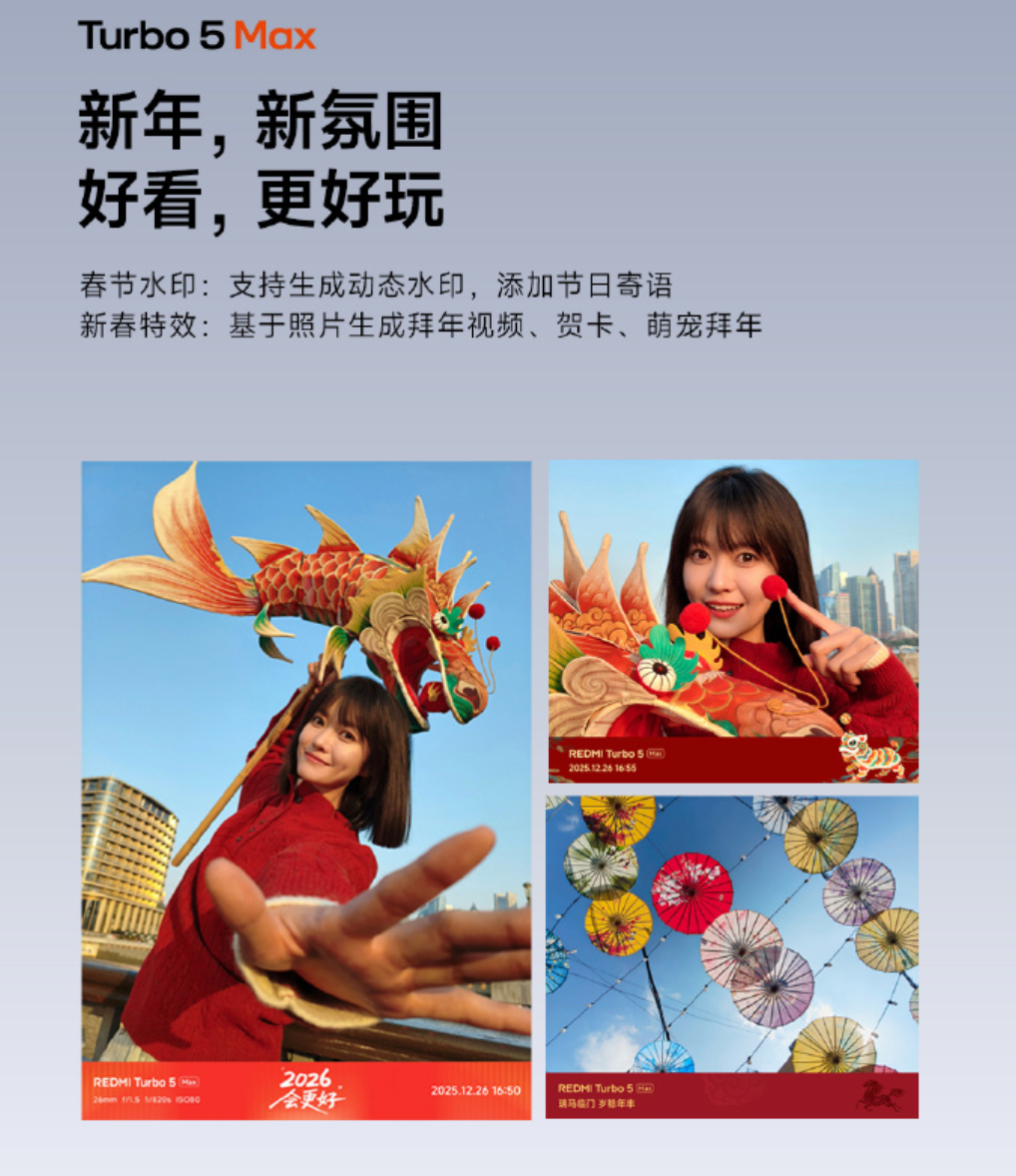
(Image credit: Xiaomi Official)
The Spring Festival presents a golden opportunity for smartphone makers to showcase their devices' capabilities: users snap more photos, share them more frequently on social platforms, and are more inclined to experiment with various phone features. Normally, you might be too lazy to switch themes, edit photos, or tinker with camera settings; but during the New Year, you're more willing to invest a few extra clicks for a "prettier, more festive" outcome.
The question arises: Is repeating the same tactics every year merely following trends? When watermarks and themes lose their luster, why do manufacturers persist in crafting "New Year editions"? What are their objectives, and will users grow increasingly indifferent?
From photo watermarks to one-click content creation, what novel innovations have smartphone makers introduced?
Let's start with the basics: camera watermarks, themes, and widgets remain staples for every manufacturer. They have the lowest technical complexity but high communicability (here, it refers to the ability to be widely shared or disseminated). During the Spring Festival, photos are often shared with family, friends, classmates, or posted on social platforms like WeChat Moments, Weibo, and Xiaohongshu. Given that users tend to "take a thousand photos and carefully select nine, spend an hour taking photos and two hours editing," a watermarked photo can subtly boost brand recognition.
In my view, watermarks are as vital as a manufacturer's logo, serving as a "second logo." However, this year, manufacturers have transcended simply "turning watermarks red and adding blessings," introducing new variations.
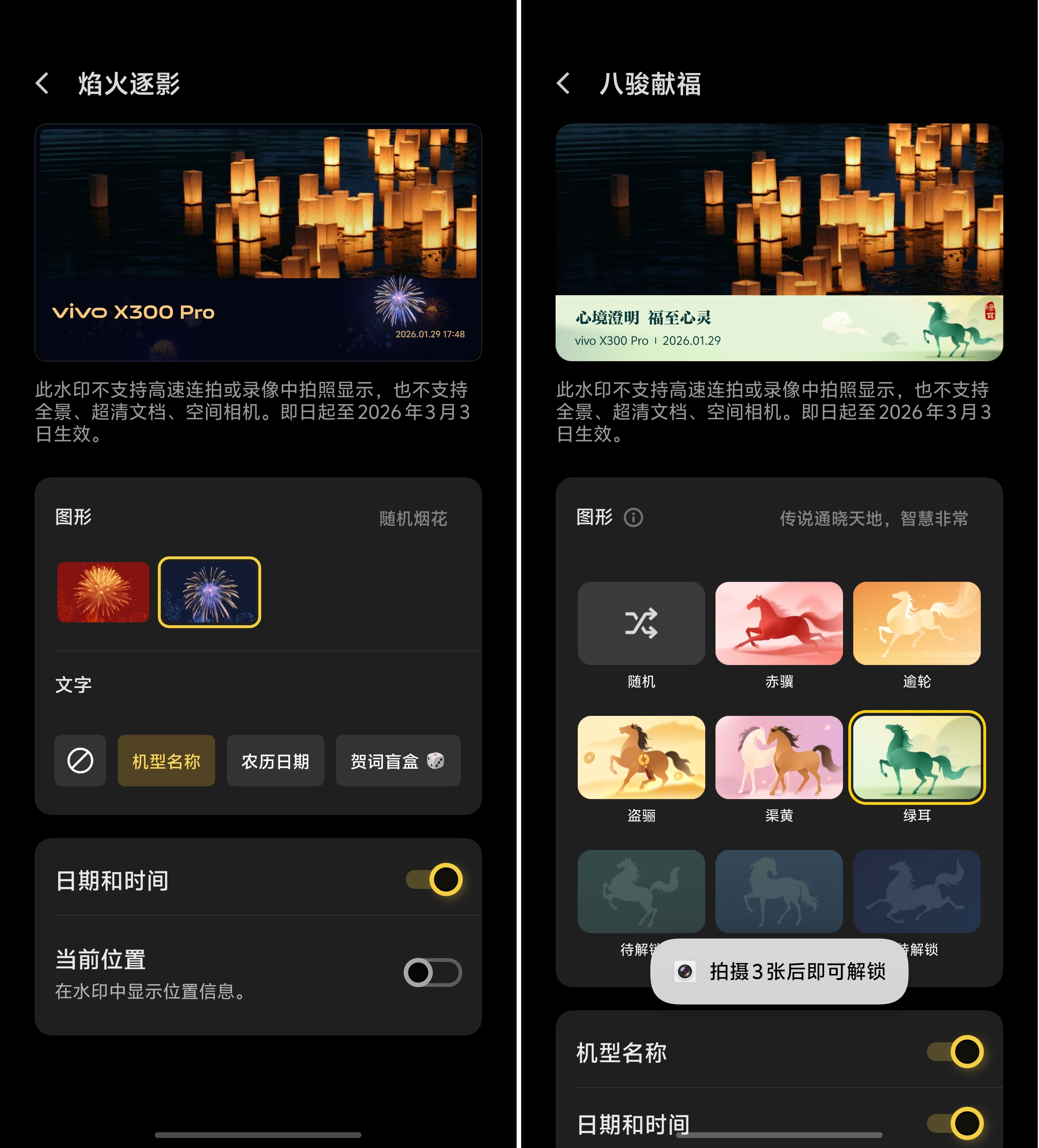
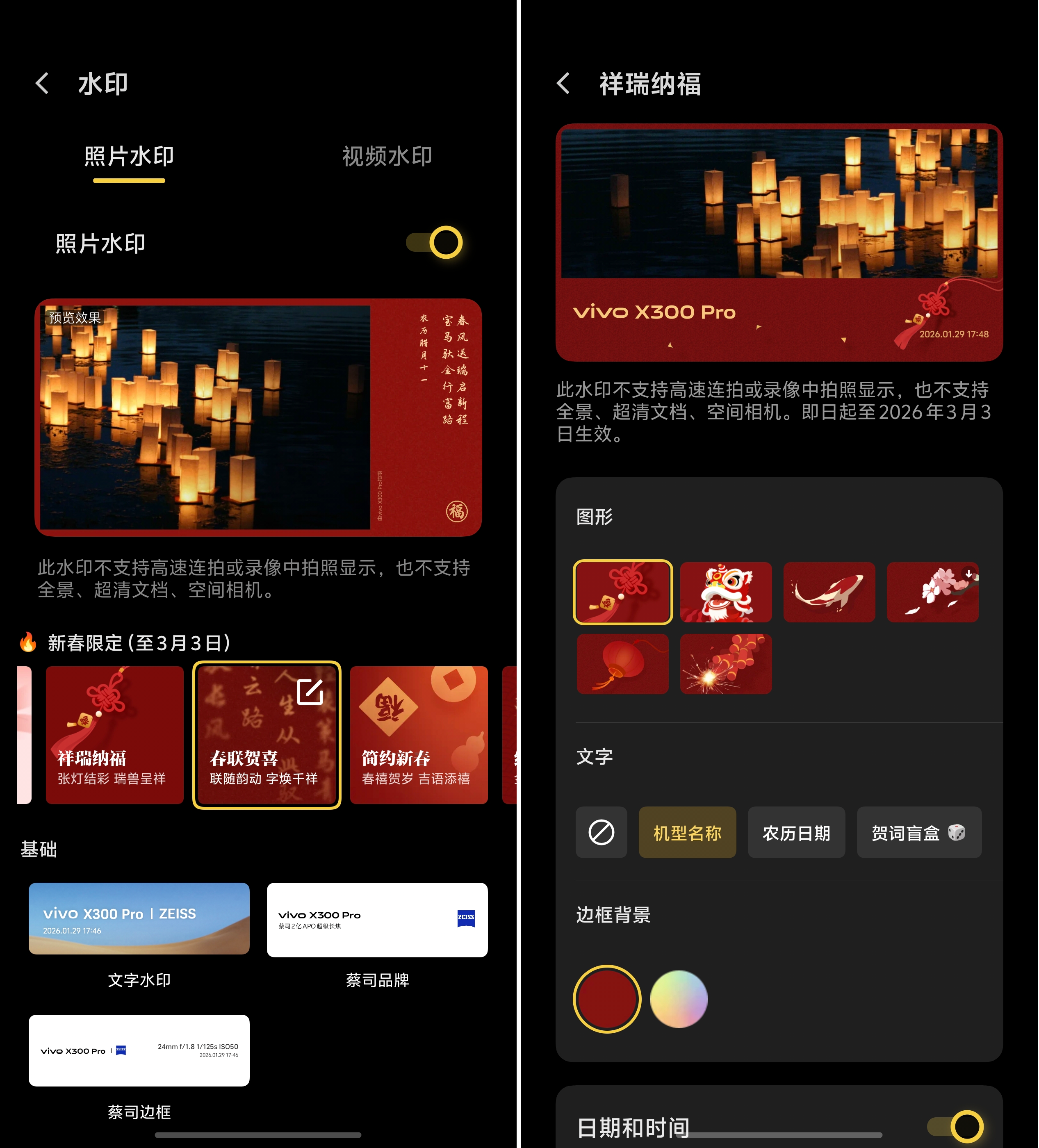
Take Vivo as an example: this year, Vivo unveiled six types of special New Year watermarks, each featuring dynamic effects, custom patterns, and personalized blessings. This "shoot-and-customize" design makes the shooting process more flexible and enjoyable, offering users a fresh and heightened sense of fun.
(Image credit: Leitech Graphics)
The flagship Year of the Horse limited-edition watermark even unlocks eight distinct patterns and theme colors as users take more photos, providing maximum emotional value.
Xiaomi and Vivo have taken different paths but similarly focus on special New Year watermarks, though specific launch dates remain undisclosed, so we won't delve further.
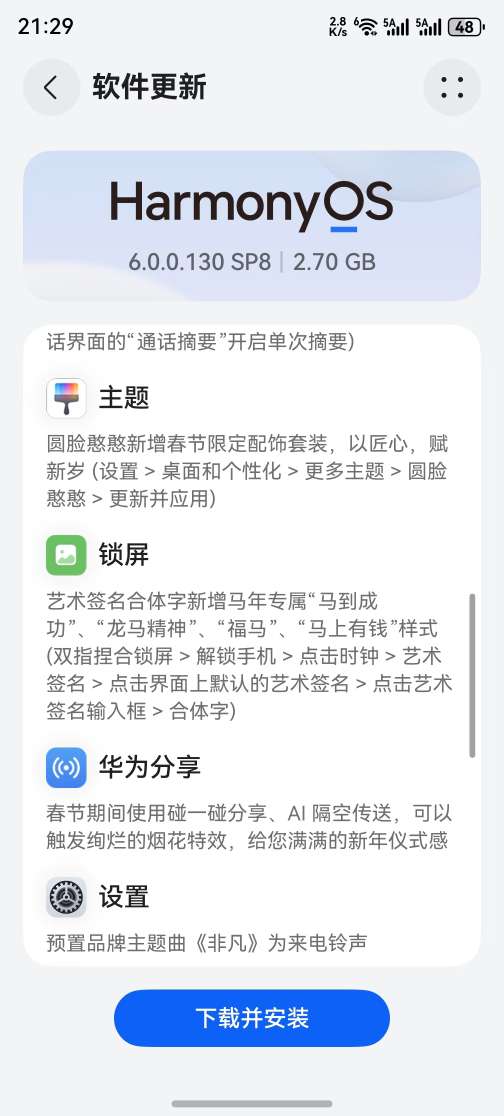
Huawei also emphasizes emotional value, offering features like "creating a New Year greeting short film from interesting photos of the past year" and "setting a Year of the Horse exclusive signature on the lock screen." Although I don't own a Huawei phone, based on Huawei's official update logs and user feedback, Huawei has indeed infused various "festive atmospheres" into every corner of the phone.
(Image credit: Xiaohongshu user)
OPPO's approach mirrors Huawei's. The company announced that ahead of the Spring Festival (meaning it's not yet available), features like New Year's Eve countdown, New Year fireworks, festive cards, festive atmosphere effects, and daily blessings will be launched on Xiao Bu Suggestions. Camera watermarks and various New Year photo editing templates will also be available, along with AI blessings and AI couplets.
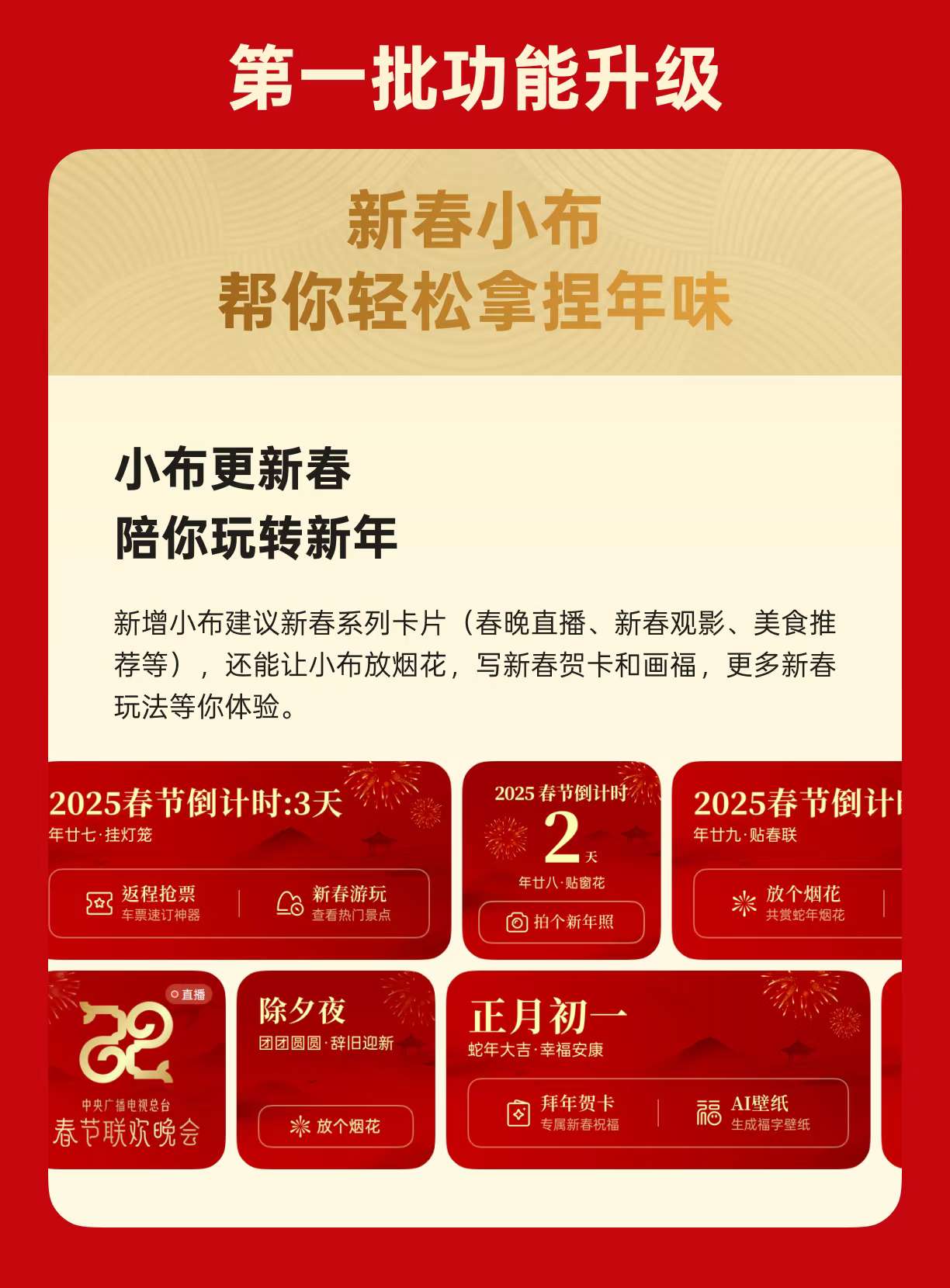
(Image credit: OPPO Official)
Honor's approach is more straightforward: it directly adds a "Red Packet Reminder" feature. According to the official description, when users receive QQ/WeChat/Alipay red packet notifications, Honor will alert users via a floating capsule, enabling them to immediately jump to the red packet collection interface with a single click. Compared to the others, Honor's New Year features directly cater to users' fundamental needs.
When viewed collectively, the keywords for this year's Spring Festival features are no longer just "festive" but also "easier to use," "more streamlined," and "more productive."
Thus, while Spring Festival features may seem like minor enhancements, they are actually vying for something crucial: brand recognition. Why are watermarks enduring? Because they naturally appear in shared photos. Why are lock screen signatures significant? Because unlocking the screen is one of the most frequent actions. Why is one-click content creation vital? Because content like New Year's Eve dinners, gatherings, and trips is best suited for transforming multiple photos into a shareable video for WeChat Moments.
(Image credit: Leitech Graphics)
If these minor features are executed well, they can lead to countless free brand exposure opportunities, potentially even surpassing manufacturers' previous elaborate marketing campaigns.
Will users experience aesthetic fatigue with all these New Year limited editions?
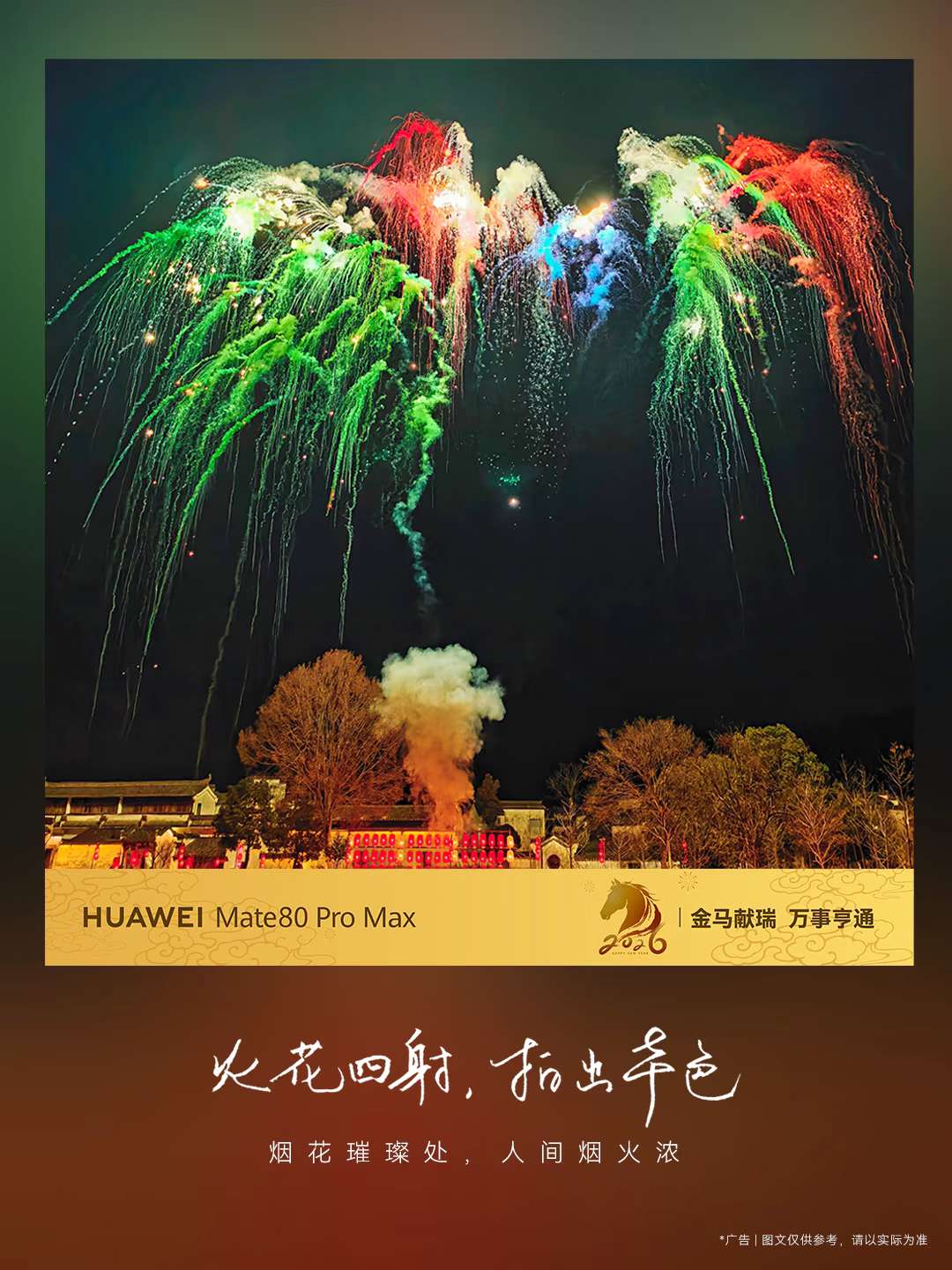
Undoubtedly, aesthetic fatigue will set in, and the reason is straightforward: most New Year features are "decorative"—switching to a red theme, adding zodiac stickers, or applying a four-character watermark may look festive but lack practicality. Once the novelty wears off, there's no lasting appeal. Especially since the design language for these watermarks and themes is similar: red backgrounds, golden text, lanterns, fireworks, and identical blessings, users can quickly go from "this is interesting" to "why is this the same again?"
(Image credit: Huawei Official)
More critically, the content during the Spring Festival is highly similar: the same New Year's Eve dinners, the same New Year greetings photos, the same red packet screenshots, and the same travel check-ins. When users shoot similar material and phones offer similar decorative templates, it creates a "template-like" feel for WeChat Moments.
At this juncture, users may feel that watermarks are irrelevant, and changing themes is pointless, as everyone is posting similar content.
More importantly, when festive limitations shift from "freshness" to "obligation," users may feel like they're not using features but being forced to complete a festive checklist. The more manufacturers use terms like "limited-time," "exclusive," and "New Year special" to urge users, the more likely they are to provoke a backlash, making users increasingly dislike these "limited-time features."
Therefore, in my view, what New Year features need most is not freshness but "automation"—automatically selecting the best photos after shooting, generating New Year greeting short films from group photos with one click, adjusting New Year's Eve dinner photos to a warmer atmosphere with one click, and generating natural blessings based on the recipient.
This way, users can have more unique material and won't lose interest due to repetitive templates and themes. Meanwhile, the frequency of these features should be restrained, ideally appearing only in interfaces like the camera and gallery that users naturally access, rather than "forcing" usage through various push notifications.
Festive vibes should not be a task but an optional aid.
Conclusion: Are New Year Features Decorative or Functional Toolkits?
So, returning to the original question: Do manufacturers' annual New Year features hold meaning? The answer is yes, but only if they evolve from "trend-following" to "practical functional scenarios." Today's New Year features are heading in two directions: one is scenario-based, making users' photos more atmospheric and effortless; the other is efficiency-oriented, like red packet reminders, countdowns, and festive information streams, reducing user operations during the already busy Spring Festival holiday.
(Image credit: Doubao AI)
If it's just an annual skin change, users will naturally tire of it. But if it allows you to produce content faster and complete Spring Festival socializing more easily, it becomes a fixed "New Year system upgrade." For manufacturers, it's the strongest scenario entry point of the year; for users, it's ideally an optional "Spring Festival toolkit" that doesn't need to be amazing every year but should at least be helpful annually.
Spring Festival, Smartphones, OPPO, Vivo, Honor, Huawei, Xiaomi
Source: Leitech
All images in this article are from the 123RF Authentic Library (123RF Licensed Image Library)
-
![]()
Hardware is the skeleton, AI is the soul, and data integrates the two
-
![]()
China’s AI Industry: A Unified Pivot Towards Monetization?
-
![]()
New Progress! Infineon Completes Acquisition of ams OSRAM's Non-Optical Sensor Business
-
![]()
35 Million Bet on an Optical Future! Tengjing Technology Makes a Move in AR
-
![]()
Why World Models Get Stuck on Construction Roads in Autonomous Driving Applications
-
Alibaba Initiates Cultural Transformation: Is Jack Ma Making a Strategic Comeback?
-
Tianfeng Heads to Hong Kong for IPO with RMB 3.8 Billion in Funds: Xingyu's Cross-Border Foray into Embodied AI Faces Uncertain Future
-
![]()
Mengshi Auto’s High-End Aspirations Dashed: Huawei Partnership Fails to Revive Sales, New Model’s Entry Price Dips Below 300,000 Yuan