Is the First Mobile Lobster Here?
 03/10 2026
 535
535
Source | Bohu Finance (bohuFN)
In our previous analysis, "Will 2026 Mark the Start of a Smartphone Elimination Race?" we argued that 2026 would be a year of differentiation in the smartphone industry. With memory prices on the rise and a trend toward premiumization, the operational challenges for Chinese smartphone manufacturers have doubled in 2026. Traditional smartphone business models are no longer viable, and manufacturers must find new breakthroughs.
On March 6, Xiaomi unveiled China's first mobile agent product, "Xiaomi miclaw," which has now entered a small-scale closed beta test. According to reports, this AI interaction test product, built on Xiaomi's MiMo large model, features four levels of capabilities: system-level functionality, personal context understanding, ecological interconnection, and self-evolution. When reposting his company's Weibo post, Lei Jun referred to it as the "mobile lobster."
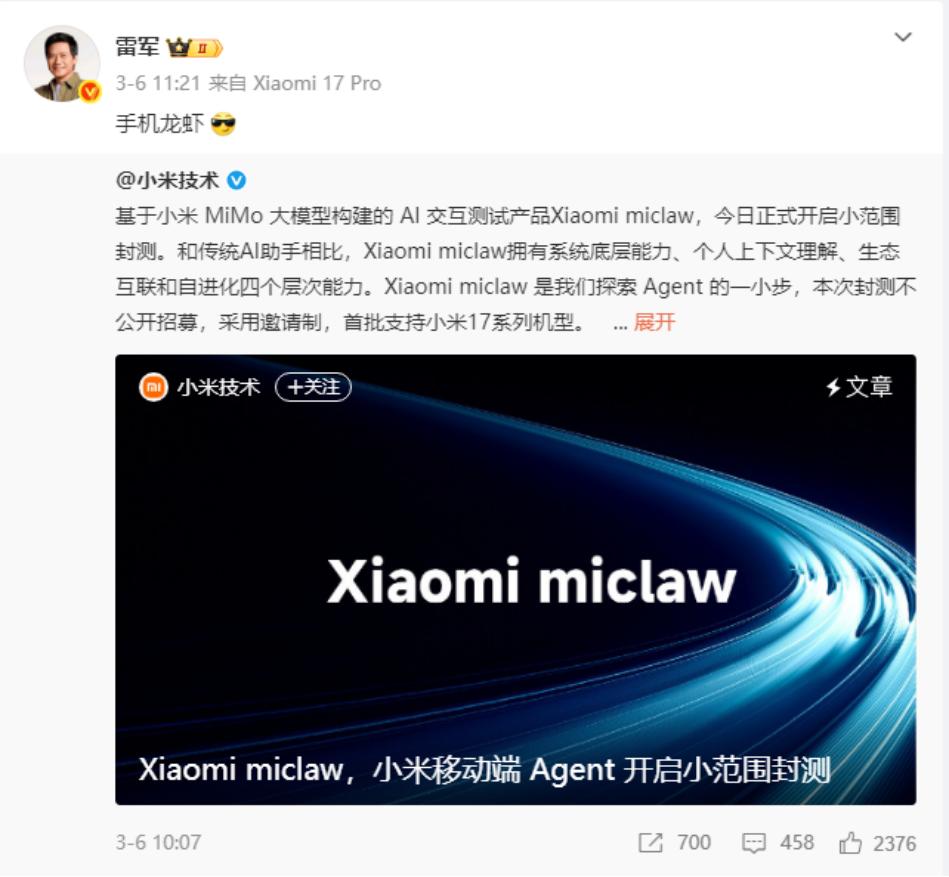
Since 2026, the main narrative in AI has clearly shifted from model capabilities to applications. OpenClaw has not only sparked global token consumption but also boosted the stock prices of AI companies listed in Hong Kong. On the day of the product launch, market sentiment quickly spread to the secondary market. Xiaomi's Hong Kong-listed shares surged by 6% at one point during intraday trading and closed up 3.79%.
What exactly is Xiaomi's "mobile lobster"? What is the significance of a hardware manufacturer developing a mobile agent? These are the questions this article aims to answer.
01 The Lobster and the Mobile Lobster
AI enthusiasts are likely already familiar with the concept of "lobster." If the Lunar New Year's red envelope battle marked a key turning point for the domestic AI industry's shift toward applications, then overseas, OpenClaw took center stage.
This open-source agent tool has transformed how people interact with large models. In the past, the public primarily used large language models (LLMs) as chatbots: you ask a question, and the model responds. However, OpenClaw has turned AI into an agent capable of autonomously calling tools and executing cross-application tasks. With predefined rules, you can sleep or attend to other matters while OpenClaw handles all the work through its own judgment, decision-making, and actions.
Within just a few months of its launch, OpenClaw garnered 262,000 stars on GitHub, surpassing Linux to claim the top spot. Even installing and debugging OpenClaw has become a means of wealth creation, with many sharing on Xiaohongshu how they earned tens or even hundreds of thousands by offering OpenClaw installation services.
Miclaw does not simply replicate OpenClaw's capabilities on mobile devices. From firsthand experience, miclaw exhibits several distinct characteristics.
First, miclaw is not a third-party app; it operates as an integral part of the operating system. Officially, it boasts API-level access to over 50 native system tools, enabling it to read and interpret information on your phone while providing proactive services—akin to a "butler."
For example, most people receive numerous daily text messages, some useful and others not. You can instruct miclaw to summarize important messages and unsubscribe from spam. Similar to OpenClaw, it can also automatically generate news briefings and other functions.
As Xiaomi's technical article aptly summarizes: An AI running within an app sandbox, no matter how powerful the model, is primarily limited to answering questions and conducting online searches. A system-level AI, however, can provide system-level control.
Second, miclaw integrates seamlessly with Xiaomi's ecosystem.
On one hand, you can directly use miclaw to control smart home devices. On the other hand, miclaw can monitor and manage these devices, making real-time decisions based on context. For instance, if you tell miclaw, "I'll bring friends home in half an hour—prepare the house," it will break down and execute tasks: automatically coordinating Mi Home devices to adjust lighting, close curtains, set the air conditioner to 26°C, activate the air purifier, and play background music via the speaker.
Empowered by this ecosystem, miclaw extends beyond the phone, offering physical reach. However, compared to OpenClaw's productivity potential, miclaw currently focuses more on practicality in daily life.
02 The Advantage of Hardware-Software Integration
During the mobile internet era, smartphones became essential to modern life, but the biggest winners were app giants. In the AI era, hardware is regaining prominence: a consensus is emerging that AI can only permeate daily life across diverse scenarios by embedding AI functionalities into physical devices like phones, earbuds, and cars to address real-world needs.
The future super gateway will not be just an app or a single phone but a cross-device, cross-scenario, evolving AI agent. Whoever can stay closer to users, control more terminals, and access more authorized entry points will dominate the ecosystem.
ByteDance was the first to experiment. Late last year, ByteDance and ZTE jointly developed the Nubia M153 engineering prototype, equipped with a technical preview of the Doubao mobile assistant. In Doubao's demo video, users could simply input, "Help me compare prices and place an order for a product across e-commerce platforms," and Doubao would automatically search major platforms, filter the lowest price, and wait for user confirmation only during the sensitive payment step.
However, Doubao's mobile assistant soon faced compatibility issues with major apps like WeChat and Taobao.
The ability to integrate hardware and software is a unique advantage and opportunity for hardware manufacturers like Xiaomi to break through in the AI era.
In 2024, Xiaomi officially entered the foundational large model space. By 2025, it had released and open-sourced the MiMo language model, multimodal model, voice model, and embodied model. In February 2026, it introduced HySparse, a hybrid sparse attention architecture tailored for the agent era.
The core of the MiMo model is speed and cost. Take MiMo-V2-Flash, for example: its inference cost is slightly lower than DeepSeek-V3.2, while its inference speed is roughly three times faster. Compared to Gemini 2.5 Pro, MiMo-V2-Flash matches its speed but costs about 20 times less.
The inference and cost efficiency of the MiMo model allow Xiaomi to integrate AI into phones, cars, and future consumer-oriented products: from the mobile-based miclaw to the home-optimized visual-language multimodal model Miloco showcased at MWC, and on to Xiaomi's autonomous driving technology.
Smartphones, new energy vehicles, and smart home devices form a vast "human-vehicle-home" ecosystem. Miclaw is not just a phone assistant but a super hub for orchestrating physical devices—marking the first step in AI's physical evolution.
Moreover, in today's stagnant smartphone market, an agent capable of understanding vague instructions, retaining personal context, and self-evolving could become a core selling point for future upgrades and premium pricing.
03 Conclusion
On the day of miclaw's release, a long queue formed outside Tencent's Shenzhen headquarters, with nearly a thousand developers and enthusiasts lining up to install OpenClaw for free. ByteDance and Alibaba Cloud quickly followed suit, launching deployment solutions.
Today, Volcano Engine announced on its official WeChat account the launch of ArkClaw—a ready-to-use cloud-based SaaS version of OpenClaw. With no complex setup required, users can access a 7x24 AI assistant via a webpage and easily "raise their own shrimp." Tencent also introduced QClaw, supporting one-click deployment and direct WeChat integration.
AI agents are emerging as the next core gateway, with more AI hardware connecting to OpenClaw. For instance, smart glasses brand Rokid launched a "custom agent" feature, allowing developers to integrate glasses with locally deployed OpenClaw. Users can now directly call OpenClaw via voice commands through the glasses to initiate tasks and instruct AI to control computers.
During MWC 2026 demonstrations, Qianwen AI glasses showcased capabilities like real-time translation and object recognition through photos. Once features like food delivery and hotel booking are enabled, users will be able to complete AI-powered shopping tasks—such as ordering food, purchasing items, and booking flights and hotels—with a single voice command.
The window of opportunity for Xiaomi may not remain open for long.
Referenced Sources:
1. GeekPark: "OpenClaw is Nurturing an Entire 'AI Hardware' Ecosystem"
2. Will, the Grain Factory Researcher: "Xiaomi miclaw Release: Why Didn't Doubao's Mobile Version Last 72 Hours?"
3. Digital Life Kha'Zix: "The First 'Lobster' That Runs on Mobile Phones Has Arrived—Its Name Is miclaw."
4. Xiaomi Corporation: "Xiaomi miclaw: Xiaomi's Mobile Agent Enters Small-Scale Closed Beta Test"
The cover image and illustrations in this article are owned by their respective copyright holders. If the copyright owner believes their work is unsuitable for public browsing or should not be used without compensation, please contact us promptly, and our platform will immediately make corrections.
-
![]()
Hardware is the skeleton, AI is the soul, and data integrates the two
-
![]()
China’s AI Industry: A Unified Pivot Towards Monetization?
-
![]()
New Progress! Infineon Completes Acquisition of ams OSRAM's Non-Optical Sensor Business
-
![]()
35 Million Bet on an Optical Future! Tengjing Technology Makes a Move in AR
-
![]()
Why World Models Get Stuck on Construction Roads in Autonomous Driving Applications
-
Alibaba Initiates Cultural Transformation: Is Jack Ma Making a Strategic Comeback?
-
Tianfeng Heads to Hong Kong for IPO with RMB 3.8 Billion in Funds: Xingyu's Cross-Border Foray into Embodied AI Faces Uncertain Future
-
![]()
Mengshi Auto’s High-End Aspirations Dashed: Huawei Partnership Fails to Revive Sales, New Model’s Entry Price Dips Below 300,000 Yuan